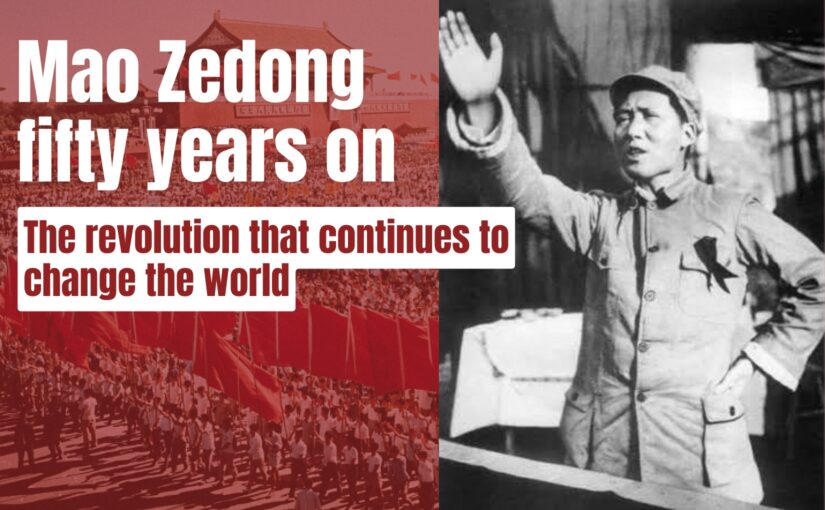
Fifty years after his death, Mao Zedong remains among the most systematically vilified figures of the twentieth century in Western writing, but in China he is still revered as the architect of the revolution that ended imperialist domination and laid the foundations for the country’s socialist development.
On September 6, Friends of Socialist China, in conjunction with the International Manifesto Group convened a webinar to take the measure of Chairman Mao’s legacy. Introduced and moderated by Professor Radhika Desai, the panel featured Ding Xiaoqin (Chinese Academy of Social Sciences), Senator Mushahid Hussain (Chairman, Pakistan-China Institute), Ken Hammond (Professor of History, New Mexico State University), Tings Chak (Asia coordinator, Tricontinental Institute), Jenny Clegg (Author and peace campaigner), Fiona Sim (Co-founder, Black Liberation Alliance) and Keith Bennett (Co-editor, Friends of Socialist China).
The webinar stream is embedded below, followed by a brief report.
The vilification is not about Mao
Radhika Desai opened by framing the problem. The charge sheet is long and familiar – the accusations of totalitarianism, the Great Leap Forward, the Cultural Revolution – but, she argued, the campaign is not fundamentally about Mao at all. It is about the history he made, so this part of the record of human liberation can be dismissed as a terrible mistake from which nobody should take inspiration or lessons.
Radhika highlighted the importance of understanding the global and historical context of China’s development from 1949, starting from a baseline of horrifying poverty and technological backwardness to which imperialism and the century of humiliation had reduced it, and proceeding in the teeth of relentless imperialist hostility. What’s more, China’s industrialisation had to be accomplished without any of the things that financed Western prosperity: no tribute extracted from subject peoples, no cheap forced inputs, no exporting of surplus population to supposedly empty lands.
Given this context, China’s achievements become even more impressive, and its errors more understandable.
Three resolutions, one method
Ding Xiaoqin of the Chinese Academy of Social Sciences read Mao through the three historical resolutions that the Communist Party of China has adopted on its own past. The 1945 resolution, on the eve of victory over Japan, was the first major party document to state that the party had developed a system of thought, Mao Zedong Thought, which was Marxism-Leninism adapted to Chinese conditions.
The 1981 resolution navigated a path between those who insisted on rigid adherence to all of Mao’s policies and those who wanted to repudiate his legacy wholesale. The 2021 resolution reaffirms Mao Zedong Thought as marking “the first historic step” in adapting Marxism to the Chinese context.
Running through all three, Ding said, is the basic methodology of Chinese Marxism: historical materialism, seeking truth from facts, and opposition to historical nihilism. From this follows the principle emphasised throughout the webinar: the period of initial socialist construction cannot be used to negate the period of reform and opening up, and vice versa.
From Peking to Paraguay
Senator Mushahid Hussain shared his personal reminiscences of China under Mao. He first flew into China in the early 1970s as a 17-year-old leading a Pakistani youth friendship delegation, at the time of the Cultural Revolution. The air hostess on the connecting flight from Shanghai to Beijing opened it with a quotation from Mao: “Be resolute, fear no sacrifice, and surmount every difficulty to win victory”. On the same plane were a group of people from Paraguay’s then Marxist-Leninist party, who had come to China for military training. “From Peking to Paraguay”, Mushahid said, “that inspiration was there.”
Mushahid recalled: “It was an amazing time in China: China in transition, China in turbulence, China in transformation. China was weak then, China was poor then, China was isolated then. But the people had tremendous pride. I think that pride was what Chairman Mao had spoken of when he liberated China on 1 October 1949 — that today the Chinese people have stood up. I think that resonated with the vast majority of the Chinese people.”
Two hundred million proletarians
Ken Hammond went back to the mid-1920s for the original breakthrough. The party founded in 1921 had soon come to accept the Communist International’s view that China’s industrial working class was too small to make a revolution alone, hence the united front with the Kuomintang that came to a bloody end with Chiang Kai-shek’s Shanghai massacre of April 1927.
According to Ken, orthodox Marxism had derived from Marx’s writings on France a somewhat dim view of the peasantry as a volatile petty-bourgeois stratum with, in the famous phrase, the political coherence of a sack of potatoes. Working with peasant unions in Hunan, and then in the Analysis of the Classes in Chinese Society published in March 1926, Mao looked instead at the actual relations of rural labour. Tenant farmers and day labourers owning neither land nor implements, with nothing to sell but their labour power, could not be considered petty bourgeois at all.
The consequence was a reconfiguration of the revolutionary arithmetic: from an industrial working class of perhaps two million to a resolutely revolutionary class of two hundred million. This was Marxism applying a method to actually existing conditions rather than deducing a programme from texts – the core theme of Mao’s pamphlet Oppose Book Worship written four years later.
Reading “On Protracted War” in Beijing
Tings Chak, speaking from Beijing, began with an interesting fact: at Tsinghua University, Mao’s selected works have in recent years been near the top of library loans for the first time in decades.
Discussing Mao’s On Protracted War, Tings noted that it opens by refuting two positions – the theory of national subjugation, which held that a weaker China must inevitably lose, and the theory of quick victory – refusing both an unscientific pessimism and an unscientific optimism. The parallel with today is direct: the defeatist position says US imperialism is too big to fail, the triumphalist one says that multipolarity has already arrived and the paper tiger will be shredded any day.
On the eve of the recent Xi-Trump summit in Beijing, while the official readouts spoke of “strategic stability”, the China Institute of Contemporary International Relations (CICIR) published an assessment using a different term: strategic stalemate, a direct reference to Mao’s middle phase between defensive and counteroffensive. Its prescription – through struggle seek cooperation, through struggle seek stability – reads as the diplomatic expression of a protracted war.
Her closing proposition was that China should be understood as a base area in Mao’s sense, not for China alone but for the Global South and for the prospect of socialism itself. Echoing Gramsci: “The old world is not leaving peacefully, and this new one is still not yet born.” What follows the stalemate depends on what is built inside it.
“Mao gave us land”
Dr. Jenny Clegg, drawing on her recent book on peasants and revolution in China, gave a two-part answer to the question of why Mao is still revered in China. As a peasant put it to her on her first visit to China back in 1971: “Mao gave us land.” And land meant survival for a people destitute from flood, famine and endless war. And 1949 meant China would never again be a humiliated nation.
On the bifurcation of the Mao Zedong and Deng Xiaoping periods, she stressed that the two were not opposites but successive stages of development and noted that the debate on this question in the West is almost always held without reference to imperialism. Through the 1950s and 1960s it was the United States that was on the offensive against national liberation, in Vietnam and in Indonesia, and the mobilisation of the Red Guards could be seen in part as a warning to Washington to stay out. What opened the door for Deng’s reforms was the shift in US policy from hostility to engagement.
Of all Mao’s concepts, Jenny finds the handling of contradictions among the people the most useful for understanding China today: the proposition that even antagonistic contradictions can be handled non-antagonistically and thereby transformed, which allowed the socialist transition to be accomplished peacefully and the private sector to be accommodated in the primary stage of socialism.
The youth are rediscovering Mao
Fiona Sim of the Black Liberation Alliance began with Mao’s 1957 address to Chinese students in Moscow – “the world belongs to you” – and asked what the young are inheriting. Fiona observed: “This message carries a timeless reminder for all of us who are striving towards a socialist future in this world, and for the generations to come. What kind of world are the youth going to inherit, and what kind of world will they build?”
Fiona pointed to evidence of a meaningful shift in the attitudes of young people in the West: 62 percent of young Americans are now favourable to socialism according to Cato Institute polling; roughly three quarters of 18-to-29-year-old voters supported Zohran Mamdani, the newly-elected Mayor of New York who describes himself as a democratic socialist; youth unemployment in Britain is at a ten-year high of 16.2 percent.
However, Mao teaches that spontaneous unrest without continuous political education “defaults to bourgeois self-interest”, and can be co-opted – as colour revolutions in the South, as controlled opposition in the North. Against that, they set the distinction between political identity and political practice: a Communist Youth League 78 million strong, 5.5 million young people coordinated through task groups during the pandemic, Burkina Faso graduating 65,000 from its patriotic immersion programme. Concluding, Fiona said: “The youth of today can demonstrate to us the beating hearts of resistance in the Global South, and they can demonstrate how Mao’s legacy lives on in the youth of the world.”
“How many people lived thanks to Mao?”
Keith Bennett closed with a deliberately bold claim: that no single person in history has made a greater contribution to the liberation of humanity than Mao Zedong.
His case rested first on the theoretical breakthrough: that in a large semi-colonial, semi-feudal country the revolution could be won with a Marxist-Leninist party providing working-class political leadership but with the peasantry playing the main role, through establishing revolutionary base areas, with protracted people’s war and the encirclement of the cities from the countryside. No other Marxist had thought of it, and its significance was not confined to China – the Chinese road was applied to one degree or another in Vietnam, Korea, Cuba, Nicaragua, Mozambique, Zimbabwe, Guinea-Bissau and elsewhere, and Mao’s works were smuggled into the H-Blocks in the north of Ireland.
Second, the record: life expectancy rose by more than one year for every year of Mao’s leadership. “Bourgeois academic hacks like to bleat about how many people Mao killed”, Keith said. “The real question they should ask themselves is how many people lived, and are alive, thanks to Mao”. A land of pervasive famine achieved food security. A complete industrial system was built. Hundreds of millions learned to read and obtained healthcare through the barefoot doctors. The 1950 Marriage Law struck at the institutions of concubinage and arranged marriage, and started the process of deconstructing the thousands-of-year-old edifice of patriarchy. And Mao was the first national leader anywhere to declare unequivocal support for the African-American struggle against racism.
Keith noted that Mao made some serious errors in his later years, but argued that they had to be viewed within the context of his incredible far-sightedness. His verdict on the Soviet Union may have been one-sided and premature and may have done real harm. Was he nevertheless wrong to see the warning signs before others did, and to look for ways in which China might escape the same fate? The People’s Republic has, after all, now outlasted the Soviet Union.
The Great Leap Forward, in context
In the discussion that followed the presentations, questions came up on the Great Leap Forward and on what Marxist-Leninists in the imperialist core can usefully do.
On the Great Leap Forward, Keith argued that a distinction needed to be made between criticism made by the Communist Party of China and the anti-communist industry built around the episode – books after reading which, he remarked, it is a miracle any Chinese people remain alive at all. He recommended the Indian Marxist economist Utsa Patnaik for a more balanced and rigorous fact-based assessment. And he set the period in its actual conditions: a dual blockade, with the US embargo from 1950 compounded by the Soviet withdrawal of experts and aid at precisely the moment China was in difficulty; US pressure on Canada, Australia and Argentina not to sell China wheat; three consecutive years of natural disaster; and bureaucratic misreporting from below.
On the question of the imperialist core, both Jenny and Keith returned to protracted war: take the long view, and do not expect to rise up and smash the state any time soon. Keith added that class struggle in the United States cannot be separated from anti-imperialism, not least given how the actual US proletariat has been constituted, from the transatlantic slave trade to the communities now hunted by ICE.
Which was, in the end, the webinar’s overall argument. What survives of Mao is not a set of conclusions to be applied but a method to be used – investigate, seek truth from facts, analyse the contradictions actually in front of you – and the demonstration, as Jenny put it, that the road to global socialism does not necessarily begin with the working class of the imperialist West.