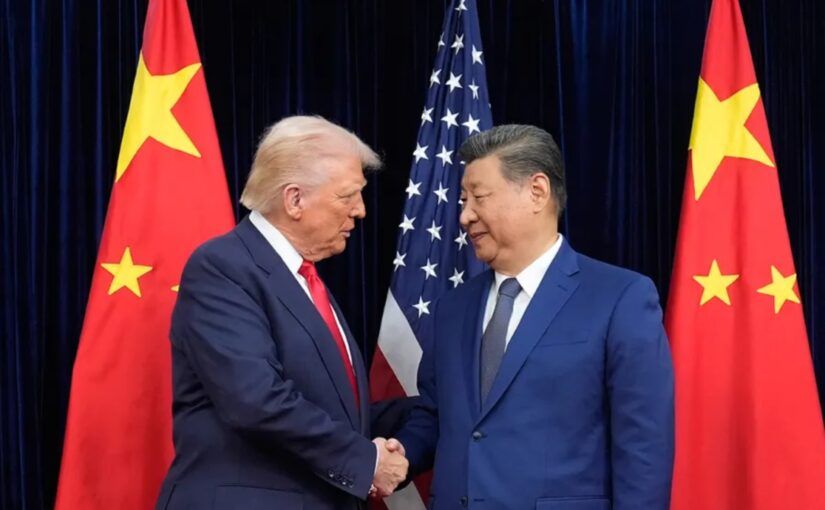
Chinese President Xi Jinping paid a state visit to the United States of America from September 23 to 25 at the invitation of President Donald J. Trump. It was his first state visit to the country since September 2015, during the Barack Obama administration, and follows President Trump’s state visit to China in May this year.
On the eve of the visit, the Morning Star published an editorial, arguing that this visit “could scarcely come at a more critical moment”, with:
- Two already-disastrous wars threatening to spin out of control, in Ukraine and in the Gulf
- Alarm mounting at the dangers posed by artificial intelligence
- Growing levels of debt threatening to deepen problems in the global capitalist economy
- The menace of climate change developing apace
All of these crises, the paper argues, “are rooted in the workings of imperialism today, in the dynamics for its ceaseless drive for capital accumulation on a global scale, its search for the greatest possible profit through international competition and coercion.”
Furthermore: “In Trump this failing system has an appropriate, if highly dangerous, lead representative. His actions, animated both by a bullying ‘America First’ aggression and a drive for personal and financial self-aggrandisement, have made every aspect of the threats facing the world worse.
“Yet for all his bluster and military adventures, Trump approaches his summit with Xi as the weaker party in some respects.”
Among the reasons for this are that: “In contrast to Trump, Beijing continues to uphold international law and the authority of the United Nations — thin defences against the depredations of imperialism but a base to build on rather than an edifice to be torn down…
“Xi also leads a cohesive society developing apace along almost every indicator of human well-being. Trump’s US by contrast is choking on its own divisions, including rampant racism, the removal of all restraints on private and corporate greed and the negation of the rights notionally provided for under the constitution.”
From this, the paper concludes: “Because of this it is, alas, unlikely that the meeting will lead to any great breakthroughs on major issues… Ultimately, the meeting between Xi and Trump is a meeting of a plausible future for the international order and a dystopian present. Xi and the Communist Party of China he leads bear much of the hopes of the world in the present crisis.”
The full text of the editorial is reprinted below.
The meeting this week of the presidents of the United States and the People’s Republic of China could scarcely come at a more critical moment.
Donald Trump and Xi Jinping will confer as two already-disastrous wars threaten to spin out of control, in Ukraine and in the Gulf, the latter the consequence of Washington’s Israel-assisted bovine aggression.
Alarm is also mounting at the dangers posed by artificial intelligence, with the possibility of human extermination being repeatedly raised.
Further, growing levels of debt threaten to deepen problems in a global capitalist economy which has yet to fully recover from the crash of 2008.
The menace of climate change is also developing apace, powerfully assisted by the US administration’s withdrawal from climate treaties and boosting of fossil fuel industries.
All of these crises are rooted in the workings of imperialism today, in the dynamics for its ceaseless drive for capital accumulation on a global scale, its search for the greatest possible profit through international competition and coercion.
In Trump this failing system has an appropriate, if highly dangerous, lead representative. His actions, animated both by a bullying “America First” aggression and a drive for personal and financial self-aggrandisement, have made every aspect of the threats facing the world worse.
Yet for all his bluster and military adventures, Trump approaches his summit with Xi as the weaker party in some respects.
Alone in the world China successfully stood up to Trump’s tariffs and forced Washington to declare a trade war truce through carefully targeted counter-measures.
China has also advanced constructive proposals for resolving the other problems facing humanity, including the international regulation of AI.
In contrast to Trump, Beijing continues to uphold international law and the authority of the United Nations — thin defences against the depredations of imperialism but a base to build on rather than an edifice to be torn down.
It has proposed solutions to the wars in Ukraine and the Gulf, as well as strongly opposing Israel’s assault on the Palestinian people.
Xi also leads a cohesive society developing apace along almost every indicator of human well-being. Trump’s US by contrast is choking on its own divisions, including rampant racism, the removal of all restraints on private and corporate greed and the negation of the rights notionally provided for under the constitution.
Because of this it is, alas, unlikely that the meeting will lead to any great breakthroughs on major issues, with Trump still floundering around as his aggression in the Gulf, like his trade conflicts, runs into deeper and deeper trouble, when he is not obsessing about his new White House ballroom and the triumphal arch he proposes to erect in Washington.
Rather, it will provide a study in contrasts, between statesmanship and piracy, between a vision of a peaceful and equitable world resolving problems through diplomatic discussion and the law of the jungle, between a developing socialist perspective and decaying imperialism.
Ultimately, the meeting between Xi and Trump is a meeting of a plausible future for the international order and a dystopian present. Xi and the Communist Party of China he leads bear much of the hopes of the world in the present crisis.