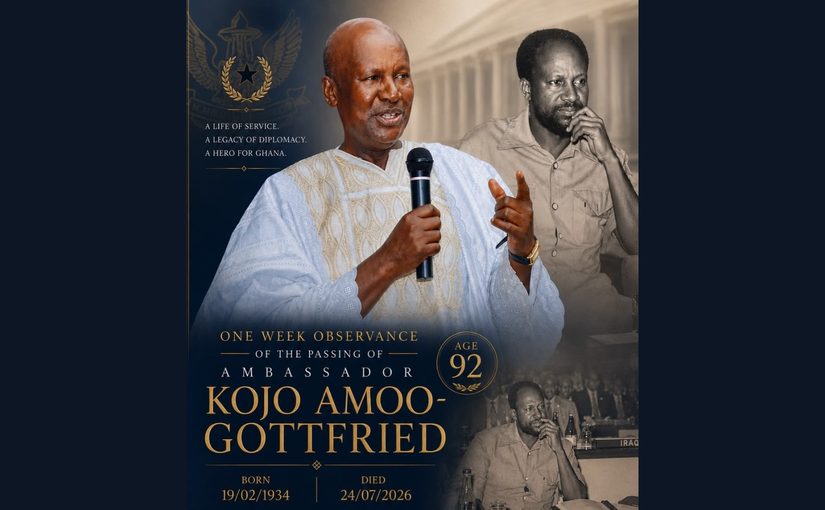
Our co-editor Keith Bennett remembers his friend and comrade Kojo Amoo-Gottfried, who passed away peacefully in Ghana on July 24, 2026, at the age of 92.
His Excellency Ambassador Kojo Owusu Gyamadua Amoo-Gottfried, known to one and all simply as Kojo, was a Ghanaian patriot and public servant, a revolutionary Pan-Africanist, a Marxist, a member of the Ashanti royal family, a scientist, an Ambassador to Cuba, China, Switzerland and the United Nations in Geneva, a member of the Friends of Socialist China advisory group, a husband, father, grandfather and to me personally a much-loved friend and comrade.
Although I was aware of the fact that he had been ailing for some time, it still came as a considerable shock when I somewhat belatedly learned of his passing.
On the introduction of a mutual friend, we first met in the 1990s in Beijing, where he was serving as his country’s ambassador. We found ourselves wondering how we had not met before, considering the number of friends we had in common. But we soon made up for lost time, with the years that followed filled with numerous meetings and activities in Beijing during his period of office, in London where he had a family home and still visited regularly until his very last years, and on visits together to Durban and Hanoi.
Ambassador to China, and concurrently non-resident ambassador to Vietnam, Cambodia and the Democratic People’s Republic of Korea, in the late 1990s, was his last job before retiring. But his close relationship with the Chinese revolution long predated this. He would often recall being at boarding school and sharing the excitement with his lifelong best friend Captain Kojo Tsikata at the news of the founding of the People’s Republic of China and their discussing what this meant for the anti-colonial struggle in Africa.
Ten years later, he represented the West African Students Union (WASU), as its president, at the anniversary celebrations in Beijing, where he was received by Chairman Mao. Decades later, at a dinner I organised in an Indian restaurant in London, the wife of a Chinese diplomat, who was later to briefly serve as his country’s foreign minister, said she wished she could never wash her hand again as she had just shaken a hand that had shaken Mao Zedong’s.
He was present at the Workers Stadium in Beijing on August 23, 1961, when President Osagyefo Dr. Kwame Nkrumah and President Liu Shaoqi signed the treaty of friendship between their countries in the presence of Chairman Mao. He then worked closely in the international student movement with Li Lanqing, who was then a leading figure in China’s Communist Youth League. When he returned as ambassador in 1994, Li, who in 1998 was to be appointed Vice Premier, told him, “You’ve come home at last”.
When he was completing his term as ambassador, one of his last acts was to secure visa-free access for Ghanaian citizens to a Hong Kong newly returned to the motherland. When paying a farewell call on President Jiang Zemin he asked him if there was anything he could do for China on his return home. As a result, at Jiang’s request, he founded GHACHIFA, the Ghana China Friendship Association, serving as its first president and building it the length and breadth of the country.
Kojo always paid close attention to the work of building friendship and solidarity with socialist China in Britain, initially through the West African Students Union and the Committee of African Organisations, and working with comrades like Claudia Jones and Abhimanyu Manchanda. He was a founding member of the Society for Anglo-Chinese Understanding (SACU) in 1965. When in 2008, Carlos Martinez and I initiated the Hands Off China campaign, he readily assumed an honorary position, speaking at the founding meeting and other public events. When we formed Friends of Socialist China together in 2021, he readily accepted the invitation to join our advisory group.
Cuba was a country that Kojo loved as much as he loved China. It was his first diplomatic posting, as ambassador from 1982 to 1989, the first Ghanaian envoy to the socialist island after the government of Jerry Rawlings resumed diplomatic ties. He also served as non-resident ambassador or high commissioner to numerous countries in the region, including Jamaica, Trinidad and Tobago, and revolutionary Nicaragua and Grenada.
In its tribute, the Cuban embassy in Accra wrote: “We had the pleasure of meeting him and hearing his anecdotes about the Commander-in-Chief.” Indeed, his first-hand stories about Comrade Fidel were legion and the affection was clearly mutual. It was quite something to be walking down a corridor in the Durban International Convention Centre with Kojo, only to be confronted by the Comandante approaching from the other direction, beaming broadly and throwing his arms wide in the air as he loudly exclaimed: “Kojo!”, not hiding his delight at seeing his old friend and comrade.
Reflecting, it seems extraordinary that such a quiet, modest and unassuming person as Kojo should have found himself at the centre of so many great events. He was not just a witness to history but a maker of history. A comrade and fellow fighter with Mao Zedong, Fidel Castro, Kim Il Sung and so many others.
But there were perhaps two people above all with whom he seemed to feel a special bond – Ho Chi Minh and Malcolm X. Whenever we met he always seemed to have with him a carefully preserved folder with photos and correspondence with these two leaders. It was also their photos you first saw on the wall as you entered his home in Beijing.
In the early 1960s, he had travelled from China together with Li Lanqing to meet Uncle Ho in Hanoi. Kojo and Li then took the Ho Chi Minh trail to meet Prince Norodom Sihanouk in Phnom Penh, something that Sihanouk fondly recalled when Kojo presented his ambassadorial credentials to him more than three decades later.
It was Kojo who drove Malcolm to the airport at the conclusion of his visit to Britain in February 1965. He would recall saying to Malcolm that he was “becoming a real threat to them” and would need to take his security more seriously. Malcolm was assassinated just days later.
Kojo was a great historical figure but above all he was a friend – someone whose phone call and card would, until the last period, arrive without fail at birthday and Christmas. Someone who formed a warm friendship with my mother and gave me comfort, advice and courage during her final illness.
A tribute carried by Modern Ghana put it well: “Behind the protocols and high offices of state lived a gentleman of infinite warmth… He passed down an indelible life lesson to the generations behind him: ‘Never look down on anyone. See the world through the lens of community, collaboration and mutual respect.’
“Those who shared close quarters with him will forever cherish the vibrant life that filled his home – his sharp wit, resonant laughter and legendary generosity. Even when facing his own health battles, his focus remained outward, seamlessly coordinating welfare and assistance for friends and comrades in need.”
Kojo was a comrade who remained faithful to his original aspiration for some eight decades and never forgot why he started. There are some phrases that are overused but are occasionally true. This is one such occasion: I will never see his like again.
Farewell, Comrade Ambassador Kojo, an unassuming hero and my beloved comrade and friend.
The video of the funeral service for Ambassador Kojo Amoo-Gottfried, highlighting his extraordinary life, can be viewed here.