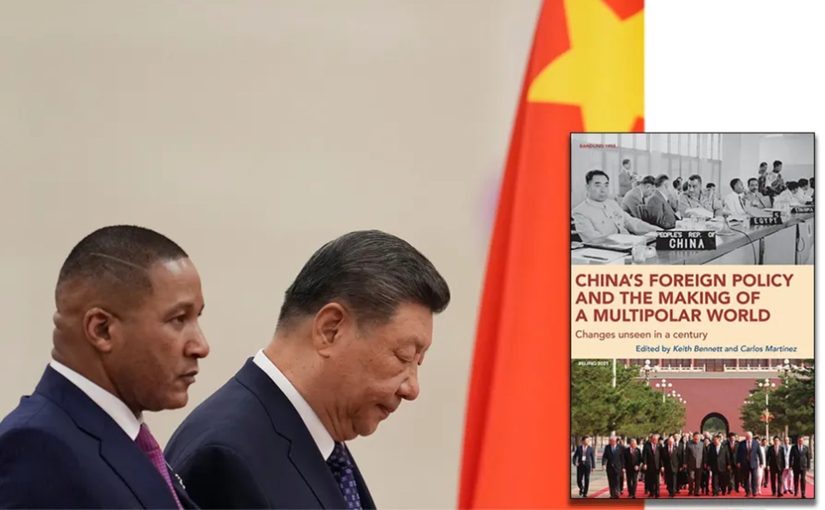
We are pleased to republish this review by Ben Chacko, editor of the Morning Star, of China’s Foreign Policy and the Making of a Multipolar World: Changes unseen in a century, edited by Friends of Socialist China co-editors Keith Bennett and Carlos Martinez and published by Praxis Press.
Ben describes the book as “a necessary – and consistently carefully argued – corrective to the scaremongering about China which dominates the Western media and goes unchallenged far too often on the Western left”. He stresses that the book is not just about China, but about how we respond to the decline of US imperialism, and he takes aim at those who spin a “neither Washington nor Beijing” narrative based on the idea of the US-China dynamic as an example of inter-imperialist rivalry.
Highlighting contributions by Andrew Murray, Danny Haiphong and Torkil Lauesen, the review concludes that a socialist country presenting a viable alternative to US supremacy is “arguably the biggest challenge to world imperialism since the Russian Revolution”, and that this is “a book that should sit on every anti-imperialist bookshelf”.
The book is available from Praxis Press in paperback and as an ePub.
This article first appeared in the Morning Star.
China’s Foreign Policy and the Making of a Multipolar World
Edited by Keith Bennett and Carlos Martinez, Praxis Press, £24
“CHANGES unseen in a century.” This invaluable book’s subheading, taken from a speech on the state of the world by Chinese President Xi Jinping, reflects the importance of the historical moment we are living through.
Like editors Keith Bennett’s and Carlos Martinez’s previous collaboration, People’s China at 75 — The Flag Stays Red, China’s Foreign Policy and the Making of a Multipolar World is a collection of essays by diverse authors, each focusing on a particular aspect of China’s changing role in the world. It brings together voices from a range of countries and political traditions. But the common theme is that China’s rise is hugely significant — and overwhelmingly positive.
That in itself makes it a necessary — and consistently carefully argued — corrective to the scaremongering about China which dominates the Western media and goes unchallenged far too often on the Western left.
But we should not neglect the second half of the title. This is not just about China. It is about how we respond to the decline of US imperialism and to those countries challenging US global hegemony.
These are crucial questions for the British peace movement. Our own political reporter Andrew Murray, in his contribution China, Cold War & Empire, asks us to consider a rivalry usually framed as about China’s rise afresh: “It is not a ‘China problem’ but the decay of the mightiest economic and military power the world has seen into a form of senescence, vomiting blood, smoke and ashes over the planet as it rages against its dying light.”
This is a problem for those “anti-imperialists” who spin a “neither Washington nor Beijing” narrative based on the idea of inter-imperialist rivalry. Washington is lashing out in all directions, kidnapping presidents, trying to bomb or starve adversaries into submission by force, even threatening its own junior allies; there is no comparison with China, whose insistence on respect for the UN, the peaceful resolution of disputes and global co-operation on both climate change and AI are, as Murray notes, “on every point… the direct opposite [platform] to that championed by Trump’s USA.”
But is China’s foreign policy “good enough?” In another gem of an essay Danny Haiphong takes issue with criticisms common on the Western left, including allegations that its economic relations with other countries are exploitative, and that it is not assertive enough in confronting the US bloc from Latin America to Palestine. We learn a great deal about its practical solidarity with global South countries and resistance movements, as well as (in this and other essays) the good reasons China has to be wary of provoking direct confrontation with Washington that could spiral into world war.
Ironically, just as many who cite market relations in China as evidence it is “state capitalist,” and who made the same accusation against the non-market economy of the USSR, many who hold its cautious foreign policy undermines its revolutionary credentials argued the more interventionist Soviet approach was imperialist.
From Bennett’s and Martinez’s introductory essay, through examinations of the history of Chinese foreign policy and whether it can be classified as imperialist; from the “five principles of peaceful coexistence” as applied to an era of emerging multipolarity and an analysis of international relations through Mao’s lens of principal and secondary contradictions, to a glimpse of a post-imperialist world order in Xi’s four “global initiatives,” this is a highly readable and informative little book which equips us with the arguments to take on those who — by insisting on viewing China as a threat equivalent to the US — undermine solidarity with the international resistance to US and European imperialist domination.
As Torkil Lauesen notes in his chapter, the end of that domination may be in sight “if we avoid major wars,” while “we are also working under time pressure due to the impact of the capitalist mode of production on the climate and the ecology of the planet.”
A socialist country presenting a viable alternative to US supremacy is a “change unseen in a century” — arguably the biggest challenge to world imperialism since the Russian Revolution.
The shift from a world in which Europe and its settler offshoots have controlled the trade and resources of the planet and written its economic rulebook, to one in which different countries and civilisations co-operate and exchange on a basis of equality and mutual respect, as set out in Xi’s four initiatives, would arguably be a change unseen in 500 years.
The stakes are high, and it’s important we understand them. To that end, this is a book that should sit on every anti-imperialist bookshelf.