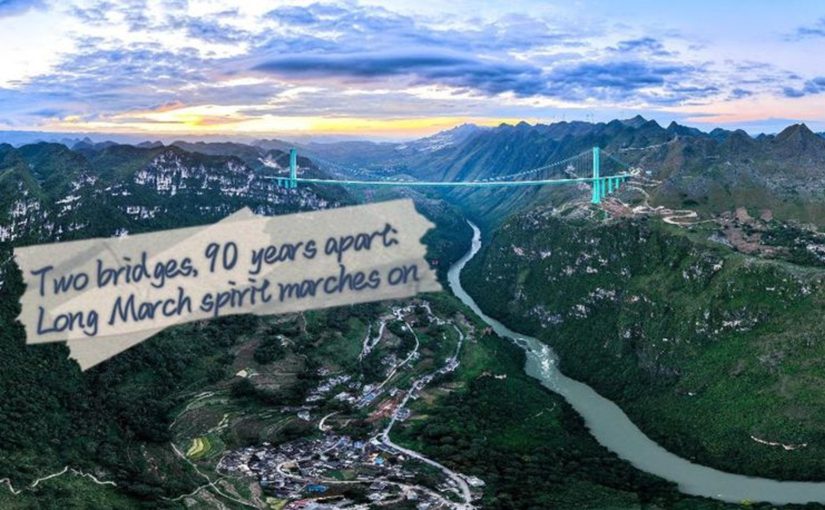
In the following article, Friends of Socialist China co-editor Carlos Martinez marks the 90th anniversary of the conclusion of the Red Army’s Long March, taking as his starting point Mao Zedong’s description of the march as “a manifesto… a propaganda force… a seeding-machine”.
Carlos traces the road to the Long March – from the Kuomintang’s betrayal of the First United Front and the 1927 Shanghai massacre to the reorientation towards the countryside and the five encirclement campaigns against the Jiangxi Soviet – and recounts the march itself, including the crossings of the Jinsha and Dadu rivers and the seizure of the Luding Bridge. He emphasises that the Long March was also a landmark in the development of Chinese Marxism: the Zunyi Conference brought Mao to the core of decision-making, and the march created a political distance from the Comintern representatives’ dogmatic interpretation of Marxism, laying the deepest roots of socialism with Chinese characteristics.
The article concludes that each generation has its own Long March – today walked in the victory over extreme poverty, the drive for scientific and technological self-reliance, and the building of an ecological civilisation – and that, for the Global South, the march remains the great demonstration that a people organised around a clear political project can defeat apparently overwhelming force.
Xi Jinping made a similar point in his speech marking the anniversary on October 22, stressing that “the road of the Long March continues to extend”.
This article will be published in Beijing Review in late October.
This October marks ninety years since the three main forces of the Chinese Workers’ and Peasants’ Red Army – the First, Second and Fourth Front Armies – joined hands at Huining, in Gansu province, and at Jiangtaibao, in what is now Ningxia, bringing to a close what Edgar Snow called “an Odyssey unequalled in modern times”.
Speaking in December 1935, two months after the First Front Army reached northern Shaanxi, Mao Zedong employed the imagery of cultivation rather than of war:
“The Long March is a manifesto. It has proclaimed to the world that the Red Army is an army of heroes… The Long March is also a propaganda force. It has announced to some 200 million people in eleven provinces that the road of the Red Army is their only road to liberation… The Long March is also a seeding-machine. In the eleven provinces it has sown many seeds which will sprout, leaf, blossom, and bear fruit, and will yield a harvest in the future.”
Nine decades on, that harvest is visible from space. To understand modern China – its achievements, its vision, its socialist orientation – one must understand the Long March.
The road to Jiangxi
The Communist Party of China (CPC) was formed in 1921, in the wake of the May 4th Movement. The 1911 revolution that overthrew the Qing dynasty had reached a dead end; warlords controlled most of the country; the feudal economy remained in place; and imperialist powers maintained their footholds. The CPC was the first organisation to put forward the slogan “Down with imperialism”, recognising that China’s weakness was inherently bound up with foreign domination.
From 1923 the young party built a United Front with Sun Yat-sen’s Kuomintang (KMT) – to end feudalism, unite the country and drive out the imperialist powers. That alliance was drowned in blood after Sun’s death. In March 1927 Shanghai was liberated from warlord control by an insurrection of the local working class; three weeks later, Chiang Kai-shek’s forces took the city by massacring its liberators. Under Chiang’s new regime, communism became a crime punishable by death; CPC membership fell from 58,000 to 10,000 in a single year.
Disaster forced a strategic reorientation of world-historic significance. A revolution modelled on the European template – built on the industrial proletariat of the major cities – was no longer viable in a country where the urban working class constituted less than one percent of the population. Mao Zedong, fleeing with his forces into the Jinggang mountains, was, in Han Suyin’s words, “the first in the party who abandoned the city orientation and devised a major strategy born from China’s reality”. The Jiangxi Soviet – the first substantial liberated territory – grew to encompass millions of people. Land was redistributed, taxes lightened, mass literacy campaigns launched.
Between 1930 and 1934, Chiang’s forces waged five successive encirclement campaigns against the base areas, the last mobilising nearly a million troops and some four hundred aircraft under German advisers headed by Hans von Seeckt, lately commander-in-chief of the German army. As Agnes Smedley recorded, the KMT itself admitted that “about 1,000,000 people (almost entirely peasants) were killed or starved to death in the process of recovering Soviet Jiangxi”. There was, she concluded, “no alternative but to abandon Jiangxi in order to save the Red Army. The sequel was the famous Long March.”
The march
In October 1934, some 86,000 fighters broke through the blockade lines and set out towards the west. Over the following two years, the Red Army’s columns crossed some of the most hostile terrain on Earth. Snow’s account in Red Star Over China remains definitive: eighteen mountain ranges, five of them perennially snow-capped; twenty-four rivers; twelve provinces; an average of nearly twenty-four miles a day, on foot, under fire – “one long battle from beginning to end”.
The Long March featured several extraordinary feats, including the crossing of the Jinsha River, secured by a feint and an eighty-five-mile march in a night and a day, without the loss of a single life. The crossing of the Dadu River was assessed by Edgar Snow to be “the most critical single incident of the Long March” – “had the Red Army failed there, quite possibly it would have been exterminated”. The Dadu crossing culminated in the seizure of the Luding Bridge, where troops crawled along bare iron chains into machine-gun fire. Peng Dehuai, who walked most of the six thousand miles, giving his horse to wounded comrades, put it bluntly: “Victory was life; defeat was certain death.”
The Long March was equally a triumph of political strategy and a landmark in the development of Chinese Marxism. At Zunyi, in January 1935, the party leadership confronted the failed military line associated with its Comintern advisers and elevated Mao Zedong to the core of decision-making – the beginning of a process through which the Chinese Revolution came under the leadership of those who best understood China.
As the Danish Marxist Torkil Lauesen observes, the Long March “not only created a physical distance between the Communists and the Kuomintang, but also a political distance between the Comintern’s Eurocentric interpretation of Marxism and the Chinese interpretation of Marxism”. Here are the roots of the “sinification of Marxism” – the insistence, in Mao’s formulation, that Marxism apart from Chinese peculiarities is “merely an empty abstraction” – and thus the deepest roots of what we now call Socialism with Chinese Characteristics.
And the march had a destination that was also a purpose: north, to resist Japan – converting a desperate retreat into a strategic advance and positioning the party as the standard-bearer of national resistance against foreign occupation.
Yan’an and the harvest
From their new centre at Yan’an, the seeds sown along the march began to bear fruit. Yan’an became a pole of attraction for progressive youth from all over China – and indeed in the West, for a generation inspired by Red Star Over China. It was in the Yan’an caves that Mao, drawing on extensive discussions with the other communist leaders, wrote On Practice, On Contradiction and On New Democracy, giving the revolution its most important theoretical foundations. The army that had numbered a few thousand exhausted survivors in 1935 would, fourteen years later, found the People’s Republic.
This is why the Long March stands at the heart of the PRC’s origin story; why millions of Chinese people travel each year to Yudu, to Zunyi, to Luding. It is the founding epic of modern China – proof that the party’s leadership and the people’s sacrifice could overcome any obstacle.
The new Long March
Marking the CPC’s 105th anniversary this July, Xi Jinping described the party’s century as “the most magnificent epic in the several-thousand-year history of the Chinese nation”, and identified among the qualities that explain its success: pursuing truth and testing it in practice; remaining deeply rooted in the people; daring to struggle no matter how strong the enemy or how perilous the road; and perfecting itself through self-revolution. Every one of these was forged on the Long March.
And for China, as Xi said in 2016 at a Beijing gathering marking the 80th anniversary of the Long March’s victorious conclusion, the march never ends: each generation has its own Long March. Today’s is walked in the victory over extreme poverty and the work of rural revitalisation; in the drive for scientific and technological self-reliance in the face of a US-led technology war; in the building of an ecological civilisation. Each of these long-term undertakings demands the perseverance, strategic resolve and reliance on the people that carried the Red Army to Shaanxi.
The march speaks to the world, too. For the Global South, it remains the great demonstration that a people organised around a clear political project can defeat apparently overwhelming force, and that Marxism lives by adaptation to national conditions. Its spirit finds contemporary international expression in Belt and Road cooperation and the global initiatives on development, security, civilisation and governance – China working with other countries, above all in the Global South, towards a community with a shared future for humanity. The road is long; the foundations were laid by those youths of whom Snow wrote that they “would not admit defeat either by man or nature or God or death”.
Or, as Mao’s 1935 poem has it: “The Red Army fears not the trials of the March / Holding light ten thousand crags and torrents… / The three Armies march on, each face glowing.”






One thought on “A manifesto, a propaganda force, a seeding-machine: the Long March at 90”