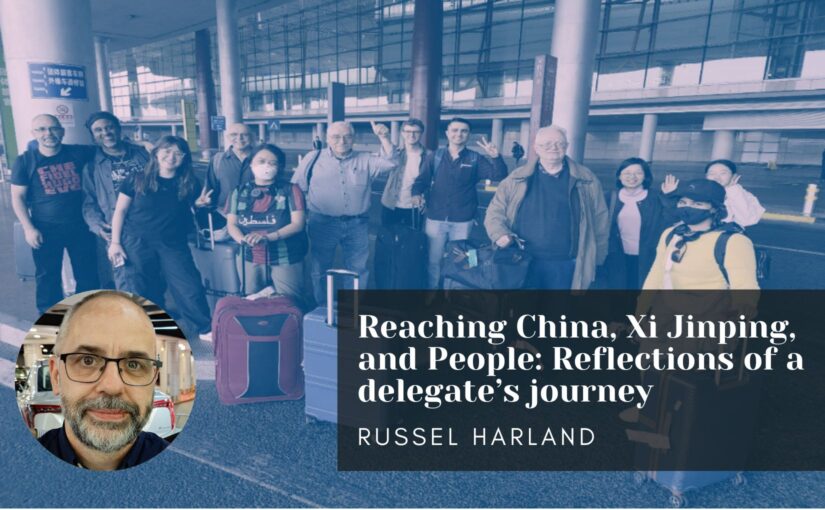
In the following article, Russel Harland (Deputy Branch Secretary and International Relations Officer, Surrey County UNISON, and a member of the Friends of Socialist China Britain Committee) provides a detailed and throught-provoking description of his experiences on our recent delegation to China.
Discussing the delegation’s field trip to the Beijing headquarters of the ‘12345’ service hotline, Russel observes that this is an example of “Socialism with Chinese Characteristics in action, using all available resources to work for the common goal of serving the people while responding to reality in the process.” He contrasts this with his own experience working in service provision in Britain: “There were many occasions that I knew when giving vulnerable people advice, either in their homes or on the phone, that it was mostly theatre given the constraints on public services in Britain.”
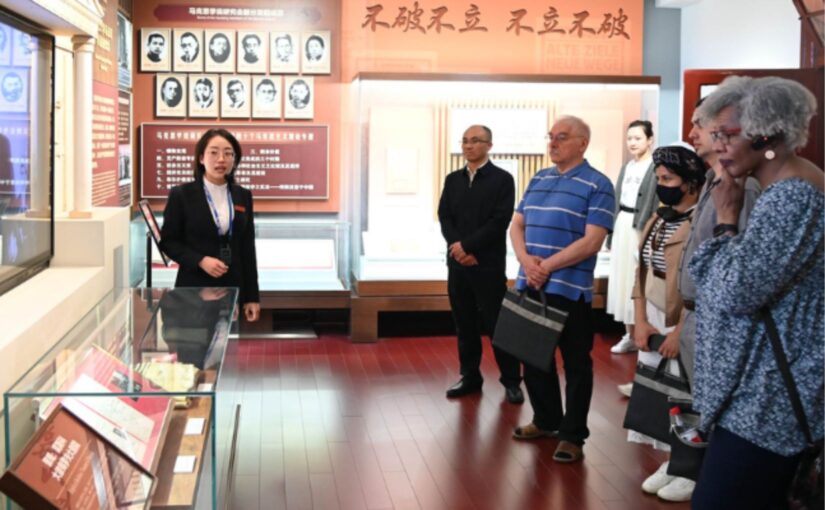
Russel writes that “fundamental to our visit, unsurprisingly, is what you could call our red education”. Through the Chinese presentation of their own historical and ideological trajectory, it becomes clear that “the red gene flows through the life blood of everything that China is trying to do.” Reflecting on his experiences growing up in Belfast, Russel notes: “The battle for symbols is an important arena on the journey of any country’s rejuvenation, known only too well by those us from former colonies who have spent a lifetime walking past statues and symbols of our colonial oppression… After what our delegation experienced during our visit in China, the North of Ireland has some way to go in matching China’s cultural regeneration before it can truly unburden itself from the past.”
The article also explores the nature of China’s evolving Marxism, in particular Xi Jinping Thought on Socialism with Chinese Characteristics for a New Era. Russel emphasises the importance of casting off New Cold War propaganda – and deep-rooted ‘yellow peril’ racism – in order to understand the reality of China today.
It is vitally important for anyone wishing to understand contemporary China, that we attempt to claw ourselves out of the ideological pit of ignorance whence we bathe in untruths, which are then nonchalantly echoed as informed opinion on Xi Jinping, and China in general. Centuries of constructed racism, which we Irish understand only too well, against China from the West, with the alleged threat of the “yellow peril” lurking in the shadows ready to pounce on our “freedoms,” distorts reality and the standing in which President Xi is held, both in China and the non-western world.
Russel concludes: “The Friends of Socialist China 2024 delegation to the People’ Republic of China has born witness to an inspiring alternative that truly puts the wellbeing of all its population first.”
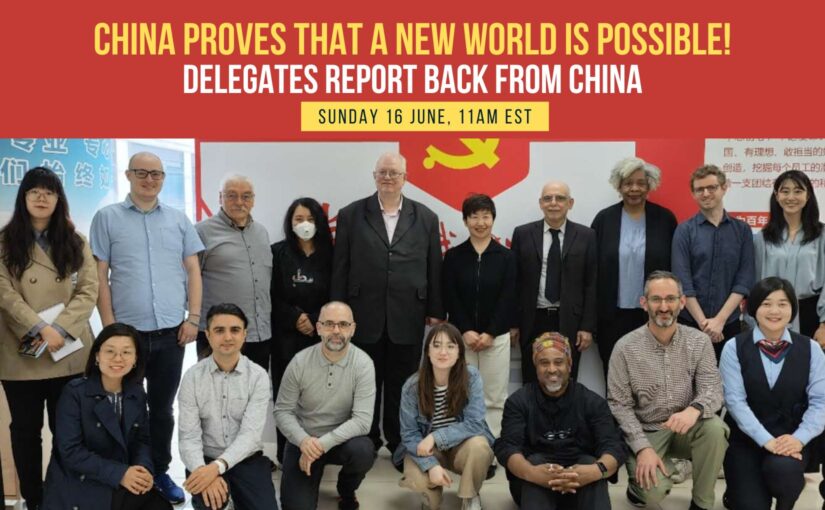
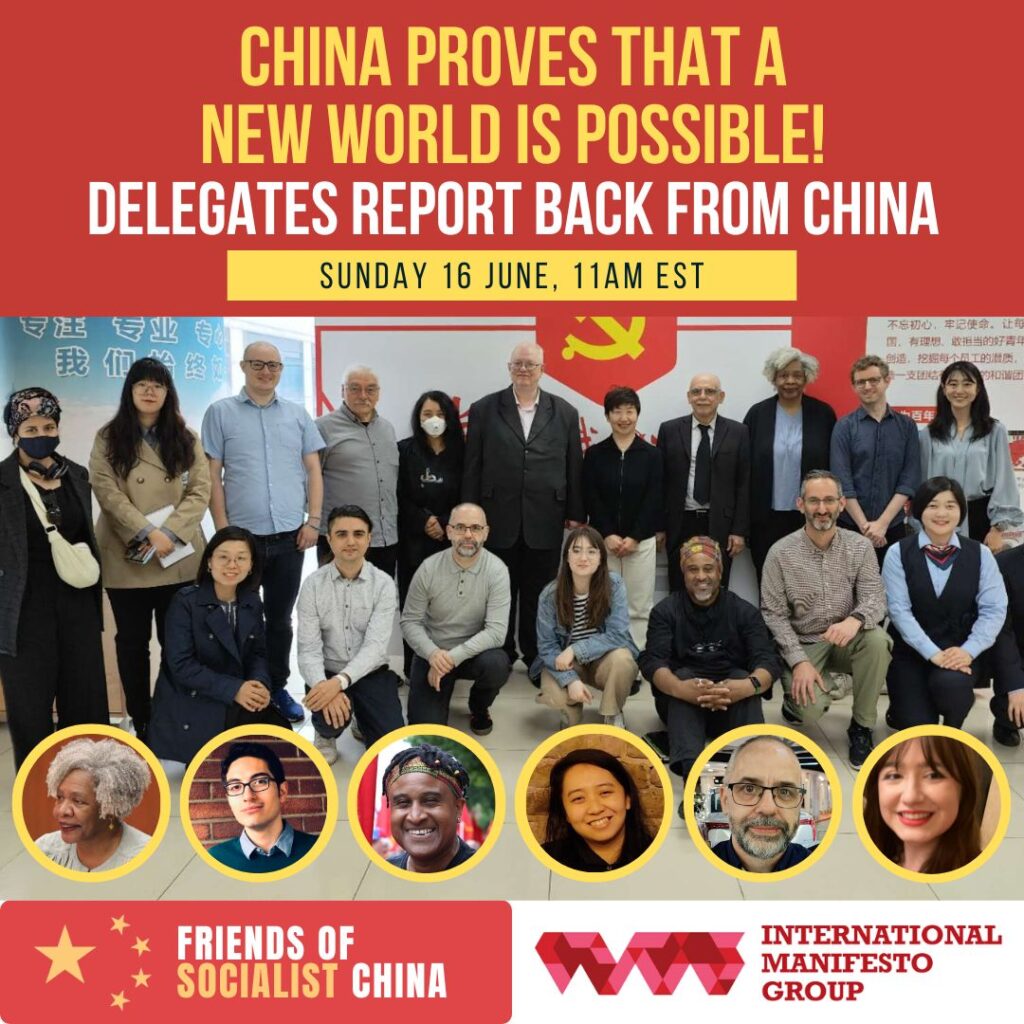
Russel is among the speakers at our webinar on 16 June 2024, China proves that a new world is possible! Delegates report back from China.
A chance quip by a comrade during a discussion on Chinese food one evening stimulated my reflection on the world that had opened up to me before my participation in the 2024 Friends of Socialist China (FoSC) delegation had even been confirmed. For around five years I had been attending online events organised by groups such as No Cold War Britain, the International Manifesto Group, and Friends of Socialist China, where I took inspiration to begin researching Chinese revolutionary history, economics, and Marxist theory. As a child of “The Troubles” in the North of Ireland, as it’s euphemistically known, I was a latecomer to Marxism as a mature student at university in my late thirties. The subsequent new focus on China led me to embrace a world of possibilities that would sit much more comfortably with my working-class experience and global south allegiances.
Reading from many sources, old and new, from Mao Zedong to Xi Jinping, I began to formulate a tentative overview of the historical and contemporary Chinese experience, particularly from the time of China’s defeat to the British in the first Opium War in 1840, which ushered in the ‘century of humiliation’. Around this time in Ireland, Britain’s bloody footprint continued to be stamped on the colonised population, as an Gorta Mór (The Great Hunger) was set to ravage the country with devastating consequences still felt to this day as the outcome. Back in China, the crumbling dynastic society was violently exploited and reduced to extreme poverty by foreign invaders, mainly from the industrialised countries of the West and Japan, which ultimately sowed the seeds for the Civil War from 1945-49, which saw the defeated nationalists of the Guomindang retreat from mainland China to Taiwan. Bear in mind that China’s average life expectancy pre 1949 was just 36 years. Thus, the ‘century of humiliation’ left a deep scar on the population’s psyche.
Yet, in all the darkness there shone a glimmering of hope as the embers of something new began to spark. The second half of the century of humiliation witnessed the introduction of Marxism into Chinese Society, spearheaded by Li Dazhao, which then led to the formation of the Communist Party of China (CPC) in 1921. Mao Zedong, famed for his ability to relay Marxism to the masses by writing in simple and accessible terms,wrote in 1937:
“We must use Marxism, which is positive in spirit, to overcome liberalism, which is negative. A Communist should have largeness of mind and he should be staunch and active, looking upon the interests of the revolution as his very life and subordinating his personal interests to those of the revolution; always and everywhere he should adhere to principle and wage a tireless struggle against all incorrect ideas and actions, so as to consolidate the collective life of the Party and strengthen the ties between the Party and masses…”
As a result, armed with Marxist theory, inspired by the Russian revolution, Mao Zedong built a revolutionary movement, and despite the odds and impoverished conditions secured victory. A new dawn had broken as the People’s Republic of China (PRC) was declared on 1 October 1949 which set the country on the road to development based on scientific socialism.
We must remember though that China is much more than the last two centuries. In the formidable words of Victor Gao, China is a 5000-year-old civilisational fact. This bears contemporary relevance for those so-called human rights defenders engaging in scurrilous anti-China talking points emanating from destabilising sources in the West, as it reveals that China’s borders have remained largely the same during this long, sometimes turbulent history, with some differentiation in those alleged “disputed territories”, such as Xinjiang, Tibet, Hong Kong, and Taiwan. According to Kishore Mahbubani, there are ‘some hard political realities that cannot be changed’ in China by any leader,and the territorial integrity of the country is one of them. Rather than regurgitating flippant and ignorant remarks about China, people in the West should be mindful that humanity needs engagement, not more estrangement during what appears the decaying stage of American Hegemony.
The contrast between the Chinese and Irish experiences of the 20th century is stark. In Ireland, when an already dying James Connolly was carried on a stretcher, tied to a chair, and executed by the barbarous British for his heroic part in the Easter Uprising of 1916, it is said that Ireland’s chances of a Socialist Republic died too. Without Connolly’s Marxism and indomitable voice, an unfulfilled void was left in Ireland, which was soon to see an undemocratic partition in the north of the country which became the Protestant-dominated Northern Ireland. In the post 1949 years, Catholic Ireland in the south was to totally embrace the “red scare” of anti-communism. By the time Deng Xiaoping’s Reform and Opening Up got underway in 1978, Northern Ireland was witnessing another bloody year of conflict, as the British government was found guilty by the European Court of Human Rights for ‘inhuman and degrading treatment’ of innocent people snatched from their homes by the British army and interrogated in 1971. At this point, the Good Friday Agreement, which would give parity of rights to all citizens in the gerrymandered statelet, was still 20 years away.
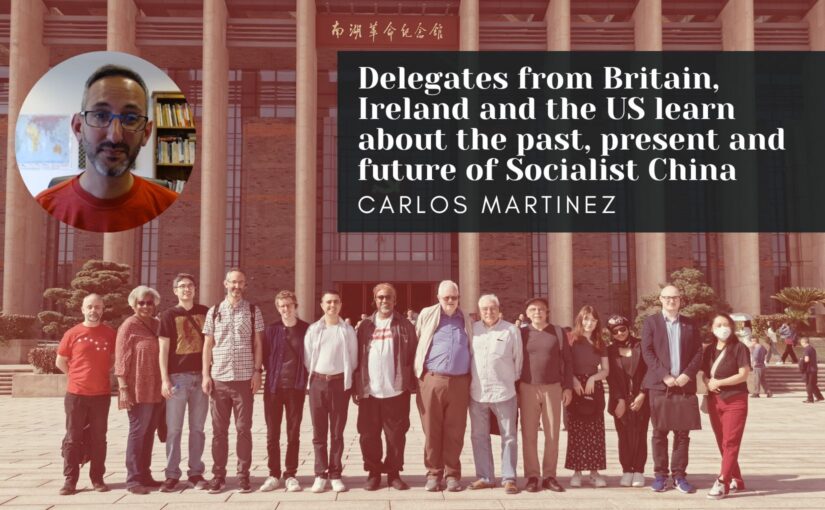
This is some of the historical baggage that I was carrying prior to landing in Beijing on Sunday 14 April, although I tried to leave as much of it as I could back in London, in order to approach this delegation with a true open mind. The delegation was made up of 14 people of various ages, experiences, and backgrounds, coming from Ireland, Britain, and the US, but expanding more globally in their origins. For many of us this was our first time in China.
We were met at the airport by our three Chinese representatives from CNIE (China NGO Network for International Exchanges) Ma Jingjing, Xu Luning, and Liu Huihui, who, along with many other people during our stay, played an invaluable role in keeping us on schedule and in the right place during our 10 days in China. I think it is fair to say that by the time that our stay in China came to an end our three hosts had become comrades due to our mutual respect and shared values.
Continue reading Reaching China, Xi Jinping, and People: Reflections of a delegate’s journey