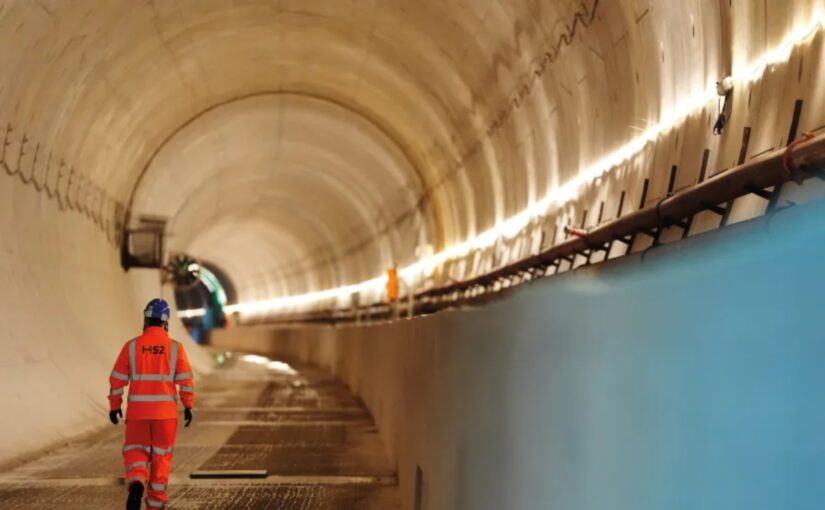
In the following article, originally published in the Morning Star, our co-editor Carlos Martinez uses the unfolding HS2 fiasco to illustrate the stark difference between the British and Chinese political economies, and to make the case for socialism.
On May 19, it was announced that Britain’s high-speed rail project will cost some £103 billion and will not carry passengers for at least another decade. Carlos sets these figures against China’s record: at roughly £736 million per mile, HS2 track is around 25 times more expensive than Chinese high-speed rail, and is being built at a fraction of the pace. China laid 31,000 miles of high-speed rail in 22 years; Britain may manage 140 miles in 19.
The explanation, Carlos argues, is not technical but political. Where China builds through vertically integrated state-owned enterprises under coordinated national planning, Britain’s project has been handed to a fragmented patchwork of private contractors, each adding its margin – the predictable result of four decades of privatisation and deindustrialisation.
The HS2 fiasco is not just a story about one botched railway project. It is a story, ultimately, about the fallacy of neoliberalism, about the consequences of four decades of deindustrialisation and privatisation, about the consequences of treating public infrastructure as an opportunity for private extraction rather than as a public good.
And it is a story about how, as Deng Xiaoping put it in 1984 (at the start of capitalism’s neoliberal era), “the superiority of the socialist system is demonstrated, in the final analysis, by faster and greater development of the productive forces than under the capitalist system.”
It was announced on May 19 that Britain’s ill-fated HS2 high-speed rail project is set to cost three times more than originally budgeted, and will not start running for at least another decade.
Transport Secretary Heidi Alexander stated that, following a review of the project, the estimated final cost will be £103 billion. What’s more, this only covers the first phase, between Old Oak Common (in west London) and Birmingham Curzon Street — a distance of 140 miles.
To put the figures in perspective: £103bn divided by 140 miles works out at around £736 million per mile. By comparison, the average cost of a mile of high-speed rail in China is in the region of £30m. HS2 track is therefore around 25 times more expensive than Chinese HSR.
The contrast in pace is if anything even more striking. Construction on HS2 began in 2017. If we see a train running in 2036, the pace of construction will have been a smidgen north of seven miles per year.
China started building its high-speed rail network in 2004; by 2008 the first 220 miles-per-hour service was running. Just 22 years later, it has approximately 31,000 miles, making the pace of construction around 1,400 miles per year.
The Beijing-to-Shanghai line — 819 miles of it — was built in just over three years. I can tell you from personal experience that it’s a very comfortable and pleasant journey, and costs in the region of £50.
Why is China so much better at building high-speed rail than Britain? The answer is not technical; it is political.
In China, high-speed rail is built by vertically integrated state-owned enterprises. China Railway Rolling Stock Corporation (CRRC) manufactures the rolling stock. As a centralised manufacturing monopoly, it is able to achieve massive economies of scale, and to invest in the long-term research and development required to build advanced trains.
The China Railway Construction Corporation (CRCC) and the China Railway Group Limited (CREC) do the heavy lifting, handling specialised civil engineering, tunnelling and track-laying.
The China State Railway Group operates the network, managing timetabling, ticketing and so on.
They work under co-ordinated state planning, with land acquisition simplified by public ownership, and a coherent national industrial strategy behind every stage of the project.
In Britain, HS2 is being delivered, or not delivered as the case may be, through a fragmented patchwork of private contractors — Skanska, Costain, Bouygues, Strabag, Eiffage, Balfour Beatty and many others — each layering profit margins onto every stage of the work.
There is no integrated industrial base capable of designing, building and operating the network as a single coherent project. Rather it bounces between governments that have alternately cancelled, paused and modified it.
It seems there is no state authority anywhere capable of pushing it through to completion.
This mess is the result of neoliberalism in action. Britain has spent four decades systematically shedding precisely the kinds of capacity that made the original railway revolution possible — public ownership, long-term planning, a state-backed industrial base and an integrated skills pipeline.
Successive governments have outsourced, privatised, financialised and treated public infrastructure as an opportunity for private extraction rather than a public good.
Britain’s rail unions have been making this argument for many years. RMT, Aslef and TSSA have consistently warned that fragmentation would drive costs up and standards down, and that public ownership of the railways would deliver better results for both workers and passengers.
The HS2 saga has vindicated them so thoroughly that the National Audit Office, in its successive reports on the project, has effectively conceded the point: the project’s cost escalations have been driven by fragmented contracting, weak central oversight, and the absence of integrated industrial capacity.
The sad fact is that Britain no longer has an integrated industrial base capable of building advanced infrastructure at scale. The skills, supply chains and engineering capacity that built the railways, the National Grid and the post-war housing programme have been systematically dismantled.
Whereas China’s CRRC employs nearly 200,000 people in rolling-stock manufacturing alone, Britain manufactures almost none of its own trains.
When the Treasury and the press blame “waste” and “mismanagement” for the HS2 debacle, they are evading the central political question: who actually controls Britain’s economy, and in whose interests is it organised?
The answer is: the City, the property developers, the financial services industry and the network of consultancies that have made themselves indispensable to a hollowed-out Civil Service.
High-speed rail has been flourishing in China — along with renewable energy, advanced manufacturing, electric vehicles, batteries and a good deal else — because China’s political economy is exceptionally well placed to deliver large-scale public goods: democratic ownership of the commanding heights of the economy, long-term strategic planning, vertical industrial integration, and a political leadership willing and able to prioritise public over private interest.
The HS2 fiasco is not just a story about one botched railway project. It is a story, ultimately, about the fallacy of neoliberalism, about the consequences of four decades of deindustrialisation and privatisation, about the consequences of treating public infrastructure as an opportunity for private extraction rather than as a public good.
And it is a story about how, as Deng Xiaoping put it in 1984 (at the start of capitalism’s neoliberal era), “the superiority of the socialist system is demonstrated, in the final analysis, by faster and greater development of the productive forces than under the capitalist system.”
Another reminder that what this country really needs is socialism.






One thought on “Two railways, two systems: HS2 and the case for socialism”