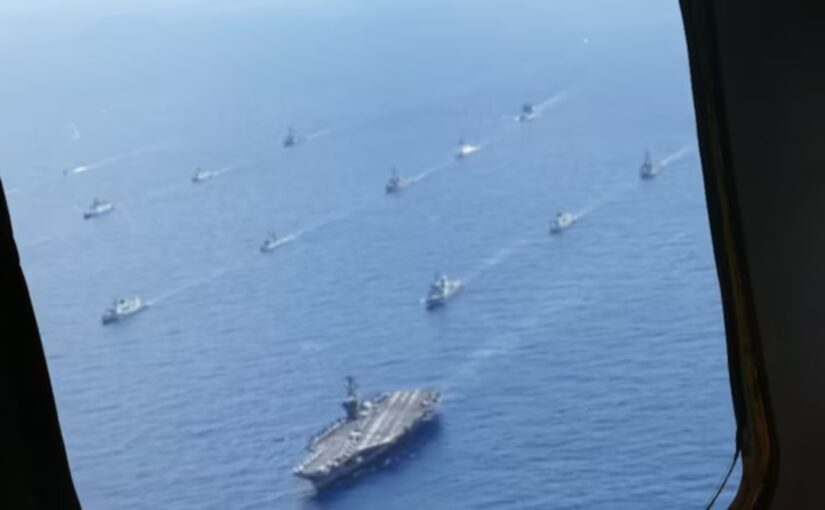
On June 24, the United States launched the biennial Rim of the Pacific (RIMPAC) exercises off Hawaii – the world’s largest international naval war games, bringing together 31 countries, more than 25,000 personnel, dozens of warships and submarines, and 140 aircraft. Running until July 31, RIMPAC represents a further escalation of Washington’s preparations for war on China, militarising the Pacific and normalising the prospect of conflict through ever-larger exercises and an expanding web of alliances and military bases.
We reproduce below a selection of critical coverage examining what RIMPAC means for the peoples and environment of the Pacific – from the diversion of resources amid a deepening climate emergency, to the participation of NATO states and Israel, to the dispossession and militarisation of Hawai’i and its indigenous Kanaka Maoli.
The following articles were originally published by Common Dreams, Popular Resistance, Consortium News, Truthout and Solidarity.
The US Kicks Off World’s Largest Naval War Games: RIMPAC, China, and the Cost of War
By Megan Russell
July 14 (Common Dreams) – June 24 marked the start of the biennial Rim of the Pacific, or RIMPAC, exercises, the world’s largest international naval war games. Led by the US, the military exercises bring together 31 countries and include more than 25,000 personnel, 40 surface ships, five submarines, and 140 aircraft. The event, which will run until July 31, marks the newest escalation of US preparations for war on China, further militarizing the Pacific and normalizing the prospect of conflict through increasingly large-scale exercises and an ever-expanding web of alliances and military bases.
At the same time, the US and partner nations kicked off the 10-day Valiant Shield 2026 exercises across Guam, the Northern Mariana Islands, Japan, and surrounding seas, submerging the entire Pacific into an intensive military operation zone. At a moment of intensifying climate disasters and growing economic insecurity, the message from Washington is clear: There is always more money for war. RIMPAC comes as Congress is attempting to approve a staggering $1.5 trillion war budget, even as communities across the world are facing deadly heatwaves, floods, and other climate-fueled disasters.
This past week, while US military vessels practiced war off their coasts, super typhoon Bavi pummeled Guam and the Northern Mariana Islands. Coming only a week into the typical typhoon season, this is already the second major typhoon to hit the islands. Many locals were still without power from the last super typhoon Sinlaku, which killed 17 people and caused over $1.5 billion in damages. Rather than protecting local communities, militarization leaves them more vulnerable. All the while, massive military spending diverts resources away from urgent needs such as climate relief.
Climate scientist Kristina Dahl remarked, “In both of these cases we can see the fingerprint of climate change on the storms and that has really devastating consequences for the people who are repeatedly in their paths.”
These overlapping crises reveal a profound imbalance in priorities. As Pacific communities contend with increasingly severe climate disasters, the United States continues to invest staggering sums in military expansion and war preparations. The irony is especially stark given that the US military is the world’s largest institutional consumer of fossil fuels and one of the largest institutional greenhouse gas emitters, while decades of US military activity have caused lasting environmental and human harm across Pacific Island communities. Instead of pouring resources into preventing climate change and protecting people on the frontlines of the climate crisis, the US continues to pump money into its bloated war budget.
In the Pacific, military expansion is justified by the increasing push toward war on China. The 2026 National Defense Strategy committed to “deterring China in the Indo-Pacific through strength” by “erect(ing) a strong denial defense along the First Island Chain” so that “Joint Force always has the ability to conduct devastating strikes and operations against targets.”
The US conception of “deterrence” is both illogical and hypocritical in nature. In the name of “protecting” the Pacific from a future imaginary threat, the United States is harming the very communities it claims to defend through military buildup, environmental degradation, and the transformation of islands into staging grounds for war. The narrative of an imminent Chinese takeover of the Pacific is often treated as a foregone conclusion despite there being no evidence that China seeks to invade or occupy Pacific nations. Rather than making the region safer, the pursuit of “deterrence” risks turning the Pacific into a battlefield while diverting resources away from the urgent challenges that communities are actually facing today.
A recent report by the Institute for Policy Studies found that the US military’s economic benefits to Hawaiʻi have been significantly overstated and that local communities bear enormous hidden costs from its presence. The report estimates that military demand for housing drove Oʻahu rents up by 7.1% in 2024 alone, costing non-military renters an additional $234.8 million. It also found that cleaning up PFAS contamination at just three military installations could cost at least $493 million, with broader health and environmental damages potentially reaching into the billions. Meanwhile, the Pentagon has leased more than 46,000 acres of Hawaiian land for just $1 leases, despite the land’s estimated fair market value reaching as high as $133.7 billion. Far from protecting Pacific communities, the US military buildup has contributed to housing insecurity, environmental contamination, and the dispossession of Indigenous lands.
Similarly, US militarization of Guam has severely impacted local communities. The US military controls roughly 27% of the island’s land, while decades of military activity have left behind contaminated groundwater, hazardous waste, and damaged ecosystems. PFAS “forever chemicals” linked to military firefighting foam have been detected in Guam’s drinking water wells, threatening the island’s primary freshwater source. Military expansion has also endangered coral reefs, sensitive coastal habitats, and wildlife.
These events, which are just a few of many examples of the environmental and human costs of militarization, reveal the deep hypocrisy of the US strategy of “peace through strength.” Rather than protecting local communities, militarization leaves them more vulnerable. All the while, massive military spending diverts resources away from urgent needs such as climate relief. The proposed $1.5 trillion war budget will only deepen these harmful priorities, while large-scale military exercises like RIMPAC intensify US-China tensions, heighten the risk of dangerous encounters at sea, and increase the possibility of pulling the Pacific into a devastating war.
33% of NATO Countries Have Military Forces in the Pacific with RIMPAC
By Colonel (Ret.) Ann Wright
Israel brings genocide, assassination and AI targeting experience to RIMPAC.
July 6 (Popular Resistance) – With the 32 North ATLANTIC Treaty Organization (NATO) member countries in Ankara, Turkey for their annual meeting this week, July 7 and 8, many of the militaries of NATO countries are half-way around the world in the PACIFIC ocean in war preparation maneuvers.
10 NATO countries, almost one-third of all NATO countries, have sent military forces, land, air and sea, to Hawaii to participate in the Rim of the Pacific (RIMPAC), 38 day (June 24-July 31, 2026) war drills.
40 naval vessels, headed by the U.S. aircraft carrier Theodore Roosevelt, 5 submarines, 206 aircraft, land forces from 15 nations and over 30,000 military personnel.
These war drills are specifically directed toward the propagandized military threat of China, when China’s main “threat” is its economic challenge to the “West,” not military confrontation.
30 countries are spending lots of their national budgets to send some of their military forces to one of the most isolated island archipelago in the world, the Hawaiian Islands.
Of the 10 countries from NATO countries, only two have shores on the Pacific Ocean- the United States and Canada.
The other eight NATO countries in RIMPAC are sending vessels and military forces all the way from Europe: Denmark, Germany, Greece, Italy, Netherlands, Poland, Spain and the United Kingdom.
Additionally, there are 5 NATO “partners” sending aircraft, ships and land forces to Hawaii at least have Pacific Ocean coasts: Australia, Japan, New Zealand, Korea and Colombia, the only country in Latin America to be a “partner” in NATO.
The other 14 countries with shores on the Pacific or Indian oceans that are sending military forces to Hawaii for RIMPAC 2026 are: Brunei, Chile, Fiji, Guatemala, India, Indonesia, Malaysia, Mexico, Peru, Philippines, Singapore, Sri Lanka, Thailand and Tonga.
Israel brings to NATO first-hand experience in assassination of national leaders, journalists and ordinary citizens, and AI development of targeting of infrastructure and surveillance around the world
The 6th NATO “partner” in RIMPAC 2026 is Israel. Israel has an office in NATO headquarters in Brussels, Belgium and is well integrated into NATO operations through its deep association with the United States military.
Israel is the U.S. partner in the genocide of Palestinians in Gaza and tragically brings the most recent combat experience among RIMPAC militaries with land, air and sea combat operations in Gaza, West Bank, southern Lebanon and Iran.
Israel is the first country from the Middle East to send military to RIMPAC, providing first-hand experience not only in conducting a genocide of Palestinians in Gaza with the weapons provided by the United States, and also offering the latest artificial intelligence programs for assassination of national leaders, journalists and ordinary citizens, targeting of infrastructure and surveillance of areas anywhere in the world to the NATO war machine.
RIMPAC is not the only big naval war practice in the Pacific
While RIMPAC is one of the largest war practice, each year the US Pacific Command, by its own count, sponsors over 1,500 war practice maneuvers and other engagement activities with military forces from other countries in Asia and the Pacific.
In fact, the week June 22-July 1, 2026 as RIMPAC began in Hawaii, the war practice Valient Shield ended in the front yard of China near Guam, Northern Marianas and Okinawa. Valient Shield is held every two years, just as is RIMPAC. The U.S., Japan, Australia, Canada and New Zealand participated in Valient Shield, only the second time Japan has sent military forces since Valient Shield began in 2006.
The Navy described Valient Shield as an anti-submarine warfare exercise, high altitude balloon launch, MQ-28 Ghost Bat drone surveillance flight, bilateral medical operations, bi-lateral resupply and cross-decking, and a live fire of the medium-range intercept capability.
The United States sent the aircraft carrier, Nimitz-class aircraft carrier USS George Washington (CVN 73), the guided-missile cruiser USS Robert Smalls (CG 62), the guided-missile destroyers USS Shoup (DDG 86) and USS Benfold (DDG 65), and Virginia-class fast-attack submarine USS Minnesota (SSN 783) to Valient Shield.
The Japanese ships included the helicopter destroyer Kaga, the guided-missile destroyer Fuyuzuki and the attack submarine JS Jingei.
Japanese air and ground Self-Defense Forces also participated in Valient Shield 2026, with 4,100 Japanese ground forces, 150 vehicles and 60 aircraft involved in the war maneuvers.
The Royal Canadian Navy frigate HMCS Charlottetown (FFH339) and a P-8A Poseidon MPA from the Royal New Zealand Air Force and Royal Australian Air Force also participated in Valient Shield 2026.
The story of the 2026 Valient Shield sinking of the current USS Juneau by a Japanese torpedo – a strange chapter in military history
A Navy press release about Valient Shield enthusiastically read that “The pinnacle event was the sinking exercise (SINKEX) of the decommissioned Austin-class amphibious transport dock USS Juneau (LPD 10) in the Philippine Sea, June 27. The SINKEX brought together air, surface, and subsurface assets in coordinated strikes, allowing crews to sharpen critical skills in weapons employment and target engagement under realistic conditions that no simulator can fully replicate.”
The amphibious transport dock USS Juneau (LPD 10) entered service in 1969 and saw action in the Vietnam War and Operation Desert Storm before being decommissioned in 2008 and being made ready to be sunk as a part of military war practice, 18 years later in 2026.
June 2026 U.S. Navy images show that aircraft stopped bombs on the USS Juneau. But, according to the U.S. Navy, the final hit that sank the USS Juneau was a torpedo strike from a Japan Maritime Self-Defense Force submarine.
The Captain of the Japanese submarine JS Jingei whose torpedo finally sunk the USS Juneau in Valient Shield 2026 perhaps did not know the history of the ships that have carried the name USS Juneau, or he might have passed up the opportunity to give the final blow to this USS Juneau in June 2026.
Japanese submarine sank the USS Juneau in 1942 during World War II, killing 600 sailors
In 1942, during World War II, the namesake of the 2026 Valient Shield USS Juneau, was sunk near the Solomon Islands when torpedoes from a Japanese submarine split the light-cruiser in half, sinking it almost immediately. More than 600 sailors died that day, including perhaps the most well-known case of brothers killed during the war.
The Sullivan brothers, five brothers from Waterloo, Iowa—Albert, Francis, George, Joseph, and Madison Sullivan—all served as shipmates on the USS Juneau. Normal protocol during wartime required siblings be assigned to different units to prevent one family from having to endure such a hardship should tragedy strike. But the Sullivans insisted that they serve together and requested special permission to do so from the Secretary of the Navy.
Tragically, all five brothers were killed in action when their ship, the USS Juneau, was sunk on November 13, 1942 by Japanese submarine torpedoes.
Reminder that the “Killer US Submarine” USS Charlotte is operating in RIMPAC 2026
In RIMPAC 2026 is the notorious USS Charlotte, a U.S. nuclear attack submarine that torpedoed and sunk in March 2026 the Dena, an Iranian naval frigate, 2,000 miles from Iran as it was leaving a regional military exercise in the Indian ocean killing 87 Iranian sailors.
US Navy’s ‘Killer’ Submarine Joins RIMPAC 2026
By Ann Wright
July 6 (Consortium News) – As the Trump administration and the U.S. Congress continues to ramp up “China is our enemy” rhetoric, we are also approaching the 30th year of the United States organizing the largest naval war practice in the world, known as “Rim of the Pacific (RIMPAC).”
For 37 days from late June through the end of July, the RIMPAC war “games” will be held in the waters off the state of Hawaii. This year 31 countries have sent naval, air and land military forces to Hawaii for RIMPAC. The exercise is intended to increase tactical proficiency and coordination among the navies of participating nations, as well as bolstering the appearance of U.S. hegemony.
Interestingly, 50 percent of the participating countries are members or “partners” of NATO, the NORTH ATLANTIC Treaty Organization. Eight of the 10 NATO countries are from Europe: Denmark, Germany, Greece, Italy, Netherlands, Poland, Spain and the United Kingdom. Canada is the only other NATO member from the Western Hemisphere aside from the host country, the United States. Five of the six NATO “partners” have Pacific Ocean coasts: Australia, Japan, New Zealand, Korea and Colombia.
Israel will also have a presence in RIMPAC, as it continues to weave itself into the fabric of the U.S. military. This amidst Israel’s ongoing wars in the Middle East, the genocide of Palestinians in Gaza, the ethnic cleansing of the West Bank, the destruction of southern Lebanon and the war on Iran.
Although RIMPAC has not specified what the role of the Israeli military delegation is, one can surmise that they will act as liaison officers, planners, observers, or staff officers participating in command-and-control and multinational planning activities and giving lessons-learned in the genocide of Palestinians in Gaza.
US Navy Involvement in US-Israeli War on Iran
On Feb. 28, the Trump administration allowed itself to get suckered into joining Israel in attacking Iran. The massive bombings and missile attacks from the U.S. and Israel assassinated the Iranian supreme leader Ali Khamenei and many other senior Iranian officials on the first day of the war on Iran.
Also killed on Feb. 28, the first day of the U.S./Israeli attack on Iran, were 156 civilians, including 120 school children when a U.S. missile destroyed the Shajareh Tayyebe Elementary School school in Minab, southern Iran.
One of the five submarines in 2026 RIMPAC is the U.S. Navy’s USS Charlotte.
On March 4, five days after the U.S.- Israel war on Iran began, the USS Charlotte torpedoed and sunk the Iranian frigate IRIS Dena in international waters 19 nautical miles off the southern tip of Sri Lanka in the Indian Ocean. At the time of the attack, Dena had a crew of 136 personnel and only 32 survived.
According to reports, the remains of 20 of the deceased were not recovered.
It is the only instance since World War II in which a United States Navy submarine sank a surface vessel using torpedoes.
The Iranian ship was 2300 miles from Iran, having participated in the multilateral naval exercise MILAN 2026 in February as well as the International Fleet Review 2026 held at the Indian port of Visakhaptnam.
The U.S. sent U.S. Pacific Fleet commander Admiral Steve Koehler, the highest ranking naval officer in the Pacific Command, to the International Fleet Review. Ironically, a U.S. Navy release revealed that a P-8A Poseidon maritime patrol and reconnaissance aircraft took part and conducted anti-submarine warfare drills with other participating forces in MILAN 2026.
The United States Navy was to have sent the Arleigh Burke Class guided-missile destroyer USS Pinckney (DDG-91), but participation was cancelled at the last minute for “undisclosed operational reasons.”
According to an article in the Maritime Executive written before the U.S.-Israeli war on Iran started, the Indian military was probably not concerned about the lack of U.S. participation, “It would have been embarrassing for the Indian hosts to have had Pinckney moored alongside IRINS Dena, should war have broken out with Iran during the period of the fleet review.”
After the USS Charlotte sunk the Dena, India allowed Iranian warship IRIS Lavan to dock at the port of Kochi on March 4th with 183-member crew housed at naval facilities. Sri Lanka allowed another Iranian warship IRIS Bushehr to dock at Trincomalee port and housed its 208-member crew at the naval camp on March 5th.
India’s former chief of naval staff, Admiral Arun Prakah commented that “It’s a bit of treachery of the U.S. to attend a peaceful function side-by-side with Iranian navy, where there’s a lot of camaraderie, and then the moment the Iranian ship pops out of harbour, it’s sunk … They could have delayed this action to spare India this embarrassment.”
That comment and India allowing one Iranian ship to seek safe harbor in an Indian port after the USS Charlotte torpedoed the IRIS Dena is probably the reason why the massive U.S. military unified command “Indo-Pacific Command,” and host of RIMPAC, recently dropped “Indo” from its name and is now called the “Pacific Command,” even though its area of responsibility still includes the Indian subcontinent.
The U.S. Central command said that the U.S. has now sunk/destroyed 60 Iranian naval vessels.
Another Tragedy, Another US Submarine at Pearl Harbor
Those of us who live in Hawaii and those from Japan remember another tragic incident with a U.S. submarine homeported in Pearl Harbor.
On Feb. 9, 2001, the U.S. Navy’s USS Greenville conducted an “emergency” surfacing with 16 VIP civilians onboard as a part of the U.S. Navy’s Distinguished Visitor Embarkation (DVE) program. The USS Greeneville came up under the Japanese student training vessel Ehime Maru, 9 nautical miles off the island of Oahu, breaking the hull of the ship which quickly sunk.
Of the 35 people aboard the Ehime Maru that day 26 were rescued, one with serious injuries. Nine were killed, including four high school students, two teachers, and three crew members, with U.S. Navy and Japanese divers retrieving eight of the nine bodies from the sunken vessel which was raised from the ocean floor during October 2001.
Thankfully, the USS Greeneville is not participating in RIMPAC 2026 and is now homeported in San Diego.
Citizens Protest RIMPAC
Each edition of RIMPAC is protested by citizens in Hawaii. On June 24th a spirited ceremony and procession preceded the protest at the gates of the U.S. Pacific Fleet at Pearl Harbor. Numerous persons will be at the gates of Pearl Harbor over the next weeks to continue the challenge to the war practice called RIMPAC.
Impact on Marine Life
The violent mission of war will include 40 military ships, including 13 from the U.S., 200 aircraft, 25,000 military personnel and five submarines in this year’s RIMPAC, which will include live fire and bombings on the Pohakuloa range on the Big Island of Hawaii. A large retired U.S. Navy ship will be sunk off the island of Kauai, in addition to amphibious landings on the turtle hatching beach of Bellows on the island of Oahu.
Harm to marine mammals created by the large numbers of ships continues to be a major concern. The number of “takes” or deaths of marine mammals allowed by U.S. government permits are horrendous.
As Hawaii Hosts International War Games, Residents Question Costs of Militarism
By Jon Letman
Rim of the Pacific — the world’s largest maritime exercise — unleashes five weeks of intensified pollution on Hawaii.
July 6 (Truthout) – This summer, military forces from 30 nations are gathering in Hawaii for Rim of the Pacific (RIMPAC) 2026, the world’s largest maritime exercise. For its organizers, RIMPAC isn’t just five weeks of trainings, drills, and live-fire exercises — it’s an opportunity to enhance coordination and communication (what the military calls “interoperability”), which they say is critical for military operations, humanitarian assistance, disaster response, and other contingencies.
First held in 1971, the biennial RIMPAC includes 25,000 personnel, 40 surface ships, 5 submarines, and 140 aircraft. RIMPAC organizers say the exercise promotes regional stability and provides an economic boost for Hawaii.
But for opponents, RIMPAC exemplifies a global order structured around militarism and regional domination. They say RIMPAC calls into question the true costs of an increasingly militarized Pacific where international cooperation and economic prosperity are predicated on the threat of military force and characterized by environmental degradation with overstated economic benefits. Critics say the exercise is an insult to Hawaiian culture, sovereignty, and society.
A Nation Devoted to Peace
Jonathan Kay Kamakawiwo’ole Osorio, a professor of Hawaiian studies at the University of Hawaii Manoa, told Truthout that “the United States has this understanding of Pacific Islands and Hawaii as important to its ambitions in Asia.”
“If you’re going to talk about RIMPAC … those exercises are all about ‘how do we prepare for warfare that would be conducted most likely with a Eurasian enemy,’ but would certainly involve these Pacific islands in one way or another.”
Referring to the formerly independent Hawaiian Kingdom prior to its illegal overthrow by the U.S. in 1893, Osorio says RIMPAC has enveloped Hawaii “despite the fact that our nation, our Kingdom was devoted to peace, did not militarize, and saw our relationship with other countries in the world … as unquestionably peaceful and where diplomacy was the actual tool that we used to further our own interests.”
Pacific in Name, Global in Practice
Most RIMPAC participants are Pacific or Asian nations, but this year’s exercise also includes eight European countries. The Israeli navy is also participating for the fourth time. An Israeli military spokesperson declined to provide information about the number of personnel participating, the type of exercises it would join, or the equipment it would deploy.
RIMPAC takes place on and below Hawaiian waters, on land, in the air, and in space and cyber domains with activities including anti-submarine warfare, mine clearance, explosive ordnance disposal, and amphibious raids. RIMPAC includes sinking exercises in which several countries coordinate to target, fire upon and sink decommissioned naval ships. RIMPAC also provides an opportunity to test new capabilities including unmanned systems and robotic surface vessel-fired missiles.
This comes as all major military spending metrics are on the rise: Global military spending is up. Nuclear weapons spending is up. U.S. military spending is up, and the Trump administration is calling for a record-smashing military budget increase to $1.5 trillion for fiscal year 2027. A recent report by the Project on Government Oversight argues that the true cost of military spending is vastly underestimated.
As a large-scale mobilization of military hardware crossed the Pacific Ocean to converge in Hawaii, Laurie Moore, executive director of the state’s Military and Community Relations Office (MACRO), told Truthout in an email, “RIMPAC isn’t just about ships and aircraft. It’s also about relationships.” She said Hawaii’s unique location and diverse population makes it a “natural place to bring partners together.”
RIMPAC does allow the militaries of different nations to cooperate in activities like urban combat and sniper training. During the 2018 RIMPAC, Japan’s Ground Self-Defense Force coordinated with the U.S. and Australia to fire HIMARS rockets in Japan’s first such launch from U.S. territory.
Moore said that “Hawaii’s land and ocean resources are among its greatest assets, and their protection must remain a priority,” adding, “MACRO supports continued efforts to incorporate lessons learned and ensure that training activities are carried out responsibly and with respect for Hawaii’s natural and cultural resources.” That message was delivered to RIMPAC participants in a MACRO-produced video presentation.
The U.S. military has faced increased scrutiny in Hawaii after a series of major fuel storage leaks contaminated residential drinking water in 2021. In May, the Institute for Policy Studies (IPS), the Cost of War Project, and others published a report entitled The True Cost of the Military in Hawaii which analyzes the economic, environmental, strategic, and social impacts of military activities in Hawaii. The report examines what it calls “the myth of military environmental stewardship.”
Uneven Geographies
In an interview with Truthout, one of the authors of the IPS report, Laurel Mei-Singh, an assistant professor with the department of geography and environment at the University of Texas at Austin, said militarism reorders collective life according to the needs of the military. The report, which challenges commonly held beliefs about the military contribution to Hawaii’s economy, asserts a litany of harmful outcomes and offers alternatives to military dependency, including a chapter on the public health impacts to communities living near military bases.
Mei-Singh, who was born and raised on Oahu, says the military presence in Hawaii separates Native Hawaiians from ancestral lands and is associated with poor health outcomes in communities living near military bases. “People on the Waianae Coast [west Oahu] and places like Pearl Harbor self-report poor or fair health at significantly higher rates than the rest of the island,” Mei-Singh said. The chapter she co-authored examines pollution, access to resources, and public health in those highly militarized communities and the disparities even among militarized parts of Oahu.
“There are the obvious environmental impacts of RIMPAC … very much bound with societal impacts because people depend on the natural resources including the ocean resources,” Mei-Singh said. “While RIMPAC might bring some short-term economic activity to the islands, we need to consider the much more long-term costs that we outline very thoroughly in the report.”
Kyle Kajihiro, an assistant professor of ethnic studies at the University of Hawaii, also contributed to the IPS report. He told Truthout that while RIMPAC is characterized as a form of strategic and economic security, it can also be seen as provocative to rival nations, specifically China. Kajihiro points to the concentration of U.S. military bases in Persian Gulf states which, instead of ensuring security, became targets in the U.S.-Israeli war against Iran.
“When we think about potential for a war with China, all these places in the Pacific, including Hawaii, Guam, Okinawa, all potentially become targets in that conflict. We get used as the weapon against adversaries, but it also puts a bullseye on our back,” said Kajihiro.
Kajihiro sees a connection between RIMPAC and wars in other parts of the world, particularly the Middle East. He cites pro-peace groups who charge that RIMPAC normalizes relations with states accused of war crimes and human rights violations, pointing to RIMPAC participants Israel and Indonesia as examples.
Economic Injection
Criticism of military activities in Hawaii can be a difficult position to take when so many residents and businesses depend on the military for their income, but the recent IPS report argues economic benefits are overstated and other costs are hidden. Organizations like MACRO and Hawaii’s Chamber of Commerce see RIMPAC as an important economic driver.
In an email to Truthout, Jason Chung, vice president of the Chamber of Commerce of Hawaii’s Military Affairs Council, praised RIMPAC’s contribution to Hawaii’s economy which he described as a “meaningful short-term economic injection for local businesses.”
The figure of $50 million injected into Hawaii’s economy is frequently cited as an economic impact of RIMPAC, although that number is over a decade old and its source is unclear. Hawaii’s Department of Business, Economic Development & Tourism did not respond to a query about RIMPAC’s economic benefit.
Chung also acknowledged the legitimacy of RIMPAC critics’ concerns about environmental stewardship and other community impacts and said there needs to be “transparency, accountability, mitigation, and sustained dialogue” between the military and local officials and affected communities.
“Any large event (military or non-military) creates impacts that should be communicated and managed. RIMPAC organizers should continue to engage early with the state and community, explain what is occurring and why, and demonstrate how concerns are addressed,” Chung said.
The U.S. Navy Third Fleet and RIMPAC organizers did not respond to multiple requests for comment.
Polluted Water, Air, and Land
Speaking from the west side of Oahu, Sparky Rodrigues, a Native Hawaiian who served as a Navy Seabee during the Vietnam war, was strongly opposed to the militarized state of Hawaii and RIMPAC. “It doesn’t benefit our community,” Rodrigues said.
From excessive aircraft noise to fallen ash generated by military activity, contamination and unexploded ordnances on land and in the ocean, Rodrigues told Truthout that, “their presence, their activity has been very abusive to our community.”
“RIMPAC is really the culmination of all these individual community impacts …What is the cost to our community? We’re getting all the exhaust. Every time they dump chaff [small aluminum-coated glass fibers used as a radar countermeasure] we’re getting it in our community and we can’t even see it but we’re going to end up absorbing all of that. So, for me, ‘No RIMPAC.’”
Growing a Different Future
Also on west Oahu is Kukui Maunakea-Forth, founder and executive director of MA‘O Organic Farms, which covers around 500 acres on the Waianae Coast. The farm is located next to a more than 9,000-acre naval complex and radio transmitting facility. MA‘O is focused on bolstering community farming, youth education, Indigenous agroforestry, and biocultural restoration. “Our goal is to malama (care for) all those lands,” she told Truthout.
Speaking about land once farmed by Native Hawaiians where water is now diverted for fire control on military-occupied land, Maunakea-Forth said “the lack of care of those lands is concerning.” She talked about the importance of building relationships, encouraging better land stewardship, and developing a Native Hawaiian work force with the skills to manage the land for “when they do leave,” referring to what she envisions will be the military’s eventual departure.
“The thing about RIMPAC is that it hurts our land. Anything that hurts our land, it hurts us,” she said. Maunakea-Forth says MA‘O is working to bolster education and improve local food security. “I think MA‘O doesn’t have a specific position on all the things that are happening on our land without our consent. So maybe that’s where I’ll leave it because all of the things that have happened to our people have happened without our consent. We never left. We are still here and we never relinquished our ea (sovereignty).”
“There’s an economy around RIMPAC that is so deep and on its own is probably exploitive and extractive and those things are antithetical to our values,” Maunakea-Forth added.
When she sees trucks driving onto the nearby military base, a facility she describes as “literally falling apart,” she reflects that the community could be using that land to grow food and house people or to stimulate economic activity.
She says the problem is not only RIMPAC. “Our target is not just the military. It’s about all misuse of aina (land) and the resources that we depend on for life.”
“For us we live in that reality every day.”
RIMPAC: Militarism trumps people and the environment
By Eugene Doyle
RIMPAC 2026. Part 2: Hawaiian activist torpedoes lies about US security and respect.
July 4 (Solidarity) – This is a story about what has been taken and what can be saved. I had the honour and pleasure of interviewing Dr Emalani Case, a Hawaiian (Kanaka Maoli) academic and activist about the cultural, political and environmental impact of RIMPAC 2026 on Hawai’i. We also discussed the wider implication of the surge in US-led militarism in the Pacific, its dangers for all Pacific nations, and what a better vision of our future might look like.
Dr Emalani Case is a Senior Lecturer in Pacific Studies at Waipapa Taumata Rau, the University of Auckland. She has written extensively on Indigenous rights, environmental impacts, and decolonial movements across Oceania.
I see that you’re named after Queen Emma.
Emalani Case is named after Queen Emma Kalanikaumakaʻamano Kaleleonālani Naʻea Rooke (1836 – 1885) the wife of King Kamehameha IV. The United States overthrew the Hawaiian monarchy and seized Hawai’i in 1893.
She was the godmother of my great grandmother. She loved her people and cared for their health. She was instrumental in creating the Queen’s Hospital on Oʻahu and worked to create spaces of safety, health and genuine security. If I could make some link between RIMPAC and her – RIMPAC is not about the health of the people; it’s not about our safety; and it’s not about our future.
RIMPAC is representative of the militarization of our islands. There’s always this claim that it is for our benefit, for our protection and for the security of Hawaii and the region, but beginning with the military-backed overthrow of the kingdom, the military has always been there for America’s imperial interests.
The PR for the event suggests the military exercise is conducted in an environmentally and culturally sensitive manner. Is it? What makes you stand up to RIMPAC?
You can’t say that you are aligned with the interests of the people or even with the environment when you’re based on destruction and violence.
I’ve experienced militarism and really felt it in visceral ways. When you grow up in Hawaii, the military becomes normalized. It’s in your face all the time. It actually wasn’t until I moved away from Hawaii I realized, “Oh, it’s actually odd to see helicopters every day, and it’s an odd thing to see tanks driving through your community.” Growing up in Waimea, which is about 40 miles from Pōhakuloa, one of the biggest military training facilities in the Hawaiian archipelago, we could hear and feel when they were doing live target bombing there.
I grew up with parents who were activists in their own right, always fighting for our language, our way. My mom was part of opening a Hawaiian language preschool in my town and my dad was always fighting for our rights to continued access to our land, to be able to hunt and harvest, and fish. So I grew up with that, and I grew up experiencing militarism and observing the violence. That led me to naturally stand against RIMPAC.
Tell us more about the rhetoric that the military are here to protect you – and us.
There’s a myth that the military is here to protect us. I always ask: who’s here to protect us from the military? They see us as being sacrificeable and dismissible. When you start to confront this notion that we are supposed to be patriotic American citizens, that it’s our duty to give up our land and it’s our duty to sacrifice our places … that can be quite confronting for people. Militarism shouldn’t be normalized, it is highly destructive. We need to unravel and challenge military rhetoric, because it is so strong.
I had a lot of family members around me who had already started to push back against that. We have a Hawaiian Renaissance, this huge reawakening of political consciousness that started in the 70s around the time of the bombing of Kahoʻolawe, one of our islands [for Vietnam war live firing training]. So I was born in the 80s, and I grew up with that reawakening, that renaissance, that revitalization of language and culture, and dance.
It’s beautiful and it’s strong. We’ve got a really strong nation of people who are still learning, still unraveling, and still dismantling these normalized ideas, this colonial rhetoric.
What else do people need to understand about the negative impact massive events like RIMPAC have on the environment?
If you take Pōhakuloa – as just one example – you have these long stretches of black lava. It might look empty but under that lava is a massive aquifer. If you bomb on top of that and contaminate it with the chemicals that then seep into the soil, there’s major environmental damage. If you repeatedly bomb a place the threat to the aquifer is serious.
The logo for RIMPAC looks like a tourist advertisement for a tropical paradise.
That image of Hawaii as a tourist paradise is strategic. The tourism industry is working as a mask for all of this other violence that’s happening here.
RIMPAC is part of this alliance of nations that ultimately might do crazy things like start a war on China? How worried should we be?
We have to confront these things like RIMPAC that are pulling us together in really dangerous, violent ways. It means confronting how militarism in one place actually shapes and even bolsters militarism in other places across the Pacific.
When these countries do decide to come together and wage war on China, that’s going to impact all of us.
There’s an image of the future that’s a very dark one but there’s also a positive one, that the Pacific can be an ocean of peace. Tell us, how you would like to see things shape up.
I think for anybody who does this work, there has to be a vision of something positive and beautiful. Otherwise, why do we do all of this? My vision for the Pacific is, of course, not just the absence of conflict.
As Pacific peoples, we have responsibilities to engage in some kind of decolonial dreaming and envisioning – as Linda Tuhiwai Smith says: to think beyond the absence of something, and to think about what our futures actually look like, and feels like, and smells like in a future that is demilitarized.
I dream I wake up to silence because I’m too used to waking up to chaos. I want that silence in that moment to breathe and just hear nothing but birds or laughter or all the things that should be there. What peace is to me is waking up in a peaceful environment and having the energy to truly care for people. That brings us back to Queen Emalani.






No war on China!