July 28 this year marked the 50th anniversary of the devastating Tangshan earthquake. Measuring 7.8 on the Richter scale, it struck the city in north China’s Hebei province in the early hours of the morning claiming more than 240,000 lives, injuring over 160,000 and leaving 3,817 survivors paralysed while hundreds of buildings were destroyed.
Marking the 50th anniversary of this terrible tragedy, Chinese Premier Li Qiang visited the city entrusted by General Secretary Xi Jinping. He commended the collective endeavour of the people of Tangshan to rebuild a modern city from the ruins of a devastating earthquake, saying that its transformation is a vivid example of the Party leading the public in overcoming great difficulties and challenges. He described the disaster as unforgettable and the relief efforts as deeply moving and inspiring, adding that on the city’s new journey, it is important to carry forward the spiritual strength derived from battling a disaster and rebuilding lives.
During his inspection tour, Li called for continuously improving mechanisms for disaster monitoring and early warning, emergency response, rescue and relief, and post-disaster reconstruction, enhancing disaster prevention, mitigation and relief capabilities, and effectively safeguarding the lives and property of the people. He also called for strengthening support for emergency response equipment and using technology to enhance the precision and safety of rescue operations and for vigorously carrying out science promotion to enhance the awareness and ability of the public to escape danger when a disaster strikes.
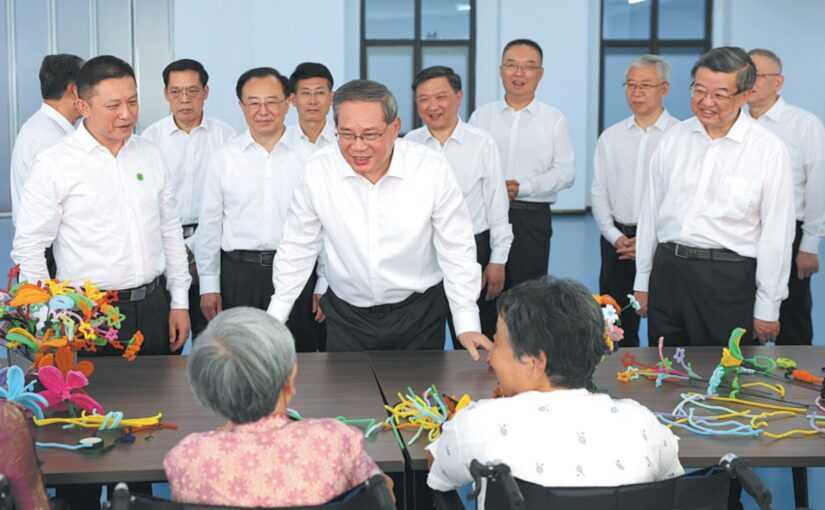
Touring a rehabilitation centre for quake survivors he called for improving medical rehabilitation and daily care services as well as strengthening the application of technological innovation in rehabilitation to constantly enhance the services for the disabled.
In a feature article for China Daily, Zheng Jinran writes movingly about the care needs of survivors half a century on:
“Born in an emergency medical team’s field tent just two hours after the devastating 1976 Tangshan earthquake struck, Yang Zhensheng’s destiny was bound to the tragedy. His parents named him Zhensheng, which literally means ‘born after the earthquake’, and in 2001, he started working at the Tangshan Paraplegic Rehabilitation Centre.
“For a quarter of a century, Yang has witnessed the courage and determination that have enabled the survivors to endure.
“‘When the rehabilitation centre first opened, many residents had lost not only the use of their legs, but also the courage to live,’ said Yang, who is now the centre’s director. ‘We soon realised that treating injuries alone was not enough. Before helping them recover physically, we had to help them regain the confidence to live.’”
Gao Qingfeng, 69, is among the more than 130 paraplegic survivors of the Tangshan earthquake who still live at the centre.
After being pulled from the rubble and sent to Beijing for treatment as a 19-year-old, he was told by the doctors that there was a chance he might walk again. He had faith, and took his physiotherapy seriously, but never walked again.
“‘The hardest time was right after the earthquake,’ Gao recalled. ‘I didn’t even know what paraplegia was. I never imagined I would spend the rest of my life this way. When I moved into the rehabilitation centre in 1981 and saw so many people living the same life, I no longer felt I was facing it alone. We trained together, lived together and encouraged one another. Their companionship helped me gradually accept reality.’”
During a visit to the rehabilitation centre in July 2016, Xi Jinping encouraged its residents by saying: “If people in sound physical condition can live fulfilling lives, people with disabilities can do so as well.”
To take one example: “Li Dongmei remembers little about the day the earthquake struck. She was 13 when the disaster left her a paraplegic. Li also suffered a brain trauma injury and did not regain consciousness until more than a month later.
“In 1984, she learned about China’s first National Games for Persons with Disabilities. ‘It was as if I suddenly saw hope again,’ she recalled… Li trained for wheelchair racing by wearing gloves and wrapping black tape around the push rims of her racing wheelchair to improve her grip. Within days, both her hands were covered in blisters that later hardened into thick calluses. Three years later, she earned a place on Hebei’s team for the second National Games for Persons with Disabilities, launching a sporting career that spanned decades… Over the following decades, Li won dozens of medals in domestic and international competitions.”
Zhao Lili, a rehabilitation physician, said: “The biggest fear isn’t illness. It’s wondering who will be there when you need help.”
She has spent nearly three decades watching Tangshan’s paraplegic survivors grow older. “When I joined the centre in 1998, rehabilitation was about helping them return to society. Today, our focus is on managing the complications of long-term paraplegia and aging, so they can maintain the best possible quality of life.”
Centre director Yang said the institution represents a promise carried across generations. “From the day it was established, it has embodied the Party and government’s commitment to people affected by the disaster. The survival of 3,817 people left paraplegic by the earthquake — and their ability to go on living meaningful lives — was itself extraordinary. That achievement did not come from one medical breakthrough. It came from a commitment that no one would be left behind.”
Tang Yandong, dean of the School of Emergency Technology and Management at the Institute of Disaster Prevention and vice-chair of the Earthquake Emergency Rescue Committee under the China Association for Disaster Prevention, said Tangshan’s experience has broadened the understanding of what post-disaster recovery means.
“From the perspectives of sociology, psychology and emergency management, recovery is a long-term, systematic process that often lasts a lifetime,” he said. “The most valuable experience is not what happened immediately after the earthquake, but what happened over the following decades.”
He added that the experience has also helped shape China’s approach to post-disaster recovery by shifting the focus from rebuilding infrastructure to improving survivors’ long-term quality of life.
The following articles were originally published by China Daily.
Li hails rebuilding of quake-hit Tangshan
Premier conducts inspection tour on 50th anniversary of catastrophic event
July 29 (China Daily) – Premier Li Qiang commended on Tuesday the collective endeavor of the people of Tangshan to rebuild a modern city from the ruins of a devastating earthquake, saying that its transformation is a vivid example of the Party leading the public in overcoming great difficulties and challenges.
Li made the remarks during an inspection tour in Tangshan as the prefecture-level city in North China’s Hebei province marked the 50th anniversary of the catastrophic temblor.
On July 28, 1976, a magnitude 7.8 earthquake rocked Tangshan in the early hours, claiming more than 240,000 lives, injuring over 160,000 and leaving 3,817 survivors paralyzed as hundreds of buildings were razed to the ground.
On Tuesday, entrusted by Xi Jinping, general secretary of the Communist Party of China Central Committee, Li made a visit to Tangshan.
At the Tangshan Earthquake Ruins Memorial Park, he laid a wreath on behalf of the CPC Central Committee and the State Council, China’s Cabinet, to solemnly remember those who died in the earthquake and to pay respects to the heroes who sacrificed their lives during relief work.
Li, who described the disaster as unforgettable and the relief efforts as deeply moving and inspiring, said that on the city’s new journey, it is important to carry forward the spiritual strength sourced from battling a disaster and rebuilding lives.
The premier underlined the need to seize the opportunities of coordinated development in the Beijing-Tianjin-Hebei region, deepen reform and opening-up, adhere to innovation-driven development, and take solid steps to promote economic development and people’s well-being to build the heroic city even better.
After years of reconstruction efforts, Tangshan saw its GDP reach more than 1 trillion yuan ($148 billion) in 2025, ranking first among all cities in Hebei.
As its economic mainstay is heavy industries, Tangshan has been working to upgrade its manufacturing sector, moving it up the value chain in recent years. Efforts have been made to develop emerging industries, including robotics, high-end equipment and environmentally friendly building materials.
During the inspection tour, Li called for continuously improving mechanisms for disaster monitoring and early warning, emergency response, rescue and relief, and post-disaster reconstruction, enhancing disaster prevention, mitigation and relief capabilities, and effectively safeguarding the lives and property of the people.
At a rescue operation base, the premier learned about the facility’s various emergency response equipment and its development plans, and he spoke with rescue personnel. He noted that disaster prevention, mitigation and relief work are related to the safety of the people and to national security.
Li emphasized the need to carry out regular training and joint exercises to comprehensively enhance professional capabilities in emergency response and execute scientific and efficient rescue operations.
He called for strengthening support for emergency response equipment and using technology to enhance the precision and safety of rescue operations. He also called for vigorously carrying out science promotion to enhance the awareness and ability of the public to escape danger when a disaster strikes.
As the country is facing the critical annual period of heavy rainfall and flooding, Li said that efforts should be made to strengthen disaster monitoring and early-warning systems and stockpile sufficient relief materials and emergency response equipment, in order to respond promptly and scientifically to disasters.
On Tuesday, Li also toured a rehabilitation center for quake survivors in Tangshan. He learned about the facility’s development initiatives and interacted with patients left paraplegic by the earthquake.
He called for improving medical rehabilitation and daily care services as well as strengthening the application of technological innovation in rehabilitation to constantly enhance the services for the disabled.
Courage, dignity heal scars of Tangshan quake
50 years after disaster, carers and survivors stand strong to confront emerging challenges
July 28 (China Daily) – Born in an emergency medical team’s field tent just two hours after the devastating 1976 Tangshan earthquake struck, Yang Zhensheng’s destiny was bound to the tragedy.
His parents named him Zhensheng, which literally means “born after the earthquake”, and in 2001, he started working at the Tangshan Paraplegic Rehabilitation Center.
For a quarter of a century, Yang has witnessed the courage and determination that have enabled the survivors to endure.
“When the rehabilitation center first opened, many residents had lost not only the use of their legs, but also the courage to live,” said Yang, who is now the center’s director.
“We soon realized that treating injuries alone was not enough,” he said. “Before helping them recover physically, we had to help them regain the confidence to live.”
The 7.8-magnitude earthquake that struck Tangshan, an industrial city in North China’s Hebei province, on July 28 at 3:42 am, claimed more than 240,000 lives, injured over 160,000 people and left 3,817 survivors paralyzed.
As the survivors grow older, many are confronted with the combined challenges of disability and aging, posing a new test for the support system.
Gao Qingfeng, 69, is among the more than 130 paraplegic survivors of the Tangshan earthquake who still live at the rehabilitation center.
After being pulled from the rubble and sent to Beijing for treatment as a 19-year-old, he was told by the doctors that there was a chance he might walk again. He had faith, and took his physiotherapy seriously, but never walked again.
“The hardest time was right after the earthquake,” Gao recalled. “I didn’t even know what paraplegia was. I never imagined I would spend the rest of my life this way.”
However, what eventually changed him was not a medical breakthrough.
“When I moved into the rehabilitation center in 1981 and saw so many people living the same life, I no longer felt I was facing it alone,” he said. “We trained together, lived together and encouraged one another. Their companionship helped me gradually accept reality.”
Sitting on his electric mobility tricycle during an afternoon rehabilitation session recently, he practiced shoulder and hand exercises alongside fellow residents under the guidance of therapists. It’s a routine that has become part of his daily life in recent years.
During a visit to the rehabilitation center in July 2016, President Xi Jinping encouraged its residents by saying: “If people in sound physical condition can live fulfilling lives, people with disabilities can do so as well.”
Authorities established a network of 18 specialized rehabilitation centers for paraplegic survivors across Tangshan. The Tangshan Paraplegic Rehabilitation Center, the largest one, has become the cornerstone of a long-term care system that has supported survivors for half a century.
Over the decades, Gao has learned to play the zhongruan, a lute-like traditional Chinese instrument, and joined the center’s band, which once performed in Beijing alongside professional musicians. Today, music, Chinese chess, cards and reading the news fill much of his day. “Life goes on,” Gao said quietly.
Beneath the shade of a tree inside the center, 77-year-old Yu Zhong sits chatting with three longtime companions.
Smiling, he said he had never imagined he would live for half a century. He has also learned to play the zhongruan.
His son visits every week, and both his son and grandson have served in the military — something he speaks of with quiet pride.
New person emerges
Li Dongmei remembers little about the day the earthquake struck.
She was 13 when the disaster left her a paraplegic. Li also suffered a brain trauma injury and did not regain consciousness until more than a month later.
In 1984, she learned about China’s first National Games for Persons with Disabilities. “It was as if I suddenly saw hope again,” she recalled.
She wrote down an aphorism that has stayed with her ever since: “If the earthquake reshaped me into another person, then I will stand in this world again as that new person.”
Li trained for wheelchair racing by wearing gloves and wrapping black tape around the push rims of her racing wheelchair to improve her grip. Within days, both her hands were covered in blisters that later hardened into thick calluses.
Three years later, she earned a place on Hebei’s team for the second National Games for Persons with Disabilities, launching a sporting career that spanned decades. “It was hard,” she recalled. “But it was worth it for my dream.”
Over the following decades, Li won dozens of medals in domestic and international competitions. More importantly, she said, the rehabilitation center gave her a new direction in life. “It was the place where my dream took root,” she said.
Li said President Xi’s encouragement during his visit to the center inspired her to keep striving. Two years later, at 55, she returned to competition and won three gold medals at the Hebei Provincial Games for Persons with Disabilities.
Now retired from competition, she spends much of her time learning sign language and Tangshan shadow carving, and helps promote local intangible cultural heritage.
“I may no longer compete,” she said. “But I can still live my life in another way.”
Growing old together
For some paraplegic survivors, rebuilding their lives meant family and companionship.
In 1991, Tangshan Rehabilitation Village was established as a barrier-free community for people with paraplegia. That same year, 10 couples held a collective wedding there. Among them were Zheng Weiqin and Yang Zhixi.
“We’re just like anyone else,” Zheng said. “We cook our own meals and take care of ourselves.”
The duo divides the household chores much like any other couple. Yang rides his electric scooter to buy groceries and run errands, while Zheng cooks, cleans and tends the jasmine plants that have grown in their home for nearly two decades.
But as both have entered their 70s, their biggest challenge is no longer paraplegia, but aging.
In recent years, Yang developed breathing problems and was later diagnosed with diabetes. Zheng began adjusting his meals, learning how to manage his diet and reminding him to take better care of himself. “I used to tell him,” she said with a laugh. “Now he finally listens.”
For many of these paraplegic survivors, growing old has brought a new reality. Alongside lifelong disabilities come diabetes, hypertension, respiratory illnesses and other chronic conditions that require long-term care.
Yet, leaving the rehabilitation center doesn’t mean leaving its support behind.
On the morning of our visit, a team of doctors and nurses from the center came to Yang’s home, accompanied him for a chest CT scan, then brought him home again. After reviewing the results, they later delivered his medication.
Zhao Lili, a rehabilitation physician, said many older residents delay seeking treatment because they do not want to burden others, or they have no family members able to accompany them. Even a routine examination may require several people to help transfer a wheelchair user onto an examination table.
“The biggest fear isn’t illness,” Zhao said. “It’s wondering who will be there when you need help.”
She has spent nearly three decades watching Tangshan’s paraplegic survivors grow older.
“When I joined the center in 1998, rehabilitation was about helping them return to society,” she said.
“Today, our focus is on managing the complications of long-term paraplegia and aging, so they can maintain the best possible quality of life.”
Those complications now include osteoporosis, shoulder injuries, urinary tract infections, pressure sores and declining cardiopulmonary function.
To address those changing needs, the center has introduced new rehabilitation equipment, including standing wheelchairs to slow physical decline and prevent complications.
“When they are able to stand again, even with the help of the device, you can see the change in their mood,” Zhao said.
Protecting upper-body function is a priority.
After decades of relying on their arms for wheelchair mobility and daily transfers, many residents develop shoulder injuries and chronic pain, making it increasingly difficult to maintain their independence, she said.
Emotional well-being
As survivors have grown older, Zhao said, the challenge has become more than just medical.
“Many never married or had children. Others have watched their parents pass away and their siblings grow old, leaving fewer people able to care for them,” she said.
As a result, questions that rarely arose decades ago have become increasingly common: Who will accompany them to hospital? Who will help transfer them onto an examination table? Who will look after them when they can no longer live independently?
For those requiring full-time care, the rehabilitation center provides dedicated nursing. Residents still living in Tangshan Rehabilitation Village receive additional support through home visits, long-term care insurance and continued assistance from the center.
Wang Yuanzhi said the rehabilitation center changed her understanding of what nursing meant.
Born the year after the earthquake, Wang grew up in a family marked by its scars. Her mother was seriously injured, and her older sisters did not survive. As a nursing student, she chose the center as her first job after graduating in 1996.
“I thought nursing was mainly about medical care,” she said.
“But after I came here, I realized our job goes far beyond treatment. We care for their daily lives and, more importantly, their emotional well-being.”
Many residents have become more like family than patients.
“They’ll stop by after breakfast and ask, ‘Do you want anything from the market?'” she said with a smile.
Nurse Liu Liyan said offering companionship has become an essential part of her work.
Every July, many survivors quietly remember the family members they lost in the earthquake. Listening, accompanying them and simply being there, she said, are just as important as medical care.
Promise kept
Yang, director of the center, said the institution represents a promise carried across generations.
“From the day it was established, it has embodied the Party and government’s commitment to people affected by the disaster,” he said.
“The survival of 3,817 people left paraplegic by the earthquake — and their ability to go on living meaningful lives — was itself extraordinary. That achievement did not come from one medical breakthrough. It came from a commitment that no one would be left behind.”
The center sends medical staff to leading hospitals for advanced training every year, while specialist teams are invited to improve treatment for age-related complications, he added.
Tang Yandong, dean of the School of Emergency Technology and Management at the Institute of Disaster Prevention and vice-chair of the Earthquake Emergency Rescue Committee under the China Association for Disaster Prevention, said Tangshan’s experience has broadened the understanding of what post-disaster recovery means.
“From the perspectives of sociology, psychology and emergency management, recovery is a long-term, systematic process that often lasts a lifetime,” he said. “The most valuable experience is not what happened immediately after the earthquake, but what happened over the following decades.”
Tangshan demonstrates the importance of sustained institutional support as survivors confront not only physical disabilities, but also the psychological, family and caregiving challenges that emerge with age, Tang said.
He said the experience has also helped shape China’s approach to post-disaster recovery by shifting the focus from rebuilding infrastructure to improving survivors’ long-term quality of life.
Having participated in a long-term study tracking the lives of Tangshan’s paraplegic survivors and exchanging experience with rehabilitation specialists involved in the 2008 Wenchuan earthquake in Sichuan province, Zhao believes Tangshan’s greatest contribution extends beyond early rehabilitation.
“The most valuable lesson from Tangshan is not the rehabilitation techniques developed in the years after the quake,” she said. “It is understanding the physical, psychological, family and caregiving challenges that emerge decades later as survivors grow old.”
She hopes the public will continue to see not only the resilience of Tangshan’s survivors, but also the new challenges they face in old age.