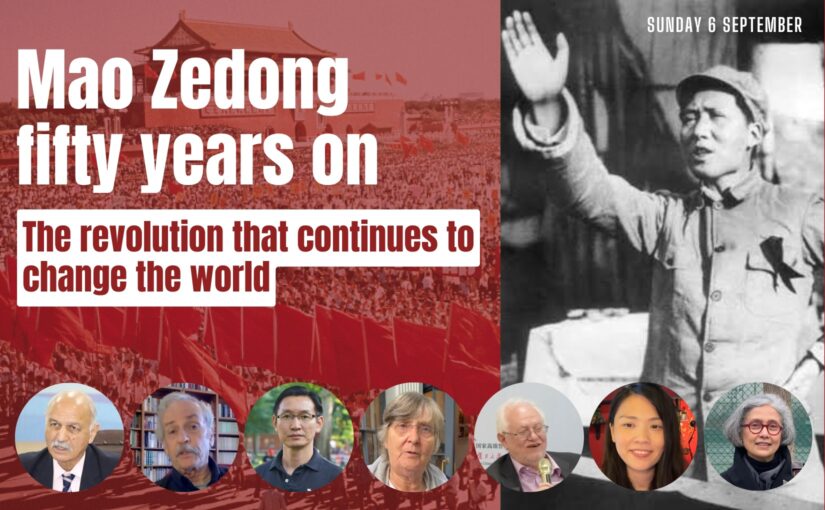
📆 Sunday 6 September 2026, 3pm Britain, 10am US Eastern, 10pm China
Fifty years after his death, Mao Zedong’s portrait still looks out over Tiananmen Square, his face is on every Chinese banknote, and Mao Zedong Thought remains written into both the country’s constitution as well as that of the world’s largest communist party. Ordinary Chinese people travel in their millions every year to Shaoshan, the village in Hunan where he was born.
This webinar asks why Mao is still revered in China, and what were the achievements of China and the Communist Party of China (CPC) under his leadership.
In 1949 China was among the poorest countries on earth: life expectancy of around 35 years, adult literacy below 20 percent, a population stagnant at four to five hundred million for a century, and a hundred years of treaty ports, extraterritoriality and foreign concessions. By 1976 life expectancy had reached around 67 – a gain of more than three decades in less than three decades, the fastest improvement ever recorded by any country in human history. Illiteracy had fallen to a third. Land was redistributed, famine ended, women emancipated, the country unified, and a complete industrial base built from a near-zero baseline.
That is the China the reform era inherited – not the backwater of Western myth. As Samir Amin put it, the take-off after 1978 “would not have been possible without the economic, political and social foundations that had been built up in the preceding period”. It is also how the CPC understands its own history, in Xi Jinping’s formulation that the post-1978 reform era cannot be used to invalidate the Mao era, nor can the Mao era be used to invalidate the reform era.
Mao’s China changed the world beyond its borders too – inspiring millions and standing with Vietnam, with Korea, with the liberation movements of Africa and with Palestine.
Join us to discuss what Mao achieved, how China’s present successes rest on those foundations, why he is still revered in China, and how the socialist project has held its course after his death, through half a century of twists and turns.
This webinar is organised by Friends of Socialist China and the International Manifesto Group.
Confirmed speakers
- Senator Mushahid Hussain (Chairman, Pakistan-China Institute)
- Ken Hammond (Professor of History, New Mexico State University)
- Keith Bennett (Co-editor, Friends of Socialist China)
- Jenny Clegg (Author and peace campaigner)
- Tings Chak (Asia coordinator, Tricontinental Institute)
- Ding Xiaoqin (Chinese Academy of Social Sciences)
- Moderator: Radhika Desai (Convenor, International Manifesto Group)






Also, there is still the issue of the reunification of China. The rogue, separatist authorities in Taiwan are trying to block the reunification of my motherland.