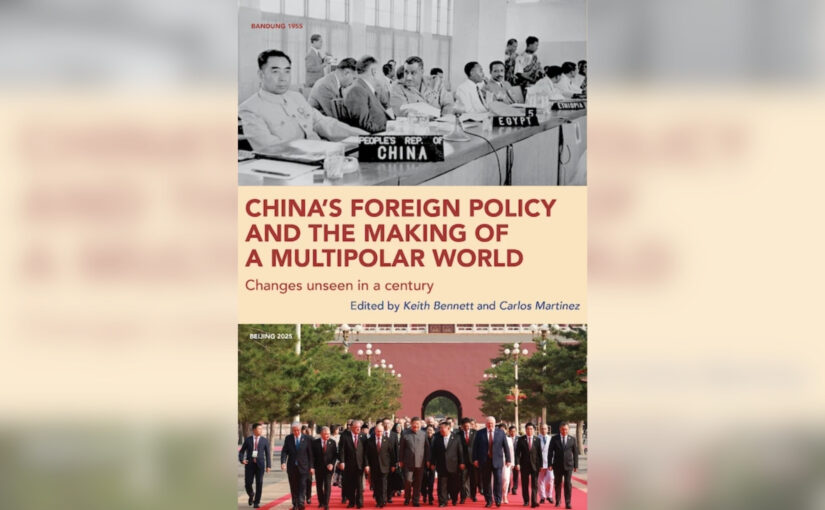
In the following review of China’s Foreign Policy and the Making of a Multipolar World, Dirk Nimmegeers describes the collection as an “intriguing, enjoyable read, aimed at a diverse readership”. The review gives an overview of each of the ten chapters – from the historical and theoretical framing provided by the editors, through contributions by Ken Hammond, Andrew Murray, Jenny Clegg, Danny Haiphong, Cheng Enfu, Torkil Lauesen and Michael Dunford, to Carlos Martinez’s closing chapter on the Four Global Initiatives.
This review first appeared, in Dutch, on Chinasquare.be, and has been machine translated.
Note: there will be an online book launch for the book – hosted by Friends of Socialist China together with the International Manifesto Group, Praxis Press, Manifesto Press and the Critical Theory Workshop – on Sunday 20 September at 4pm Britain (5pm Western Europe, 11am US Eastern), at which seven of the book’s contributors will speak.
At present, ‘the world is undergoing changes the likes of which have not been seen for a century’. This is a well-known statement by the Chinese leader Xi Jinping. According to Keith Bennett and Carlos Martinez, it is becoming clearer every day that Xi is right. They point, to name but a few signs, to the course of the war against Iran, or the rise of the Shanghai Cooperation Organisation. Furthermore, the editors of Friends of Socialist China note that China has adapted its foreign policy to this reality, shifting from a low profile approach to a more assertive and proactive strategy. When they asked seven other eminent specialists for their analysis of China’s foreign policy, the editors therefore decided to give the collection a subtitle that echoes Xi’s vision. China’s Foreign Policy and the Making of a Multipolar World: Changes unseen in a century was published by Praxis Press at the end of August.
The book contains analyses of what China represents in geopolitical terms today. The authors are well-established and experienced academics and journalists. They provide answers to questions on this subject, which is of the utmost importance for the future of the world – questions that preoccupy many readers, particularly those on the progressive and left-wing spectrum. What is the historical background to Chinese foreign policy, and how will it evolve? On what principles and theories is it based? How does practice relate to propaganda? Is China a new imperialist power? Is its international policy ‘good enough’ for a country that calls itself socialist? And what does China’s rise mean for the Global South, for the prospects of peace and for the long-term struggle to establish a more just world order?
The editors of the anthology point out that, across ten chapters, ‘these questions are answered from different perspectives, but starting from the same premise’, and that is indeed the case. According to all the authors who contributed to the book, China’s rise in no way poses a threat to humanity. On the contrary, this rise offers the greatest ‘hope for a peaceful, multipolar and ultimately socialist future’. There is, therefore, unity in the central theme, but it is expressed in a multifaceted way, with a wide variety of emphases and styles.
This variety makes the collection of essays intriguing, an enjoyable read and aimed at a diverse readership. Bennett and Martinez themselves place the evolution of China’s foreign policy within a broad historical and theoretical context. The initial impetus for China’s anti-imperialist and socialist ‘Long March’ was the October Revolution of 1917. The Second World War was followed by the (unfinished) decolonisation of the Global South. Legendary politicians from China, India and other newly independent states adopt the Five Principles of Peaceful Coexistence, elaborated by China’s Zhou Enlai. Some of these countries went on to found the Non-Aligned Movement. China maintained close diplomatic ties with the movement. It did not become a full member, but opted for observer status. Today, the need for a front against imperialism flows like a mighty river into a delta of multipolarity.
Historian Ken Hammond focuses his research on the period from 1949 to 2025 and the lessons that the government of the People’s Republic of China has drawn from it. Well-known left-wing journalist Andrew Murray unequivocally attributes responsibility for conflicts and wars to global capitalism, led by the United States. In his view, there is no rivalry between two great powers, China and the US. The Left must side with the resistance, with China and other Third World countries. Carlos Martinez expands on this, basing his anti-imperialist analysis on classics such as Lenin and Bukharin, as well as on contemporary Marxists.
Dr Jenny Clegg has China skilfully being guided along the great river of history, with its rapids and fluctuations in water level. The Five Principles of Peaceful Co-existence serve as both a compass and a system of locks. Online content creator Danny Haiphong dismantles the arguments of left-wing friends who believe that China is not doing enough to help other developing countries. His questions to the critics: ‘Are you yourselves doing enough, and do you see clearly enough who exactly the enemy is?’ Professor Cheng Enfu (Chinese Academy of Social Sciences) describes how China’s peaceful rise in science and technology, the economy, politics, culture and ecology offers new possibilities and ways forward for the lives of ordinary people. There is ‘indeed an alternative’ to neoliberalism. According to Torkil Lauesen, a communist writer, the Chinese system fits into the development of the historical struggle for socialism, which can only be resolved at a global level. The main theme (here) of economic geographer Michael Dunford, on the other hand, is the centuries-old civilisation of East and South-East Asia as one of the foundations of Chinese policy. This philosophical tradition, together with Marxism and the Five Principles, is an essential component of Xi Jinping’s vision of a ‘global community with a shared future for mankind’, he argues.
In the final chapter, Carlos Martinez sets out the blueprint for the shared future that China can offer the world. With his explanation of the Four Global Initiatives (development, security, civilisation, governance), Martinez provides a preview of how this whole story will unfold. A second book, edited by Bennett & Martinez, will focus on the specific projects and measures that China is proposing to resolve the major challenges facing the world’s population.
Just before the book was published, a foreword was added by the activist and economist João Pedro Stédile, one of the founders of the Landless Rural Workers’ Movement (Portuguese: Movimento dos Trabalhadores Rurais Sem Terra, abbreviated to MST). Quite rightly, many prominent writers (Ramzy Baroud, Martin Jacques, Peter Nolan, Zhang Weiwei, Radhika Desai, Ben Norton, Ben Chacko, John Foster, Chen Weihua and many others) praise this book for its persuasiveness and well-founded analyses. The following point often recurs in their comments. ‘This is a book that goes against the grain, one that invites debate, but which will certainly provide you with much-needed and unique insights’.
China’s Foreign Policy and the Making of a Multipolar World: Changes unseen in a century. Published by Praxis Press, 172 pp. ISBN-13: 978-1899155224. ISBN-10: 1899155228. Available to order from the publisher Praxis Press, in bookshops or online. Also available as an e-book.






Thank you for this and looking forward to an inspiring read. Chinese socialist governance, industry and political leadership is by contrast a centralised and thereby more disciplined state apparatus than it’s American counterpart. Moreover, by virtue of it being relatively more stable and secure than most if not all Western liberal democracies, Chinese governance is also more capable of steering macro-goals necessary for planetary-scale challenges such as the formation and management of BRICS and the control and adaptation of AI. China’s relatively authoritarian centralised form of governance is nevertheless able to simultaneously coexist with vibrant, decentralised competition across the wide range of China’s provinces and industries. Chinese statecraft is in effect demonstrating to BRICS and the so called ‘Global South’ how it is able to function much like a living organism ie; structured by a central nervous system, yet driven by localised, adaptive cellular activity.