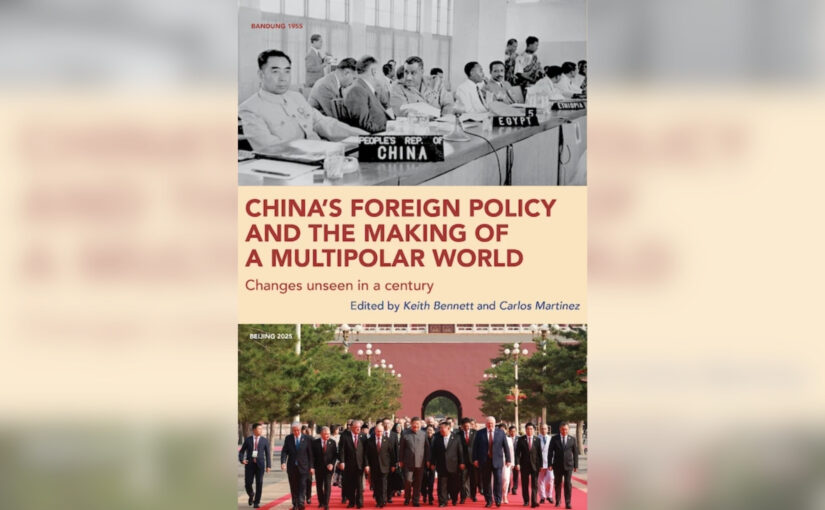
On 20 September, Friends of Socialist China and the International Manifesto Group, together with Praxis Press, Manifesto Press and the Critical Theory Workshop, held an online launch for the newly-released China’s Foreign Policy and the Making of a Multipolar World: Changes Unseen in a Century. Edited by Keith Bennett and Carlos Martinez, the book brings together nine essays on the history, theory and practice of China’s foreign relations. Chaired by Carlos, the launch heard from contributors Andrew Murray, Danny Haiphong, Mick Dunford, Jenny Clegg, Torkil Lauesen, Ken Hammond and Keith.
The full video of the event is embedded below, and each contribution is also available as a separate video, linked in the text that follows.
A case study in Iran
Carlos opened the launch by explaining why the book was put together. The US-Israeli war on Iran, he argued, is not only an attack on a country Washington and Tel Aviv happen to dislike, but part of a desperate campaign to arrest the whole process of multipolarity. It has failed: Iran’s sovereignty is intact and its strategic relationship with both China and Russia has deepened.
China’s conduct in the war, Carlos suggested, provides a case study for the book’s key arguments. Beijing condemned the aggression from the outset, continued buying the bulk of Iran’s oil in defiance of US sanctions, vetoed Security Council resolutions designed to legitimise the war, and worked persistently with regional countries – most notably Pakistan – towards a ceasefire and negotiated solution. That combination of material solidarity and an unwavering insistence on peace and the UN Charter is what the book sets out to explain: a foreign policy that is “neither the menacing expansionism imagined by the China hawks, nor the timid inadequacy lamented by parts of the Western left”.
Not a Cold War re-run
Andrew Murray, political correspondent of the Morning Star, argued that China’s rise cannot be understood without its corollary, the decay of the United States. After all, the wars in Afghanistan and Iraq, and the financial crash of 2008, had little to do with China. Only now, with US decline and China’s growing weight combined, has the contradiction between imperialism and a Global South in which China plays a leading part clearly become the main contradiction in world politics.
This is not a simple re-run of the Cold War. The Soviet Union faced a far more powerful array of forces, and the mass national liberation and labour movements of that era do not exist in the same form today. Washington has moved from hoping for the incremental restoration of capitalism in China towards military and strategic encirclement, of which AUKUS is but one symptom.
On the charge that China is imperialist, Andrew commended Carlos’s polemic with Greg Godels and offered the historian Victor Kiernan’s definition of imperialism as “coercion exerted abroad, by one means or another, to extort profits above what simple commercial exchange can procure”. That coercive element, he said, is “something which is entirely absent from China’s conduct of international affairs and business”.
The wrong question
Danny Haiphong, political analyst and broadcaster, took up the question that his chapter deals with: is China’s foreign policy good enough? Why doesn’t China use its power to come to the aid of Palestine, Yemen and Iran more directly? That, he argued, is the wrong question.
Neither Ansar Allah, nor the various Palestinian resistance factions, nor Iran’s leadership ask China for military intervention. They do however let Chinese shipping through the Hormuz and Bab al-Mandeb straits, because they regard China as a friend. The demand for direct Chinese involvement comes instead from elements of the Western left, which Danny called understandable but hubristic, given the limited achievements of revolutionary and anti-imperialist movements in the Global North. The more useful question is what we are doing to restrain our own governments.
Carlos added that the US retains more than 800 overseas bases and a per capita military budget 20 times higher than China’s. Iran could damage the US infrastructure of power projection in the Gulf because it existed; China has never had an equivalent.
Chinese and Western values
Mick Dunford, Emeritus Professor at the University of Sussex, traced the difference between Chinese and Western visions of international relations to its philosophical roots. Aristotle’s theory of natural slavery posited the ontological superiority of Greeks, and his distinction between form and matter lent itself to the coercive imposition of an ideal form on others: colonialism, colour revolutions, “our values”. Liberalism advanced hand in hand with empire; John Stuart Mill wrote that if the Chinese were ever to be improved, “it must be by foreigners”.
Chinese thought, by contrast, rests on relationality, symbiosis and harmony, in which no group is ontologically superior. Against Antony Blinken’s claim that without US leadership “you get chaos”, Mick pointed out that East and Southeast Asia were largely at peace for 300 years up to 1894, while the West was at war somewhere almost continuously from 1492. China’s idea of multipolarity, he said, is one of “193 poles” (a reference to the 193 full United Nations member states).
China wants what it says it wants
Jenny Clegg, author of Storming the Heavens, answered the question Western commentators keep asking. “China wants what it says it wants, what it has wanted for more than 100 years”: the chance to improve the lives of its people, which requires an end to external threats, a peaceful environment and a final resolution of the civil war that divided Taiwan from the mainland.
The Five Principles of Peaceful Coexistence, she argued, are not iron laws; the iron laws are the real contradictions of world history, and the Five Principles guide practice according to the way that the balance of forces shifts. Mao appeared to abandon peaceful coexistence after the mid-1950s not because China changed its ideological orientation, but because the US went on the offensive against national liberation, and coexistence is necessarily mutual.
As for the charge that China’s proposals are vague, Jenny suggested they work in a manner akin to demonstration slogans, setting a direction for a movement rather than imposing a plan. International democracy means states negotiating their own solutions.
Bending like bamboo
Torkil Lauesen applied Mao’s concept of the principal contradiction to the world system as a whole. The 1937 united front with the Kuomintang tied down Japanese forces that might otherwise have attacked the Soviet Union, and so helped decide the outcome of the Second World War. The revolutionary upsurge of the 1960s had the will but not the productive forces to break the capitalist world market. Hence the rapprochement with the US in the early 1970s, and China’s “kung fu strategy” of absorbing the neoliberal thrust, bending like a bamboo branch without breaking the Party’s power. The result was the lifting of a 200-year curse of polarised development. China is now itself one aspect of the principal contradiction in the world, and its foreign policy no longer simply reacts to the world system but is able to set the agenda for its future.
Sovereignty, territorial integrity, respect
Ken Hammond, Professor Emeritus at New Mexico State University, identified what China lost in the century of humiliation: its sovereignty, its territorial integrity and its respect in the eyes of the world. These became the underpinnings of the Five Principles and the thread of continuity through three phases of modern China’s foreign policy: actively supporting revolution (1949–78), “hide our strength, bide our time” (1978–2012), and a more confident stage since the election of Xi Jinping as General Secretary.
Ken addressed some of the contradictions of the middle phase, but situated them within the wider context of China’s long-term strategy, which was to develop the productive forces and the socialist core of the country while avoiding antagonising the sources of the capital and technology it needed.
The shift towards a more assertive foreign policy after 2012, Ken argued, was at least in part related to a geostrategic shift in Washington, summed up in the 2011 Pivot to Asia.
Gaza changes everything
Keith Bennett closed by explaining why the book exists at all. Bookshops are full of Jung Chang, Gordon Chang and Frank Dikötter; the press offers “entertaining fiction suggesting, for example, that China is bugging tractors”. As Mao observed, to make a revolution it is necessary first to create public opinion, and the same goes for counter-revolution. That battle for public opinion is why Friends of Socialist China was founded in May 2021, and why the book was written.
Anti-China leftism, Keith argued, reflects the tenacious influence of imperialist ideas, above all where it is hard to accept that the cutting edge of human liberation lies not in the working class of the Global North but to its East and South. And something has shifted. Gaza is the first genocide livestreamed on people’s phones. “A few years ago, refuting the wholly invented tale of a supposed genocide in Xinjiang could seem like an uphill struggle. Today, the difference between an actual and a fictional genocide is there for all with eyes to see.”
It is above all that new generation, coming to anti-imperialist politics through Gaza, that the book is written for.
China’s Foreign Policy and the Making of a Multipolar World is published by Praxis Press and available from socialistbooks.com. The discount code CHINA35 gives 35 percent off all Praxis titles until the end of the year.






One thought on “Launching “China’s Foreign Policy and the Making of a Multipolar World””