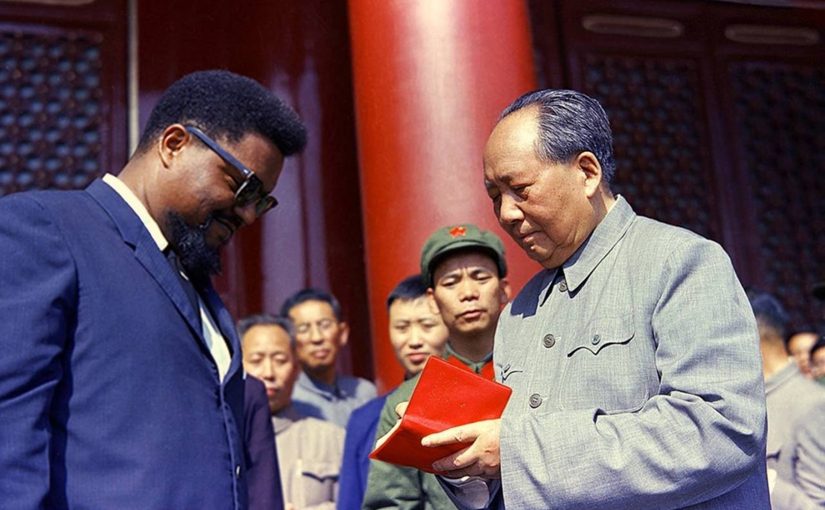
The following article by our co-editor Carlos Martinez explores the long history of the relationship between People’s China and the struggle for black liberation – from WEB Du Bois, Robert F Williams, Claudia Jones and the Black Panthers, through China’s support for African liberation movements and the building of the TAZARA railway, to today’s development partnerships with Africa and the Global South. It argues that the New Cold War on China is also a war on the project of black liberation.
The article is based on a presentation given by Carlos at the Black Liberation Alliance day school in London on 14 November 2026, in a session entitled “Black Liberation: Defending 21st-Century Socialism and Pan-Africanism”.
What is black liberation, and what has China got to do with it?
Black liberation can be understood in two senses, closely connected. In the narrower sense, it is the struggle in the West for equal rights, dignity and justice – against racism and white supremacy, in the courts, on the streets, in academia, in culture. In the broader sense, it is about the global struggle against imperialism, of which white supremacy has always been a core ideological pillar, providing justification for five centuries of slavery, colonialism and plunder.
People’s China has engaged with black liberation in both senses, in different ways and in different periods.
“No more Toms in China”
The high-water mark of the relationship between China and the black freedom struggle in the West came between the late 1950s and the early 1970s. For a generation of black radicals, the Chinese Revolution showed that a people written off as backward and servile could stand up, throw out the colonial powers and their local collaborators, and build a new society on their own terms.
Malcolm X put it with characteristic forcefulness in his 1963 “Message to the Grassroots”: “The Chinese Revolution – they wanted land. They threw the British out, along with the Uncle Tom Chinese… No more Toms in China. And today it’s one of the toughest, roughest, most feared countries on this earth – by the white man. Because there are no Uncle Toms over there.”
WEB Du Bois, the Pan-African communist and giant of black scholarship in the US, spent his 91st birthday in Beijing in February 1959, having finally won back the passport the US government had confiscated from him in the McCarthy years. He met Mao Zedong and Zhou Enlai, and travelled for eight weeks across the country. “I have never seen a nation which so amazed me and touched me as China in 1959,” he wrote.1
He was clear about why Washington was so frightened of the new China: “White America fears that the example of the Soviet Union and China may tempt the Negroes of America to see the salvation in socialism rather than in the free enterprise of capitalism.” Addressing students at Peking University, he gave the peoples of Africa some advice: “Turn from the West and your slavery and humiliation for the last 500 years and face the rising sun.” His widow, Shirley Graham Du Bois, later made her home in China, and died in Beijing in 1977.
Claudia Jones – the Trinidadian-born communist who was jailed and then deported from the US during the heyday of McCarthyite repression, and who went on to found the West Indian Gazette and the Notting Hill Carnival in London – made her last major journey to China in 1964, meeting Mao and interviewing Soong Ching-ling for the Gazette.2 She died later that year. There is a direct line from that history to the Black Liberation Alliance’s work today.
Robert F. Williams, the North Carolina civil rights leader hounded out of the US by the Ku Klux Klan and the FBI, was exiled first to Cuba and then China. It was at his prompting that Chairman Mao issued his statement of August 1963 calling on the people of the world to support African Americans in their struggle against racial discrimination. The statement contains a profound observation:
In the final analysis, a national struggle is a question of class struggle… At present, it is the handful of imperialists headed by the United States, and their supporters, the reactionaries in different countries, who are carrying out oppression, aggression and intimidation against the overwhelming majority of the nations and peoples of the world. They are the minority, and we are the majority.
Mao returned to this theme in April 1968, after the assassination of Martin Luther King, in a statement that connects the two senses of black liberation with extraordinary clarity:
The Afro-American struggle is not only a struggle waged by the exploited and oppressed Black people for freedom and emancipation, it is also a new clarion call to all the exploited and oppressed people of the United States to fight against the barbarous rule of the monopoly capitalist class… The struggle of the Black people in the United States for emancipation is a component part of the general struggle of all the people of the world against US imperialism, a component part of the contemporary world revolution.
When Huey P Newton led a Black Panther Party delegation to China in 1971 and met Zhou Enlai, he came back transformed. “To see a classless society in operation is unforgettable”, he wrote. And in his memoir Revolutionary Suicide:
What I experienced was the sensation of freedom – as if a great weight had been lifted from my soul and I was able to be myself, without defence or pretence or the need for explanation. I felt absolutely free for the first time in my life – completely free among my fellow men. This experience of freedom had a profound effect on me, because it confirmed my belief that an oppressed people can be liberated if their leaders persevere in raising their consciousness and in struggling relentlessly against the oppressor.3
Guns, doctors, railways
China’s engagement with the broader struggle against imperialism has been a constant feature of its foreign policy, the basic contours of which were moulded in the early years of the People’s Republic. The Five Principles of Peaceful Coexistence – mutual respect for sovereignty and territorial integrity, mutual non-aggression, non-interference in each other’s internal affairs, equality and mutual benefit, and peaceful coexistence – were first set out by Zhou Enlai in 1953–54, and were incorporated in the final communiqué of the Bandung Asian-African Conference of 1955, the founding moment of Afro-Asian solidarity.
China was an early and consistent supporter of Algeria’s war of liberation, and it was to newly independent Algeria that China sent its first medical team in 1963. Chinese doctors have worked across Africa ever since.
In southern Africa, too, the support was military as well as political. Nelson Mandela recalls in Long Walk to Freedom that he urged Walter Sisulu to visit China in 1953 in order to “discuss with the Chinese the possibility of supplying us with weapons for the armed struggle”.4 China went on to train cadres of uMkhonto we Sizwe and, later, the Pan Africanist Congress. ZANU’s guerrilla army, ZANLA, was trained and armed by China, as were fighters from Frelimo in Mozambique, SWAPO in Namibia, the PAIGC in Guinea-Bissau, the Eritrean liberation movement and the Sawaba party in Niger. Indeed, two of Africa’s current heads of state – Emmerson Mnangagwa of Zimbabwe and Isaias Afwerki of Eritrea – received military training in China in the 1960s.
The Tanzania-Zambia Railway, TAZARA, was built between 1970 and 1975 by a China that was itself still a very poor country, in order that landlocked Zambia could break its dependence on the routes through white-ruled Rhodesia and apartheid South Africa. It has been described as “the first infrastructure project conceived on a pan-African scale”. More than 50,000 Chinese workers took part in its construction, and 70 of them died in the process.
The solidarity flowed in both directions. In October 1971, when the UN General Assembly voted to restore the People’s Republic to China’s seat, African votes were decisive. Mao remarked that it was “our African brothers who got the People’s Republic of China back into the United Nations”.
From liberation struggle to development partnership
China’s relationship with Africa, and with the Global South more generally, has changed since the 1970s, and features a great deal less support for armed liberation struggles. That partly reflects changes in the world – the end of formal colonialism and apartheid, the end of the Cold War – and partly changes in China’s own strategy: a shift to a different phase of the same project. Having won political independence, the countries of the Global South face the twin tasks of winning economic independence and protecting their sovereignty.
Today, the relationship is more focused on trade, infrastructure and development cooperation. China has been Africa’s largest trading partner since 2009, with bilateral trade reaching a record $295.6 billion in 2024. All African countries but one (Eswatini [Swaziland]) have signed up to the Belt and Road Initiative.
What does development cooperation look like? It produces railways, power stations, hospitals, schools and ports. Around 40 percent of Chinese lending to Africa has gone into electricity generation and transmission, on a continent where hundreds of millions of people still lack reliable power.
Since 1 May this year, all 53 African countries with which China has diplomatic relations have enjoyed zero-tariff access to the Chinese market – something no other major economy has offered. When Zimbabwe decided to end the export of raw lithium, a Chinese company committed $400 million to a processing plant in the country, so that the value is added in Zimbabwe for the first time. China has committed over $16 billion in the last two years to mineral processing and refining projects in Africa.
Alongside commercial projects comes aid. China has built and handed over the African Union headquarters in Addis Ababa, the Africa CDC headquarters, Zimbabwe’s new parliament building, and hundreds of millions of Covid vaccine doses at a time when the rich countries were hoarding them.
It is equally important to note what the China-Africa relationship does not offer: no regime change, no coups, no assassinations, no loan conditionality, no demands for privatisation and austerity. In this, the contrast with the West is stark. Kwame Nkrumah, in Neo-Colonialism (1965), described a system in which “foreign capital is used for the exploitation rather than for the development of the less developed parts of the world”. Chinese investment in Africa is helping to build a path out of centuries of colonial-imposed underdevelopment.
These economic relationships sit alongside a growing political and diplomatic realignment. China is a key driver of BRICS, which now has ten full members, three of them African (South Africa, Egypt and Ethiopia); its members account for nearly half of humanity, and their combined economy is larger than the G7’s in purchasing-power terms. BRICS, the Shanghai Cooperation Organisation (SCO), the G77+China, the Forum on China-Africa Cooperation (FOCAC), the China-CELAC Forum, and other bodies are helping to build a multipolar world in which the nations of the Global South can assert their sovereignty and pursue their own development paths.
What has all this got to do with black liberation? China’s development partnerships enhance the sovereignty of the nations of the Global South, and start to break the colonial division of labour under which Africa, Latin America and much of Asia export raw materials and import finished goods – an arrangement that has kept them poor and dependent for centuries. Together, these changes point towards the end of the 500-year division of the world into oppressor and oppressed nations.
The New Cold War is a war on black liberation
Since its founding, the People’s Republic of China has been on the side of black liberation. That is one reason why today’s New Cold War on China is also a war on the project of black liberation – and why its ideological underpinnings draw so heavily on the old racist tropes of the “yellow peril” and the inscrutable, menacing Oriental. Defending 21st-century socialism means defending China, Cuba and all the socialist countries, and the right of every country of the Global South to choose its own path.
The last word goes to Mao, in 1968:
The evil system of colonialism and imperialism arose and throve with the enslavement of Negroes and the trade in Negroes, and it will surely come to its end with the complete emancipation of the Black people.
Notes
1. Robeson Taj Frazier, 2015, The East Is Black: Cold War China in the Black Radical Imagination. Duke University Press, p38
2. Liu Zifeng (2019), Decolonization Is Not a Dinner Party: Claudia Jones, China’s Nuclear Weapons, and Anti-Imperialist Solidarity, Journal of Intersectionality. 3. 21. 10.13169/jinte.3.1.0021.
3. Huey P Newton and J Herman Blake, 2009, Revolutionary Suicide, Penguin Books, p348
4. Nelson Mandela, 2004, Long Walk to Freedom: The Autobiography of Nelson Mandela, Abacus, p175