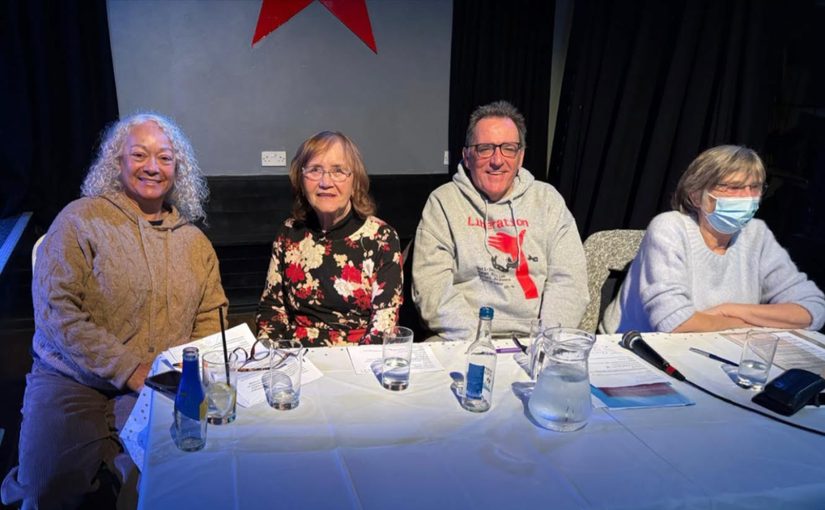
On Saturday November 14, more than 70 people packed the function room of Liverpool’s Casa Bar, a popular venue for working class and progressive events in the city founded by former dockworkers, for a meeting on the city’s Chinese seafarers’ long fight for justice, organised by the North West Trade Union International Committee. The event marked the donation of papers about the Liverpool Chinese Seamen’s Union collected at the time by Arthur Clegg, who was the national organiser of the China Campaign Committee, to the Maritime Museum Archives in Liverpool, by his daughter, the author and activist, Dr Jenny Clegg.
Tens of thousands of Chinese merchant seamen based in Liverpool during WW2 served an invaluable role during the entire Battle of the Atlantic at great risk to life. Once the war ended, many were secretly deported, and their families left behind in Liverpool have long campaigned for the truth as to what happened to their fathers and to demand an apology from the government.
The repatriation episode after the war cannot be detached from the seamen’s unequal treatment throughout it. To organise against the discrimination in pay and conditions, sometime around October 1941 a branch of the Chinese Seamen’s Union was organised in the city, and from February to April the following year there were a series of strikes with some violent confrontations with police which saw Chinese sailors jailed. The seafarers eventually won an equal war risk bonus but not equal pay.
Chairing the meeting, veteran trade union leader Kevan Nelson, on behalf of the organisers, described the deportations as a great injustice of the twentieth century, before introducing Jenny Clegg. (The full text of Jenny’s speech is printed below.)
Jenny’s speech was followed by one from Judy Kinnin, whose heartfelt words touched the audience. Her father had been one of those who went out to play mahjong for the evening and never came home. The government, she pointed out, still won’t say what happened to their fathers: “Those of us who are left just need to know.”
Annie Cogan Thomas then read a poem about the seafarers written by the late Ken Lo, who had served in China’s consulate in Liverpool during the war. Lo, who died in 1995, later went on to play tennis for China in the Davis Cup and to become a famed food writer and restaurateur.
Kim Johnson, Labour MP for Liverpool Riverside, spoke about how relevant papers had remained sealed in the National Archives in Kew for years. She first became aware of the issue from a BBC Radio 4 programme in 2004. More than 20 years have gone by and the families still don’t have answers.
This injustice had occurred under a Labour government and when Labour returned to office in 2024, she believed they would wish to address the issue. But it had proved to be a case of “treading treacle; one step forward – ten steps back”.
She compared the situation to that faced by the Windrush generation as well as migrant workers in the NHS and the care sector today – brought to the country to do a vital job but facing discrimination whilst working and possible deportation later.
Kim was followed by a video message from the writer, poet and broadcaster Anna Chen, the daughter of Sam Chen (Samuel Chinque; Chen Tiansheng), who served as the Honorary Secretary of the Chinese Seamen’s Union in Liverpool.
Anna compared the treatment of the seamen to that faced by the Chinese Labour Corps in World War I, another largely forgotten group who performed some of the most dangerous jobs in that conflict.
Sam, who was born in Jamaica, became a merchant seaman at the age of 18 and settled in Liverpool in the late 1920s, where much of his socialism was honed. Anna noted that her father passed away in 2004, sadly not living to see China’s historic victory over absolute poverty and the country becoming an undisputed technology superpower.
During the discussion period, Joseph Phillips Sze, whose father was among those deported and who attended along with his brother John, spoke of how, due to government secrecy, their mother died still thinking that she had been deserted and left to raise four children on her own.
Steve Todd, retired National Secretary for Shipping of the RMT transport workers union, spoke of working alongside Chinese seafarers and of the need to build international trade union solidarity around this issue.
This part of the meeting closed with a video of the legendary Paul Robeson singing Chee Lai (Arise) in Chinese and English. Written in 1934 and set to music the following year, it is now the Chinese national anthem.
In concluding remarks, Jenny Clegg said this embodied the theme of the meeting and the struggles of the Chinese people – one of standing up and fighting for your rights.
Apologies were received from Eddie Dempsey, General Secretary of the RMT.
Following a break the event was rounded off with a showing of The Secret Betrayal, a 2022 documentary on the issue produced by China’s CGTN television.
The meeting marked an important step forward in the campaign for justice for the Liverpool Chinese seamen and their descendants.
The full text of Jenny Clegg’s speech is printed below.
Speech by Jenny Clegg
The forced repatriation of the Chinese seamen after the end of WW2 is a deep stain of injustice in Liverpool’s history.
The fact that these men had actually played a vital role in the service of this country in the war only compounds the injustice.
The fact that they had been discriminated against in their very act of service cuts the wound even deeper.
Some 2,000 Chinese men, some married with children, were forcibly deported between 1945 and 1947 after a Home Office ruling that they were “undesirable elements”. This history has been brought to public attention thanks to the tireless campaigning of the families left behind.
My father, Arthur Clegg, was involved in supporting the Chinese seamen’s demands for equal treatment during the war and earlier this year I came over to deposit his wartime collection of papers about the Chinese Seamen’s Union in Liverpool and they are now in the Maritime Museum Archive. This meeting organised with the help of Kevan Nelson and the North West Trade Union International Committee and supported by Kim Johnson MP helps to draw attention to the collection.
There are three points I think worth making about this history:
First, it is important to understand that it is not a history of victimhood — the Chinese seamen stood up and fought for their rights.
As we know, Chinese seamen were a core part of the British merchant navy; numbers are hard to pin down since they were out at sea on ships, but there were probably around 10,000 rising to 20,000 with the formation of the Allied Merchant Marine pool in Liverpool in May 1941.
Stereotypes should be avoided – there were those from ordinary worker or peasant backgrounds; but there were skilled workers too – engineers, fitters, joiners. There were also the more educated who went to sea to see the world. The Chinese crewed on the dangerous Atlantic Run bringing vital food and munitions to support Britain’s war effort; they sailed on the Arctic convoys, they transported troops and supplies to the campaigns in North Africa and Asia and probably the D-Day landings.
Tony Lane’s account of the merchant navy during the war presents a picture of one riven by class division and racism. The Chinese were indeed treated as cheap ‘coolie’ labour, paid basic wages at 30 per cent lower than the British seamen or less. Ashore they were herded into overcrowded boarding houses.
There were constant disputes: over shore leave, back pay, the distribution of blankets – the Brits got two; the Chinese one. Most contentious was unequal payment of the war risk bonus. The Atlantic crossing was terrifying – German U-boats could appear in the midst of a convoy. The Chinese were often assigned to the most dangerous cargo — oil. By March 1943, 831 had been killed, with 254 missing, 14 disabled and 268 held as prisoners of war.
Disputes began to escalate from 1940 only to be suppressed by force a year later with protestors jailed or deported. The Chinese were in fact subject to military discipline although they were civilians – even missing their ship could result in an arrest for desertion and a court appearance.
On one notable occasion, a Liverpool paper, reporting under a headline Chinese run amok, claimed 400 Chinese armed with knives, swords and mallets had attacked police officers at a Liverpool court. What the report did not initially make clear was that 41 men were in the dock at the time after a fracas over the war risk bonus.
In April 1942, a British officer actually shot a Chinese crew member in New York; he was arrested but acquitted there, news that reverberated through the Chinese crews.
The merchant navy’s unequal structure underwrote overt racism amongst the ships’ officer class. Although many ships experienced the camaraderie that comes with facing danger together, colonial attitudes towards Chinese ‘coolie labour’ were pervasive. Often speaking only a few words of ‘pidgin’ English meant the seamen were treated as if they were mentally retarded, that the only language they understood, as one Chinese reporter put it, was ‘that of the boot and even the pistol’. Developing the point he added: the seamen would have been brought up in homes that respect good manners and, in the face of the get-tough tactics, were probably thinking ‘how your mothers never taught you manners’.
In 1940, a branch of the Chinese Seamen’s Union (CSU) was set up in Liverpool; at its peak it had 10,000 members. When Hong Kong fell to the Japanese in December 1941 Britain and China became allies and circumstances changed. Chiang Kai-shek took a stand against British imperialism and demanded equal treatment with the end of the unequal treaties and the treaty port system imposed following the opium wars. Roosevelt leant on Churchill to give way.
The CSU now pressed the case, particularly on the war risk bonus. Disputes and strikes again escalated from February to April 1942; and police broke up union meetings. The British and Chinese governments eventually agreed on a formula for equality of treatment but although the war risk bonus was won and pay did increase, the seamen never got full equality in wages.
The Chinese seamen protested and resisted inequality throughout the war, challenging the colonial attitudes that they were just cheap and expendable labour. For this they became known as troublemakers and undesirables, something that influenced the subsequent repatriations.
Secondly, if the Chinese seamen stood up against racism and injustice, they were not alone.
Support in Britain came from the China Campaign Committee of which my father was national organiser. The CCC had been set up at the end of 1937 in solidarity with the Chinese resistance to Japanese aggression. It was no mere fringe group: in 1938 it organised a successful boycott of Japanese silk stockings, persuading the major London stores to impose a ban; in 1940 its petition calling for the reopening of the Burma Road gained over one and a quarter million signatures in just three months. From the start of the war in China it raised funds for the united front, especially for desperately needed medical aid. Money came from the trade unions, the churches, the cooperative societies and women’s organisations. Ordinary people up and down the country dipped their hands in their pockets to aid China even though times were hard. Taking various funds together, something like £40 million in today’s money was raised for China during the war.
The Chinese communities and the seamen also made their contribution. Sam Chen was instrumental in building support in Liverpool. Sam was a former seafarer who settled in Liverpool in the late 1920s and served as a fireman during the war. In Liverpool, donations came to some £1,000 a month mainly from the seamen.
Through these links Sam Chen became a major mover in the formation of the Liverpool seamen’s union – he was to be made honorary secretary. Sam was the key link with the CCC and my father who in 1940 arranged a meeting with one of the leaders of the National Union of Seamen, to advise on setting up a branch.
My father was also instrumental, I think, in lobbying MPs to raise the issues of unequal pay and war risk bonus with the Ministry of Transport and in Parliament. The Ministry of Transport proved evasive.
The other important thing about the CCC was how they challenged racist arrogance and belittling of Chinese people: in their campaigning methods and publicity, they showed Chinese people as standing in dignity against Japanese aggression. It was their mission to turn public opinion in Britain showing China’s cause was Britain’s cause too, in the fight against worldwide fascism.
Thirdly, if the history of the forcible repatriations has been deliberately suppressed and the seamen’s contribution to the WW2 victory unacknowledged; the story of the CCC has also been forgotten. Indeed, my father’s book about it is subtitled, ‘A Memoir of a Forgotten Campaign’.
Perhaps following my father, the well-known historian, Rana Mitter, titled his book on China’s role in WW2, ‘Forgotten Ally’. China’s contribution he says “disappeared down a hole created by the early Cold War” – something which could apply to all three histories.
Why is it important that we remember? The failure to recognise China’s part in WW2 leaves us with an unbalanced view of history which elevates the role of the US-UK alliance and consequently distorts our understanding of the world today. Their claim of a Western Allied victory over fascism was assumed to have earned them the right to rule the post war world.
In his new book ‘Blood Dawn: World War II and the Making of Modern Asia’, Cambridge historian Hans van de Ven shows how the war saw Asia transform from a region subjugated by empires towards a region of sovereign nation states. China itself, as we have seen, transformed during the war from its semi-colonial status. Van de Ven’s point is that today’s rise of Asia has its origins in these transformations and the Western-centric understanding of this history equips us ill in making sense of the new multipolar world.
The war in Asia marked the beginning of the end of European colonialism and the emergence of new nations. Liverpool Chinatown in the war has been described as a microcosm of the emergent nationhood of New China. If China’s fighting stand against Japan played its part in building the confidence of the seamen to stand as equals, the end of China’s semi-colonial status in 1942 must also have been a spur to oppose the colonial and discriminatory mentality of the British merchant navy and authorities.
At the end of the war, even as the seamen were herded onto ships – tricked or coerced – to be sent goodness knows where, Britain and the European powers launched into a desperate effort to reclaim their empires in the East. To no avail: India declared independence in 1947; the Indonesian declaration of independence in 1945 was finally accepted by the Dutch in 1949 and of course Mao declared the founding of the People’s Republic of China in 1949 with the words: The Chinese people have stood up. China will never be a humiliated nation again.
Britain finally withdrew from ‘East of Suez’ in the 1960s, orienting towards Europe whilst keeping hold of sufficient remnants to still claim a role as ‘Global Britain’.
It seems to me a further readjustment of our place in a now multipolar world is demanded – whether Andy Burnham has this in him, I don’t know. But I think people today, including younger generations, are now looking for new understandings and are becoming more interested in all this history – the legacy of the seaman, the CCC and the anti-colonial and anti-imperialist struggles in Asia.
The failure of the UK authorities to rectify the long-time injustice of the forced repatriation, the failure to include China in WW2 commemorations – these indicate that Britain still struggles to treat Chinese people as equals. Continuing to bring all this history to light helps to build pressure from below for the readjustments that this country needs to make in facing the challenges of the future.
Recommended reading
- Arthur Clegg, Aid China 1937–1949: A Memoir of a Forgotten Campaign, New World Press, Beijing China. First published in 1989.
- Tony Lane, The Merchant Seamen’s War, Bluecoat Press, Liverpool, 1990.
- Rana Mitter, Forgotten Ally: China’s World War II, 1937-1945, Mariner Books, Boston/New York, 2014.
- Hans Van De Ven, Blood Dawn: World War II and the Making of Modern Asia, Basic Books, London, 2026.