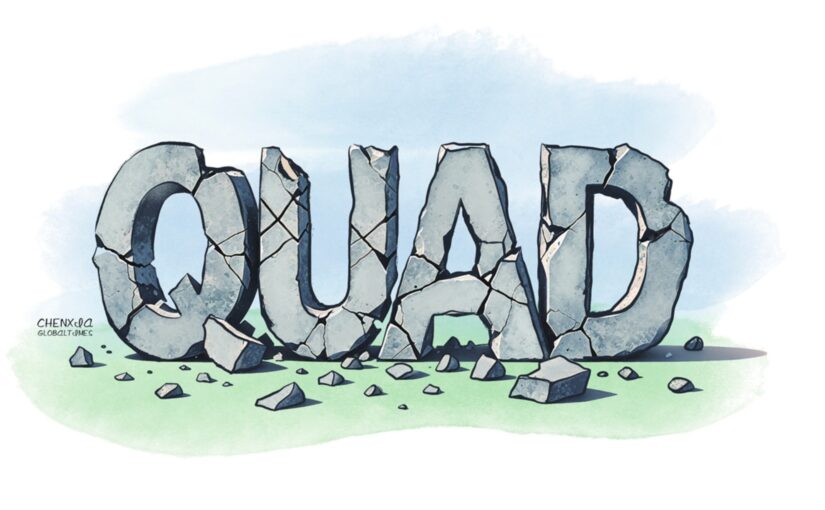
The foreign ministers of the Quad (Quadrilateral Security Dialogue) met in the Indian capital New Delhi on May 26. This US-led body which also comprises Japan, Australia and India plays a provocative role in US imperialism’s attempts to encircle and contain China as well as other socialist countries and anti-imperialist forces in the Asia-Pacific region.
On May 27, the Xinhua News Agency released a commentary stressing the need to guard against what it called the Quad’s “bloc politics”, noting that its members had “again hyped maritime issues related to the East and South China Seas.”
It added: “In recent years, nearly every joint statement issued after Quad foreign ministers’ meetings has reiterated these themes. Yet such patronising rhetoric about safeguarding so-called ‘freedom of navigation’ cannot obscure the reality that the bloc itself has become a source of turbulence, fueling tensions and deepening confrontation in the region.
“At a time when most Asia-Pacific countries are focused on economic recovery and regional integration, the Quad appears to be moving in the opposite direction by unveiling a raft of new measures — a move widely seen as driven by a Cold War mentality aimed at containing China’s development.”
According to Xinhua: “While the Quad foreign ministers voiced concern over regional peace and stability, few will overlook the irony that the war against Iran launched by Washington is itself undermining supply-chain resilience across the Asia-Pacific.
“Regional economies such as India — also a Quad member — are already bearing the brunt of the resulting turmoil in global energy markets. In the meantime, the still-undecided date for the Quad leaders’ summit offers a glimpse into the grouping’s growing disarray.”
However, it warned that “the world should still stay vigilant against countries like Japan [attempting] to use this bloc as a cover to hype up groundless security concerns in the region for its own militarist agenda… What the region needs is cooperative frameworks that prioritise development, mutual trust and shared prosperity over ideological alignment and geopolitical calculation. The Quad should recognise that Asia’s future lies in cooperation, not confrontation.”
The following day, the Korean Central News Agency (KCNA) reported the answers given by a spokesperson for the foreign ministry of the Democratic People’s Republic of Korea (DPRK) regarding the meeting.
The spokesperson noted that the joint statement issued by the meeting “not only seriously distorted the immediate and urgent challenges and threats faced by the countries in the Asia-Pacific region but also clearly exposed the hostile intention against specific countries.
“Quad talked about the strengthening of cooperation while expressing ‘concern’ over the situation in the South Sea and East Sea of China. It is aimed at justifying Japan’s moves for rearmament and Australia’s possession of a nuclear submarine, which are arousing concern of the international community.”
They continued: “In particular, the US-led Quad members took issue with the DPRK’s legitimate exercise of sovereign rights, calling for ‘denuclearisation’. This goes to prove that Quad is nothing but a political and diplomatic tool serving the US strategy for unipolar domination… The Foreign Ministry of the DPRK resolutely denounces and rejects the US-led Quad’s hostile stand against the DPRK and other regional countries and strongly demands that it drop its attempt to escalate inter-camp confrontation destroying regional peace and stability.”
The following articles were originally published by the Xinhua News Agency and KCNA.
Xinhua Commentary: Guarding against Quad’s bloc politics
BEIJING, May 27 (Xinhua) — As top diplomats of the Quadrilateral Security Dialogue, known as the Quad, wrapped up a one-day meeting in India on Tuesday, they have again hyped maritime issues related to the East and South China Seas.
In recent years, nearly every joint statement issued after Quad foreign ministers’ meetings has reiterated these themes. Yet such patronizing rhetoric about safeguarding so-called “freedom of navigation” cannot obscure the reality that the bloc itself has become a source of turbulence, fueling tensions and deepening confrontation in the region.
At a time when most Asia-Pacific countries are focused on economic recovery and regional integration, the Quad appears to be moving in the opposite direction by unveiling a raft of new measures — a move widely seen as driven by a Cold War mentality aimed at containing China’s development.
Behind the Quad’s rhetoric of defending “rules” and “standards” lies a clear logic of exclusion. From strengthening the so-called maritime security to “de-risking” supply chains, the grouping of the United States, Japan, India and Australia has become a vehicle for advancing selective partnerships and ideological alignment aimed at reshaping the regional order along geopolitical lines.
Such moves run directly counter to the region’s longstanding success story — one built on openness, economic integration and practical cooperation rather than confrontation and bloc politics.
Even more alarming is the growing tendency to securitize economic and technological cooperation. Sectors once driven primarily by development priorities and market demand are now increasingly viewed through the lens of national security and strategic rivalry. Such a shift not only disrupts normal economic cooperation, but also places mounting pressure on regional countries.
While the Quad foreign ministers voiced concern over regional peace and stability, few will overlook the irony that the war against Iran launched by Washington is itself undermining supply-chain resilience across the Asia-Pacific.
Regional economies such as India — also a Quad member — are already bearing the brunt of the resulting turmoil in global energy markets. In the meantime, the still-undecided date for the Quad leaders’ summit offers a glimpse into the grouping’s growing disarray.
However, the world should still stay vigilant against countries like Japan to use this bloc as a cover to hype up groundless security concerns in the region for its own militarist agenda. Since Japanese Prime Minister Sanae Takaichi took office, Tokyo has been pushing ahead with a series of militaristic policies, including relaxing arms export rules and seeking to revise the pacifist constitution, raising alarm across the region.
Across the globe, prosperity has always been built on openness, inclusiveness and mutually beneficial cooperation, not exclusive blocs or ideological camps. At a time when many developing economies struggle to spur economic recovery and boost climate resilience, few countries want to be drawn into geopolitical rivalry.
Over the years, most countries in the region have repeatedly voiced their opposition to bloc-based security politics, stressing the importance of cooperation and avoiding bloc confrontations.
Business communities and academic circles alike have also warned that excessive securitization risks undermining economic vitality, weakening supply chain efficiency and increasing uncertainty for regional development. These views ought to serve as a wake-up call for the Quad.
History has repeatedly shown that attempts to build “small yards with high fences” can hardly eliminate the sense of insecurity. More often, they create fault lines, deepen mistrust and fan geopolitical tensions.
What the region needs is cooperative frameworks that prioritize development, mutual trust and shared prosperity over ideological alignment and geopolitical calculation. The Quad should recognize that Asia’s future lies in cooperation, not confrontation.
Spokesperson for DPRK Foreign Ministry on QUAD Foreign Ministers’ Meeting
Pyongyang, May 28 (KCNA) — A spokesperson for the Foreign Ministry of the Democratic People’s Republic of Korea gave the following answer to a question raised by KCNA on May 28 as regards the fact that the recent U.S.-led QUAD foreign ministers’ meeting made public a “joint statement”, which includes the content pulling up the DPRK:
The “joint statement” not only seriously distorted the immediate and urgent challenges and threats faced by the countries in the Asia-Pacific region but also clearly exposed the hostile intention against specific countries.
QUAD talked about the strengthening of cooperation while expressing “concern” over the situation in the South Sea and East Sea of China. It is aimed at justifying Japan’s moves for rearmament and Australia’s possession of a nuclear submarine, which are arousing concern of the international community.
The creation of the “Critical Minerals Initiative Framework” newly, agreed by QUAD, also contains an exclusive and confrontational nature as it is pursuant to the foreign strategy of the present U.S. administration to hold a hegemonic position in the world supply chain by expanding the concept of security to the economic field.
In particular, the U.S.-led QUAD members took issue with the DPRK’s legitimate exercise of sovereign rights, calling for “denuclearization”. This goes to prove that QUAD is nothing but a political and diplomatic tool serving the U.S. strategy for unipolar domination.
The signboard of “peace and stability” cannot be a means for justifying the U.S. policy of inter-camp confrontation.
The Foreign Ministry of the DPRK resolutely denounces and rejects the U.S.-led QUAD’s hostile stand against the DPRK and other regional countries, and strongly demands that it drop its attempt to escalate inter-camp confrontation destroying regional peace and stability.
Explicitly speaking once again, the “denuclearization” of the DPRK will never happen forever.
We will thoroughly defend the sovereign rights, security interests and development rights of the state no matter what others may say, and actively join the international efforts to oppose the formation of an exclusive group and inter-camp confrontation in the region and promote the mutual trust, cooperation, peace and co-prosperity among nations.