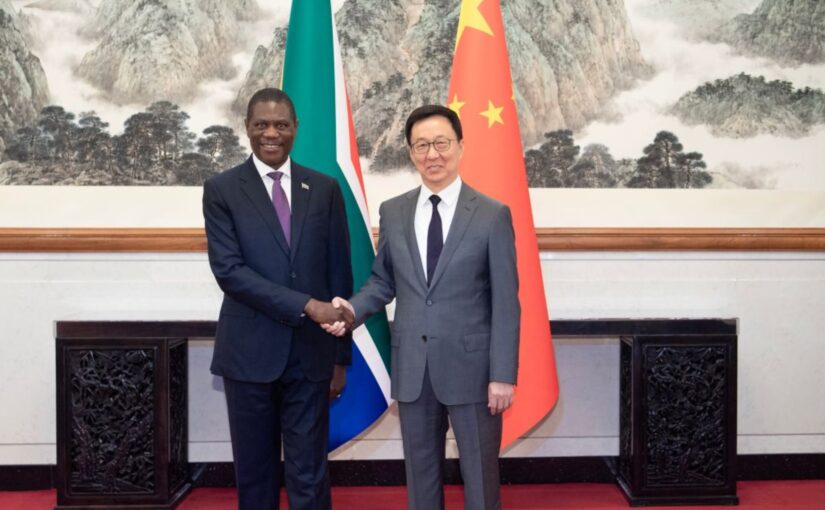
The special friendship of comrades and brothers between China and South Africa has been reinforced by three recent high-level meetings.
On June 23, Chinese Vice President Han Zheng met with visiting South African Deputy President Paul Mashatile in Beijing.
Han said that as members of BRICS and the G20, China and South Africa should strengthen international coordination and jointly play a positive role in improving global economic governance.
Mashatile said South Africa has always been committed to deepening political mutual trust and enhancing mutually beneficial cooperation with China.
The same day, Mashatile, who is also Deputy President of the African National Congress (ANC) of South Africa, met with Liu Haixing, Minister of the International Department of the Communist Party of China (CPC) Central Committee (IDCPC).
Liu said that although China and South Africa are separated by vast oceans, the two countries share a common destiny. The special friendship of “comrades and brothers” between the two countries dates back to the period of their respective struggles for national liberation, to their mutual support in advancing national development, and to their solidarity in the pursuit of international fairness and justice. President Xi Jinping has paid four state visits to South Africa, working with President Cyril Ramaphosa to guide bilateral relations into a “Golden Era”.
Mashatile said he sincerely congratulated China on the tremendous development achievements made under the leadership of the CPC and General Secretary Xi Jinping. He thanked China for its support and assistance to South Africa and for its zero-tariff treatment for all African countries that have diplomatic relations with China. The signing of the Framework Agreement on Economic Partnership for Shared Development is an important milestone in the history of South Africa-China relations. South Africa stands ready to work with China to strengthen practical cooperation in such areas as trade and investment, artificial intelligence, mineral processing and automobile manufacturing, so as to deliver greater benefits to the two peoples. The ANC cherishes its brotherly ties with the CPC and stands ready to further strengthen inter-party exchanges and cooperation, deepen the sharing of experience in party governance and state governance, and better advance relations between the two Parties and the two countries.
The previous day, in the Indian capital New Delhi, Member of the Political Bureau of the CPC Central Committee and Director of the Office of the Central Commission for Foreign Affairs Wang Yi, who is also Chinese Foreign Minister, met with Minister in the Presidency of South Africa Khumbudzo Ntshavheni. They were both attending the 16th Meeting of BRICS National Security Advisors and High Representatives on National Security.
Wang Yi stated that as representatives of emerging economies and founding members of BRICS, China and South Africa have firmly upheld multilateralism, advocated greater democracy in international relations, maintained close high-level exchanges, deepened practical cooperation across all sectors, and set an exemplary model for solidarity and cooperation among the Global South. At present, unilateralism and the law of the jungle undermine the legitimate rights and interests of all countries and erode the norms governing international relations. As the backbone of the Global South, BRICS countries need to strengthen solidarity and coordination, jointly burnish the golden brand of BRICS that symbolises unity and self-improvement of developing countries, work hand in hand to safeguard international fairness and justice, and preserve world peace and stability.
Khumbudzo Ntshavheni said South Africa attaches great importance to developing relations with China and always regards China as a reliable friend. She thanked China for its long-standing support and assistance to South Africa and Africa, especially the benefits brought by the zero-tariff policy to people across Africa. South Africa firmly pursues the one-China policy, stands ready to step up coordination and collaboration with China on multilateral platforms including BRICS, jointly safeguard the rights and interests of developing countries, revitalise multilateral mechanisms, and advance the process of world multipolarisation.
The following articles were originally published by the Xinhua News Agency and on the websites of the IDCPC and the Chinese Foreign Ministry.
Chinese vice president meets South African counterpart
BEIJING, June 23 (Xinhua) — Chinese Vice President Han Zheng met with South African Deputy President Paul Mashatile on Tuesday in Beijing.
Han recalled that he co-chaired with Mashatile the ninth plenary session of the China-South Africa Bi-National Commission in March, describing it as a complete success.
The two sides should further act on the important common understandings between the two heads of state, deepen political mutual trust, strengthen practical cooperation, and work for further progress in the implementation of the meeting outcomes, Han said.
As members of BRICS and the G20, China and South Africa should strengthen international coordination and jointly play a positive role in improving global economic governance, he said.
Mashatile said South Africa has always been committed to deepening political mutual trust and enhancing mutually beneficial cooperation with China.
South Africa adheres to the one-China policy and stands ready to work with China to support each other in safeguarding their respective core interests, he said.
Liu Haixing Meets with Paul Mashatile, Deputy President of the ANC and Deputy President of South Africa
June 23 (IDCPC) – On June 23, Paul Mashatile, Deputy President of the African National Congress (ANC) and Deputy President of South Africa, met with Liu Haixing, Minister of the International Department of the CPC Central Committee.
Liu said that although China and South Africa are separated by vast oceans, the two countries share a common destiny. The special friendship of “comrades and brothers” between the two countries dates back to the period of their respective struggles for national liberation, to their mutual support in advancing national development, and to their solidarity in the pursuit of international fairness and justice. President Xi Jinping has paid four state visits to South Africa, working with President Cyril Ramaphosa to guide bilateral relations into a “Golden Era”.
Mashatile said he sincerely congratulated China on the tremendous development achievements made under the leadership of the CPC and General Secretary Xi Jinping. He thanked China for its support and assistance to South Africa and for its zero-tariff treatment for all African countries that have diplomatic relations with China. The signing of the Framework Agreement on Economic Partnership for Shared Development is an important milestone in the history of South Africa-China relations. South Africa stands ready to work with China to strengthen practical cooperation in such areas as trade and investment, artificial intelligence, mineral processing and automobile manufacturing, so as to deliver greater benefits to the two peoples. The ANC cherishes its brotherly ties with the CPC and stands ready to further strengthen inter-party exchanges and cooperation, deepen the sharing of experience in party governance and state governance, and better advance relations between the two Parties and the two countries.
Wang Yi Meets with Minister in the Presidency of South Africa Khumbudzo Ntshavheni
June 23 (MFA) – On June 22, 2026, Member of the Political Bureau of the CPC Central Committee and Director of the Office of the Central Commission for Foreign Affairs Wang Yi met with Minister in the Presidency of South Africa Khumbudzo Ntshavheni in New Delhi.
Wang Yi stated that as representatives of emerging economies and founding members of BRICS, China and South Africa have firmly upheld multilateralism, advocated greater democracy in international relations, maintained close high-level exchanges, deepened practical cooperation across all sectors, and set an exemplary model for solidarity and cooperation among the Global South. At present, unilateralism and the law of the jungle undermine the legitimate rights and interests of all countries and erode the norms governing international relations. As the backbone of the Global South, BRICS countries need to strengthen solidarity and coordination, jointly burnish the golden brand of BRICS that symbolizes unity and self-improvement of developing countries, work hand in hand to safeguard international fairness and justice, and preserve world peace and stability.
Wang Yi noted that China is a trustworthy friend and partner for South Africa and Africa. China-South Africa relations have maintained steady momentum of growth. The two sides should earnestly implement the important consensus reached by their heads of state, stay committed to mutual respect and win-win cooperation, continuously improve exchange mechanisms at all levels, consolidate and deepen strategic mutual trust, and jointly expand the pie of cooperation. We should fully leverage policy dividends including zero-tariff treatment and the “Green Channel 2.0” for African agricultural and food products entering China, so as to inject strong impetus into the joint modernization drive of China and South Africa as well as China and Africa.
Khumbudzo Ntshavheni said South Africa attaches great importance to developing relations with China and always regards China as a reliable friend. She thanked China for its long-standing support and assistance to South Africa and Africa, especially the benefits brought by the zero-tariff policy to people across Africa. South Africa looks forward to closer high-level exchanges with China and deeper cooperation in trade, investment, cybersecurity, infrastructure and other fields to elevate South Africa-China and Africa-China relations to new heights. South Africa firmly pursues the one-China policy, stands ready to step up coordination and collaboration with China on multilateral platforms including BRICS, jointly safeguard the rights and interests of developing countries, revitalize multilateral mechanisms, and advance the process of world multipolarization.






Thank you, South Africa!