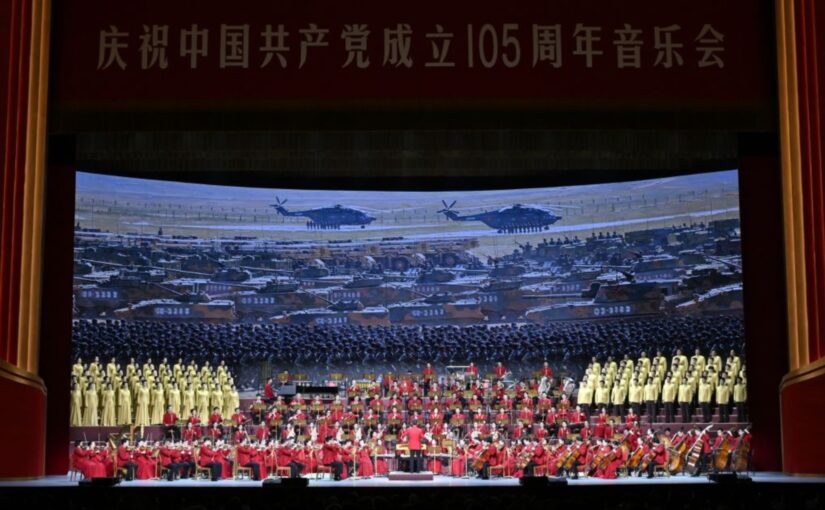
As the Communist Party of China (CPC) marked its 105th founding anniversary on July 1st, the Xinhua News Agency reported that the party had nearly 101.29 million members as of the end of 2025. The number increased by more than 1.01 million, or one percent, from the end of 2024.
When it was founded in 1921, the CPC had just over 50 members. Now, according to the latest figures reported by Xinhua, it had over 5.43 million primary-level organisations by the end of last year, up by some 181,000, or 3.4 percent year on year. Those aged 35 or below accounted for 84 percent of newly admitted members. More than half of the new members, or 51.4 percent, came from the forefront of production and work. Workers and farmers remained the largest segment of the Party, representing 32.4 percent of the total members.
China has continued sending “first Party secretaries” to villages, drawing cadres from across the nation to help drive rural revitalisation. By the end of last year, approximately 188,000 first secretaries were serving in villages nationwide.
A commentary published by the Xinhua News Agency on June 30 noted: “As the Communist Party of China (CPC) marks its 105th anniversary, its journey represents a mission of resilience, innovation and strong leadership. Staying true to its founding aspiration, the CPC has led one of the most far-reaching modernisation transformations in human history.
“Against the backdrop of a weak country that suffered from foreign humiliation, poverty, and failed attempts to save the nation, the CPC was founded in 1921 with a mission to seek happiness for the Chinese people and rejuvenation for the Chinese nation. The CPC united and led the Chinese people of all ethnic groups in working tirelessly to achieve national independence and the people’s liberation. In the following decades, the CPC has continued to lead China’s journey toward prosperity, strength and a better life for its people.”
Analysing the secrets of the CPC’s success, it explains:
“Unlike parties that primarily represent particular groups or interests, the CPC has always put the people first, responded to their concerns and needs, and worked to improve their well-being. These deep-rooted, inseparable flesh-and-blood ties with the masses provide the CPC with an inexhaustible source of strength. As a service-oriented political party, the CPC makes decisions and sets policies based on the fundamental interests of the people…
“Unlike Western political systems that are often plagued by partisan gridlock and the pursuit of electoral gains, the CPC maintains a long-term perspective and carries a blueprint through to the end. The five-year plans, which have guided national development since 1953, stand as a testament to this strategic consistency — a key reason for China’s rapid development and a sharp contrast to the policy volatility often observed in Western democracies.”
Among the other key points stressed by the article are:
The CPC is a dynamic organisation that constantly adapts to changing times. It is not bound by rigid dogma but has developed as a learning and innovative party that integrates the basic tenets of Marxism with China’s specific realities and fine traditional culture. Scientific political theories enable the CPC to grasp the overarching trends of human development and always stand at the forefront of the times.
The CPC is clear minded about the dangers and risks it faces, such as detachment from the people and corruption. With a zero-tolerance approach to corruption, the CPC has pursued full and rigorous self-governance.
The CPC is open minded and has a global vision, making China’s development increasingly integrated with the rest of the world. The Party has championed the building of a community with a shared future for humanity. Through its global initiatives on development, security, civilisation and governance, the CPC has contributed significantly to global peace, stability and prosperity.
It concludes: “The CPC’s 105th anniversary coincides with the 90th anniversary of the victory of the Long March of the CPC-led Red Army. The spirit demonstrated by that epic military maneuver, including a firm belief that a just cause will surely prevail, fearlessness in the face of any difficulties, a commitment to seeking truth from facts, and a steadfast reliance on the masses, will continue to empower the CPC to march forward and navigate any challenges.
“With a clear sense of mission, a strong executive capacity and a commitment to shared development, the CPC is certainly capable of leading China to achieve new victories on today’s Long March: advancing the great rejuvenation of the Chinese nation on all fronts through a Chinese path to modernisation, and working with the rest of the world for a better future.”
The following articles were originally published by the Xinhua News Agency.
China Focus: CPC membership tops 101 mln as Party marks 105th anniversary
BEIJING, June 30 (Xinhua) — The Communist Party of China (CPC) had nearly 101.29 million members as of the end of 2025, marking another year of steady growth, which was announced ahead of the Party’s 105th founding anniversary on July 1.
The number increased by more than 1.01 million, or 1 percent, from the end of 2024, said a report released by the Organization Department of the CPC Central Committee on Tuesday.
When it was founded in 1921, the CPC had just over 50 members.
The Party has seen continued membership expansion, while its organizational system has become increasingly well-structured, the report said.
“The CPC has built a robust organizational system featuring unimpeded communication and effective policy implementation at all levels. It gives full play to the role of grassroots Party organizations and the exemplary role of Party members in advancing reform, development, and stability,” it said.
The CPC had over 5.43 million primary-level organizations by the end of last year, up by some 181,000, or 3.4 percent year on year, it said.
Steady growth
The latest figures point to a young and well-educated intake of new members to the Party in 2025. Those aged 35 or below accounted for 84 percent of newly admitted members, while 54.8 percent had a junior college education or above.
More than half of the new members, or 51.4 percent, came from the forefront of production and work.
Beyond the profile of new members, the overall membership structure also continued to improve, the report said.
By the end of 2025, members with a junior college education or above exceeded 59.76 million, accounting for 59 percent of the total, the figures show.
Women made up 31.5 percent of the membership, while members from ethnic minority groups accounted for 7.8 percent, up 0.6 and 0.1 percentage point, respectively.
Workers and farmers remained the largest segment of the Party, representing 32.4 percent of the total members.
Stronger grassroots organizations
“Grassroots Party organizations have become stronger,” the report said, highlighting their continuous growth.
In rural areas, efforts to advance rural revitalization continued, with further improvements in village-level Party leadership.
Among the country’s some 483,000 secretaries of village Party organizations, 56.5 percent had a junior college education or above, up 8.9 percentage points from a year earlier, the report said.
China has continued sending “first Party secretaries” to villages, drawing cadres from across the nation to help drive rural revitalization.
By the end of last year, approximately 188,000 first secretaries were serving in villages nationwide.
The overall effectiveness of grassroots governance has seen continuous improvement through Party building, said the report.
Xinhua Commentary: At 105, the CPC embodies a mission of resilience, innovation and leadership
BEIJING, June 30 (Xinhua) — As the Communist Party of China (CPC) marks its 105th anniversary, its journey represents a mission of resilience, innovation and strong leadership. Staying true to its founding aspiration, the CPC has led one of the most far-reaching modernization transformations in human history.
Against the backdrop of a weak country that suffered from foreign humiliation, poverty, and failed attempts to save the nation, the CPC was founded in 1921 with a mission to seek happiness for the Chinese people and rejuvenation for the Chinese nation. The CPC united and led the Chinese people of all ethnic groups in working tirelessly to achieve national independence and the people’s liberation. In the following decades, the CPC has continued to lead China’s journey toward prosperity, strength and a better life for its people.
Under the leadership of the CPC, China has grown into the world’s second-largest economy, made major advances in science and technology, significantly improved people’s living standards, and become an important force of stability and certainty in a turbulent world. As the world’s largest developing country, China is pushing ahead on all fronts toward basically achieving socialist modernization by 2035.
What makes the CPC capable of leading the nation to achieve sustained development outcomes? The answer lies in its defining qualities, namely its people-centered mission, its organizational, mobilization and executive capacities, its learning and innovation ability, its openness and vitality, and its commitment to self-reform. Together, these qualities help explain the underlying logic of China’s rise.
Unlike parties that primarily represent particular groups or interests, the CPC has always put the people first, responded to their concerns and needs, and worked to improve their well-being. These deep-rooted, inseparable flesh-and-blood ties with the masses provide the CPC with an inexhaustible source of strength. As a service-oriented political party, the CPC makes decisions and sets policies based on the fundamental interests of the people.
Through decades of continuous efforts, especially eight years of targeted poverty alleviation, China has achieved the historic feat of eradicating absolute poverty and building a moderately prosperous society in all respects. Public well-being is also reflected in the establishment of the world’s largest education, social security and healthcare systems. Both urban and rural residents in China enjoy a life much more convenient than ever before, thanks to remarkable infrastructural improvements in transport, power and telecommunications.
Unlike Western political systems that are often plagued by partisan gridlock and the pursuit of electoral gains, the CPC maintains a long-term perspective and carries a blueprint through to the end. The five-year plans, which have guided national development since 1953, stand as a testament to this strategic consistency — a key reason for China’s rapid development and a sharp contrast to the policy volatility often observed in Western democracies.
The CPC’s strength lies in its institutional architecture, which features the centralized, unified leadership of the CPC Central Committee, its local committees, over 5.43 million primary-level organizations, and over 101 million members nationwide. This system gives the Party a formidable capacity to mobilize and unite the 1.4 billion Chinese people to work toward a common goal. It also ensures an effective mechanism for cultivating high-caliber cadres through local and grassroots work experience, so as to advance the cause of the CPC.
The CPC is a dynamic organization that constantly adapts to changing times. It is not bound by rigid dogma, but has developed as a learning and innovative party that integrates the basic tenets of Marxism with China’s specific realities and fine traditional culture. Scientific political theories enable the CPC to grasp the overarching trends of human development and always stand at the forefront of the times. The CPC’s innovation-driven strategy has accelerated the country’s industrial upgrade and fostered new growth drivers for the high-quality development of the Chinese economy.
Just as it requires a skilled blacksmith to forge good steel, the CPC’s leadership ability is inextricably tied to its continuous self-reform. The CPC is clear-minded about the dangers and risks it faces, such as detachment from the people and corruption. With a zero-tolerance approach to corruption, the CPC has pursued full and rigorous self-governance. In 2025 alone, disciplinary watchdogs launched investigations into 181 officials registered at and supervised by the CPC Central Committee. Nationwide, they handed disciplinary or administrative penalties to 983,000 individuals involved in corruption. Since the 18th National Congress of the CPC in late 2012, the Party has carried out a series of study and education campaigns to maintain its advanced nature and purity.
The CPC is open-minded and has a global vision, making China’s development increasingly integrated with the rest of the world. The Party has championed the building of a community with a shared future for humanity. In an era marked by geopolitical tensions and global challenges, China firmly pursues true multilateralism and adheres to the path of peaceful development. Through its global initiatives on development, security, civilization and governance, the CPC has contributed significantly to global peace, stability and prosperity.
The CPC’s 105th anniversary coincides with the 90th anniversary of the victory of the Long March of the CPC-led Red Army. The spirit demonstrated by that epic military maneuver, including a firm belief that a just cause will surely prevail, fearlessness in the face of any difficulties, a commitment to seeking truth from facts, and a steadfast reliance on the masses, will continue to empower the CPC to march forward and navigate any challenges.
With a clear sense of mission, a strong executive capacity and a commitment to shared development, the CPC is certainly capable of leading China to achieve new victories on today’s Long March: advancing the great rejuvenation of the Chinese nation on all fronts through a Chinese path to modernization, and working with the rest of the world for a better future.