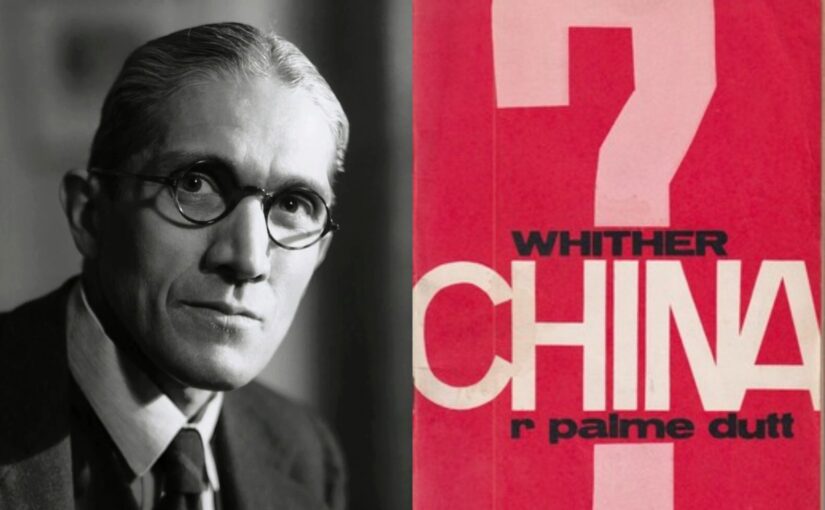
The following is the text of a lecture delivered by Carlos Martinez, author of The East is Still Red: Chinese Socialism in the 21st Century and a co-editor of Friends of Socialist China, marking the 130th anniversary of the birth of Rajani Palme Dutt – theoretician, organiser and, for half a century, one of the foremost Marxist minds in the British movement.
Taking as its starting point Palme Dutt’s 1967 pamphlet Whither China?, written at the height of the Sino-Soviet split and a year into the Cultural Revolution, the lecture asks what this towering figure of British Marxism – who died in 1974 – would have made of the People’s Republic today. Carlos tests Palme Dutt’s critique against the verdict of history: on the Cultural Revolution, on the Theory of the Three Worlds, and on the rival conceptions of peaceful coexistence – finding some of it vindicated, and some of it a product of a European Marxism that struggled to fully grasp a peasant-driven revolution.
Confronted with two stubborn facts – that the People’s Republic still exists while the Soviet Union does not – Palme Dutt, who even in 1967 refused to write China out of the socialist camp, would, Carlos argues, have recognised China as the largest and most developed socialist society in history. He would have recognised that in China it is the state that disciplines capital, not the other way round. The lecture closes with a call to carry forward Palme Dutt’s enduring principle: solidarity with a socialist country under imperialist siege, “irrespective of any differences”.
This lecture was delivered on 27 June 2026 at the R. Palme Dutt Memorial Lecture 2026 at SOAS University of London, organised by the Students’ Federation of India UK and the Young Communist League.
Comrades and friends. Thank you to the Students’ Federation of India UK and the Young Communist League for organising this event, and for asking me to speak.
We gather to mark the 130th anniversary of the birth of Rajani Palme Dutt – theoretician, organiser, anti-imperialist, and for half a century one of the foremost Marxist minds in the British movement. A man whose very name – the Bengali ‘Rajani’ and ‘Dutt’ alongside the Swedish ‘Palme’ – embodied the internationalism he preached and practised.
I want to use my time to ask a particular question. Palme Dutt died in 1974. He did not live to see China’s reform and opening up, the collapse of the Soviet Union, China’s rise to becoming the second-largest economy on earth, or the New Cold War now being waged against the People’s Republic. So: what would Rajani Palme Dutt have made of contemporary China?
It might seem a strange or pointless question to pose. The most substantial thing Palme Dutt wrote about China was his 1967 pamphlet Whither China? – which is, on its surface, a sharp polemic against the Chinese leadership, written at the height of the Sino-Soviet split, a year into the Cultural Revolution.
Palme Dutt was of course very much on the Soviet side in that split. Nonetheless, his pamphlet was not a simple repetition of the Soviet line, but a careful and serious analysis from a fundamentally comradely perspective.
So the question is posed not as a parlour game, but as a way of asking what a great Marxist of the past would make of the present; of testing his analysis against the reality of history; and of separating enduring principles from contingent positions.
A pamphlet of its moment
The Sino-Soviet split was, of course, one of the greatest setbacks our global movement has ever suffered, and reading Palme Dutt’s pamphlet, you feel the weight of it on every page. He is clearly shocked and deeply saddened by the bitterness of the situation.
And with the hindsight of six decades, we can recognise that both sides were at fault and went too far. As Deng Xiaoping put it to Gorbachev in 1989, when the two parties finally normalised relations again, “there was a lot of empty talk on both sides”. Deng’s verdict – “we no longer think that everything we said at that time was right” – could stand as an epitaph for the whole dispute.
So let me look at the substance of a few elements of Palme Dutt’s critique, and subject it to the test of history.
The Cultural Revolution
Certain parts of Palme Dutt’s criticism actually resonate with the assessment the Communist Party of China itself would later reach. On the Cultural Revolution’s assault on nearly all hitherto existing culture, he wrote:
“This offensive in the cultural field repeated in the most exaggerated form the kind of trend which had been familiar in the early days of the Russian Revolution in the movement known as ‘proletcult’, and which had been soundly trounced by Lenin – the tendency to what Lenin described as ‘cultural nihilism’, of the denunciation of the whole classical heritage of pre-revolutionary culture as ‘bourgeois’ or ‘feudal’ and worthless for revolutionaries.”
The CPC’s own 1981 Resolution on certain questions in the history of our Party came to call the Cultural Revolution “the most severe setback … suffered by the Party, the state and the people since the founding of the People’s Republic”.
Meanwhile Xi Jinping today warns insistently against ‘historical nihilism’ – though, in a neat reversal, he deploys the term to defend the achievements of the Mao era against those who would erase them, while also championing the importance of China’s traditional culture and civilisational heritage.
Palme Dutt’s instinct – that a revolution must “take over and absorb all that was best in the entire heritage of human culture”, in his paraphrase of Lenin – is, in its essentials, the position of the Chinese leadership today. I would note in passing – just to emphasise the point that things are always complicated – that Mao himself also advocated making the past serve the present and stressed the need to “extensively and critically make use of China’s cultural heritage” and “to make the things we have inherited our own”.
So Palme Dutt’s critique of the Cultural Revolution’s excesses is, at one level, vindicated by history. One caveat I would raise, however, is that part of the motivation for the Cultural Revolution was identifying in the Soviet leadership of that era a blunting of revolutionary edge, a bureaucratisation and ossification of the Communist Party, and a degree of ideological weakening – all of which appeared to the Chinese leaders as being cause for concern.
Given the continuation of those phenomena in the ensuing decades, and given how they contributed to the tragic collapse of the Soviet Union just 24 years later, I’d argue that some of the Cultural Revolution’s impulses were not misplaced, even if the methods were often extreme and disastrous.
In my view there is still some work to be done in developing a fully nuanced and dialectical assessment of the Cultural Revolution.
Three Worlds and the principal contradiction
This brings us to what Palme Dutt called the ‘three-continent theory’ – the emerging Chinese conception, soon to be elaborated as the Theory of the Three Worlds, that the principal arena of world revolution had shifted to the national liberation struggles of Asia, Africa and Latin America, “the rural areas of the world” encircling “the cities of the world”.
Palme Dutt regarded this as a substantial departure from Marxism-Leninism; a downgrading of the working class and the socialist camp to “an auxiliary role”.
This is essentially the Soviet line, and really captures the essence of the split. The Soviet Union was the first country to build socialism, to maintain a socialist revolution. That revolution was waged primarily by the industrial working class against the primary enemy of the capitalist class. Then this socialist revolution had to defend itself against a hostile capitalist world.
The Chinese communists, on the other hand, set out to build socialism in a semi-colonial, semi-feudal society. The revolution was waged primarily by the poorer sections of the peasantry against both the big landlords and the imperialist powers. Without question the primary contradiction in the situation was not between the Chinese proletariat and the Chinese bourgeoisie, but between the Chinese people and the imperialist powers.
The Soviet leadership of the time was unable to grasp the historic significance of this difference, and that’s reflected in Palme Dutt’s critique. He writes:
“Owing to its class basis… the peasantry can never be the leading class in a revolution. Only the industrial working class, even though much smaller in numbers, can, if strongly organised and with Marxist political consciousness and leadership, successfully fulfil this role, and in alliance with the peasantry lead the revolution to victory.”
To me this reads as a perfectly reasonable hypothesis that had by that point already been decisively proven wrong by the experiences in China, Vietnam and Korea – experiences that were theorised most clearly in the writings of Mao Zedong. It’s really a framework of an advanced European Marxism: the industrial working class as the leading class, the peasantry as a problem to be managed.
Much like the Soviet leadership of the time, Palme Dutt doesn’t manage to fully get his head around a peasant-driven revolutionary process, or around the historic significance of the expansion of Marxism into the colonial and semi-colonial world.
As for the Three Worlds Theory itself, it retains real validity and applicability today. Palme Dutt correctly identifies the main thing it got wrong, that is, that the Soviet Union was part of the ‘First World’, was an imperialist power and an objective ally of US imperialism.
But the notion of the principal contradiction in global politics as being between oppressed and oppressor nations; and identifying the main arena of struggle as being in the Global South rather than in the industrialised North; and furthermore highlighting the possibility of establishing a modus vivendi with the ‘Second World’, or the ‘intermediate zone’, and helping to draw it away from a dying hegemonism – all that remains valid and useful for understanding the world today.
Peaceful coexistence
One of the strongest critiques in the pamphlet – and another of the central disagreements of the split – is around differing conceptions of peaceful coexistence.
While the entire communist movement was committed to the general principles of peaceful coexistence, the Soviet Union had developed a particular conception of it in the 1950s and 1960s, that emphasised stabilising the world situation, avoiding another world war at all costs, avoiding nuclear annihilation, and to that end attempting to arrive at some sort of lasting accommodation with the capitalist powers.
This included not being seen to overtly encourage revolutionary movements in the capitalist world, an ideological side effect of which was the downgrading of the importance of revolutionary struggle in general.
In a context of intense and bitter debate between the CPC and the CPSU, the Chinese leadership were quick to dismiss the Soviet line as wholesale capitulation to imperialism.
In reality, the differences shouldn’t have been irreconcilable.
One oft-overlooked element in the equation is that the Soviet and Chinese revolutions were at different stages of their development. The Soviet Union by the 1960s was an established superpower, seeking to consolidate its gains and arrive at some sort of stable, long-term equilibrium with the West. China was younger, poorer, still encircled, still excluded from its own seat at the United Nations, and understandably less willing to accept a settlement that seemed to freeze the world in place.
Partly also the Soviets too often did not consult the Chinese, did not treat them as equals, did not grasp the historic significance of the world revolution’s expansion into Asia. Deng Xiaoping explained to Gorbachev in 1989 that the Chinese side had felt humiliated, not treated as equals.
Beneath the doctrinal quarrels lay older, uglier residues that our movement inherited from capitalism – eurocentrism, and the assumption that the capitals of European Marxism had a natural right to lead. Russia, we should remember, had itself been one of the powers that imposed unequal treaties on China, leading to the loss of a huge amount of Chinese territory. It is not hard to see why Chinese communists were sensitive on the point.
Meanwhile, looking at the world situation today, what’s striking is that China’s foreign policy – with its focus on multipolarity and win-win cooperation, its insistence on peace and on the principles of the UN Charter – is in many respects not so far removed from the Soviet conceptions of the time.
Not, in the end, uncomradely
It must be said that Whither China? is not by any means an uncomradely document. For all its polemic, Palme Dutt never crossed the line into treating China as an enemy. Indeed, the pamphlet’s most important passages are its most generous. It correctly notes, for example, the underlying culpability of imperialism:
“The main responsibility for the present difficulties in China lies, not in the internal situation, but in the international situation, in the criminal aggressive role of United States imperialism. The US imperialists have cut off China from her rightful place in international politics and maintained a permanent war situation.”
Palme Dutt then quotes US Defence Secretary McNamara, coolly estimating in January 1967 that a “relatively small number of warheads detonated over 50 Chinese urban centres would destroy half of the urban population … and more than one half of the industrial capacity” – and observes that it was hardly surprising such permanent menace should breed a suspicion that any kind of détente was betrayal. He continues:
“For this reason our international duty, irrespective of any differences on policy or tactical questions with the Chinese leadership within the international communist movement, is to maintain solidarity with China and the Chinese people and the Chinese revolution against the aggression of US imperialism.”
Written at the very nadir of the split, this is a principled and correct conclusion, and speaks admirably to Palme Dutt’s commitment to the defence of socialism and the socialist world.
What would Palme Dutt make of China today?
Even in 1967, even while penning a relatively harsh critique, Palme Dutt refused to write China out of the socialist camp:
“China is a socialist country. During the First Five Year Plan the foundations of socialism were securely established… There is no sign or indication whatever of the foundation of socialism being abandoned or overthrown … Experience has shown how socialist revolutions can go through difficult and dangerous phases, but can in the end overcome them and carry forward the advance.”
This assessment has aged well.
So what would he make of China now?
He would, first of all, have to take on board two stubborn facts: the People’s Republic of China still exists, and the Union of Soviet Socialist Republics does not. China has come to be the largest and most developed socialist society in history – it’s outlasted the USSR, lifted some 800 million people out of poverty, become the world leader in renewable energy, and now stands at the head of the long process of building a multipolar world.
And the change has not been only material. The Italian philosopher Domenico Losurdo, touring China in 2010, watched peasants from the remotest corners of the country arriving in Beijing for the first time – men and women who had ceased to be, as he put it, “simple peasants tied to the piece of earth they cultivated, as if imprisoned”, and become citizens. Development had brought them not just an end to hunger but “individual and national dignity”.
Ultimately, China is carrying forward the projects that Palme Dutt cared most about: the defeat of imperialism, the advance of the oppressed nations, the survival and flourishing of socialism.
And given his assessment in 1967 that the foundations of socialism were secure, he would have seen the continuity of the revolution, and recognised that the People’s Republic remains socialist today. He would have asked the materialist’s questions: who holds the commanding heights of the economy? What class is in power?
He would have found his answer in the fact that the Chinese state owns the land beneath every city. That it owns the great banks – the largest banks in the world are Chinese and state-controlled, their executives, as The Economist has observed, “beholden to a higher authority than the stock market”. That it controls and manages energy, telecommunications, rail and heavy industry. Investment is still steered by five-year plans, and the Communist Party sits inside the major boardrooms. There is a capitalist class, and there are billionaires – but they are tolerated, not sovereign: not permitted to organise as a class, to form their own party, or to impose their will on society.
Many on the left can and do object: a stock market, billionaires, private capital, huge inequality – how can this be socialism? But the test was never the mere existence of capitalists; it is whether capital rules. The decisive question is who disciplines whom – and in China it is the state that disciplines capital, not the other way round.
Modern China is, as Albert Szymanski argued of the socialist states generally, a system whose legitimacy rests on building socialism and on raising the condition of the working people – and which is therefore driven, by its own internal logic, to keep doing so.
Palme Dutt would, in short, have recognised the continuity that runs, through every twist and turn, from the Jiangxi Soviet to the period of New Democracy, through the first three decades of socialist construction, through reform and opening up, to socialism with Chinese characteristics in the present day.
The Chinese idiom ‘seek truth from facts’ – which Deng Xiaoping would later make the watchword of the reform era – was given its classic Marxist formulation by Mao in 1940, in his essay On New Democracy, in a section with the subheading, of all things, “Whither China?”. Mao wrote:
“To seek truth from facts is the scientific approach, and presumptuously to claim infallibility and lecture people will never settle anything … There is but one truth, and the question of whether or not one has arrived at it depends not on subjective boasting but on objective practice. The only yardstick of truth is the revolutionary practice of millions of people.”
That is the standard by which I think Palme Dutt would have wanted to be judged, and by which he would have judged China. By objective practice – by the revolutionary practice of millions of people.
Taking Palme Dutt’s legacy forward
Does anything of practical importance flow from all this? I think it does.
The first thing is that, with the distance of a few decades, we can recognise that the Sino-Soviet split was a tragedy for our movement, but also that it need not be a permanent dividing line in our movement. We can learn the relevant lessons and move forward in the spirit of unity.
The cooperation we increasingly see across once-hostile traditions, the renewed solidarity with China among parties that were on the Soviet side of the split, is part of that healing. Palme Dutt, who was deeply committed to the unity of the international communist movement, would have welcomed it without reservation.
The other tasks flow from the one principle from which he never wavered in Whither China?: solidarity with a socialist country under imperialist siege, “irrespective of any differences”. That means the defence of socialism as a living project, regardless of any reservations comrades may have about this or that socialist country, or indeed of any differences that exist or may arise among the presently existing socialist countries.
It means the defence of the oppressed nations and peoples. It means the defence of the People’s Republic of China and its genuine, world-historic achievements against the slanders of the New Cold War – the trade war, the tech war, the propaganda war, AUKUS, the encirclement campaign, and so on. And it means the fight against imperialism and against the resurgent fascism that is imperialism’s shadow, and against the drive to war that threatens us all.
Palme Dutt ended his pamphlet on a note of confidence. Let me close with his words:
“Despite the present formidable difficulties and dangers … we maintain our confidence in the future of the great Chinese revolution and the Chinese people, and in the creative forces of a socialist revolution.”