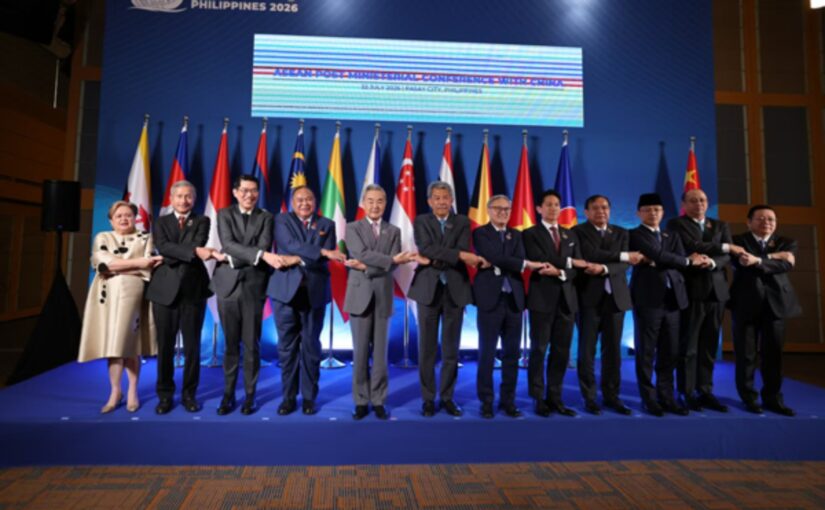
The China-ASEAN [Association of South East Asian Nations] Foreign Ministers’ Meeting was held in the Philippines’ capital Manila on July 22, as part of a series of bilateral and regional dialogues hosted by the 11-member grouping.
Chinese Foreign Minister Wang Yi co-chaired the meeting with Malaysian Minister of Foreign Affairs Mohamad bin Haji Hasan, with Malaysia serving as the Country Coordinator for China-ASEAN Dialogue Relations.
Wang Yi noted that this year marks the fifth anniversary of the establishment of the China-ASEAN Comprehensive Strategic Partnership. Under the joint strategic guidance of leaders of the two sides, China-ASEAN cooperation has been at the forefront, moved forward steadily and rapidly, and yielded fruitful outcomes, benefiting more than two billion people on both sides. The foundation for building an even closer China-ASEAN community with a shared future has become more solid.
China is ready to work with ASEAN to uphold the principles of peace, development and win-win cooperation, bring more benefits to people of regional countries through closer cooperation, and respond to emerging challenges and uncertainties with stronger solidarity.
Wang put forward four suggestions:
To uphold an environment of peace and development in the region. The two sides should promote the Asian values of peace, cooperation, openness and inclusiveness, resolutely oppose unreasonable external interference, reject the formation of exclusive ‘small circles’, resist attempts to incite bloc confrontation, and never allow the revival of militarism.
To make regional development more resilient. The two sides should uphold open cooperation and deepen the integration of development, develop the China-ASEAN Free Trade Area 3.0, pursue high-quality implementation of the Regional Comprehensive Economic Partnership (RCEP), and strengthen regional food security, energy security and supply chain stability.
To pursue innovation-driven and green development. The two sides need to expand cooperation in such areas as climate change response, clean energy, green agriculture and the blue economy.
To uphold a people-centred approach. The two sides should promote inclusive and universally beneficial development, so that the outcomes of China-ASEAN cooperation can be tangible and accessible and better benefit the people of all countries. China is ready to enhance exchanges and cooperation with ASEAN in such areas as poverty reduction, public health, education, youth, think tanks, tourism, media and culture.
Wang Yi also expounded on China’s principled position on the South China Sea issue and said that the South China Sea is our shared home. China and ASEAN countries have the wisdom and capability to continue handling the South China Sea issue properly and make peace, stability, cooperation and friendship the mainstream narrative of the South China Sea. Regional countries should reject attempts by external forces to fan the flames, oppose certain countries’ moves to stir up trouble by taking advantage of maritime issues, and keep the initiative over peace and stability in the South China Sea firmly in our own hands.
All sides expressed their expectation for the early conclusion of a Code of Conduct in the South China Sea within this year, so as to jointly maintain peace and stability. They also expressed readiness to work with China to uphold multilateralism, address global challenges, and make ASEAN-China relations a stabilising force for regional peace and development and a model for dialogue partnerships.
Wang Yi also briefed participants on the fruitful cooperation outcomes of the China-ASEAN Comprehensive Strategic Partnership over the past five years:
Progress in building a neighbourhood community with a shared future has deepened and solidified. China has reached important consensus with eight ASEAN member states on jointly building bilateral shared communities.
Trade volume has maintained steady growth. The ASEAN-China Free Trade Area (ACFTA) 3.0 Upgrade Protocol has been formally signed. China and ASEAN have remained each other’s largest trading partners for six consecutive years.
China and ASEAN have pulled together to tide over difficulties. When Myanmar was hit by a powerful earthquake and an earthquake struck Mindanao of the Philippines, China rushed to provide assistance without delay, embodying the fine tradition of mutual support between China and ASEAN countries.
People-to-people exchanges have become more vibrant. China has specially introduced the ‘ASEAN Visa’ scheme to facilitate and boost cross-border people flows, making the people-to-people bonds linking both sides ever closer.
Wang Yi also held numerous bilateral meetings with his counterparts from various parts of the world during his stay in Manila.
The following articles were originally published on the website of the Chinese Foreign Ministry.
China-ASEAN Foreign Ministers’ Meeting Held in Manila
July 23 (MFA) – On July 22, 2026, the China-ASEAN Foreign Ministers’ Meeting was held in Manila, the Philippines. Member of the Political Bureau of the CPC Central Committee and Foreign Minister Wang Yi co-chaired the meeting with Malaysian Minister of Foreign Affairs Mohamad bin Haji Hasan, with Malaysia serving as the Country Coordinator for China-ASEAN Dialogue Relations. Foreign ministers of ASEAN member states and the Secretary-General of ASEAN attended the meeting.
Wang Yi noted that this year marks the fifth anniversary of the establishment of the China-ASEAN Comprehensive Strategic Partnership. Under the joint strategic guidance of leaders of the two sides, China-ASEAN cooperation has been at the forefront, moved forward steadily and rapidly, and yielded fruitful outcomes, benefiting more than two billion people on both sides. The foundation for building an even closer China-ASEAN community with a shared future has become more solid. The journey of China-ASEAN relations shows that mutual respect and mutual trust form the foundation of good neighborliness, treating each other with sincerity is the way to coexist, win-win cooperation provides the basis for delivering results, and openness and inclusiveness hold the key to prosperity. These are all valuable experiences that deserve to be carried forward.
Wang Yi said that China has just commemorated the 105th anniversary of the founding of the Communist Party of China (CPC). Over the past 105 years, the CPC has united and led more than 1.4 billion Chinese people in tireless efforts, creating remarkable achievements that have drawn worldwide attention, greatly advanced the progress of human civilization, and profoundly changed the global development landscape. Facing a succession of global challenges, President Xi Jinping has put forward the important vision of building a community with a shared future for humanity and the four major global initiatives, in an effort to follow the trend of the times toward peace and development, address the deficits in peace, development, security and governance, and work for a more just and equitable global governance system. China is ready to work with ASEAN to uphold the principles of peace, development and win-win cooperation, bring more benefits to people of regional countries through closer cooperation, and respond to emerging challenges and uncertainties with stronger solidarity. The two sides will continue to jointly build the “five homes,” and make China-ASEAN cooperation an engine for Asia’s development and revitalization, a fine example of Asia-Pacific regional cooperation, and a pacesetter for the Global South in seeking strength through unity, thus injecting a strong force of lasting stability and prosperity for good into a turbulent and changing world.
Wang Yi put forward four suggestions:
First, to uphold an environment of peace and development in the region. Taking the 50th anniversary of the signing of the Treaty of Amity and Cooperation in Southeast Asia (TAC) as an opportunity, the two sides should promote the Asian values of peace, cooperation, openness and inclusiveness, resolutely oppose unreasonable external interference, reject the formation of exclusive “small circles,” resist attempts to incite bloc confrontation, and never allow the revival of militarism.
Second, to make regional development more resilient. The two sides should uphold open cooperation and deepen the integration of development, develop the China-ASEAN Free Trade Area 3.0, pursue high-quality implementation of the Regional Comprehensive Economic Partnership, and strengthen regional food security, energy security and supply chain stability.
Third, to pursue innovation-driven and green development. The two sides need to expand cooperation in emerging fields such as the digital economy, artificial intelligence and submarine cables, explore synergy with the ASEAN Digital Economy Framework Agreement, and accelerate cooperation in such areas as climate change response, clean energy, green agriculture and the blue economy.
Fourth, to uphold a people-centered approach. The two sides should promote inclusive and universally beneficial development, so that the outcomes of China-ASEAN cooperation can be tangible and accessible and better benefit the people of all countries. China is ready to enhance exchanges and cooperation with ASEAN in such areas as poverty reduction, public health, education, youth, think tanks, tourism, media and culture.
Wang Yi also expounded on China’s principled position on the South China Sea issue and said that the South China Sea is our shared home. China and ASEAN countries have the wisdom and capability to continue handling the South China Sea issue properly and make peace, stability, cooperation and friendship the mainstream narrative of the South China Sea. Regional countries should strictly abide by the Declaration on the Conduct of Parties in the South China Sea (DOC), reject attempts by external forces to fan the flames, oppose certain countries’ moves to stir up trouble by taking advantage of maritime issues, and keep the initiative over peace and stability in the South China Sea firmly in our own hands. At present, an important window of opportunity exists for concluding a Code of Conduct in the South China Sea (COC). The parties must seize the opportunity, remove disruptions, and strive to achieve the goal.
All sides spoke highly of the fruitful outcomes achieved over the past five years since the establishment of the ASEAN-China Comprehensive Strategic Partnership. They agreed that China is one of ASEAN’s most important friends, neighbors and dialogue partners and its largest trading partner. ASEAN-China relations are the most vibrant and effective, bringing tangible and visible benefits to the people of all countries. ASEAN member states expressed support for the vision of building a community with a shared future for humanity and the four major global initiatives proposed by China, congratulated China on the successful holding of the World Artificial Intelligence Conference and the establishment of the World Artificial Intelligence Cooperation Organization, and highly appreciated China’s support for ASEAN Community building and for ASEAN’s centrality in the regional architecture. Facing a turbulent and volatile international situation, ASEAN countries look forward to strengthening strategic synergy with China, making their own development more resilient, advancing high-quality connectivity, developing the ASEAN-China Free Trade Area 3.0, deepening cooperation in such areas as economy and trade, investment, the digital economy, artificial intelligence, climate change, clean energy, and combating cross-border crime, and promoting people-to-people exchanges to further strengthen the foundation of public support. All sides expressed their expectation for the early conclusion of a Code of Conduct in the South China Sea within this year, so as to jointly maintain peace and stability in the South China Sea. They also expressed readiness to work with China to uphold multilateralism, address global challenges, and make ASEAN-China relations a stabilizing force for regional peace and development and a model for dialogue partnerships.
The meeting adopted the joint statement of the China-ASEAN foreign ministers on addressing the impact of the evolving situation in the Middle East on the region and strengthening regional energy cooperation.
On the sidelines of the meeting, Wang Yi also met with foreign ministers of relevant countries.
Wang Yi on Outcomes of China-ASEAN Mutually Beneficial Cooperation
July 23 (MFA) – On July 22, 2026, when attending the China-ASEAN Foreign Ministers’ Meeting in Manila, Member of the Political Bureau of the CPC Central Committee and Foreign Minister Wang Yi briefed participants on the fruitful cooperation outcomes of the China-ASEAN Comprehensive Strategic Partnership over the past five years.
First, progress in building a neighborhood community with a shared future has deepened and solidified. China has reached important consensus with eight ASEAN member states on jointly building bilateral communities with a shared future, laying a more solid foundation for fostering a closer China-ASEAN community with a shared future.
Second, trade volume has maintained steady growth. The ASEAN-China Free Trade Area (ACFTA) 3.0 Upgrade Protocol has been formally signed. China and ASEAN have remained each other’s largest trading partners for six consecutive years, with two-way trade volume exceeding one trillion US dollars in 2025.
Third, China and ASEAN have pulled together to tide over difficulties. When Myanmar was hit by a powerful earthquake and an earthquake struck Mindanao of the Philippines, China rushed to provide assistance without delay, embodying the fine tradition of mutual support between China and ASEAN countries.
Fourth, people-to-people exchanges have become more vibrant. Nearly 200 high-profile, well-attended events were held throughout the ASEAN-China Year of People-to-People Exchanges (2024-2025). China has specially introduced the “ASEAN Visa” scheme to facilitate and boost cross-border people flows, making the people-to-people bonds linking both sides ever closer.






One thought on “China-ASEAN Foreign Ministers’ Meeting held in Manila”