China’s Xinhua News Agency has recently published a number of articles outlining some of the practical ways in which China has been contributing to development and improving people’s livelihood across the countries of southern and central Africa, drawing appreciation from the presidents of Mozambique, South Africa, Zimbabwe and the Democratic Republic of the Congo (DRC), and the vice presidents of Tanzania and Uganda, as well as building on the success of the Namibian president’s recent state visit to China.
Mozambique
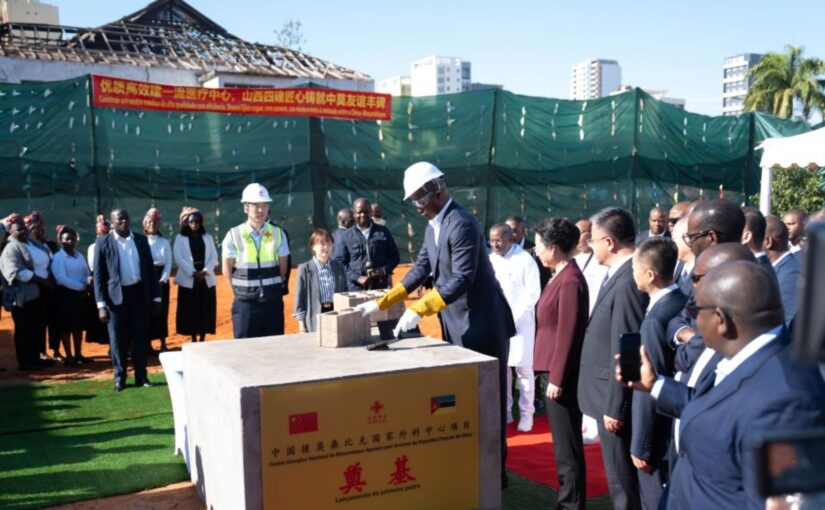
On August 3, a groundbreaking ceremony for the China-aided National Surgical Centre Project was held in the Mozambican capital Maputo. The complex will be built within Maputo Central Hospital and will include a surgical centre building and two utility buildings, with a total floor area of more than 20,000 square metres. The eight-storey facility will also house emergency and trauma services, a medical imaging department, a pharmacy, laboratories, 14 operating rooms, a 19-bed intensive care unit and 456 inpatient beds.
Addressing the ceremony, Mozambican President Daniel Chapo said the groundbreaking marked the beginning of a new stage in Mozambique’s capacity to save lives and treat complex diseases, enabling more Mozambicans to access specialised medical care within their own country.
Describing Mozambique and China as brotherly countries, Chapo said the Mozambican government hopes to work with the Chinese government to end the need for Mozambicans to travel abroad in search of better medical treatment.
A feature published by Xinhua on July 28 highlighted the 50th anniversary of cooperation between China and Mozambique in the field of health care.
On April 15, 1976, the first batch of 29 Chinese medical experts arrived in Mozambique, planting the seed for an enduring partnership that has since blossomed beyond clinical care to include medical training, technology transfer, emergency response, and healthcare infrastructure development.
In a recent interview with Xinhua, Mozambican Minister of Health Ussene Isse said that bilateral health cooperation has achieved positive results over the past five decades. The dispatch of Chinese medical teams, in his eyes, is “not merely a medical cooperation project, but a history of solidarity and a partnership that has remained steadfast across generations despite changes in the international environment.”
Over the past 50 years, China has sent 383 medical professionals in 26 teams to Mozambique, where they have treated approximately 1.4 million patients.
Apart from providing medical services, Isse noted that Chinese medical teams have helped build local capacity by training Mozambican healthcare professionals in fields including surgery, anesthesiology, and traditional Chinese medicine, while introducing advanced technologies such as telemedicine and laparoscopic surgery at Maputo Central Hospital.
South Africa
On July 31, South African President Cyril Ramaphosa hailed growing China-South Africa cooperation in clean energy, saying the participation of Chinese wind turbine manufacturer Goldwind in the Ummbila Emoyeni Wind Farm project demonstrates how bilateral partnerships are supporting the country’s just energy transition.
Addressing the launch of commercial operations of the 155-megawatt (MW) wind farm in Mpumalanga Province, Ramaphosa said South Africa welcomes Chinese companies’ participation in the country’s renewable energy development.
He added that South Africa’s future energy mix will combine coal, wind, hydropower, nuclear, solar, gas and other emerging technologies to ensure energy security while advancing decarbonisation. “South Africa’s future energy system will draw on the strengths and resources we already possess while embracing new opportunities.”
Chinese Ambassador to South Africa Wu Peng said: “It has been proven in practice that Chinese enterprises are not merely visitors from afar, but partners deeply rooted in South Africa. More and more Chinese enterprises are contributing to South Africa’s development.”
Zimbabwe
On the same day, Zimbabwean President Emmerson Mnangagwa hailed Chinese investment in lithium processing as key to maximising the value of the country’s mineral resources.
In a speech read on his behalf by Vice President Constantino Chiwenga at the opening of the Mining, Engineering and Transport Expo in Bulawayo, Mnangagwa commended China’s Zhejiang Huayou Cobalt for building Zimbabwe’s first lithium sulphate plant in Goromonzi, Mashonaland East Province. He also praised other Chinese-invested companies for pushing lithium beneficiation, including Sinomine’s subsidiary Bikita Minerals, which is also building a lithium sulphate plant in Bikita, Masvingo Province.
“Once set up, the plants will result in Zimbabwe being the only nation in Africa to host multiple lithium-processing operations,” Mnangagwa said. Zimbabwe had long derived limited benefits from supplying raw minerals to global markets, but “that narrative is changing”.
Zimbabwe, Africa’s major lithium producer, has seen significant investment in its lithium sector in recent years due to growing global demand for the mineral, which is critical to the global energy transition.
On July 23, it was announced that Zimbabwe has officially joined the BRICS New Development Bank (NDB), which will unlock crucial credit and funding opportunities for the country.
Established in 2014 by Brazil, Russia, India, China, and South Africa, the NDB officially began operations in 2015, with a mission to mobilise resources for infrastructure and sustainable development projects in BRICS member nations and other emerging-market economies and developing countries. Zimbabwe applied to join the bank in 2023, with formal accession negotiations progressing earlier this year. The country has also formally applied to join the BRICS group.
And on July 24, the Chinese Embassy in Zimbabwe hosted a reception to celebrate the 99th founding anniversary of the Chinese People’s Liberation Army (PLA).
Chinese Ambassador to Zimbabwe Zhou Ding said the profound friendship between China and Zimbabwe was forged in the national liberation struggle, giving rise to strong revolutionary bonds between the two countries. He noted that a Zimbabwean veterans’ delegation recently visited China to retrace their revolutionary steps, further consolidating the ties between the two nations.
Commander General of the Zimbabwe Defence Forces (ZDF) Emmanuel Matatu expressed his congratulations on the PLA’s 99th anniversary. He noted the coincidence that both militaries celebrate their milestones in August — the PLA marks its 99th anniversary on August 1, while the ZDF celebrates its 46th anniversary on August 11. Matatu also expressed gratitude for China’s unwavering support since the liberation war. “For the ZDF, the PLA has always been a reliable partner in our development,” he said, adding that the ZDF looks forward to further nurturing and cherishing this all-weather relationship for generations to come.
Democratic Republic of the Congo (DRC)
On July 29, President of the Democratic Republic of the Congo (DRC) Felix Tshisekedi inaugurated a Chinese-built water treatment plant in Kamina, capital of the southern province of Haut-Lomami.
Speaking at the inauguration ceremony, DRC Minister of Hydraulic Resources and Electricity Aime Sakombi Molendo said the project would help improve living and public health conditions for local residents and would bolster the country’s drinking water treatment capacity.
The project was financed by Sino Congolaise des Mines, a joint venture between the DRC state mining company Gecamines and a group of Chinese companies.
Underlining the importance of such projects, it was reported in the same week that more than 400 million Africans still lack access to basic drinking water, while over 700 million people across the continent remain without safely managed sanitation.
On August 1, China’s third medical expert team for Ebola response arrived in Kinshasa, capital of the DRC, to support the country’s efforts to strengthen its defences against the epidemic.
Luku Maleyo Marius, a representative of the DRC health ministry, welcomed the team at the airport. He said the Ebola situation in the DRC remained severe and response efforts continued to face considerable pressure. The arrival of the Chinese experts would provide strong support for epidemic surveillance, patient treatment and laboratory testing.
On August 4, a Chinese foreign ministry spokesperson in Beijing said that with the Ebola outbreak still spreading, China will continue to assist African countries and provide the support needed to bring an early end to the outbreak.
The third medical expert team is composed of experts in epidemiology, health quarantine, clinical treatment, and pathogen laboratory testing. Building on the work of the previous teams, it will continue to strengthen exchanges and coordination with the DRC and international organisations in light of the needs of epidemic prevention and control.
Namibia
On July 29, Chinese Ambassador to Namibia Zhao Weiping said at a press briefing that China will work with Namibia to translate the outcomes of President Netumbo Nandi-Ndaitwah’s recent state visit to China into concrete cooperation.
During the July 5-11 visit, the two countries elevated their relations to a China-Namibia community with a shared future for the new era and signed eight cooperation agreements.
Zhao noted that youth empowerment was given particular emphasis. Agricultural cooperation, which could help Namibia translate improved market access into export growth, was another major outcome. Cooperation will also extend to healthcare, including medical personnel training, disease control and emergency response, as well as the exploration of pharmaceutical production in Namibia.
Tanzania
On July 26, Tanzanian Vice President Emmanuel Nchimbi commended China Railway Construction Engineering Group (CRCEG) for the significant progress made in building the Arusha Stadium, a key venue for the 2027 Africa Cup of Nations (AFCON).
During an inspection visit, Nchimbi praised both the quality of work and the pace of implementation, noting that the project has reached 88 percent completion and is on track for delivery by the end of August 2026.
AFCON 2027 will be jointly hosted by Tanzania, Kenya and Uganda, marking the first time East African nations will co-host Africa’s premier football tournament.
Uganda
On July 23, Ugandan Vice President Jessica Alupo hailed the China-Uganda Agricultural Cooperation Industrial Park as a key driver of the country’s agricultural transformation through agro-processing.
Alupo made the remarks while leading a delegation of senior government officials on an assessment tour of the industrial park in the central Ugandan district of Luwero. She commended the FAO [UN Food and Agricultural Organisation]-China-Uganda South-South Cooperation initiative, under which the Chinese private sector-led industrial park was established, saying that it has enabled Uganda to process agricultural products for export to the world. Uganda stands to benefit further from China’s continued high-standard opening-up and its zero-tariff policy for eligible exports.
Luo Heng, chairman of Kehong Uganda Industrial Development Limited, the Chinese company managing the industrial park, said it plans to invest 500 million US dollars over the next five years as part of its second phase of development.
The following articles were originally published by the Xinhua News Agency.
China-aided national surgical center project breaks ground in Mozambique
MAPUTO, Aug. 3 (Xinhua) — A groundbreaking ceremony for the China-aided National Surgical Center Project was held on Monday in Maputo, the Mozambican capital.
The complex will be built within Maputo Central Hospital, including one surgical center building and two utility buildings, with a total floor area of more than 20,000 square meters.
The eight-story surgical center, with one basement level, will house emergency and trauma services, a medical imaging department, a pharmacy, laboratories, 14 operating rooms, a 19-bed intensive care unit and 456 inpatient beds.
Addressing the ceremony, Mozambican President Daniel Chapo said the groundbreaking marked the beginning of a new stage in Mozambique’s capacity to save lives and treat complex diseases, enabling more Mozambicans to access specialized medical care within their own country.
Describing Mozambique and China as brotherly countries, Chapo said the Mozambican government hopes to work with the Chinese government to end the need for Mozambicans to travel abroad in search of better medical treatment.
He said the two countries have built a solid partnership over decades, based on mutual respect, political trust and a shared commitment to seeking development solutions for the benefit of their peoples.
“This friendship is once again being translated into an investment that will have a direct impact on the lives of thousands of Mozambican families,” Chapo said, adding that he believes the project will become “another important symbol” of the long-standing friendship and cooperation between the two countries, particularly in the field of public health.
Chinese Ambassador to Mozambique Zheng Xuan said China has always prioritized people’s health and attached great importance to supporting the development of Mozambique’s healthcare sector.
She said China has continuously worked with Mozambique to improve the well-being of the two peoples by dispatching medical teams, providing medical training and supplying medical equipment and medicines.
Feature: 50 years on, China-Mozambique health cooperation carries forward life-saving mission
MAPUTO, July 28 (Xinhua) — On April 15, 1976, the first batch of 29 Chinese medical experts arrived in Mozambique, planting the seed for an enduring partnership that has since blossomed beyond clinical care to include medical training, technology transfer, emergency response, and healthcare infrastructure development.
In a recent interview with Xinhua, Mozambican Minister of Health Ussene Isse said that bilateral health cooperation has achieved positive results over the past five decades.
The dispatch of Chinese medical teams, in his eyes, is “not merely a medical cooperation project, but a history of solidarity and a partnership that has remained steadfast across generations despite changes in the international environment.”
Over the past 50 years, China has sent 383 medical professionals in 26 teams to Mozambique, where they have treated approximately 1.4 million patients.
Alongside their routine clinical work, Chinese doctors have successfully performed a wide range of complex surgeries. In 1986, the fifth Chinese medical team successfully performed a replantation surgery on a patient with a severed upper arm. In 2019, the 22nd team carried out the resection of a giant liver tumor.
Among the beneficiaries is Inacio Cesar, a journalist for Television of Mozambique.
In 1987, at age six, Cesar suffered a serious injury after his fingers were caught in a flour mixer. He was rushed to Maputo Central Hospital, where Chinese doctors treated him.
“I am deeply grateful to the Chinese medical team for treating me with their professional skills,” Cesar said. “Over the past 50 years of Mozambique-China medical cooperation, many people like me have received help from Chinese doctors.”
Chinese medical teams have also actively contributed to emergency responses following natural disasters and other crises in Mozambique. Medical supplies and relief assistance from the Chinese side reached affected communities after Cyclone Idai struck the African country in 2019 and during severe flooding in 2026.
According to the Mozambican health minister, bilateral cooperation has played an important role in addressing public health challenges and protecting people’s lives and health.
Apart from providing medical services, Isse noted that Chinese medical teams have helped build local capacity by training Mozambican healthcare professionals in fields including surgery, anesthesiology, and traditional Chinese medicine, while introducing advanced technologies such as telemedicine and laparoscopic surgery at Maputo Central Hospital.
In 2023, an intelligent laparoscopic training and assessment system was inaugurated at Maputo Central Hospital to enhance local doctors’ capacity to perform abdominal surgeries.
In recent years, China and Mozambique have continued to join hands in strengthening medical institutions and specialist healthcare capacity. The China-Africa Joint Medical Center (Mozambique) was established at Maputo Central Hospital, where the two sides also plan to build a national surgical center.
According to Isse, the joint medical center will focus on improving trauma care, particularly for victims of road traffic accidents, and is expected to further enhance Mozambique’s surgical capabilities and strengthen regional healthcare services.
Looking ahead, Isse expressed hope that the two countries will continue expanding cooperation in the health sector to further strengthen Mozambique’s healthcare system and enable more Mozambicans to access high-quality medical services within their own country.
China-South Africa clean energy cooperation highlighted as flagship wind farm launches
BETHAL, South Africa, Aug. 1 (Xinhua) — South African President Cyril Ramaphosa on Friday hailed growing China-South Africa cooperation in clean energy, saying the participation of Chinese wind turbine manufacturer Goldwind in Ummbila Emoyeni Wind Farm demonstrates how bilateral partnerships are supporting the country’s just energy transition.
Addressing the launch of commercial operations of the 155-megawatt (MW) wind farm in Mpumalanga Province, Ramaphosa said South Africa welcomes Chinese companies’ participation in the country’s renewable energy development.
“We are very pleased that it is a company that is riding on the relationship that South Africa has with China,” he said, referring to Goldwind, which supplied and commissioned the project’s wind turbines.
Ramaphosa said South Africa’s future energy mix will combine coal, wind, hydropower, nuclear, solar, gas and other emerging technologies to ensure energy security while advancing decarbonization.
“South Africa’s future energy system will draw on the strengths and resources we already possess while embracing new opportunities,” he added.
Speaking at the event, Chinese Ambassador to South Africa Wu Peng said: “I would like to extend my warm congratulations on the milestone achievement, and express gratitude to all who consistently support China-South Africa cooperation.”
The ambassador cited the De Aar Wind Power Project in Northern Cape Province and other successful projects, saying, “It has been proven in practice that Chinese enterprises are not merely visitors from afar, but partners deeply rooted in South Africa. More and more Chinese enterprises are contributing to South Africa’s development.”
The facility, located in South Africa’s traditional coal-producing region between Bethal, Davel and Morgenzon in Mpumalanga Province, is the first phase of South African company Seriti Green’s planned 900-MW renewable energy program, which aims to supply clean electricity to the company’s mining operations while supporting a more diversified and resilient national energy system.
Speaking to Xinhua on the sidelines of the launch ceremony, Goldwind Chairman Wu Gang said the project demonstrates how Chinese technology and local partnerships can help advance South Africa’s energy transition.
“As a Chinese enterprise, we are proud to work with our South African partners to advance clean energy development and contribute to the country’s sustainable growth,” Wu told Xinhua.
Noting China-Africa business cooperation is creating new opportunities for investment and innovation, he said: “Goldwind is committed to expanding its presence in South Africa by investing in more renewable energy and energy transition projects in the years ahead.”
Zimbabwean president hails Chinese investment in lithium beneficiation
HARARE, July 31 (Xinhua) — Zimbabwean President Emmerson Mnangagwa on Friday hailed Chinese investment in lithium processing as key to maximizing the value of the country’s mineral resources.
In a speech read on his behalf by Vice President Constantino Chiwenga at the opening of the Mining, Engineering and Transport Expo in Bulawayo, Mnangagwa commended China’s Zhejiang Huayou Cobalt for building Zimbabwe’s first lithium sulphate plant in Goromonzi, Mashonaland East Province.
Through its local subsidiary, Prospect Lithium Zimbabwe, the company in April dispatched Zimbabwe’s first-ever export of locally produced lithium sulphate, marking a major milestone in the southern African country’s drive toward mineral beneficiation and value addition.
Mnangagwa also praised other Chinese-invested companies for pushing lithium beneficiation, including Sinomine’s subsidiary Bikita Minerals, which is also building a lithium sulphate plant in Bikita, Masvingo Province.
“Once set up, the plants will result in Zimbabwe being the only nation in Africa to host multiple lithium-processing operations,” Mnangagwa said.
He said Zimbabwe had long derived limited benefits from supplying raw minerals to global markets, but “that narrative is changing.”
“Benefits must not only accrue to mining company shareholders, but to actors along the value chain including local communities,” Mnangagwa said, urging stakeholders to boldly transition to value addition.
Zimbabwe, Africa’s major lithium producer, has seen significant investment in its lithium sector in recent years due to growing global demand for the mineral, which is critical to the global energy transition.
To maximize benefits from the critical resource, the Zimbabwean Cabinet approved a ban on raw minerals and lithium concentrates exports in March, urging players in the industry to invest in processing plants.
Zimbabwe joins BRICS New Development Bank
HARARE, July 23 (Xinhua) — Zimbabwe has officially joined the BRICS New Development Bank (NDB), Finance, Economic Development and Investment Promotion Minister Mthuli Ncube announced on Thursday.
Speaking at the Zimbabwe Industrialization Conference and Expo in Harare, Ncube confirmed that Zimbabwe was admitted as a member of the Shanghai-based institution on Wednesday, unlocking crucial credit and funding opportunities for the country.
On the social media platform X, Zimbabwe’s Ministry of Information, Publicity and Broadcasting Services said that the milestone secures access to development finance, strengthens economic ties with BRICS nations, and gives Zimbabwe a voice in global decision-making.
Established in 2014 by Brazil, Russia, India, China, and South Africa, the NDB officially began operations in 2015, with a mission to mobilize resources for infrastructure and sustainable development projects in BRICS member nations and other emerging-market economies and developing countries.
Zimbabwe applied to join the bank in 2023, with formal accession negotiations progressing earlier this year. The country has also formally applied to join the BRICS group.
Reception held in Zimbabwe to celebrate PLA’s 99th founding anniversary
HARARE, July 24 (Xinhua) — The Chinese Embassy in Zimbabwe hosted a reception on Friday to celebrate the 99th founding anniversary of the Chinese People’s Liberation Army (PLA).
Zimbabwean government ministers, senior military officers, diplomats, and liberation war veterans attended the event, seeking to bolster traditional friendship between the two countries.
Speaking at the reception, Wang Zhenyu, Defense Attache at the Chinese embassy, highlighted the PLA’s commitment to the Global Security Initiative, saying that over the past 36 years, the Chinese military has deployed more than 50,000 personnel to United Nations peacekeeping operations.
“No matter how the international situation evolves, the PLA will remain committed to its responsibilities, safeguarding world peace and advancing the vision of a shared future for all,” Wang said.
Chinese Ambassador to Zimbabwe Zhou Ding said the profound friendship between China and Zimbabwe was forged in the national liberation struggle, giving rise to strong revolutionary bonds between the two countries.
He noted that a Zimbabwean veterans’ delegation recently visited China to retrace their revolutionary steps, further consolidating the ties between the two nations.
“Over the years, the long-standing fraternity has matured into a resilient, all-weather China-Zimbabwe community with a shared future, delivering fruitful outcomes across diverse sectors,” Zhou said.
Commander General of the Zimbabwe Defense Forces (ZDF) Emmanuel Matatu expressed his congratulations on the PLA’s 99th anniversary. He noted the coincidence that both militaries celebrate their milestones in August — the PLA marks its 99th anniversary on August 1, while the ZDF celebrates its 46th anniversary on August 11.
Matatu also expressed gratitude for China’s unwavering support since the liberation war. “For the ZDF, the PLA has always been a reliable partner in our development,” he said, adding that the ZDF looks forward to further nurturing and cherishing this all-weather relationship for generations to come.
On the sidelines of the reception, the 23rd Chinese medical team to Zimbabwe provided free healthcare services to the attending liberation war veterans and distributed brochures to promote disease prevention and treatment.
DR Congo president inaugurates Chinese-built water plant
KINSHASA, July 30 (Xinhua) — President of the Democratic Republic of the Congo (DRC) Felix Tshisekedi on Wednesday inaugurated a Chinese-built water treatment plant in Kamina, capital of the southern province of Haut-Lomami.
Tshisekedi toured the plant’s operational sections, inspected its water treatment equipment and also examined a water sample before officially switching on the pumping system, while expressing satisfaction with the project, according to the presidency.
Speaking at the inauguration ceremony, DRC Minister of Hydraulic Resources and Electricity Aime Sakombi Molendo said the project would help improve living and public health conditions for local residents and would bolster the country’s drinking water treatment capacity.
The DRC government would continue developing modern water supply facilities to expand access to safe drinking water across the country, the minister added.
Chinese Ambassador to the DRC Zhao Bin said the Kamina water plant was a project born through practical cooperation between China and the DRC.
China stands ready to work with the DRC to deepen practical cooperation in various fields and deliver more benefits to the two peoples, Zhao said.
The project was financed by Sino Congolaise des Mines, a joint venture between the DRC state mining company Gecamines and a group of Chinese companies.
With a designed daily supply capacity of more than 7,000 cubic meters, the plant is expected to provide drinking water that meets local health standards to residents of Kamina and surrounding areas.
Over 400 mln Africans lack access to basic drinking water: UN official
ADDIS ABABA, July 29 (Xinhua) — More than 400 million Africans still lack access to basic drinking water, while over 700 million people across the continent remain without safely managed sanitation, according to Claver Gatete, United Nations under-secretary-general and executive secretary of the United Nations Economic Commission for Africa.
While addressing the 49th Ordinary Session of the Executive Council of the African Union (AU) on Tuesday in Addis Ababa, the capital of Ethiopia, Gatete said the situation is undermining health, productivity, food security and economic development of the continent.
Noting that rainfall is becoming less predictable, Gatete said climate-related shocks are already reducing agricultural productivity and costing some African economies as much as 5 percent of their gross domestic product each year.
Highlighting that water sits at the center of every major development challenge confronting Africa today, the executive secretary urged African governments to embrace integrated planning across water, agriculture, energy, climate, industry and urban development.
According to the executive secretary, the responses require stronger domestic resource mobilization, innovative financing instruments, sound public financial management, and stronger domestic and regional capital markets.
Gatete also urged expanding local-currency financing, mobilizing pension and insurance assets, and developing bankable projects to increase Africa’s savings and finance its development programs.
The executive secretary recalled that nearly 600 million Africans continue to live without access to electricity, limiting productivity, industrialization and competitiveness.
“We need to accelerate structural transformation, advance industrialization, expand productive capacities, deepen regional integration and mobilize resources at the scale required to deliver both the Sustainable Development Goals and Africa’s Agenda 2063,” Gatete pointed out.
Highlighting that Africa has abundant renewable energy resources, the world’s youngest population and many of the strategic minerals required for the global energy transition, Gatete called for advancing agro-processing, renewable energy technologies, manufacturing and modern services across the continent.
He said Africa’s future depends not on pursuing isolated priorities, but on connecting water security, industrialization, climate action, finance and regional integration into a single development agenda.
Held under the AU’s 2026 theme, “Assuring Sustainable Water Availability and Safe Sanitation Systems to Achieve the Goals of Agenda 2063,” the two-day session, which brought African foreign ministers together, is expected to deliberate on key continental priorities, including water security, sanitation, financing, regional integration and sustainable development.
China’s third medical expert team arrives in DR Congo to support Ebola response
KINSHASA, Aug. 1 (Xinhua) — China’s third medical expert team for the Ebola response arrived in Kinshasa, capital of the Democratic Republic of the Congo (DRC), on Saturday to support the country’s efforts to strengthen its defenses against the epidemic.
Luku Maleyo Marius, a representative of the DRC health ministry, welcomed the team at the airport.
He said the Ebola situation in the DRC remained severe and response efforts continued to face considerable pressure. The arrival of the Chinese experts would provide strong support for epidemic surveillance, patient treatment and laboratory testing, he said.
The DRC stands ready to further strengthen cooperation with China and jointly enhance its epidemic response capacity, he added.
Yang Xiaochen, head of the third expert team, said the team would build on the work of the previous two teams, continue providing technical assistance in line with practical response needs, and deepen exchanges and cooperation with the DRC’s health authorities and relevant international partners.
The team would contribute Chinese expertise to efforts to bring the current Ebola outbreak to an early end, Yang said.
China will continue to assist African countries in fighting Ebola: spokesperson
BEIJING, Aug. 4 (Xinhua) — A Chinese foreign ministry spokesperson on Tuesday said that with the Ebola outbreak still spreading, China will continue to assist African countries and provide the support needed to bring an early end to the outbreak.
Chinese foreign ministry spokesperson Lin Jian made the remarks when answering a query about the third medical expert team sent by the Chinese government that arrived in Kinshasa, the capital of the Democratic Republic of the Congo (DRC), on Aug. 1.
Lin said that in the wake of the Ebola outbreak in Africa, China has taken the situation seriously and sent multiple medical expert teams there including the DRC to fight the outbreak, which has been highly commended.
The third medical expert team is composed of experts in epidemiology, health quarantine, clinical treatment, and pathogen laboratory testing. Building on the work of the previous teams, the team will continue to strengthen exchanges and coordination with the DRC and international organizations in light of the needs of epidemic prevention and control, according to Lin.
“With the Ebola outbreak still spreading, China will continue to bring to bear its medical professionals on the continent, assist African countries and provide the support needed to bring an early end to the outbreak,” Lin said.
China remains committed to implementing consensus of Chinese, Namibian leaders: ambassador
WINDHOEK, July 29 (Xinhua) — China will work with Namibia to translate the outcomes of President Netumbo Nandi-Ndaitwah’s recent state visit to China into concrete cooperation, Chinese Ambassador to Namibia Zhao Weiping said Tuesday at a press briefing in Windhoek.
During the July 5-11 visit, the two countries elevated their relations to a China-Namibia community with a shared future for the new era and signed eight cooperation agreements.
Zhao noted that youth empowerment was given particular emphasis.
China’s Ministry of Commerce has awarded scholarships to 87 Namibian students for master’s and doctoral studies this year, while the two countries signed a memorandum of understanding to promote exchanges and cooperation between their technical and vocational education institutions.
Agricultural cooperation, which could help Namibia translate improved market access into export growth, was another major outcome, according to the ambassador.
The two countries signed a protocol setting phytosanitary requirements for Namibian fresh table grapes to enter the Chinese market. China also announced a regional market-access arrangement for wild aquatic products from Africa, creating new opportunities for Namibian fisheries exports.
These measures followed China’s implementation of zero-tariff treatment for all 53 African countries with which it maintains diplomatic relations. Zhao said China would take further steps to facilitate the entry of African agricultural products into its market.
Cooperation will also extend to healthcare, including medical personnel training, disease control and emergency response, as well as the exploration of pharmaceutical production in Namibia. China also pledged additional grant assistance for development projects in the country.
Zhao said these sectoral measures would support Namibia’s broader efforts to accelerate industrialization and attract investment.
Addressing other media questions regarding Namibian efforts to attract foreign direct investment, the ambassador commended the Namibian delegation’s push to accelerate domestic industrialization.
Zhao meanwhile assured the media that “nothing will only stay in the papers,” promising concrete actions as China works alongside the Namibian government to carry out everything agreed upon by the two nations.
“The key message is that more companies will come to invest in Namibia, to help Namibia advance its industrialization,” Zhao said. “There will certainly be concrete actions.”
Tanzania VP commends Chinese firm for progress on Arusha stadium for AFCON 2027
DAR ES SALAAM, July 26 (Xinhua) — Tanzanian Vice President Emmanuel Nchimbi on Sunday commended China Railway Construction Engineering Group (CRCEG) for the significant progress made in building the Arusha Stadium, a key venue for the 2027 Africa Cup of Nations (AFCON), according to a statement by the Vice President’s communications unit.
During an inspection visit, Nchimbi praised both the quality of work and the pace of implementation, noting that the project has reached 88 percent completion and is on track for delivery by the end of August 2026, said the statement.
He said the progress reflects the government’s commitment to successfully host the continental tournament, adding that timely completion of the stadium is crucial for preparations.
He urged authorities to ensure that supporting infrastructure, including access roads to the stadium, is completed on schedule in line with President Samia Suluhu Hassan’s directive.
AFCON 2027 will be jointly hosted by Tanzania, Kenya and Uganda, marking the first time East African nations will co-host Africa’s premier football tournament.
Uganda VP hails China-backed agro-industrial park for boosting agricultural transformation
LUWERO, Uganda, July 23 (Xinhua) — Ugandan Vice President Jessica Alupo on Thursday hailed the China-Uganda Agricultural Cooperation Industrial Park as a key driver of the country’s agricultural transformation through agro-processing.
Alupo made the remarks while leading a delegation of senior government officials on an assessment tour of the industrial park in the central Ugandan district of Luwero.
“Today’s visit is a concrete demonstration of Uganda’s commitment to transforming our economy through targeted agro-industrialization,” she said. “Our strategic goal is clear: to transform our agricultural sector from traditional subsistence practices to commercialized high-value modern agri-business.”
Alupo commended the FAO-China-Uganda South-South Cooperation initiative, under which the Chinese private sector-led industrial park was established, saying that it has enabled Uganda to process agricultural products for export to the world.
She pledged that the Ugandan government would continue improving and supporting infrastructure and policy measures to facilitate the park’s development and create a more enabling environment for agro-industrial investment.
The industrial park, marking its 10th anniversary this year, includes a pineapple canning factory, a chili processing plant that supplies dried chilies to China, and a poultry farm supplying eggs to domestic and regional markets.
Uganda stands to benefit further from China’s continued high-standard opening-up and its zero-tariff policy for eligible exports, said Alupo. “We look forward to having more related exports by taking advantage of the 100 percent zero tariff policy.”
Luo Heng, chairman of Kehong Uganda Industrial Development Limited, the Chinese company managing the industrial park, said the first phase of development, launched in 2016, has been completed, covering major projects including commercial layer farming, contract chili cultivation, pineapple processing, and the promotion of improved rice varieties.
Luo said the park plans to invest 500 million U.S. dollars over the next five years as part of its second phase of development.