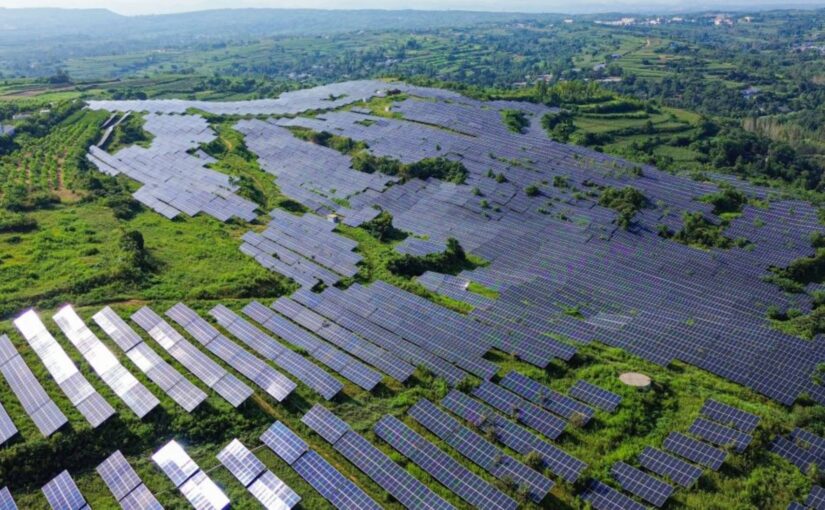
Solar is now China’s single largest power source by installed capacity. The country’s installed photovoltaic capacity reached 1,286 gigawatts at the end of July, overtaking coal for the first time. PV now accounts for over 30 percent of total installed capacity, and represents more than 40 percent of capacity added in 2026.
To give a frame of comparison: China’s solar capacity alone is now around ten times Britain’s entire generating capacity, from all sources. Under the current five-year plan, another 2,800 gigawatts of renewable capacity is to be integrated by 2030 – roughly double the whole installed capacity of the United States.
Note that installed capacity is not the same as generation. Solar produced 802.4 billion kilowatt-hours from January to July, which is 13 percent of China’s electricity consumption. Liu Zhiqiang of the China Electricity Council notes that PV is intermittent and volatile, that its utilisation hours are far below coal’s, and that “in the short term, coal-fired power will remain a major source of support for the power system in China”.
However, China is working rapidly on technological innovation, and plans to generate around 6 trillion kilowatt-hours of renewable energy annually by 2030, with over 4 trillion from wind and solar, alongside integrated PV-storage systems and PV hydrogen production.
The trajectory is clear. Coal supplied around 80 percent of China’s electricity at the start of this century. It fell below 50 percent of output in the first half of this year. Carbon emissions appear to have peaked in 2023, some seven years ahead of target.
The global significance of this is profound. China manufactures over 80 percent of the world’s solar modules and 70 percent of its wind equipment. That industrial scale is why the cost of renewable energy globally is a fraction of what it was 15 years ago. This collapse in price is the single most important factor making decarbonisation viable for much of the Global South.
Cuba, under an illegal blockade and suffering daily blackouts, has installed around 1,000 megawatts of Chinese solar in two years. Zambia is getting a solar plant with battery storage in every one of its 156 constituencies. Africa’s clean energy boom runs on Chinese equipment.
Meanwhile, the US is dismantling its clean energy industry while ramping up drilling. Britain is opening new North Sea fields. The EU imposes tariffs on Chinese electric vehicles and solar panels that could help cut its emissions.
China’s remarkable progress in renewable energy is the product of long-term state direction, sustained public investment and the deliberate construction of a complete industrial chain over two decades – that is, the things Western journalists and politicians consistently denounce as distortion and overcapacity.
A global energy transition is being made possible by Chinese socialism.
The following article was originally published by the Xinhua News Agency.
BEIJING, Sept. 1 (Xinhua) — China’s installed photovoltaic (PV) power capacity has surpassed coal-fired power capacity for the first time, making PV the country’s largest power source by installed capacity, the National Energy Administration said on Tuesday.
China’s installed PV power capacity reached 1.286 billion kilowatts at the end of July, edging past the coal-fired power capacity of 1.285 billion kilowatts, according to the administration.
“This marks a milestone in China’s green and low-carbon energy transition,” said Liu Zhiqiang, an expert from the China Electricity Council, adding that the country’s new power system, with new energy as the mainstay, is taking shape at an accelerated pace.
By the end of July, PV power had accounted for more than 30 percent of China’s total installed power generation capacity. Measured by newly added capacity, the share rose to over 40 percent in the first seven months of 2026, underscoring the rapid expansion of the PV sector.
China has built a complete PV industry chain covering research and development, design and integrated manufacturing. Technological advances, including repeated breakthroughs in PV conversion efficiency, have helped drive continuous upgrades and swift cost reductions.
China’s speedy development of PV power and other forms of new energy is also making a positive contribution globally.
With the world’s largest and fastest-growing renewable energy system, the country supplies over 80 percent of PV modules and 70 percent of wind power equipment around the world, assisting the green transition in many countries.
In particular, amid uncertainties in global supplies of energy and key raw materials, China’s growing new energy capacity helped it meet domestic energy demand while contributing to the stability of global energy markets and supply chains, experts said.
Installed capacity, however, does not equate to actual power generation. From January to July, PV power generation totaled 802.4 billion kilowatt-hours, accounting for 13 percent of the country’s total electricity consumption.
“PV power is highly intermittent and volatile due to day-night cycles and weather conditions, with utilization hours far lower than those of coal-fired power. In the short term, coal-fired power will remain a major source of support for the power system in China, serving as a backstop for power system security,” Liu said.
China is now moving to strengthen the role of renewable energy in ensuring a secure and reliable power supply. Several energy plans for the 15th Five-Year Plan period (2026-2030) have set out specific measures to better integrate renewable energy into the power system.
For example, the country aims to achieve around 6 trillion kilowatt-hours in annual renewable power generation by 2030, with wind and PV power generation expected to exceed 4 trillion kilowatt-hours.
China will strive to make PV power more predictable and dispatchable through continued technological innovation and diversified applications, including integrated PV-storage systems and PV hydrogen production, Liu noted.