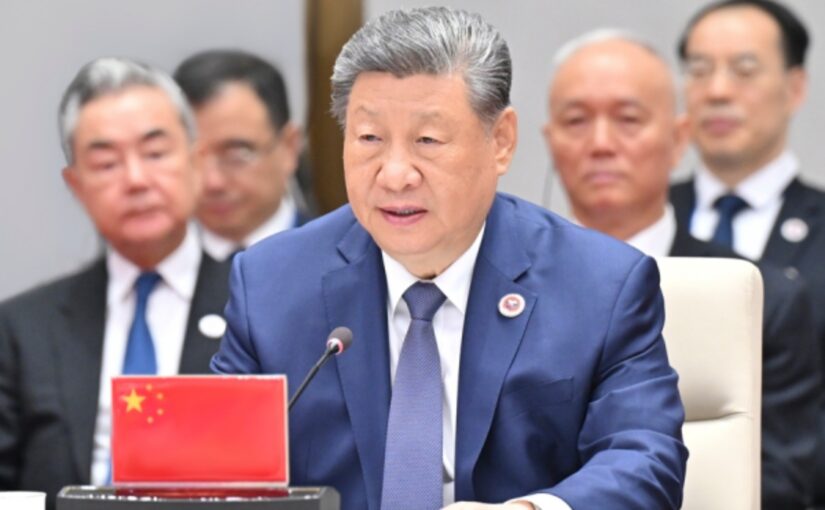
From August 30 to September 3, Chinese President Xi Jinping attended the Shanghai Cooperation Organisation (SCO) Summit 2026 in Bishkek, capital of Kyrgyzstan and paid a state visit to the country followed by one to Egypt.
On the morning of September 1, President Xi attended the 26th meeting of the Council of Heads of State of the SCO.
The meeting was chaired by President Sadyr Zhaparov of Kyrgyzstan, the current holder of the rotating presidency of the SCO, and attended by leaders of SCO member states, including President Aleksandr Lukashenko of Belarus, Prime Minister Narendra Modi of India, President Masoud Pezeshkian of Iran, President Kassym-Jomart Tokayev of Kazakhstan, Prime Minister Muhammad Shehbaz Sharif of Pakistan, President Vladimir Putin of Russia, President Emomali Rahmon of Tajikistan, President Shavkat Mirziyoyev of Uzbekistan, and Secretary General Nurlan Yermekbayev of the SCO.
Xi Jinping delivered a speech on the theme, “Toward Higher Quality Development of the Shanghai Cooperation Organisation.”
He pointed out that this year is the 25th anniversary of the SCO: “Twenty-five years ago, reckoning with the hard lessons of the Cold War, confronting the real threats from terrorist, separatist and extremist forces, and heeding the earnest aspirations of the world for peace and development, countries in our region came to a prevailing consensus on upholding sovereignty, security, and development interests. The SCO was founded in this context, and it has shown increasingly stronger vigour and vitality. Over the past 25 years, the SCO has travelled an extraordinary journey. Its biggest achievement is that it has steadily grown into a new type of regional cooperation organisation with the largest land area and population and enormous development potential. Its most valuable spiritual asset is that it pioneered, and has since followed invariably, the Shanghai Spirit of mutual trust, mutual benefit, equality, consultation, respect for diversity of civilisations, and pursuit of common development. Its most important experience for cooperation is that it has found the right way of coexistence featuring non-alliance, non-confrontation and not targeting any third party, enabling regional countries to build a common home together. Twenty-five years later today, transformation not seen in a century is accelerating across the globe. The rivalry is intensifying between dialogue and confrontation, win-win and zero-sum, and multilateralism and unilateralism. The shadow of war continues to haunt the world. At such a crossroads with humanity’s future at stake, the SCO should step forward to shoulder its historical responsibility and steer the course for the future.”
In this regard, President Xi put forward four points:
- Staying committed to putting development first and opening up the prospects for shared prosperity.
- Staying committed to taking security as a key goal and fostering an environment of common security.
- Staying committed to a people-centred approach, and cementing the foundation for everlasting friendship.
- Staying committed to dialogue and consultation, and striving for more equitable and orderly governance. “We should always advocate that all countries, regardless of their size, are equal, and that regional affairs should be discussed by all countries to bridge differences and build consensus, properly handle differences through dialogue and consultation, and meet common challenges through multilateral collaboration.”
Leaders of the SCO member states signed and issued the Bishkek Declaration on the 25th Anniversary of the Shanghai Cooperation Organisation and approved a large number of other agreements and documents.
In the afternoon of September 1, President Xi attended the Shanghai Cooperation Organisation (SCO) Plus Meeting and delivered an important statement entitled “Jointly Advocating an Equal and Orderly Multipolar World and Making Global Governance More Just and Equitable”.
He pointed out that the meeting focuses on strengthening the role of the United Nations and building a multipolar world, and it demonstrates SCO’s commitment to reforming and improving global governance as required by our times. “Currently, major changes unseen in a century are accelerating across the globe. Hegemonism, unilateralism and protectionism are resurging against historical trends. Nevertheless, the overwhelming majority of the world do not condone power politics, conflict and confrontation, or isolation and backwardness. What they want instead is to hold a place on the world stage through national development and international cooperation. In recent years, the rise of the Global South is driving a profound shift in the international balance of power. The trend toward a multipolar world is irreversible.”
Xi stressed that as a responsible major country, China advocates for an equal and orderly multipolar world. Sovereign equality and mutual respect are fundamental principles. “Mutual benefit, win-win, and inclusiveness are the way forward for development. We should ensure equal rights, equal opportunities and equal rules for all countries, regardless of their size, strength and wealth. As an important part of a multipolar world and a key driving force behind it, the Global South countries ought to have greater representation and voice in international affairs. We should promote the common values of humanity, reject double standards, exceptionalism, foreign interference, bullying and the law of the jungle, and advance the rule of law in international relations. Major countries in particular should take the lead in observing international norms and honouring the rule of law, and work together to tackle global challenges. We need to uphold the principle that world affairs should be discussed by all, and international norms should be set by all. The authority and vitality of the UN need to be restored.”
Xi pointed out that after a 25-year journey, the SCO has successfully set a stellar example in conducting relations among big countries, among neighbours, and among countries of different sizes. It has successfully brought together half of the world’s population and a quarter of the global economy, generating strong driving forces for development. A more united and vibrant SCO is fully capable of making greater contributions to a multipolar world.
To this end he put forward three points:
- We should advance common prosperity in the vast continent straddling Asia and Europe with the SCO Strength.
- We should promote the development and rise of the Global South through the SCO Wisdom.
- We should guide the reform and improvement of global governance through the SCO Action.
He concluded: “Let us take the people-centred and action-oriented approach, jointly advocate an equal and orderly multipolar world, make global governance more just and equitable, and build a community with a shared future for humanity.”
The meeting was chaired by President Sadyr Zhaparov of Kyrgyzstan, the current holder of the rotating presidency of the SCO, and attended by leaders of SCO member states, along with leaders of other countries invited, including Mongolia, Azerbaijan, Armenia, Egypt, Laos, Türkiye, Vietnam, and Togo, and heads of international and regional organisations including UN Secretary General António Guterres.
The following articles were originally published on the website of the Chinese Foreign Ministry.
President Xi Jinping Attends the 26th Meeting of the Council of Heads of State of the Shanghai Cooperation Organization and Delivers Important Remarks
September 1 (MFA) – On the morning of September 1, 2026 local time, President Xi Jinping attended the 26th meeting of the Council of Heads of State of the Shanghai Cooperation Organization (SCO) in Bishkek.
The meeting was chaired by President Sadyr Zhaparov of Kyrgyzstan, the current holder of the rotating presidency of the SCO, and attended by leaders of SCO member states, including President Aleksandr Lukashenko of Belarus, Prime Minister Narendra Modi of India, President Masoud Pezeshkian of Iran, President Kassym-Jomart Tokayev of Kazakhstan, Prime Minister Muhammad Shehbaz Sharif of Pakistan, President Vladimir Putin of Russia, President Emomali Rahmon of Tajikistan, President Shavkat Mirziyoyev of Uzbekistan, and Secretary General Nurlan Yermekbayev of the SCO.
President Xi had a group photo with leaders of SCO member states. He then attended the meeting of the Council of Heads of State and delivered important remarks titled “Toward Higher Quality Development of the Shanghai Cooperation Organization.”
President Xi pointed out that this year is the 25th anniversary of the Shanghai Cooperation Organization. Twenty-five years ago, reckoning with the hard lessons of the Cold War, confronting the real threats from terrorist, separatist and extremist forces, and heeding the earnest aspirations of the world for peace and development, countries in our region came to a prevailing consensus on upholding sovereignty, security, and development interests. The SCO was founded in this context, and it has shown increasingly stronger vigor and vitality. Over the past 25 years, the SCO has traveled an extraordinary journey. Its biggest achievement is that it has steadily grown into a new type of regional cooperation organization with the largest land area and population and enormous development potential. Its most valuable spiritual asset is that it pioneered, and has since followed invariably, the Shanghai Spirit of mutual trust, mutual benefit, equality, consultation, respect for diversity of civilizations, and pursuit of common development. Its most important experience for cooperation is that it has found the right way of coexistence featuring non-alliance, non-confrontation and not targeting any third party, enabling regional countries to build a common home together. Twenty-five years later today, transformation not seen in a century is accelerating across the globe. The rivalry is intensifying between dialogue and confrontation, win-win and zero-sum, and multilateralism and unilateralism. The shadow of war continues to haunt the world. At such a crossroads with humanity’s future at stake, the SCO should step forward to shoulder its historical responsibility and steer the course for the future.
For this, President Xi put forth four points:
First, staying committed to putting development first, and opening up the prospects for shared prosperity. We should advocate a universally beneficial and inclusive economic globalization, consolidate cooperation in traditional areas such as trade, investment, connectivity, energy and resources, and expand cooperation in emerging areas such as artificial intelligence, digital economy, green industry and green mining. We should do all this in order to deepen, substantiate and upgrade regional cooperation. China takes the SCO as a priority area for promoting high-quality Belt and Road cooperation and implementing the Global Development Initiative. China will continue to ensure the success of the SCO Digital Economy Forum, the SCO Agricultural Expo, and other events. It will develop an international AI application cooperation center with fellow SCO countries, establish a China-SCO port economic cooperation center in Tianjin, and implement 100 technological cooperation projects with other SCO countries in the next three years.
Second, staying committed to taking security as a key goal, and fostering an environment of common security. We should pursue coordinated measures to tackle traditional and non-traditional security threats. We should crack down on the three forces of terrorism, separatism and extremism, transnational organized crime, drug trafficking, and telecom fraud. We should strengthen cooperation on information security, bio-security, and outer space security. We must prevent external forces from interfering in our internal affairs, endangering our political security, and undermining regional stability. China stands ready to work with all parties to act on the vision of common, comprehensive, cooperative, and sustainable security, and make the SCO an important platform for implementing the Global Security Initiative. China supports the early opening of the SCO’s four security centers so as to upgrade the capacity of member states in responding to security threats and challenges.
Third, staying committed to a people-centered approach, and cementing the foundation for everlasting friendship. We should fully appreciate the distinctiveness of every country in its history, culture, social system, and development stage, and build cooperation networks between legislatures, political parties, institutions of education, think tanks, businesses, and the media, so as to promote nongovernmental exchanges and invigorate good-neighborliness and friendship among member states. China stands ready to work with all parties to implement the Global Civilization Initiative and supports a bigger role by nongovernmental friendship institutions such as the SCO Good-Neighborliness, Friendship and Cooperation Commission. China will establish a China-SCO basic education cooperation center, and continue to build bridges for exchanges, mutual learning and people-to-people connectivity through Confucius Institutes, Luban Workshops and other programs.
Fourth, staying committed to dialogue and consultation, and striving for more equitable and orderly governance. We should always advocate that all countries, regardless of their size, are equal, and that regional affairs should be discussed by all countries to bridge differences and build consensus, properly handle differences through dialogue and consultation, and meet common challenges through multilateral collaboration. China supports the model cooperation by the SCO on practicing the Global Governance Initiative, and calls on continuous institutional improvement of the SCO to boost its efficiency in making and executing decisions. China welcomes more like-minded countries to be partners in our joint efforts to improve regional and global governance.
President Xi noted that China will work with all parties to continue to hold high the banner of the Shanghai Spirit, implement the development strategy of the SCO for the next decade, and pursue development with higher quality, so as to make greater contributions to a community with a shared future for humanity.
Leaders of the SCO member states fully affirmed the achievements the Organization has made in the past 25 years, and recognized that the SCO has provided important guarantee for regional security and prosperity and has become one of the cornerstones of global stability and economic development. All parties expressed appreciation for China’s important contribution to the organization’s development as a founding member, and agreed to actively implement the strategic vision set out at the 2025 Tianjin Summit, continue to uphold the Shanghai Spirit, promote institution-building, enhance political mutual trust, deepen cooperation in areas including trade, investment, science and technology, energy, finance, industrial and supply chains, and connectivity, strengthen people-to-people bonds, and jointly respond to new types of security challenges, with a view to writing a new chapter of lasting peace and common development. In the face of a complex and volatile international situation, SCO member states should embrace solidarity and cooperation, enhance the influence of SCO, promote the building of a more just and equitable global governance system, and play a greater role in safeguarding peace, stability and prosperity in the region and beyond.
Leaders of the SCO member states signed and issued the Bishkek Declaration on the 25th Anniversary of the Shanghai Cooperation Organization, approved the Protocol on Amending and Supplementing the Charter of the Shanghai Cooperation Organization, the Regulations on the SCO Universal Center for Countering Security Challenges and Threats, and the Regulations on the SCO Anti-drug Center, and adopted 28 outcome documents covering security, economic, people-to-people and cultural cooperation, and organizational development.
The meeting decided that Pakistan will assume the rotating presidency of the SCO for 2026-2027.
Cai Qi and Wang Yi, among others, attended the above events.
Toward Higher-Quality Development of the Shanghai Cooperation Organization
Remarks by H.E. Xi Jinping, President of the People’s Republic of China, at the 26th Meeting of the Council of Heads of State of the Shanghai Cooperation Organization
Bishkek, September 1, 2026 (MFA)
Your Excellency President Sadyr Zhaparov,
Colleagues,
It is a great pleasure to join you in Bishkek. I would like to thank President Zhaparov for the thoughtful arrangements for our meeting. Since assuming the chairmanship, Kyrgyzstan has, under the theme “Together Toward Sustainable Peace, Development, and Prosperity,” held a variety of activities with remarkable success. China highly commends all this.
August 31 and September 1 mark the 35th anniversaries of the independence of Kyrgyzstan and Uzbekistan. I wish to extend our heartfelt congratulations to President Zhaparov, President Mirziyoyev, and to the friendly people of Kyrgyzstan and Uzbekistan.
This year is the 25th anniversary of the Shanghai Cooperation Organization. Twenty-five years ago, reckoning with the hard lessons of the Cold War, confronting the real threats from terrorist, separatist and extremist forces, and heeding the earnest aspirations of the world for peace and development, countries in our region came to a prevailing consensus on working together to uphold sovereignty, security, and development interests. Our organization was founded in this context, and it has shown increasingly stronger vigor and vitality.
Over the past 25 years, the SCO has traveled an extraordinary journey. Its biggest achievement is that it has steadily grown into a new type of regional cooperation organization with the largest land area and population and enormous development potential. Its most valuable spiritual asset is that it pioneered, and has since followed invariably, the Shanghai Spirit of mutual trust, mutual benefit, equality, consultation, respect for diversity of civilizations, and pursuit of common development. Its most important experience for cooperation is that it has found the right way of coexistence featuring non-alliance, non-confrontation and not targeting any third party, enabling regional countries to build a common home together.
Twenty-five years later today, transformation not seen in a century is accelerating across the globe. The rivalry is intensifying between dialogue and confrontation, win-win and zero-sum, and multilateralism and unilateralism. The shadow of war continues to haunt the world. At such a crossroads with humanity’s future at stake, the SCO should step forward to shoulder its historical responsibility and steer the course for the future.
First, we should stay committed to putting development first, and open up the prospects for shared prosperity. We should advocate a universally beneficial and inclusive economic globalization, consolidate cooperation in traditional areas such as trade, investment, connectivity, energy and resources, and expand cooperation in emerging areas such as artificial intelligence, digital economy, green industry and green mining. We should do all this in order to deepen, substantiate and upgrade regional cooperation.
China takes the SCO as a priority area for promoting high-quality Belt and Road cooperation and implementing the Global Development Initiative. In light of the development needs of this region, we will continue to ensure the success of the SCO Digital Economy Forum, the SCO Agricultural Expo, and other events. We will develop an international AI application cooperation center with fellow SCO countries, continue to work with fellow SCO countries to increase the installed capacity of photovoltaic and wind power each by 10 million kilowatts, implement 100 technological cooperation projects with other SCO countries in the next three years, and nurture more green industry talents through China-SCO cooperation. China welcomes interested member states to take an active part in the “Big Market for All: Export to China” event series to seize the opportunities on China’s super-sized market. To facilitate trade and logistics in the region, China supports improving the performance and efficiency of the Trans-Caspian International Transport Corridor, and will establish a China-SCO port economic cooperation center in Tianjin.
Second, we should stay committed to taking security as a key goal, and foster an environment of common security. We should pursue coordinated measures to tackle traditional and non-traditional security threats. We should crack down on the three forces of terrorism, separatism and extremism, transnational organized crime, drug trafficking, and telecom fraud. We should strengthen cooperation on information security, bio-security, and outer space security. We must prevent external forces from interfering in our internal affairs, endangering our political security, and undermining regional stability.
China stands ready to work with all parties to act on the vision of common, comprehensive, cooperative, and sustainable security, and make our organization an important platform for implementing the Global Security Initiative. We believe in a sensible, coordinated, and balanced approach to nuclear security, and support a stronger multilateral partnership for nuclear safety and security. We support the early opening of the SCO’s four security centers so as to upgrade the capacity of member states in responding to security threats and challenges.
Third, we should stay committed to a people-centered approach, and cement the foundation for everlasting friendship. Diversity of civilization and culture is a salient feature of our region. We should fully appreciate the distinctiveness of every country in its history, culture, social system, and development stage, and build cooperation networks between legislatures, political parties, institutions of education, think tanks, businesses, and the media, so as to promote nongovernmental exchanges and invigorate good-neighborliness and friendship among member states.
China stands ready to work with all parties to implement the Global Civilization Initiative. We support a bigger role by nongovernmental friendship institutions such as the SCO Good-Neighborliness, Friendship and Cooperation Commission. We will host SCO forums on innovation and sustainable development, on people-to-people friendship, and on friendship cities. We will establish a China-SCO basic education cooperation center, and continue to build bridges for exchanges, mutual learning and people-to-people connectivity through Confucius Institutes, Luban Workshops and other programs.
Fourth, we should stay committed to dialogue and consultation, and strive for more equitable and orderly governance. We should always advocate that all countries, regardless of their size, are equal, and that regional affairs should be discussed by all countries to bridge differences and build consensus, properly handle differences through dialogue and consultation, and meet common challenges through multilateral collaboration. China commends and supports the Samarkand Solidarity Initiative for Common Security and Prosperity proposed by President Shavkat Mirziyoyev as well as the Initiative on World Unity for Just Peace, Harmony, and Development by President Kassym-Jomart Tokayev.
China supports the model cooperation by our organization on practicing the Global Governance Initiative. That the SCO Plus Meeting this year is focused on strengthening the role of the United Nations and building a multipolar world in itself is a successful move to that end. China calls on continuous institutional improvement of the SCO to boost its efficiency in making and executing decisions. China welcomes more like-minded countries to be partners in our joint efforts to improve regional and global governance. On Ukraine, the Middle East, Afghanistan, and other international and regional hotspot issues, China stands ready to strengthen communication and coordination with all parties, continue tackling both the symptoms and root causes of these issues, and promote political settlement.
Colleagues,
When purpose guides us, no path is too long; when resolve strengthens us, no barrier is too high. China will work with all parties to continue to hold high the banner of the Shanghai Spirit, implement the development strategy of the SCO for the next decade, and pursue development with higher quality, so as to make greater contributions to a community with a shared future for humanity.
To conclude, I congratulate Prime Minister Shehbaz Sharif on taking over the chair of the Council of Heads of State. China will join hands with all member states in giving Pakistan our strong support.
Thank you.
President Xi Jinping Attends the “SCO Plus” Meeting and Delivers an Important Statement
September 2 (MFA) – On the afternoon of September 1, 2026 local time, President Xi Jinping attended the Shanghai Cooperation Organization (SCO) Plus Meeting and delivered an important statement titled “Jointly Advocating an Equal and Orderly Multipolar World and Making Global Governance More Just and Equitable” in Bishkek.
President Xi pointed out that the meeting today focuses on strengthening the role of the United Nations and building a multipolar world, and it demonstrates SCO’s commitment to reforming and improving global governance as required by our times. Currently, major changes unseen in a century are accelerating across the globe. Hegemonism, unilateralism and protectionism are resurging against historical trends. Nevertheless, the overwhelming majority of the world do not condone power politics, conflict and confrontation, or isolation and backwardness. What they want instead is to hold a place on the world stage through national development and international cooperation. In recent years, the rise of the Global South is driving a profound shift in the international balance of power. The trend toward a multipolar world is irreversible. What kind of multipolarity does the world need? How are countries going to take part in and promote it? The international community should build consensus and make the right choice that can stand the test of practice and history.
President Xi stressed that as a responsible major country, China advocates for an equal and orderly multipolar world. Sovereign equality and mutual respect are fundamental principles. Balance, order and the rule of law are inherent requirements. Multilateralism, dialogue and consultation are essential pathways. Mutual benefit, win-win, and inclusiveness are the way forward for development. We should ensure equal rights, equal opportunities and equal rules for all countries, regardless of their size, strength and wealth. As an important part of a multipolar world and a key driving force behind it, the Global South countries ought to have greater representation and voice in international affairs. We should promote the common values of humanity, reject double standards, exceptionalism, foreign interference, bullying and the law of the jungle, and advance the rule of law in international relations. Major countries in particular should take the lead in observing international norms and honoring the rule of law, and work together to tackle global challenges. We need to uphold the principle that world affairs should be discussed by all, and international norms should be set by all. The authority and vitality of the U.N. need to be restored. Multilateral mechanisms, global and regional, should enhance their coordination and improve their efficiency. We should focus on the development agenda, uphold openness and cooperation, and bridge the digital and AI divides, so that technological revolution and development achievements can benefit all nations.
President Xi pointed out that after a 25-year journey, the SCO has successfully set a stellar example in conducting relations among big countries, among neighbors, and among countries of different sizes. It has successfully brought together half of the world’s population and a quarter of the global economy, generating strong driving forces for development. A more united and vibrant SCO is fully capable of making greater contributions to a multipolar world. It is important that all parties ride the trend of history and shoulder the responsibility of our times, take the people-centered and action-oriented approach, jointly advocate an equal and orderly multipolar world, make global governance more just and equitable, and build a community with a shared future for humanity.
President Xi proposed three points on better leveraging the role of the SCO,
First, we should advance common prosperity in the vast continent straddling Asia and Europe with the SCO Strength. We should continue to leverage our strengths, unlock our potential, and connect the multiple growth poles across the continent through high-quality Belt and Road cooperation. We should empower each other, help each other succeed, and work together to create new opportunities and promote shared prosperity.
Second, we should promote the development and rise of the Global South through the SCO Wisdom. We should carry forward the Shanghai Spirit, strengthen and expand the SCO Plus partnerships, and jointly speak up for peace, foster synergy for development, build bridges for cooperation, and pave the way for win-win outcomes.
Third, we should guide the reform and improvement of global governance through the SCO Action. We should stay committed to building partnerships rather than alliances, and engaging in dialogue rather than confrontation. We should adhere to the principle of “planning together, building together and benefiting together” to encourage equal participation in global governance by all countries and ensure all will benefit from it.
The meeting was chaired by President Sadyr Zhaparov of Kyrgyzstan, the current holder of the rotating presidency of the SCO, and attended by leaders of SCO member states, including President Aleksandr Lukashenko of Belarus, Prime Minister Narendra Modi of India, President Masoud Pezeshkian of Iran, President Kassym-Jomart Tokayev of Kazakhstan, Prime Minister Muhammad Shehbaz Sharif of Pakistan, President Vladimir Putin of Russia, President Emomali Rahmon of Tajikistan, President Shavkat Mirziyoyev of Uzbekistan, leaders of other countries invited, including Mongolia, Azerbaijan, Armenia, Egypt, Laos, Türkiye, Viet Nam, and Togo, and heads of international and regional organizations including U.N. Secretary General António Guterres.
Prior to the meeting, President Xi Jinping attended the welcoming banquet hosted by President Sadyr Zhaparov in honor of the heads of the delegations, and had a group photo.
Cai Qi and Wang Yi, among others, attended the above events.
Jointly Advocating an Equal and Orderly Multipolar World and Making Global Governance More Just and Equitable
Statement by H.E. Xi Jinping, President of the People’s Republic of China, at the Shanghai Cooperation Organization Plus Meeting
Bishkek, September 1, 2026 (MFA)
Your Excellency President Sadyr Zhaparov,
Colleagues,
It gives me great pleasure to join fellow members and partners of the SCO family in celebrating the 25th anniversary of our organization. I wish to thank President Zhaparov for his kind invitation and the thoughtful arrangements by the government of Kyrgyzstan.
The meeting today focuses on strengthening the role of the United Nations and building a multipolar world, and it demonstrates SCO’s commitment to reforming and improving global governance as required by our times.
Currently, major changes unseen in a century are accelerating across the globe. Hegemonism, unilateralism and protectionism are resurging against historical trends. Nevertheless, the overwhelming majority of the world do not condone power politics, conflict and confrontation, or isolation and backwardness. What they want instead is to hold a place on the world stage through national development and international cooperation. In recent years, the rise of the Global South is driving a profound shift in the international balance of power. The trend toward a multipolar world is irreversible.
What kind of multipolarity does the world need? How are countries going to take part in and promote it? The international community should build consensus and make the right choice that can stand the test of practice and history. As a responsible major country, China advocates for an equal and orderly multipolar world.
—Sovereign equality and mutual respect are fundamental principles. The history of the world is written by all nations. Multipolarity, independent choice of development paths, and greater democracy in international relations are the right way forward. We should ensure equal rights, equal opportunities and equal rules for all countries, regardless of their size, strength and wealth. As an important part of a multipolar world and a key driving force behind it, the Global South countries ought to have greater representation and voice in international affairs.
—Balance, order and the rule of law are inherent requirements. The purposes and principles of the U.N. Charter set the basic norms of international relations, and serve as the bedrock of the postwar international order. We should promote the common values of humanity, reject double standards, exceptionalism, foreign interference, bullying and the law of the jungle, and advance the rule of law in international relations. Major countries in particular should take the lead in observing international norms and honoring the rule of law, and work together to tackle global challenges.
—Multilateralism, dialogue and consultation are essential pathways. The domination of international affairs by a few is an injustice left over from history, and global governance dictated by one, a few or a bloc of countries is not true multilateralism. World affairs should be discussed by all, and international norms should be set by all. The authority and vitality of the U.N. need to be restored. Multilateral mechanisms, global and regional, should enhance their coordination and improve their efficiency.
—Mutual benefit, win-win, and inclusiveness are the way forward for development. Countries are not isolated islands, but partners with intertwined interests and a shared future. Protectionism, decoupling and supply-chain disruption will lead nowhere. We should focus on the development agenda, uphold openness and cooperation, and bridge the digital and AI divides, so that technological revolution and development achievements can benefit all nations.
Colleagues,
After a 25-year journey, the SCO has successfully set a stellar example in conducting relations among big countries, among neighbors, and among countries of different sizes. It has successfully brought together half of the world’s population and a quarter of the global economy, generating strong driving forces for development. A more united and vibrant SCO is fully capable of making greater contributions to an equal and orderly multipolar world.
First, we should advance common prosperity in the vast continent straddling Asia and Europe with the SCO Strength. Cooperation within the SCO has been fruitful in political, security, economic, trade, people-to-people and cultural domains, and our organization is now a key platform for Eurasian countries to jointly pursue development and tackle challenges. We should continue to leverage our strengths, unlock our potential, and connect the multiple growth poles across the continent through high-quality Belt and Road cooperation. We should empower each other, help each other succeed, and work together to create new opportunities and promote shared prosperity.
Second, we should promote the development and rise of the Global South through the SCO Wisdom. The organization takes root in the Global South, its heart beats with the Global South, and it is an important pillar of South-South cooperation. We should carry forward the Shanghai Spirit, strengthen and expand the SCO Plus partnerships, and jointly speak up for peace, foster synergy for development, build bridges for cooperation, and pave the way for win-win outcomes.
Third, we should guide the reform and improvement of global governance through the SCO Action. Our organization takes it as its mission and responsibility to make the global governance system more just and equitable. We should stay committed to building partnerships rather than alliances, and engaging in dialogue rather than confrontation. We should adhere to the principle of “planning together, building together and benefiting together” to encourage equal participation in global governance by all countries and ensure all will benefit from it.
Colleagues,
In global governance, stagnation is regression. It is important that SCO member states and partners ride the trend of history and shoulder the responsibility of our times. Let us take the people-centered and action-oriented approach, jointly advocate an equal and orderly multipolar world, make global governance more just and equitable, and build a community with a shared future for humanity.
Thank you.






5 thoughts on “Xi Jinping at SCO summit: “The trend toward a multipolar world is irreversible””