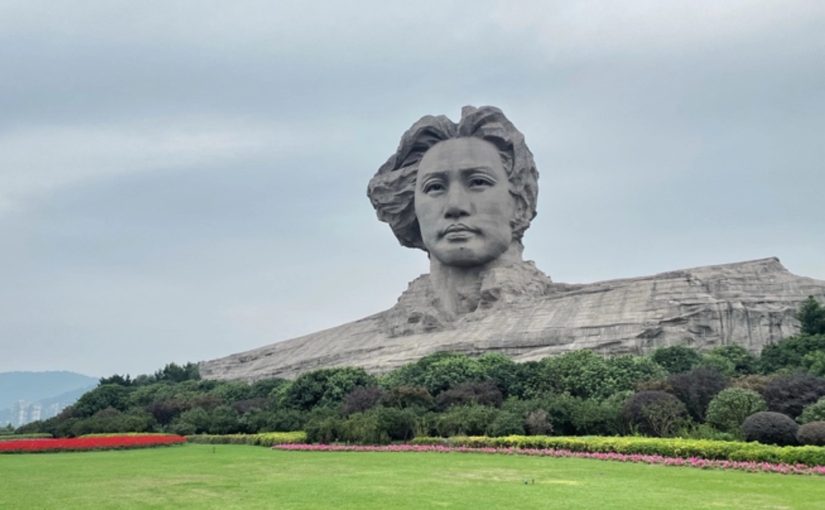
The following is the full text of the remarks prepared by our co-editor Keith Bennett, as the final speaker at our webinar, organised in conjunction with the International Manifesto Group (IMG), on Sunday September 6, marking the 50th anniversary of the death of Chinese revolutionary leader Mao Zedong.
Keith’s speech was delivered in slightly abbreviated and adapted form due to time constraints. A report on the webinar can be read here. The livestream of the event is also available on YouTube.
I’m not sure whether having to speak last after such a galaxy of brilliant speakers is a blessing or a curse. Perhaps it is both.
Let me try to draw together some threads that I believe constitute the theme of this webinar.
It will be 50 years since the death of Chairman Mao this coming Wednesday. I was one of those strange teenagers whose bedroom wall, much I’m sure to my parents’ bemusement, was not decorated with posters of footballers or rock stars but rather of Mao.
So, I remember so well when I heard the news that he’d died. I’d just turned 18. It was the summer between finishing school and starting university and, as part of my holiday job, I was on my hands and knees washing a kitchen floor when the lunchtime news on the radio led with this story.
Such are the kind of memories this anniversary evokes for me.
But the passage of half a century should allow for at least the beginnings of an objective assessment of a person’s life, work and legacy.
And in this spirit, let me express a perhaps controversial view that no single person in history has ever made a greater contribution to the liberation of humanity as that made by Mao Zedong. Further, if that is the case, then it is not unreasonable to suggest that he is the greatest person to have ever lived.
In the brief time available let me try to sketch a pathway to that bold assertion.
First, regarding his style of work, Mao insisted on careful study and social investigation.
The first article in his Selected Works, although not the first article he wrote, ‘Analysis of the classes in Chinese society’ opens with these words:
Who are our enemies? Who are our friends? This is a question of the first importance for the revolution. The basic reason why all previous revolutionary struggles in China achieved so little was their failure to unite with real friends in order to attack real enemies. A revolutionary party is the guide of the masses, and no revolution ever succeeds when the revolutionary party leads them astray. To ensure that we will definitely achieve success in our revolution and will not lead the masses astray, we must pay attention to uniting with our real friends in order to attack our real enemies.
This standpoint and method of work led directly to his ‘Report on an investigation of the peasant movement in Hunan’ a year later. Here he wrote: “Every revolutionary comrade should know that the national revolution requires a great change in the countryside. The Revolution of 1911 did not bring about this change, hence its failure.”
With extraordinary prescience, he wrote: “In a very short time, in China’s central, southern and northern provinces, several hundred million peasants will rise like a mighty storm, like a hurricane, a force so swift and violent that no power, however great, will be able to hold it back. They will smash all the trammels that bind them and rush forward along the road to liberation. They will sweep all the imperialists, warlords, corrupt officials, local tyrants and evil gentry into their graves. Every revolutionary party and every revolutionary comrade will be put to the test, to be accepted or rejected as they decide. There are three alternatives. To march at their head and lead them? To trail behind them, gesticulating and criticising? Or to stand in their way and oppose them? Every Chinese is free to choose, but events will force you to make the choice quickly.”
It is hard to overestimate the importance of this. In it we can find the seed of Mao’s greatest contribution to the development of Marxism, namely that in a large, semi-colonial, semi-feudal country, as China was at the time, the revolution could be won, and the path to socialism opened up, with a Marxist-Leninist party representing and embodying working class political leadership, but with the peasantry, in accordance with the country’s demographics, social system and class composition, playing the main role, by basing the revolutionary forces in the countryside, building stable revolutionary base areas, waging a protracted people’s war, surrounding the cities from the countryside and ultimately seizing nationwide political power by armed force.
Literally no other Marxist had thought of this before Mao, and this is the beginning of the Sinification of Marxism and the most fundamental root of what is now called socialism with Chinese characteristics.
Stalin and Trotsky, together with their local adherents, comrades such as Li Lisan, Wang Ming and Chen Duxiu, quarreled bitterly over such questions as the role of the national bourgeoisie and the independence of the proletariat. Mao’s breakthrough in the theory and practice of the revolution, if it did not render these disputes redundant, accorded them their due place. And as Mao was later to put it: “Grasp the key link and everything else falls into place.”
The fact that the revolution in China needed to be placed on new foundations was bloodily established by Chiang Kai-shek’s 1927 Shanghai massacre. It was the joining of Mao’s fledgling forces with those of Zhu De on the Jinggang Mountains that provided the answer. It was neither the first nor the last instance in history where a terrible defeat provided the springboard for future victory. As Chairman Mao wrote in one of his poems:
Bitter sacrifice strengthens bold resolve
Making sun and moon shine in new skies
Moreover, the significance of Mao’s breakthrough was by no means confined to China. Only very recently did a majority of humanity come to live in urban centres. Accordingly, the Chinese road provided the key example and reference point that was basically applied, in various ways, to the revolution in countries as varied as Vietnam, Laos, Cambodia, Korea, Yugoslavia, Albania, Cuba, Nicaragua, Mozambique, Zimbabwe, Eritrea, and Guinea-Bissau, among others. And many of us will recall iconic photos of liberation fighters in Palestine and many other countries studying the works of Mao with their AK47s close to hand. Nearer to home, those books were smuggled into the H Blocks in the north of Ireland and eagerly passed from hand to hand.
The establishment of the People’s Republic of China on October 1st, 1949, not only meant, in Mao’s famous words, that the Chinese people had stood up. Socialism had established a firm foothold in Asia. A mighty camp of peace, people’s democracy and socialism now stretched from Berlin to Shanghai. The population of China in 1949 was some 540 million. That of the Soviet Union some 240 million. The victory of the Chinese revolution therefore shifted the world balance of forces quantitatively and qualitatively. The story may be apocryphal but British communist leader Harry Pollitt is said to have consoled comrades on a local election loss by saying that we may have just lost St. Pancras but we’ve just won China.
And by winning China, Marxism definitively ceased to be solely or even mainly just the science of the liberation of the proletariat in the so-called advanced countries but indisputably that of the global majority, of all humanity.
In the ensuing 27 years in which Mao led China the foundations were laid for the thriving, prosperous and strong country that we see today. Life expectancy increased by more than one year for every year of Mao’s leadership. Bourgeois academic hacks and hired journalistic scribblers like to bleat about how many people did Mao kill. The real question they should ask themselves is how many people lived and are alive thanks to Mao.
Under Mao’s leadership, China, hitherto a land of pervasive famine, basically solved the problem of food security. A more or less complete industrial system, including in remote areas, was set up. China acquired powerful self-defensive capabilities. Hundreds of millions of people learned to read and write and, not least through the ‘barefoot doctor’ system, gained access to healthcare for the first time ever. Chairman Mao insisted that “women hold up half the sky” – the odious practice of foot binding was abolished and New China’s first major legislation, the 1950 Marriage Law established legal equality between men and women, and banned arranged marriages, concubinage, child betrothals, and interference with the remarriage of widows, striking a major blow against feudalism and patriarchy. Literature, music, opera and ballet celebrated revolutionary heroes and working people. And although still a poor country itself Mao’s China resolutely supported people’s struggles against imperialism and for the building of a new society from Korea and Vietnam to Namibia and Algeria and from Malta to the imperial core, with Mao being the first national leader to express unreserved and unequivocal support for the African-American struggle against racism.
The enormous achievements we see in China today rest on these foundations. This is why Xi Jinping, right from practically his first remarks when he was elected General Secretary of the party in 2012, has consistently stressed that the two phases of China’s socialist development, the period of Mao’s leadership and the ‘reform and opening up’ period that followed, cannot be counterposed to one another, but rather must be seen as two parts of a single revolutionary whole, one resting on the foundations laid by the other.
Any other interpretation falls at the first hurdle. Were this not the case, then the South Asian subcontinent, sub-Saharan Africa and anywhere in the Global South that is yet to take the socialist road, should be considerably more developed and more prosperous than China. That is manifestly not the case.
All that said, Mao’s achievements were clearly not his alone. Nor is his life and legacy free from contradictions. A suggestion to the contrary in the first instance would belong in the world of theology. Whilst in the case of the second, he wrote the key philosophical treatise on that very topic.
In assessing Mao’s individual role, we need to start from his own essay, ‘Where do correct ideas come from?’:
Where do correct ideas come from? Do they drop from the skies? No. Are they innate in the mind? No. They come from social practice, and from it alone; they come from three kinds of social practice, the struggle for production, the class struggle and scientific experiment.
And from his concept of the mass line:
In all the practical work of our Party, all correct leadership is necessarily ‘from the masses, to the masses’. This means: take the ideas of the masses (scattered and unsystematic ideas) and concentrate them (through study turn them into concentrated and systematic ideas), then go to the masses and propagate and explain these ideas until the masses embrace them as their own, hold fast to them and translate them into action, and test the correctness of these ideas in such action.
Further, if Mao consummated the development of Marxism into the science of liberation of the global majority, this built on, for example, Marx and Engels’ work on the Irish question, Lenin and Stalin’s on the national question generally, and that of countless other revolutionary theoreticians and fighters.
It is also in my view the case that alongside his immense achievements Mao made some serious errors in his later years, as outlined particularly by Deng Xiaoping and codified in 1981’s ‘Resolution on Certain Questions in the History of Our Party since the Founding of the People’s Republic of China’; explicitly so on the question of the Cultural Revolution; somewhat implicitly in terms of the analysis of the Soviet Union post-Stalin.
Nevertheless, both Deng and the resolution clearly state that Mao’s mistakes were those of a great proletarian revolutionary, that Mao Zedong Thought must always be upheld and adhered to, and that, without Mao, the Chinese people, at the very least, would have had to grope in the dark for far longer.
Beyond this, I think that Mao’s errors have to be seen within the context of his farsightedness in grappling with fundamental issues and that we are not yet able to make a final assessment of his explorations. His verdict on the Soviet Union may have been one-sided, premature and extreme (Soviet verdicts, be it said, were not necessarily much better) and caused some significant harm, both internationally, and nationally in terms, for example of the trajectory of the Cultural Revolution. But was he wrong in seeing the warning signs and worrying trends in the Soviet Union, and where these might end up if they went unchecked, before many others? And if this is the case, was he wrong to explore ways through which China might escape a similar fate?
It is a simple fact that the People’s Republic of China has now lasted longer than the Soviet Union. That the Soviet Union no longer exists and People’s China does. That it has developed further than any other major non-imperialist country has ever done. That China accounts for the overwhelming majority of global poverty reduction. That China leads the world in the fight against climate catastrophe. None of this would have happened, none of this would have been possible, without Mao and his leadership.
Xi Jinping stresses again and again how formative were his years from 1969 to 1975, in Liangjiahe, living in a cave dwelling, working alongside, learning from and teaching the peasants in this old revolutionary base area. This was Chairman Mao’s policy in action, designed to ensure that Socialist China would not change its red colour, and so far, through twists and turns, it has succeeded.
So, in summary, I stake my assessment of Chairman Mao as the person who has made the greatest single contribution to human liberation to date on, among other things, his liberation of the world’s most populous country, his leadership in developing a science of liberation for all humanity, his contribution to ensuring the greatest longevity of a major socialist power and laying the foundations of its ever growing strength and prosperity along with its growing ability to advance practical solutions to the existential issues facing humanity. A peasant’s son born in a Chinese village in the late 19th century, who not only changed the world in the 20th, but continues to do so, 50 years after his death, in the 21st. His greatness was not of the kind that precluded even egregious errors and mistakes. Rather it was so profound that such errors cannot detract from it. The author of ‘On Contradiction’ would hopefully approve.