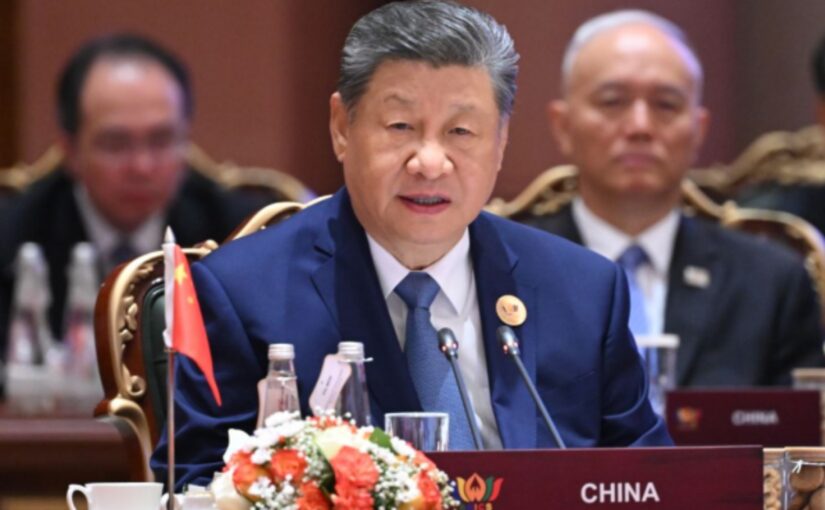
Chinese President Xi Jinping attended the 18th Summit of the BRICS cooperation mechanism held in the Indian capital New Delhi from September 12 to 13 at the invitation of Prime Minister Narendra Modi.
President Xi attended the first session of the summit on the afternoon of September 12. Chaired by Prime Minister Modi, it was also attended by Russian President Vladimir Putin, South African President Cyril Ramaphosa, Iranian President Masoud Pezeshkian, Egyptian President Abdel Fattah El-Sisi, Indonesian President Prabowo Subianto, Ethiopian Prime Minister Abiy Ahmed, the United Arab Emirates’ (UAE’s) Crown Prince of Abu Dhabi Khaled bin Mohamed, Brazilian Foreign Minister Mauro Vieira, and others.
Xi Jinping delivered a statement entitled “Jointly Shouldering the Responsibility of the Times and Striving to Be a Pioneering Force”.
He pointed out that this year marks the 20th anniversary of BRICS cooperation. Over the past two decades, BRICS has been growing with strong vigour and vitality and has become the most influential cooperation platform in today’s world for emerging markets and developing countries. These are 20 years of self-reliance and self-strengthening. BRICS countries have actively explored development paths suited to respective national conditions and set a fine example of emerging markets and developing countries seeking strength through unity. These are 20 years of standing together through wind and rain. Hand in hand BRICS countries have tackled the global financial crisis, the COVID pandemic, climate change and other challenges, and resolutely defended the common interests of the Global South, providing the world with stability and positive energy.
President Xi stressed that, today, changes unseen in a century are accelerating across the world. The Global South is gaining strength, and the trend toward a multipolar world is unstoppable. At the same time, unilateralism and power politics are surging against the tide, lashing at multilateralism and the international order. The deficits in peace, development, security and governance keep growing. BRICS must stand firmly on the right side of history, strive to be a pioneer of our times, steer the international order in a direction that is more just and equitable, and work together to build a community with a shared future for humanity.
In this regard he put forward four points:
- BRICS should be a pioneer in advancing innovation-driven development. BRICS countries must keep the initiative firmly in their hands, strengthen cooperation in the field of AI, encourage open source, openness, collaboration and sharing, and break new ground and scale new heights in practical cooperation.
- BRICS should be a pioneer in upholding peace and stability. We should act on the vision of common, comprehensive, cooperative and sustainable security, oppose the Cold War mentality and bloc confrontation, and oppose violation of other countries’ sovereignty or interference in other countries’ internal affairs. We should participate constructively in the settlement of hotspot issues and make BRICS’ unique contribution to addressing both the symptoms and root causes.
- BRICS should be a pioneer in facilitating mutual learning between civilisations. We should promote the common values of humanity, and advocate exchange, mutual learning and harmonious coexistence between civilisations. We should hold the BRICS People-to-People Exchange Forum to share experience on national governance and build up positive energy for stable state-to-state relations.
- BRICS should be a pioneer in reforming and improving global governance. BRICS should align with the trend toward greater democracy in international relations, work toward a more just and equitable global governance system, and uphold the authority of the United Nations.
The Chinese president added that during its arduous journey of 20 years, solidarity and cooperation have always been the source of strength for the cause of BRICS. We should continue treating each other with candour and sincerity and seeking common ground while shelving differences. China will take over the BRICS chairship next year and host the 19th BRICS Summit. The Chinese side will seize the opportunity to build consensus and work with all parties to plan for the future.
On the morning of September 13, President Xi Jinping attended Session II of the 18th BRICS Summit in New Delhi, and delivered an important statement entitled “Cementing the Foundation for BRICS Cooperation and Bolstering the Strength of the Global South”.
President Xi pointed out that this meeting is held at a time when changes unseen in a century are accelerating across the world. The Global South, with its collective rise, has become a key driver of world multipolarity. At the same time, the international landscape is volatile and fraught with risks and challenges. To bring stability to the world and make it a better place, BRICS countries must seize the historical initiative, rally the Global South, be an active, stabilising and positive force in international affairs, and advance the well-being of all humanity.
He stressed that Global South countries should jointly defend the rule of law in international affairs, safeguard the basic norms of international relations including sovereign equality, noninterference in internal affairs, and the peaceful settlement of disputes, and ensure that international law and international rules are applied to all, free from double standards. The international financial architecture must be reformed and improved to increase the representation and voice of developing countries. Global South countries should stay committed to a people-centred development philosophy and strive to deliver on the 2030 Agenda for Sustainable Development.
President Xi pointed out that to accomplish great things and achieve major progress, the foundation of greater BRICS cooperation must be cemented. BRICS should leverage close ties with fellow emerging markets and Global South countries, uphold open cooperation for mutual benefit, safeguard stable and smooth industrial and supply chains, foster a larger integrated market, build incubators for innovation, upgrade traditional industries, develop emerging industries, and deploy future industries. He put forward five initiatives for deepening BRICS cooperation:
- The open source and inclusive AI initiative. China will be a pioneer in establishing a BRICS AI open source community, support cooperation in developing and applying large language models, hold specialised AI seminars and training courses, and build an open ecosystem for AI.
- The trade and investment facilitation initiative. China proposes to establish a BRICS special economic zone partnership, under which countries can set up an intelligent portal, coordinate policies, and build a new frontier for open development.
- The digital industry cooperation initiative. China will push for establishing a BRICS digital ecosystem cloud platform, and conduct digital skills training, technological exchange and industrial alignment, so as to jointly enable the development of the digital economy.
- The intelligent manufacturing cooperation initiative. China stands ready to assist fellow BRICS countries in building smart factories and developing standards and norms and jointly promote manufacturing transformation and upgrading.
- The science and technology talent development initiative. China proposes to set up a BRICS engineer cultivation alliance for joint development of engineers and mutual recognition of competency standards.
The session was attended by Russian President Vladimir Putin, South African President Cyril Ramaphosa, Iranian President Masoud Pezeshkian, Egyptian President Abdel Fattah El-Sisi, Indonesian President Prabowo Subianto, Ethiopian Prime Minister Abiy Ahmed, the UAE’s Crown Prince of Abu Dhabi Khaled bin Mohamed, the Brazilian and Saudi Arabian Foreign Ministers, leaders or representatives of BRICS partner countries and guest countries, and Secretary General António Guterres of the United Nations and other heads of international organisations, and was chaired by Indian Prime Minister Narendra Modi.
The following articles were originally published by the Xinhua News Agency and on the website of the Chinese Foreign Ministry.
President Xi Jinping Attends Session I of the 18th BRICS Summit and Delivers an Important Statement
September 12 (MFA) – On the afternoon of September 12 local time, President Xi Jinping attended Session I of the 18th BRICS Summit in New Delhi.
The session was attended by Russian President Vladimir Putin, South African President Cyril Ramaphosa, Iranian President Masoud Pezeshkian, Egyptian President Abdel Fattah El-Sisi, Indonesian President Prabowo Subianto, Ethiopian Prime Minister Abiy Ahmed, the UAE’s Crown Prince of Abu Dhabi Khaled bin Mohamed and Brazilian Foreign Minister, among others, and chaired by Indian Prime Minister Narendra Modi.
President Xi Jinping delivered an important statement titled “Jointly Shouldering the Responsibility of the Times and Striving to Be a Pioneering Force.”
President Xi pointed out that this year marks the 20th anniversary of BRICS cooperation. Over the past two decades, BRICS has been growing with strong vigor and vitality, and become the most influential cooperation platform in today’s world for emerging markets and developing countries. These are 20 years of self-reliance and self-strengthening. BRICS countries have actively explored development paths suited to our respective national conditions, and set a fine example of emerging markets and developing countries seeking strength through unity. These are 20 years of standing together through wind and rain. Hand in hand BRICS countries tackled the global financial crisis, COVID pandemic, climate change and other challenges, and we resolutely defended the common interests of the Global South, providing the world with stability and positive energy. These are 20 years of fruitful outcomes. BRICS has realized a historic expansion, and now has a comprehensive, multifaceted cooperation structure. It has entered a new stage of high-quality development of greater BRICS cooperation.
President Xi stressed that, today, changes unseen in a century are accelerating across the world. The Global South is gaining strength, and the trend toward a multipolar world is unstoppable. At the same time, unilateralism and power politics are surging against the tide, lashing at multilateralism and the international order. The deficits in peace, development, security and governance keep growing. BRICS must stand firmly on the right side of history, strive to be a pioneer of our times, steer the international order in a direction that is more just and equitable, and work together to build a community with a shared future for humanity.
First, BRICS should be a pioneer in advancing innovation-driven development. BRICS countries must keep the initiative firmly in their hands, strengthen cooperation in the field of AI, encourage open source, openness, collaboration and sharing, and break new ground and scale new heights in our practical cooperation. BRICS countries are welcome to actively participate in the World AI Cooperation Organization. China proposes the BRICS initiative of AI-empowered new industrialization, and hopes to work with all parties for more outcomes in R&D and application and deeper cooperation in industrial and supply chains.
Second, BRICS should be a pioneer in upholding peace and stability. We should act on the vision of common, comprehensive, cooperative and sustainable security, oppose the Cold War mentality and bloc confrontation, and oppose violation of other countries’ sovereignty or interference in other countries’ internal affairs. We should participate constructively in the settlement of hotspot issues, and make BRICS’ unique contribution to addressing both the symptoms and root causes. China will work with fellow BRICS members to play a due role in bringing peace and tranquility to the Middle East.
Third, BRICS should be a pioneer in facilitating mutual learning between civilizations. We should promote the common values of humanity, and advocate exchange, mutual learning and harmonious coexistence between civilizations. We should hold the BRICS People-to-People Exchange Forum to share experience on national governance and build up positive energy for stable state-to-state relations. We should deepen cooperation in culture, tourism and education, step up exchanges between our youths, and facilitate mutual visits between the people to increase mutual understanding and amity.
Fourth, BRICS should be a pioneer in reforming and improving global governance. BRICS should align with the trend toward greater democracy in international relations, work toward a more just and equitable global governance system, and uphold the authority of the U.N. We should support the multilateral trading system with the World Trade Organization at its core, and reject all forms of protectionist measures. We should steer global governance in frontier domains such as cyberspace, outer space and deep sea, and increase the voice of Global South countries.
President Xi stressed that during our arduous journey of 20 years, solidarity and cooperation have always been the source of strength for the cause of BRICS. We should continue treating each other with candor and sincerity, and seeking common ground while shelving differences. We should respect each other’s core concerns, and commit ourselves to communication and dialogue to increase mutual understanding and properly handle disagreements, so that BRICS cooperation will continue to advance steadily. China will take over the BRICS chairship next year, and host the 19th BRICS Summit. The Chinese side will seize the opportunity to build consensus and work with all parties to plan for the future. Together, we will usher in the third golden decade of BRICS cooperation, and open up a bright prospect of shared prosperity and progress.
Leaders of the participating countries had an in-depth exchange of views on BRICS cooperation and international and regional issues.
All parties spoke highly of the development achievements BRICS has made over the past 20 years since its founding, noting that the BRICS mechanism is broadly representative and holds enormous potential for growth. Faced with intensifying geopolitical conflicts and rising unilateralism, BRICS countries have the responsibility to speak up for the Global South, uphold multilateralism, support the central role of the United Nations, safeguard the sovereign equality of all countries, abide by international law, oppose interference in other countries’ internal affairs, support free trade, and work together to address global challenges. The parties should uphold the BRICS spirit, deepen cooperation across all fields, strengthen economic resilience, promote a fairer and more inclusive international order, and build a secure and prosperous multipolar world. The parties commended China for its important contribution to the development and growth of the BRICS mechanism, and expressed support for China, as next year’s chair, in successfully hosting the 19th BRICS Summit, working together to bring BRICS cooperation to a new level.
The summit adopted the New Delhi Declaration of the 18th BRICS Summit.
During the summit, the BRICS leaders visited a photo exhibition marking the 20th anniversary of BRICS, planted trees together, and took a group photo.
Cai Qi and Wang Yi, among others, attended the above events.
Full text of Chinese President Xi Jinping’s speech at Session I of the 18th BRICS Summit
NEW DELHI, Sept. 13 (Xinhua) — Chinese President Xi Jinping on Saturday delivered a speech at the 18th BRICS Summit in New Delhi, India.
The following is the full text of the speech:
Jointly Shouldering the Responsibility of the Times and Striving to Be a Pioneering Force
Statement by H.E. Xi Jinping
President of the People’s Republic of China
At Session I of the 18th BRICS Summit
New Delhi, September 12, 2026
Your Excellency Prime Minister Narendra Modi,
Colleagues,
It gives me great pleasure to join you in New Delhi. I thank Prime Minister Modi and the Indian government for the thoughtful arrangements.
This year marks the 20th anniversary of BRICS cooperation. Over the past two decades, BRICS has been growing with strong vigor and vitality, and become the most influential cooperation platform in today’s world for emerging markets and developing countries.
These are 20 years of self-reliance and self-strengthening. Standing at the forefront of the Global South, we BRICS countries have upheld independence, actively explored development paths suited to our respective national conditions, and set a fine example of emerging markets and developing countries seeking strength through unity.
These are 20 years of standing together through wind and rain. BRICS countries have been forging ahead with an undaunted spirit. Hand in hand we tackled the global financial crisis, COVID pandemic, climate change and other challenges, and we resolutely defended the common interests of the Global South, providing the world with stability and positive energy.
These are 20 years of fruitful outcomes. BRICS has realized a historic expansion, and now has a comprehensive, multifaceted cooperation structure with ever deepening cooperation in trade, investment, finance and technology, among others. It has entered a new stage of high-quality development of greater BRICS cooperation.
Today, changes unseen in a century are accelerating across the world. The Global South is gaining strength, and the trend toward a multipolar world is unstoppable. At the same time, unilateralism and power politics are surging against the tide, lashing at multilateralism and the international order. The deficits in peace, development, security and governance keep growing. For the exact purpose of addressing these deficits and building a better world, I have put forward the Global Development Initiative, the Global Security Initiative, the Global Civilization Initiative and the Global Governance Initiative. BRICS must stand firmly on the right side of history, strive to be a pioneer of our times, steer the international order in a direction that is more just and equitable, and work together to build a community with a shared future for humanity.
First, BRICS should be a pioneer in advancing innovation-driven development. The new round of scientific and technological revolution and industrial transformation represented by AI is bringing breakthroughs at a faster pace, shaping the global development landscape. We BRICS countries must keep the initiative firmly in our hands, strengthen cooperation in the field of AI, encourage open source, openness, collaboration and sharing, and break new grounds and scale new heights in our practical cooperation. Not long ago, China, together with various parties, initiated the World AI Cooperation Organization, and has developed international AI application cooperation centers with BRICS and others, which provide important platforms for closer AI cooperation for the world, particularly Global South countries. We welcome the active participation of BRICS countries. Here, I propose the BRICS initiative of AI-empowered new industrialization. China hopes to work with all parties for more outcomes in R&D and application and deeper cooperation in industrial and supply chains. Facts will prove that decoupling and cutting off supply chains will not hold back our development process, and espousing “small yard, high fences” will only box oneself in and divide the world.
Second, BRICS should be a pioneer in upholding peace and stability. Far from being tranquil, the world today is increasingly fluid and turbulent. This is fundamentally because the postwar international order is being undermined, and the purposes and principles of the U.N. Charter are not effectively observed. BRICS should stand firm, uphold justice, and strive to put an end to conflicts and defend peace. We should act on the vision of common, comprehensive, cooperative and sustainable security, oppose the Cold War mentality and bloc confrontation, and oppose violation of other countries’ sovereignty or interference in other countries’ internal affairs. We should participate constructively in the settlement of hotspot issues, and make BRICS’ unique contribution to addressing both the symptoms and root causes.
The situation in the Middle East remains complex and fluid. This war has inflicted serious losses on the people of all countries in the region, and it is against the common interests of the international community. I have set out four propositions on safeguarding and promoting peace and stability in the Middle East, which are aimed at de-escalation, ending hostilities and promoting peace. The relevant parties should keep to the direction of political settlement, and work for a permanent, comprehensive ceasefire. Attention should be paid to addressing the problems at the source, rebuilding trust between regional countries, and establishing a new security architecture. The Palestinian question is always at the core of the Middle East issue, and the fundamental way forward is to implement the two-state solution and realize peaceful coexistence between Palestine and Israel. China will work with fellow BRICS members to play a due role in bringing peace and tranquility to the Middle East.
Third, BRICS should be a pioneer in facilitating mutual learning between civilizations. As a Chinese adage goes, the beauty of a delicious soup lies in the blending of different flavors. With our time-honored and diverse cultures, BRICS should be a garden of inclusive coexistence that allows various civilizations to flourish. We should promote the common values of humanity, and advocate exchange, mutual learning and harmonious coexistence between civilizations. We should hold the BRICS People-to-People Exchange Forum to share experience on national governance and build up positive energy for stable state-to-state relations. We should deepen cooperation in culture, tourism and education, step up exchanges between our youths, and facilitate mutual visits between the people to increase mutual understanding and amity.
Fourth, BRICS should be a pioneer in reforming and improving global governance. What kind of global governance system to build will determine the future of humanity. BRICS should align with the trend toward greater democracy in international relations, work toward a more just and equitable global governance system, uphold the authority of the U.N., and oppose withdrawal from international organizations and treaties or creating rival systems. We should support the multilateral trading system with the World Trade Organization at its core, advance WTO reform, oppose abuse of tariffs, and reject all forms of protectionist measures. We should steer global governance in frontier domains such as cyberspace, outer space and deep sea, and increase the voice of Global South countries.
Colleagues,
During our arduous journey of 20 years, solidarity and cooperation have always been the source of strength for the cause of BRICS. We should continue treating each other with candor and sincerity, and seeking common ground while shelving differences. We should respect each other’s core concerns, and commit ourselves to communication and dialogue to increase mutual understanding and properly handle disagreements, so that BRICS cooperation will continue to advance steadily.
China will take over the BRICS chairship next year, and host the 19th BRICS Summit. The Chinese side will seize the opportunity to build consensus and work with all parties to plan for the future. Together, we will usher in the third golden decade of BRICS cooperation, and open up a bright prospect of shared prosperity and progress.
Thank you.
President Xi Jinping Attends Session II of the 18th BRICS Summit and Delivers an Important Statement
September 13 (MFA) – On the morning of September 13 local time, President Xi Jinping attended Session II of the 18th BRICS Summit in New Delhi, and delivered an important statement titled “Cementing the Foundation for BRICS Cooperation and Bolstering the Strength of the Global South.”
President Xi pointed out that this meeting is held at a time when changes unseen in a century are accelerating across the world. The Global South, with its collective rise, has become a key driver of world multipolarity. At the same time, the international landscape is volatile and fraught with risks and challenges. To bring stability to the world and make it a better place, BRICS countries must seize the historical initiative, rally the Global South, be an active, stabilizing and positive force in international affairs, and advance the well-being of all humanity.
President Xi stressed that Global South countries should jointly defend the rule of law in international affairs, safeguard the basic norms of international relations including sovereign equality, noninterference in internal affairs, and the peaceful settlement of disputes, and ensure that international law and international rules are applied to all, free from double standards. Global South countries should hold high the banner of multilateralism, uphold the authority and role of the United Nations, support multilateral institutions in advancing reform and increasing efficiency, and see to it that reform of the World Trade Organization proceeds in the right direction. The international financial architecture must be reformed and improved to increase the representation and voice of developing countries. Global South countries should stay committed to a people-centered development philosophy and strive to deliver on the 2030 Agenda for Sustainable Development. Global South countries should jointly advance security governance, tackle both traditional and nontraditional threats, improve global climate governance, and work faster to evolve a consensus-based global AI governance framework, so that new technologies can light the way toward shared prosperity.
President Xi pointed out that to accomplish great things and achieve major progress, the foundation of greater BRICS cooperation must be cemented. BRICS should leverage close ties with fellow emerging markets and Global South countries, uphold open cooperation for mutual benefit, safeguard stable and smooth industrial and supply chains, foster a large integrated market, build incubators for innovation, upgrade traditional industries, develop emerging industries, and deploy future industries. President Xi put forward five initiatives for deepening BRICS cooperation:
First, the open source and inclusive AI initiative. China will be a pioneer in establishing a BRICS AI open source community, support the cooperation in developing and applying large language models, hold specialized AI seminars and training courses, and build an open ecosystem for AI.
Second, the trade and investment facilitation initiative. China proposes to establish a BRICS special economic zone partnership, under which countries can set up an intelligent portal, coordinate policies, and build a new frontier for open development. In an effort to cultivate new drivers of economic and trade cooperation, China will hold the BRICS Forum on Trade in Services next year.
Third, the digital industry cooperation initiative. China will push for establishing a BRICS digital ecosystem cloud platform, and conduct digital skills training, technological exchange and industrial alignment, so as to jointly enable the development of the digital economy.
Fourth, the intelligent manufacturing cooperation initiative. China stands ready to assist fellow BRICS countries in building smart factories and developing standards and norms, and jointly promote manufacturing transformation and upgrading.
Fifth, the science and technology talent development initiative. China proposes to set up a BRICS engineer cultivation alliance for joint development of engineers and mutual recognition of competency standards. China will launch a BRICS youth exchange program for scientific and technological innovation, so as to cultivate more high-caliber talent.
President Xi stressed that this year marks the launch of China’s 15th Five-Year Plan for economic and social development. It is both a blueprint for China’s development and a cooperation list for the rest of the world. China will continue to advance high-quality development, expand high-standard opening up, implement the Global Development Initiative, and promote high-quality Belt and Road cooperation to share opportunities and prosper together with all countries, and jointly write a new chapter of strength through unity for the Global South.
The session was attended by Russian President Vladimir Putin, South African President Cyril Ramaphosa, Iranian President Masoud Pezeshkian, Egyptian President Abdel Fattah El-Sisi, Indonesian President Prabowo Subianto, Ethiopian Prime Minister Abiy Ahmed, the UAE’s Crown Prince of Abu Dhabi Khaled bin Mohamed, Brazilian and Saudi Arabian Foreign Ministers, leaders or representatives of BRICS partner countries and guest countries, and Secretary General António Guterres of the United Nations and other heads of international organizations, and chaired by Indian Prime Minister Narendra Modi.
Before the session, President Xi took a group photo with participating leaders.
Cai Qi and Wang Yi, among others, attended the above event.
Full text of Chinese President Xi Jinping’s speech at Session II of the 18th BRICS Summit
NEW DELHI, Sept. 13 (Xinhua) — Chinese President Xi Jinping on Sunday delivered a speech at the 18th BRICS Summit in New Delhi, India.
The following is the full text of the speech:
Cementing the Foundation for BRICS Cooperation and Bolstering the Strength of the Global South
Statement by H.E. Xi Jinping
President of the People’s Republic of China
At Session II of the 18th BRICS Summit
New Delhi, September 13, 2026
Your Excellency Prime Minister Narendra Modi,
Colleagues,
I thank Prime Minister Modi and the Indian government for hosting this meeting.
We meet at a time when changes unseen in a century are accelerating across the world. The Global South, with its collective rise, has become a key driver of world multipolarity. At the same time, the international landscape is volatile and fraught with risks and challenges. To bring stability to the world and make it a better place, BRICS countries must seize the historical initiative, rally the Global South, be an active, stabilizing and positive force in international affairs, and advance the well-being of all humanity.
A world without rules is like a crossroads without traffic lights, where chaos and disorder are all but guaranteed. Fairness and justice is a universal aspiration, and international rules must be written by all countries. The logic of “might makes right” does not hold, and should have been discarded long ago. Global South countries should jointly defend the rule of law in international affairs, safeguard the basic norms of international relations including sovereign equality, noninterference in internal affairs, and the peaceful settlement of disputes, and ensure that international law and international rules are applied to all, free from double standards.
All countries, regardless of their size, strength or wealth, are equal members of the international community. Global South countries should hold high the banner of multilateralism, uphold the authority and role of the United Nations, support multilateral institutions in advancing reform and increasing efficiency, and ensure the equal participation of all countries in international affairs. We should see to it that the reform of the World Trade Organization proceeds in the right direction, uphold such principles as the most-favored-nation treatment, and actively explore new rules for the future. We should support the operation and development of the New Development Bank to facilitate Global South cooperation. The international financial architecture must be reformed and improved to increase the representation and voice of developing countries.
“To achieve great things, one should always put the people first.” Global South countries should stay committed to a people-centered development philosophy and strive to deliver on the 2030 Agenda for Sustainable Development. Since China launched the Global Development Initiative five years ago, we have implemented over 2,000 projects in partnership with others, and provided training for more than 200,000 professionals, benefiting people in more than 120 countries. China is opening its door ever wider to the world. We have granted zero-tariff treatment for all the 53 African countries having diplomatic relations with China. We will continue to broaden independent and unilateral opening up, and share the opportunities of China’s development with other countries.
As global challenges keep surfacing, we should adopt a holistic approach to address both the symptoms and root causes. Global South countries should jointly advance security governance and tackle both traditional and nontraditional security threats. We should improve global climate governance, and urge the full and effective implementation of the Paris Agreement. We should take a people-centered approach, develop AI for the positive and for good, and work faster to evolve a consensus-based global AI governance framework, so that new technologies can light the way toward shared prosperity.
Colleagues,
To accomplish great things and achieve major progress, the foundation of greater BRICS cooperation must be cemented. We should leverage our close ties with fellow emerging markets and Global South countries, uphold open cooperation for mutual benefit, safeguard stable and smooth industrial and supply chains, and foster a large integrated market. We should build incubators for innovation, upgrade traditional industries, develop emerging industries, and deploy future industries. To this end, I wish to put forward five initiatives:
First, the open source and inclusive AI initiative. China will be a pioneer in establishing a BRICS AI open source community, support the cooperation in developing and applying large language models, hold specialized AI seminars and training courses, and build an open ecosystem for AI.
Second, the trade and investment facilitation initiative. China proposes to establish a BRICS special economic zone partnership, under which countries can set up an intelligent portal, coordinate policies, and build a new frontier for open development. In an effort to cultivate new drivers of economic and trade cooperation, China will hold the BRICS Forum on Trade in Services next year. We welcome your active participation.
Third, the digital industry cooperation initiative. China will push for establishing a BRICS digital ecosystem cloud platform, and conduct digital skills training, technological exchange and industrial alignment, so as to jointly enable the development of the digital economy.
Fourth, the intelligent manufacturing cooperation initiative. China stands ready to assist fellow BRICS countries in building smart factories and developing standards and norms, and jointly promote manufacturing transformation and upgrading.
Fifth, the science and technology talent development initiative. China proposes to set up a BRICS engineer cultivation alliance for joint development of engineers and mutual recognition of competency standards. China will launch a BRICS youth exchange program for scientific and technological innovation, so as to cultivate more high-caliber talent.
Colleagues,
This year marks the launch of China’s 15th Five-Year Plan for economic and social development. It is both a blueprint for China’s development and a cooperation list for the rest of the world. China will continue to advance high-quality development, expand high-standard opening up, implement the Global Development Initiative, and promote high-quality Belt and Road cooperation to share opportunities and prosper together with all countries. Let us work as one to promote greater BRICS cooperation and write a new chapter of strength through unity for the Global South!
Thank you.