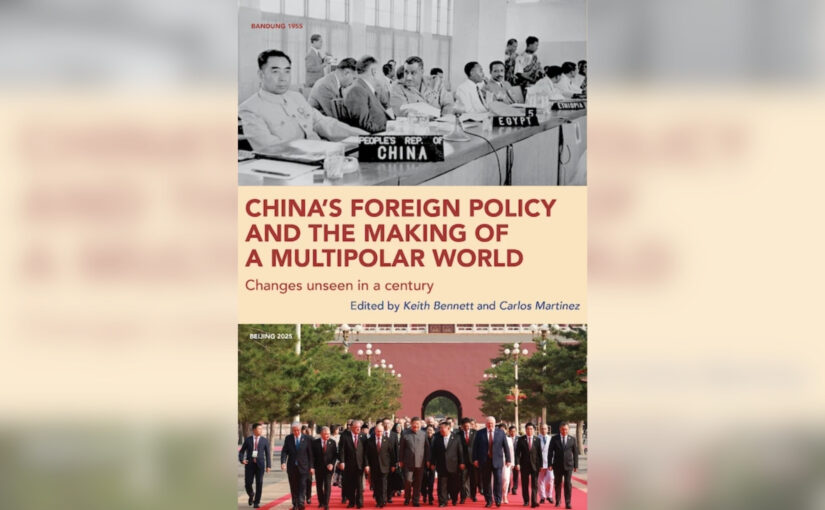
We are very pleased to publish the detailed review below by Dr Francisco Dominguez of the recently published ‘China’s Foreign Policy and the Making of a Multipolar World: Changes unseen in a century’, edited by Keith Bennett and Carlos Martinez. Francisco is one of the foremost anti-imperialist scholars and activists in Britain. Originally a political refugee from Pinochet’s Chile, he was the head of the Research Group on Latin America at Middlesex University and is the National Secretary of the Venezuela Solidarity Campaign and an executive committee member of the Cuba Solidarity Campaign.
Francisco goes through the book chapter by chapter and concludes that it is “a book that is a must read”.
It was launched online on 20 September and is available from socialistbooks.com. The discount code CHINA35 gives 35 percent off all titles from the publishers Praxis Press until the end of the year.
Three features define the contours that this book seeks to scrutinise in its examination of China’s foreign policy. The first is the proposition that “the world is presently witnessing changes unseen in a century”, whose pace and scale have intensified dramatically. The second concerns the transformation of China’s foreign policy, hitherto moulded by the principle of “hide our capacities and bide our time” and the practice of “being good at maintaining a low profile”, but now “replaced by a more assertive and proactive strategy” aimed at promoting the interests of the Global South, advancing peace and common security, and pursuing a more just world order. The third is an exploration of the historical roots and theoretical foundations of China’s foreign policy. This is quite an undertaking for a group of nine intellectual cadres, each addressing specific dimensions of China’s foreign policy, which has itself become a crucial factor in the ongoing “changes unseen in a century”.
The images on the book’s cover provide an intriguing foretaste of its content. The first depicts the 1955 Bandung Conference, at which the then Third World—represented by 29 participating countries, and still largely confined to aspirational declarations—expressed its desire for a “more just world system”, free from colonial oppression and founded upon respect for the national sovereignty and territorial integrity of all countries. The conference also featured Zhou Enlai’s proposal, on behalf of the recently founded People’s Republic of China, of the Five Principles of Peaceful Coexistence.
The second image depicts the September 3, 2025 commemoration in Beijing of the 80th anniversary of the victory of what is referred to in China as the Chinese People’s War of Resistance Against Japanese Aggression and the World Anti-Fascist War, where President Xi Jinping was joined by more than two dozen leaders from the Global South. This had been immediately preceded by the largest ever Summit of the Shanghai Cooperation Organisation (SCO), held in the neighbouring city of Tianjin, whose final statement included a commitment “to the formation of a more representative, democratic, just and multipolar world order based on universally recognised principles of international law”. It reaffirmed the Five Principles of Peaceful Coexistence and advocated “the equal participation of countries of the Global South in promoting open and equitable international cooperation in the interests of building an innovation-driven global economy”.
There is a difference of seventy years—three generations!—between the two events captured on the book’s front cover. The juxtaposition is striking: China has remained remarkably faithful to the progressive and revolutionary principles that inform its foreign policy. Through multilateral bodies and initiatives such as the SCO, BRICS and the Belt and Road Initiative (BRI)—concrete manifestations of its foreign-policy orientation—an industrially and technologically developed China is now contributing on a massive scale to the development of the Global South.
Ken Hammond, in Chapter Two, Change and Continuity in China’s International Relations, 1949–2025, takes us through the twists and turns of this extraordinary seventy-year journey in Chinese foreign policy. He concludes, correctly, that China’s role in the world “provides the best hope for a more stable and prosperous, sustainable future not only for its own people, but as a model for cooperation and development around the world”. The scale of China’s transformation is perhaps illustrated by a single statistic: in 1955, China’s GDP stood at US$41.5 billion; by 2025, it had reached US$19.6 trillion—an increase of approximately 472-fold.
Although the book focuses on the fundamental issues necessary to explain China’s foreign policy, while also providing an indispensable historical perspective, the complexity of the subject is such that several volumes will be required to offer a truly comprehensive account of the evolution of the People’s Republic and its incursions into the minefield of international relations. It is therefore with considerable anticipation that we welcome the editors’ promise that this is the “first of two projected volumes”. In any event, the first volume is a competent and informative endeavour, bringing together knowledgeable scholars and political activists in ten essays covering China’s foreign policy from the very beginnings of the People’s Republic following the victorious revolution of 1949.
The volume provides a panoramic account of the historical evolution of China’s foreign policy from 1949 to 2025: the tribulations associated with the Cold War and imperialism; the Five Principles of Peaceful Coexistence; the biased interpretations of China’s foreign policy advanced by some Western Marxists; China’s unique and peaceful rise to world power; the complexities and contradictions of Chinese socialism; China’s vision of world order as fundamentally distinct from its Western counterparts; and two mammoth contributions by a single author confronting the depiction of China as imperialist and examining China’s global initiatives. All this is preceded by an enticing Introduction.
In Chapter One, Understanding the Changes Unseen in a Century, the editors, Keith Bennett and Carlos Martinez, demonstrate just how profoundly the world has changed in the wake of the US attempt to preserve unipolarity following the collapse of the USSR. In 1993, US Under-Secretary of Defense Paul Wolfowitz declared: “Our strategy must now refocus on precluding the emergence of any potential future global competitor.” As early as 1977, US imperialist cadre such as Zbigniew Brzezinski had argued that “it is imperative that no Eurasian challenger emerges, capable of dominating Eurasia and thus also of challenging America”, adding that “potentially, the most dangerous scenario would be a grand coalition of China, Russia, and perhaps Iran, an ‘anti-hegemonic’ coalition united not by ideology but by complementary grievances”. There is no question that multipolarity has become a tangible reality; Bennett and Martinez nevertheless demonstrate that the imperial power is prepared to strike back through sanctions, tariffs, blockades and wars.
Chapter Three, by Andrew Murray, China, Cold War and Empire, and Chapter Four, by Carlos Martinez, Is China Imperialist?, approach the issue from different but equally stimulating angles. Both address the claims advanced in some quarters, particularly on the Western left, that China’s extraordinary development is leading inexorably towards a potentially lethal “Thucydides Trap” confrontation with the United States—the supposedly inevitable consequence of the rise of one world power and the decline of the incumbent—or, at worst, that China is consciously and stealthily deploying its growing economic strength in order to become the next dominant imperialist power.
Murray dismantles the view that the “rivalry between China and the USA is a great power competition, even an inter-imperialist struggle”, demonstrating instead that China “has become a major exporter of capital, and alternative source of finance for many countries around the world”, which is used for infrastructural investment “in countries of the Global South above all”. In his account, this has strengthened their political autonomy from imperialism within the emerging context of multipolarity. China thus constitutes the principal obstacle to Trump’s objective of restoring US economic supremacy over China and the Global South.
Although Murray acknowledges that, theoretically, China could become an imperialist power, he points to the substance of its present international conduct: “China consistently stands for the observation of international law, equal rights of all states large and small, non-interference in other countries’ affairs, mutually beneficial economic development, global cooperation to tackle climate, health and AI challenges, and the peaceful resolution of disputes. On every point, this platform is the direct opposite to that championed by Trump’s USA.”
Martinez, meanwhile, tackles head-on the widespread assertion in some sections of the Western left that China is a “rising imperialist power in the world system” which exploits not only its own population but also Third World countries by controlling their raw materials, “practising ‘debt trap diplomacy’ and other forms of economic coercion”. Martinez is categorical: “the notion of China as an imperialist or would-be imperialist power is fundamentally flawed; that China has been a victim of imperialism, not an agent of it; that China’s peaceful development path is a challenge to imperialism, not an expression of it; that both its internal class dynamics and the prevailing geopolitical situation militate against China becoming an imperialist power; and that the emerging multipolar world order that China is working towards provides the basis for overcoming imperialism, not for perpetuating it.” He substantiates this view with twenty pages of closely argued evidence and analysis.
China’s foreign policy has rested upon the Five Principles of Peaceful Coexistence, a concept cogently examined by Jenny Clegg in Chapter Five, China: Taking the Five Principles of Peaceful Coexistence as a Guide. Clegg explores both their historical evolution and their political significance in the struggle against colonialism and imperialism during the construction of socialism.
She traces the evolution of the Five Principles through China’s revolutionary opposition to imperialist aggression—the Korean and Vietnam wars, the US claim that the authorities in Taiwan remained the legitimate government of China, and the rift with the USSR—during a period dominated by anti-imperialist national-revolutionary struggles in Africa and Asia. Clegg cites China’s political line during this period: “countries want independence, nations want liberation and people want revolution”.
China’s regaining of its lawful seat at the United Nations in 1971, Nixon’s recognition that “all Chinese on either side of the Taiwan Strait maintain there is but one China” in the Shanghai Communique of February 1972, and the establishment of full diplomatic relations with the United States at the start of 1979 inaugurated a new period. This was subsequently defined by Deng Xiaoping’s economic reforms, which created an entirely different context in which to apply the Five Principles of Peaceful Coexistence. It was also a period that ultimately contributed to China’s pursuit of multipolarity. As Clegg aptly puts it, China’s leaders, from Mao to Deng to Xi, “have all seen China’s development over [the] long term as an integral part of the transformation of the international political and economic order towards fairness and equality”.
Danny Haiphong, in Chapter Six, Is China’s Foreign Policy ‘Good Enough’?, adopts a title whose sarcasm is entirely warranted. His contribution takes to task the demonisation of China’s foreign policy by the combined efforts of US elites, their accomplices and the media, as well as by some “on the political ‘left’, even some communists”, who echo the claim that China’s foreign policy is “riddled with debt traps for poorer countries in the Global South”. In short, this united front of sorts characterises China’s foreign policy as imperialistic.
Haiphong not only dismantles this characterisation but also argues that the supposed instances of Chinese imperialistic behaviour are nothing more than malicious propaganda, while providing numerous examples of China’s “win-win” cooperation agreements with countries of the Global South, which he contends have been highly beneficial to the latter. In stark contrast to the United States and its imperialist allies, China, he argues, has neither threatened nor undermined the national sovereignty of other nations, nor fought a war since 1979, whereas the United States and its allies have continued to engage in military aggression, with devastating consequences for the nations and peoples affected.
Haiphong therefore answers the sarcastic question posed in his title in unequivocal terms: “China doesn’t wage wars of aggression, commit genocide, engage in expansionism, or seek hegemony of any kind. By committing itself to the core principles of international law such as respect for self-determination and non-interference, and by developing win-win relations in all spheres, China provides an example to the entire world of what a future of global peace could look like.”
In Chapter Seven, How China’s Peaceful Rise Is Changing the World, Cheng Enfu examines a distinctive feature of China’s extraordinary economic and technological development: its peaceful character, a theme that, in different ways, runs throughout the volume. In a typically measured Chinese style, Cheng argues that China, with its fundamental orientation towards peaceful development, has gradually demonstrated distinctive characteristics in its approach to global engagement and to shaping the international system, differentiating itself from the traditional paths followed by ascending great powers.
Rather than resorting to protectionism during periods of crisis, “China has consistently adhered to opening up and mutually beneficial cooperation”. Nor does it seek to convert its growing strength into expansionism “or the imposition of its system”. It does not practise great-power politics by deploying its strength “to bully or seek dominance”; instead, it advocates “resolving difference through dialogue, consultation” and “win-win” cooperation.
China also stresses, crucially, “the intrinsic unity of economic development, social progress, and ecological conservation”. This means, Cheng concludes, that the Chinese model makes it possible not merely to protect the environment while pursuing development, but also to achieve development through environmental protection.
Torkil Lauesen, in Chapter Eight, The Principal Contradiction in the World and China’s Pursuit of Socialism, examines the interaction between developments in the world system and China’s socialist path, which he defines in terms of “the decline of US hegemony versus the rise of China, and the development of a multipolar world order”.
Through an engaging methodological discussion of Mao’s concept of the principal contradiction, combined with a concise account of the historical development of capitalism and its recurring crises, Lauesen arrives at a striking conclusion: “The rise of China as the world’s leading industrial power has broken the polarising dynamic between centre and periphery, for the first time in two hundred years.”
The implications, in his view, are enormous: “With the decline of US hegemony, the rise of China, and the development of a multipolar world-system, we are reaching the point where the capitalist mode of production is no longer the most effective one with which to develop the productive forces, but rather has become irrational, destroying both human life and the earth itself. […] The US can no longer effectively compete with China, which is becoming the leading innovative economic power in the world.”
Michael Dunford, in a concise but richly argued Chapter Nine, Why Chinese and Western Visions of World Order Differ and Why the Difference Matters, contrasts Western and Chinese conceptions of world order. Western liberalism, he argues, posits both nations and individuals as self-interested actors, thereby making agreement on the common good difficult and creating a perceived need for the state to impose domestic order, while generating the potential for international anarchy. International relations consequently become the “realm of power politics and interests”. The result is capitalist “uneven development, invasion, domination, conflict and warfare, as powerful nation states/coalitions of states seek hegemony to advance their security and economic interests, while liberal ideologies are instrumentalised to conceal or justify outside interference in the affairs of other countries”.
Dunford then traces the East Asian, and specifically Chinese, tradition of a symbiotic system “characterised by a set of principles, norms and codes of conduct relating to inter-state relations, in which large and small countries found a proper place, over the course of millennia fostered voluntary and tribute trade, and peaceful coexistence”. The Chinese concept of harmony, he argues, is synonymous with the East Asian concept of symbiosis, from which derives Xi Jinping’s contemporary interpretation of the Five Principles of Peaceful Coexistence. Dunford concludes by stressing that President Xi has repeatedly insisted that China neither seeks hegemony nor believes that the world needs a hegemon.
Carlos Martinez, in Chapter Ten, The Four Global Initiatives and the Political Meaning of a Community of Shared Future for Humanity, examines President Xi Jinping’s concept of a global community with a shared future for humanity, which has become central to China’s foreign policy and was written into the Party Constitution in 2017.
The question Martinez addresses is what the contours of the world order that might replace the unipolar system the United States is seeking to entrench, by one means or another, would look like.
It is a testament to the editors’ political acumen that they chose to conclude the volume with a chapter devoted to China’s four global initiatives which, as Martinez suggests, “together constitute an operational programme for the shared future of humanity”. The four initiatives are the Global Development Initiative (GDI), proposed in September 2021; the Global Security Initiative (GSI), launched in April 2022; the Global Civilisation Initiative (GCI), proposed in March 2023; and the Global Governance Initiative (GGI), introduced in August–September 2025.
Martinez argues that each initiative addresses a “different fundamental pillar of international cooperation” and that, taken together, they constitute a holistic framework because they “share a common conceptual architecture for the building of a global community of shared future”. Furthermore, Martinez provides evidence of the beneficial impact of their application in countries of the Global South. He goes further still: “the four initiatives articulate something far more than just a foreign policy package; they sketch a deeply humane and essentially Marxist pathway towards a post-imperialist world order”.
China’s foreign policy plays a central role in global affairs and, according to the contributors to this volume, has a significant transformative impact on the Global South. It seeks to build “an open, inclusive, clean and beautiful world that enjoys lasting peace, universal security, and common prosperity”. In contrast, imperialism has generated existential threats to humanity, including “climate catastrophe, the danger of nuclear war, the challenges posed by artificial intelligence, and the ever-present threat of pandemics”. President Xi Jinping’s formulation of Building a Global Community with a Shared Future is a rich and comprehensive concept, one that encapsulates centuries of history, political development, class struggle and human sacrifice. China’s Foreign Policy and the Making of a Multipolar World examines these themes with considerable depth and authority. It is a book that is a must read.