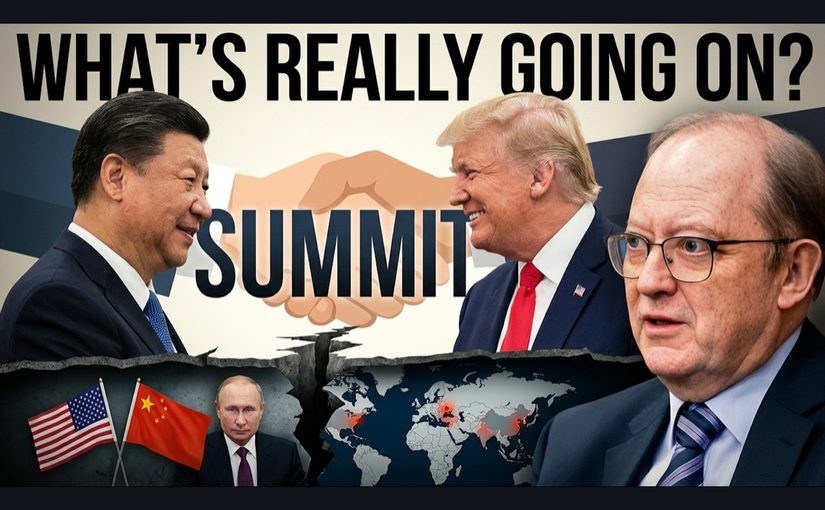
In a recent interview on India & Global Left, British economist John Ross, senior fellow at the Chongyang Institute for Financial Studies at Renmin University of China, discusses the significance of Xi Jinping’s state visit to the United States. In his view, the summit was positive mainly for what did not happen: Washington launched no new attack on China. The relative stability between the two countries reflects not goodwill but China’s strength – after Trump’s “Liberation Day” tariffs ran into China’s counter-measures on rare earths, the US switched to going after other targets.
That approach, John argues, has largely failed. The attempted “reverse Kissinger” to detach Russia from China has gone nowhere; Cuba has not buckled under the oil blockade; and in the war on Iran, “this is a fifteen-round contest and we’re probably up to about round five – but so far Iran’s won all five of the rounds.”
He characterises the New Cold War as, to an extent, the reverse of the first one. The Soviet Union was a military equal of the US but never an economic one, so Washington shifted the contest onto economic terrain. Today China is outgrowing the US and leading in EVs, batteries, drones, biotech and parts of AI, so the US seeks to shift the contest onto military terrain – hence the encouragement of German and Japanese rearmament, the military pressure on Venezuela, Cuba and Iran, and the attempts to stir up trouble in the South China Sea.
The interview also covers the security picture in East Asia, Europe’s self-defeating subordination to Washington, and why the Global South will keep trading with China regardless.
John will be among the speakers at the Socialist China Conference in London on Saturday 3 October. Tickets are available on Eventbrite.
The interview was first broadcast on India & Global Left. The transcript below is AI-generated.
Transcript
Host: Hello and welcome to another episode of India and Global Left. If you’re new to the show, please hit that subscribe button. Also consider becoming a YouTube member, a Patreon, or donating a small amount via the link in the description box. Without further ado, let me welcome our guest tonight, John Ross. John is a British economist and he is known for his academic work on China. He’s a senior fellow at the Chongyang Institute for Financial Studies, Renmin University of China. John, welcome back to India and Global Left.
John Ross: Very pleased to be here.
Host: I want to discuss with you the US–China relationship in general, and I thought the recent summit in the United States of America between China and the US is interesting. The Chinese media’s coverage has been, broadly speaking, very positive. I wonder what is your analysis about the significance of the summit?
John Ross: Well, I think the estimate from the Chinese media — positive — is correct, in the following sense: that the United States did not launch any big attacks on China. In fact, from the point of substantial agreement, not many things came out of the meeting.
One interesting detail was that the tariff truce was only extended until January, when it was widely reported — I’m not saying it was true, but it was widely reported, and it would obviously be in China’s interests to extend it for a longer period of time — what was reported in the press was until the end of the Trump presidency. That means it leaves the US with room for manoeuvre, because China’s not going to launch a tariff offensive against the US, but the US may against China.
If we look at what’s behind this, I think it’s the fact that the United States found out that China is a very strong opponent, and therefore, for tactical reasons due to the international situation at the moment, the US genuinely does not want at this particular moment in time to have a confrontation with China. And to explain why — or Trump doesn’t, let’s put it more precisely, because there are people in the US who do, but let’s talk about Trump.
If we call the first Trump presidency Trump 1.0: he decided, together with the general establishment view that China is the main enemy — which remains the view of all serious foreign policy circles within the United States — and he launched a frontal attack on it. This did not go well. It didn’t have any significant effect at all on China’s economy. China didn’t change its policies. Actually, many people in the US thought this was a very foolish policy. I mean, it’s not very sensible to attack your enemy’s strongest point; a military commander would not give that as the advice they’d give.
Biden then didn’t reverse the things which Trump did, and in the technology field he added some. And Trump, when he came to Trump 2.0, made an attempt to attack China in the so-called Liberation Day tariffs, which ended up with the tariffs against China being at 145% — which basically means no trade would take place at that level of tariffs.
And China, as in usual China style, didn’t make very big noise, but it just struck back. It struck back with its own tariffs, and in particular it struck back with rare earths. And the American military said to Trump, “We can’t produce military equipment without the rare earths from China.” The American motor industry said to Trump, “We’ll have to close down in about six months without the rare earths from China.” And Trump thought, this is not going very well.
So he decided to back out of the situation and embark upon a new strategy, which would be more sensibly advised by a military strategist — which was: don’t attack your enemy’s strongest point, deal with some weaker points. So therefore he decided to attack other people than China.
He tried to do a deal with Russia first. That wasn’t an attack on Russia, because the biggest problem for Trump is the relations between Russia and China, and therefore he tried what is known as a reverse Kissinger or reverse Nixon — that is, to try to separate Russia from China. That’s named after Nixon and Kissinger’s famous trip to China in 1972, to attempt, successfully, due to the stupid policies of the Soviet leadership, to detach China from Russia. In this case it was to detach Russia from China.
But that didn’t go very well, because, one, Putin is certainly not an idiot and understands that if the United States succeeded in defeating China, the United States would then turn around and attack Russia. And due to the situation in the United States, they were not prepared to make enough concessions over the question of Ukraine. So that didn’t go well.
So then Trump — apart from another thing, which was to use military attacks, or military-related attacks, on a series of Global South countries which were seen as favourable to China and not in the interest of the United States. He obviously had a big success in Venezuela. Cuba turned out to be a very much tougher nut to crack than he thought, and that situation has become threatening. That situation may escalate — there are discussions at the moment in the United States about invading Cuba. We’ll see whether that develops or not. But despite the oil blockade, Cuba has not shown any signs of giving in.
And of course he launched the war against Iran, which has gone very seriously wrong. Let’s say, okay, this is a fifteen-round contest and we’re probably up to about round five — but so far Iran’s won all five of the rounds, and therefore that’s not going very well. In fact, it’s going badly.
So under those circumstances, launching a frontal attack on China at the present time, he needs like a hole in the head.
So therefore that’s why the situation produced a situation of relative stability. It means two contending forces are pressing against each other; they have approximately equal strength in the present situation, therefore the situation doesn’t shift much. That’s why I think the situation is relatively stable in the short term — because of the strength of China.
That therefore explains why there was a summit with a great deal of pageantry, which is significant. It has an effect: the United States was forced to treat China as an equal, which it wouldn’t like to do — because, my interpretation, I don’t think China would have gone ahead with the trip if it hadn’t been done. Why should it? And that has an effect within the United States. I was talking to some friends from the United States last night, and they say it does have an effect, and it’s conveying the message inside the United States that China is essentially a peer of the United States. But there was not a great deal of substantial things that came out of it, because of the fact that there are two forces pressing against each other, and it therefore doesn’t create much movement in the situation.
Host: Given, as you have rightly pointed out, the US finding or realising its vulnerability in a trade war, because of China switching off the switch on rare earths — one can also add agriculture there, given its imports of soy and others were recalibrated to Brazil, and that has been creating a massive problem in the US agriculture sector. So given US vulnerability in the trade sector, linked with that the financial vulnerability, and given the US exposing itself in its military strength by losing, with every passing day ever losing, its war with Iran — you said there is a realisation in the Trump administration, or in Trump at the very least, that this is not the right moment to strike.
My question to you is: do you think this is a very short-term strategy, or do you think these defeats, these vulnerabilities, are significant enough to have permanently recalibrated US strategy towards China?
John Ross: No, it hasn’t permanently recalibrated it. Whether it’s the short term can’t really be measured in months. It depends what happens.
At the moment, the United States, I think — as long as the situation in Ukraine remains one where the war is tipping against NATO, that’s the way I would see the situation in Ukraine. And the results of the recent legislative elections in Russia are very important. Putin’s party, United Russia, actually increased its support, and I think that shows two things in Russia. The support for pro-Western parties — of which the most important is Yabloko — didn’t even get the 5% to get into parliament. Pro-Western currents in Russia are so peripheral they have almost no influence. And the parties which wanted a higher mobilisation for war, essentially full mobilisation — the Communist Party, which is the most important, their vote went down a bit, but they’re still on around 15% of the vote, so they’re very strong.
So Putin judged the situation, I think, rather accurately: that the Russian people support the war, but they don’t want an escalation in the sense of a direct military attack on a NATO country, for example, which some bloggers and some forces within Russia are suggesting.
All of which indicates, therefore, that Trump’s attempt to split Russia from China is likely to go nowhere in the short term. His attempts either to persuade Russia to break from China are not working, or to threaten Russia to break from China are not working. There was the fiasco of the recent trip of the head of the CIA to Moscow, where Lavrov — Putin didn’t even meet him, because he was trying to throw his weight around, from all the reports. So that’s not going anywhere.
Cuba is a difficult situation, because of course the oil embargo is doing damage there, but there’s no sign of the government giving in and no sign of it being overthrown, and therefore that’s why they’re considering things like invasion. There are two obstacles to that. One is the Cubans will fight, unlike the situation in Venezuela. And secondly, the American people don’t support it. That’s problematic.
And the situation in Iran: I think they face a bigger choice after the midterm elections. According to the reports — never mind the reports, what they confirm, or what we can work out — they either have to escalate in a major way, because the present attack is not enough to defeat Iran. By which I mean it could mean attacks on the energy facilities, attacks on oil facilities, or in the most extreme case even a tactical nuclear attack on Pickaxe Mountain. But a big escalation.
The problem is that the war is very, very unpopular in the United States, so therefore that’s difficult. There’s a leaked story — which may be a planted story by Trump — in the Wall Street Journal saying that Trump is going to resume bombing, or says he’s going to resume bombing, after the midterm elections. But that could equally well be an attempt to put pressure on Iran, so I don’t pay any attention to the manoeuvring going on. But they’re obviously confronted with a choice: they’re either going to lose, or they have to have a huge escalation, and we don’t know what the outcome of that is going to be yet.
And therefore none of the things which would constitute a big shift in the relation of forces with China — apart from Venezuela, which is not significant enough to alter it — are in place at the present time. So as long as that continues, it’s very difficult for Trump to attack China. There are a lot of people there who want to.
And there’s no change in the strategic position. Every significant foreign policy analyst, force and so on in the United States sees China as an enemy which has to be defeated, whose peaceful rise has to be stopped. Their only divisions are over how to do it. And at the present time Trump — in my judgement correctly, from the point of view of the interests of the United States — judges that this is not the moment to have a confrontation, and he wants to try to deal with some of the United States’ other opponents first and then turn around and attack China. But so far, defeating these other people has not been extremely successful, or has even gone wrong, with the exception of Venezuela.
Host: I agree with your assessment about the geopolitics and how that’s not going to change in the short term. I also think the economic constraints are not going to change overnight — whether it is about the US acquiring technology to successfully mine rare earths and turn them into chips and military technology, that would take a long, long time; whether it is about recalibrating the whole US agriculture sector; whether it’s the impact of sanctions and tariffs on the financial sector as that disrupts capital flows; whether it’s reliance on Treasury bonds. These are not things that are going to change overnight. Even bringing back industries to the United States is not happening in the short term.
So I’m proposing this, and I want your reaction: even if in terms of intention or motivation those in the US ruling elite think of it as short-term — so they’ll be thinking, oh, let’s give it a pause, let’s be ready, and we will strike China again when things change — the objective conditions and objective realities might suggest that those opportunities would never arrive, and the US would be forced to maintain the status quo.
John Ross: Well, there are two aspects to what restrains the US. One is China’s foreign policy, which I very much agree with, which is that the rest of the world does not want a fight between China and the United States. They want to get on with economic development. Therefore China very correctly does everything to make clear that if there are bad relations between China and the United States, it is the responsibility of the United States, not the responsibility of China. China has never taken an aggressive action. It’s shown that it will, if you like, counter-punch very strongly — to the degree that the United States, after the failed attempt at Liberation Day, won’t launch the punch to which China would launch the counter-punch, because the United States is aware that China has a very big counter-punch.
On the economic situation — that’s correct. But I don’t think that the United States’ policy towards China is primarily dictated by economic… [caption gap] …matters, by which I don’t necessarily mean all-out war.
I think in a certain sense this new situation, sometimes referred to as Cold War II, is in a certain sense the reverse of Cold War I. What happened in Cold War I? In Cold War I the Soviet Union was militarily essentially the equal of the United States, in particular in its ability to destroy the United States. But it was never economically an equal of the United States, or anything close to it. At its peak the Soviet economy was about 40 to 50% the size of the United States.
Under those circumstances the strategy of the United States, very logically, was to attempt to shift the conflict onto economic terrain. Even the huge arms build-up of Reagan wasn’t really aimed at having a war with the Soviet Union; it was aimed at putting huge strain on the Soviet economy. Now, it was perfectly prepared to engage in localised things — obviously there was war in Korea, war in Vietnam, a number of conflicts in Global South countries. But overall the US interest was to attempt to shift matters from the military sphere onto the economic sphere. And as we know, due to the mistakes in the economic policies of the Soviet Union — essentially its failure to carry out the type of economic reforms China did — in the end the Soviet economy couldn’t bear the strain, and the United States was victorious in the Cold War. That is, the strategy worked.
In the present situation it’s the reverse. China’s economy is growing approximately twice as fast as the United States. It’s expanding its technological lead in a number of industries. It’s not yet equal to the United States from the point of view of overall technological level, but China has achieved something no developing country has ever achieved before — that is, to become a technological leader in a significant number of industries. Previously you had developing countries which grew fast, not as fast as China but nevertheless fast; the classic ones in the early stages of development, although now of course they’ve become more technologically advanced, were the Asian tigers. But they never became technological leaders. China has a technological lead in EVs, batteries, drones, biotech, areas of AI, and so on.
In that case, the interest of the United States is to attempt to shift the conflict onto military or military-related spheres. That’s why there is military aggression. I don’t mean directly against China, because that runs the direct risk of nuclear war, and you’d have to have different preconditions existing for that — the Golden Dome would have to work, and although the US discusses the question of a first strike, it doesn’t possess the capacity at the moment to launch a first strike against China. But it means that the US increasingly uses its military activity against other countries.
So Venezuela was military — a limited military operation, but nevertheless a military operation. The blockade of Cuba is enforced by the US military. The attack on Iran is a direct military operation. And the United States is attempting to create a lot of trouble in the South China Sea. It hasn’t been very successful so far; it’s only really got the Philippines to join in, because the other countries really want to get on with economic development. So they’re resisting what the US does, but it keeps trying all the time.
And then of course it sees what it sees as its big trump card, which is that it hopes India will become a 100% ally of the United States, which would be a very significant thing for it. It would create all sorts of geopolitical issues for China. It would put pressure, even from a military point of view, on China’s southern border.
So therefore I think that the United States is not judging things purely from an economic point of view. I think it’s seeing how it can continue to use its military-related situation in order to confront China — because China is not as strong as the United States on the military field. You know, the US spends as much as the next nine countries in the world put together.
That’s why the relations of China and Russia are so crucial. Nobody knows exactly how many nuclear weapons China has, right? But the best Western estimates are around 600 — this is not like the more than 3,000 of the US, or the 3,000 of Russia. Russia is the one country which can completely destroy the United States in the event of nuclear war. China may or may not be able to survive a first strike, but Russia certainly can.
Therefore the alliance between Russia and China — or, no, it’s not an alliance, that’s not exactly correct — the alignment of forces, the alignment of interests between China and Russia is a huge strategic problem for the United States. And there are many people in the United States who say it was a disastrous error to simultaneously pick a fight with Russia and China. And the United States would like to, and Trump in particular — that’s why he has these continual overtures to Putin — would like to split this up. At the present time he’s not got very much chance of doing so, but that’s what he would like to do.
So I think that the preconditions for a US attack on China — by which I don’t mean a military attack, I mean stepping up hostility, let’s put it that way — won’t be judged primarily by economic criteria. I think they’ll be judged by what they judge to be the military situation: whether the US has won in a number of its wars, whether it could detach Russia from China, military matters rather than economic. I agree with you on the economic: not in the interests of the US. But I think they would be prepared to make some economic sacrifices if they thought that the military-related considerations were more favourable to them.
Host: This is a very interesting explanation about the US’s own perception — and to some extent it might reflect part of the objective reality. Certainly what you said about the Soviet Union and the US is correct, and there was an objective reflection of what the consciousness was as well: that the military asymmetry is not as much as the growing economic asymmetry is, and that’s why, let’s double down on the economic front, and that would allow the Soviet Union to be toppled.
With China I want to complicate it a little bit. For one, the realisation that China is in a better position economically, or at least at par in the event of a conflict, has been relatively recent. And my evidence would be the trade war. Up until that they were talking as if they could control everything. They didn’t realise their vulnerability on rare earths, the agriculture sector, the impact of trade on US finance. So I think it is correct, but it is a rather late realisation.
And on the military front, I think the recent events particularly in Iran might have changed the analysis. What I’m saying is that if you couldn’t take on Iran — and Iran in terms of GDP is maybe the 24th or 25th nation, nowhere close to China in terms of its economic and technological development — but you couldn’t defeat them. So I think a rational assessment within the United States ruling elite would have told them that maybe we were overestimating the military asymmetry that we were thinking of just based on numbers. Because sometimes you might get a misleading conclusion about the asymmetry just based on what they spend on the military, but it’s not just the military, it’s the supply chain, it’s everything that goes into fighting a war, and the US is extremely vulnerable in that. So I just wanted your response to my response to your assessment.
John Ross: I would agree with you that it’s a recent realisation. Let’s deal with the economic, then we’ll deal with the military.
Yeah, I would agree with that very much. Trump clearly thought when he launched the tariff war against China that China would be forced to give in. That was the one area in which Trump 2.0 started off by attempting to repeat Trump 1.0, despite the fact that Trump 1.0 had not been a success. Nevertheless, he tried it again, and it all went wrong. And I think that they’ve realised that.
And I’d add a second thing at the present time, which is that from the point of view of renewable energy, China has totally won against the United States. Trump’s engaged in an absurd attempt to get the world to adopt fossil fuels instead of renewable energy when, for example, on the latest survey, on new electricity production in 86% of cases it’s cheaper to use renewable energy. So that’s going nowhere.
And then I think an important recent blow is on the question of AI. I think the US thought it would have succeeded in completely dominating the sphere of AI — super-profits would go to the American corporations, Anthropic, OpenAI and so on, and China would be nowhere. That’s why I think the DeepSeek phenomenon, and a whole series of announcements since then, was really very serious for the US. They realised that’s not going to work. China has a different strategy: basically, by using open-source methods, in economic terms you reduce the super-profits which were aimed at down to a normal level of profit. Of course Chinese companies want to make profits, but Anthropic and OpenAI can kiss goodbye to their super-profits. And all this has caused one hell of a shock. So I agree very much with your assessment on that, and I think there’s a whole load of rethinking going on in the United States on that matter.
On the military question, though, I think they push ahead, except they’ve slightly altered their tactics. Basically, I think the United States has taken a strategic decision that Germany and Japan can rearm provided they don’t have nuclear weapons. And the reason they won’t allow them to have nuclear weapons is because the United States knows that if they don’t have nuclear weapons, they can’t really be independent of the United States. But it is encouraging them to have a big conventional military build-up. That’s a strategic decision.
I mean, the latest projections in Japan, for example, are 3.5% of GDP. Okay, we know that the 1% which was nominal was fake and they used to hide a lot of military expenditure, but nevertheless it was nothing like the 3.5% which is being envisaged. In Germany you have war fever — that’s the only way you can describe what is going on. You’ve got a situation where Protestant chaplains are being recruited for the armed forces to deal with the number of wounded and dead. The atmosphere is completely hysterical in Germany at the present time, and the United States is therefore using this to say to both of you: get on with it, we will remove all limits on your conventional rearmament, in fact the more the better — the aim of which is to try to maintain the military edge against China.
So I would agree with you that the US realisation on the economy is very recent, and that does induce some hesitancy. But I think on the military sphere the United States is continuing to try to maintain its own position. It’s also increasing its own military budget, of course, from 1 trillion to 1.5 trillion, but it’s allowing the conventional rearmament of allies. So it’s continuing with military pressure, military build-up, in preparation for confrontation with China.
That’s why there were various tensions in the lead-up to the summit — because the US is continuing to expand its military bases, and China is perfectly well aware that it’s the US which is permitting Japan to carry out the rearmament. If the United States said, Japan, stop, Japan would have no option but to stop.
And then the US can’t help but do some tricks, like putting out this thing from the G20 economic ministers’ meeting: a communiqué which would normally have to be unanimous, which was against China, basically stating the normal things about excess capacity and trade imbalances and all the normal sorts of things they go on about. Obviously China wouldn’t agree to it, so they carried out a trick by putting it out as a chair’s statement instead of a communiqué.
Because they haven’t really changed their strategic policy towards China, they therefore in a certain sense can’t conceal what is their aggressive intent. If what they were really seeking was long-term stability with China, they wouldn’t be encouraging the build-up of armaments in Japan. They wouldn’t be encouraging the build-up of armaments in Germany — I know that’s against Russia. They’d be looking for a reduction of tension. You can also carry out indicators: you can close down a few bases or something like that, symbolic types of gestures. But they’re not doing that.
Therefore they can’t really conceal the fact that they’re attempting to put in place all the strategic questions for having a confrontation with China, and that comes out and produces the tensions. They just don’t feel that now is the right moment to unleash them. That’s my reading of the situation, and that’s why the military build-up goes up. I would agree with you on the economic realisation, but I just don’t think the US is judging it fundamentally by economic criteria. I think it’s judging it by military criteria.
Host: This ties well to a point I thought I would discuss with you on East Asia. My own assessment was that gradually the US imperial wing would see stiffer and steeper resistance in West Asia and Eurasia. In the Western hemisphere, though, the story is completely the opposite: the US would double down, triple down, and there seems to be no resistance at the moment. Cuba of course is struggling — it hasn’t gone away. But with Venezuela, Delcy Rodríguez coming to New York and not making one statement about President Maduro being imprisoned in the same city — and then the defeat of the pink tide, country after country in Latin America — the story is going in the opposite direction.
My question is nevertheless on East Asia, where I thought all kinds of possibilities are open, and given what you said, that the US has no intention of dialling back on East Asia. I wonder what your assessment is about how the security situation in East Asia would play out in the near term, given that in South Korea we have seen President Lee Jae-myung refusing to contribute militarily to the US adventure in West Asia — and there are positive developments in South Korea that we discussed in one of our recent episodes with K.J. Noh. Japan is a different story: as you said, they have already crossed 2%, they are projecting 3.5% under Prime Minister Sanae Takaichi, and they are taking quite a right-wing turn, as the Global Times has said today. And there are situations in Taiwan where the DPP and independence rhetoric are facing limits, and with the KMT people are saying that some kind of better relationship with China might be possible. And this is over and above the economic entanglement — whether it is the Korean giants’ entanglement with China, or Japanese entanglement with China, and also Taiwan’s ever-growing dependence on, as well as competition with, the PRC.
So I’m curious to hear your assessment: how would the security rebalancing in East Asia look in the next 10 or 20 years? Is it the same postwar US-dictated structure that we are seeing, or is that falling apart and a new chapter being written?
John Ross: I’ll deal with that. I’d just like to add one point to the last question which I forgot, which is: I’d add another thing to your assessment of what the attack on Iran has shown militarily. I think it’s very significant, and this could seriously affect US–China relations — the fact that what has been shown in the war against Iran is that the missile interceptors don’t work, that their rate of interception is too low, because Iran’s missiles have been getting through. And also it’s economically not viable, because they are having to intercept very cheap drones.
The most fundamental thing is that the United States continuously looks to get the capacity to have a first strike against China and Russia. But that really depends on the fact that you believe your interceptor missiles work: firstly that you can launch a big enough attack in the first strike, and secondly that your interceptors are good enough to knock out most of the incoming missiles. The imperialists, you know, they’re completely ruthless. If their calculation was, okay, we’ll lose New York, Chicago and Los Angeles but we’ll win the war, I don’t think that would stop the United States launching a nuclear war at all. But if it’s several hundred incoming missiles — therefore I think that’s a big thing. The fact that it’s been shown that even the most advanced US missile systems don’t really work, even against less sophisticated missiles than China or Russia has, that’s another thing. I’ll just add that, as it further reinforces the point you were making.
Now, the question. I think you’ve got to differentiate the situation in East Asia between two things. Firstly, Japan, in my opinion, has no essential autonomy from the United States and will do entirely what it’s told. And therefore the United States, as I said, has said no, you can’t have nuclear weapons, and yes please, the more that you have a conventional military build-up the better — which means we continue to control you, but you take some of the burden off us. And unfortunately I don’t think that the popular resistance in Japan is enough to stop this.
South Korea is a different thing. It’s true that the attempt to get them to deploy ships and so on to the Iran war didn’t work, but there was massive resistance in South Korea. Through No Cold War, of which I’m part, we’ve got a member from South Korea on our international collective, so we get weekly reports on the situation there. And there was a huge mobilisation of the population against it, which meant that no matter what the president wanted to do, he would have paid an incredible political price. So the resistance of the population in South Korea is a very big problem for the United States — not at all like the situation in Japan.
Then the Philippines. The Philippines I think again is essentially another military colony, if you like, and does what it’s told, but it’s not enough to create — it creates annoyances, but it doesn’t actually fundamentally change the situation.
The really big players in the situation are Vietnam and Indonesia. Vietnam I think has made very clear that it is not going to be drawn into any sort of anti-China pact at all. Vietnam very much wants foreign investment, and it’s getting a lot of foreign investment, but it’s made very, very clear by visits, by policy statements, by refusing to have US bases, that it’s not going to get drawn into any type of anti-China pact — in addition to the fact that they understand perfectly well, because it’s a socialist country, that if the United States were to defeat China, it would then turn around and get rid of the government of Vietnam as well. So I think there’s a lot of speculation in the US, but I think that’s all going nowhere.
The United States is attempting to make things in Malaysia; there’s a sort of fight going on there, but Malaysia is not powerful enough to alter the situation.
The big thing is Indonesia. Indonesia is a huge economy; people underestimate it. I always really think that BRICS should really have two I’s in it — both not merely India but Indonesia. Depending exactly how you measure it, it’s just outside or just inside the top ten economies in the world. So far Indonesia has shown — for decades Indonesia has shown itself no interest in having a particular fight; it’s adopted a relatively low political profile and really got on with economic growth. The United States is making big overtures to try to get Indonesia into some situation against China, so far without success, or no major success. Periodically small deals on security and the economy happen, but it hasn’t got them into any serious confrontation with China.
And therefore I think the situation in East Asia is going to continue to be an area of contention and struggle for some quite considerable time. Because of course, economically, the problem for the United States is that none of these countries really wants — well, apart from Japan, which is prepared to do all sorts of crazy things — really wants to get into it. From an economic point of view it’s greatly against their interests to get into a fight with China.
So I would assess that the situation will remain relatively stable, because of the situation of China and there being no countries there — apart from the Philippines, and Japan, but Japan’s another thing — which can really be used by the US. But I think it’s an area in which quite a lot of political manoeuvring will go on in the next period. I don’t anticipate a big change in the situation, for the reasons I’ve given.
Host: I have two final questions, so adjust your answers as your time permits. First is on Europe and China, since you mentioned Germany and the US intention of using European resources to fight the imperial wars or strengthen the US position. There has been a lot going on in Europe vis-à-vis the relationship with the US. There seems to be no break at the moment from the US-led security regime. Europe continues to be reliant on the US, and that is a huge factor in everything that Europe does — which in my assessment is even a big difference between India’s relationship with the US compared to Europe’s. India is not dependent on US security, even if India’s economy depends on the US to a great extent. So the kind of recalibration that India can make — I’m not saying that we have made it, but there are signs — the kind of recalibration India can make towards China, moving away from the US, is very, very difficult for Europe.
So given the continuous hostility in Europe against Russia — I mean, there are divisions in Germany and so on, but the EU as a whole is very belligerent and still thinks it can win a war against Russia — how do you assess Europe going forward, or its geopolitical strategy?
John Ross: A very sad one. I don’t expect anything good to happen in Europe, to be quite honest. The European governments have made a fundamental choice to subordinate themselves to the United States. I mean, really since World War II, but nevertheless they show no sign of breaking from it whatever. And I don’t think they’re capable of breaking from it, because I think their attitude is — to use a famous phrase of Lenin — that politics comes before economics. That’s the ABC of Marxism. Well, they don’t judge it by Marxist criteria, of course, but they judge it from political criteria.
I would say the situation is the following. The United States is determined to maintain the division of Europe, because of the fact that manufacturing, services and so on are in Western Europe, and raw materials, energy plus some high-tech are in Eastern Europe. As long as Europe is divided it can’t be an economic rival to the United States, whereas if Russia and Western Europe got together, it is an economic rival to the United States. Eastern Europe is like a gigantic Texas or Alaska — I don’t mean that from the point of view of Russia’s civilisation; Russia is a great state with an incredible history, I’m not comparing it at that political point of view. I mean from the point of view of resources: as long as Europe is divided between west and east, it can’t be a rival to the United States, and the United States is therefore determined to maintain the division of Europe.
Secondly, I think for their own reasons France and Germany also will maintain the division of Europe. At the present time in Western Europe, if France and Germany agree, then Western Europe has to follow behind what they do. But if Russia were really allowed into Europe — don’t forget that Russia has the population almost of France and Germany combined, and in real terms is a huge economy — France and Germany would not be able to maintain the dominance of Western Europe. So I don’t think they want Russia admitted. It’s true Angela Merkel was more sensible and wanted cheap energy and that type of thing, but they’re not prepared to have a real admission of Russia into what you might call the leading circles of Western Europe. Therefore there is essentially an agreement between the United States, France and Germany to keep Russia out.
That is very economically suicidal for Europe, and the German economy is suffering greatly. There is a lot of popular opposition to this. Initially that opposition went to the right, with the rise of Le Pen and with the rise of the AfD in Germany. Now a new opposition is appearing to the left. It’s not as strong as the one to the right — let’s say in Germany, if the AfD is on 25 to 30% or something, Die Linke is 10 to 12%, but Die Linke got most of the situation in Berlin. And in France almost all the polls indicate that the run-off election will be between Le Pen and Mélenchon, with the centre being nowhere. So you’ve had the development of the left as well as the right.
In Britain the Greens, who unlike the European Greens are in left-wing positions, are becoming strong, although Reform, that is to the right of the Tories, is stronger again — around 25 to 30%, with the Greens coming in at 10 to 12%. And then weaker than that, but you now have the interesting development in the United States, where you had MAGA and the sort of rightist Trumpist things, and now of course you’ve got the rise of the Democratic Socialists of America, which has nothing like that support but is capable of winning some elections.
So what’s happening in Europe, and in the United States to different degrees — Europe more advanced — is that the centre is being squeezed. The right were the first to take advantage, but now left-wing currents too. The Workers’ Party of Belgium has about 12 seats in parliament, and the polls show it’s got 28 to 30% support in Brussels.
So there is a lot of strain on the centre, but I don’t think that the centre is going to lose control of the situation. So therefore I would very much agree with your estimate about the situation in Europe, and this will continue to create huge problems for Europe. It means slow economic growth. It means higher inflation than in other countries. It means continuing political polarisation. It means no quick end to the war in Ukraine.
So it’s a bit sad, because it’s the continent where I’m from, but I don’t see any good prospects in Europe in the next five to ten years. I hope I’m wrong, but if I was making foreign policy for a country outside Europe, that would be my estimate of the situation.
Host: My final question, John — and feel free to keep it short if you have to — is on the Global South. You mentioned the Global South in the context of US–China rivalry in your first answer. What should be the strategy in most of the rest of the world in terms of their relationship with the United States and China? China of course doesn’t make it contingent; China doesn’t say that for you to have a good relationship you’ll have to have a bad relationship with the US. But that’s the kind of choice the US is giving. We can add the Russia element there as well: the US is saying, basically, you have to cut off your ties with Russia if you are to have a relationship with the United States, or you would be punished. Under such circumstances, and with BRICS ever emerging and bit by bit strengthening, what should the strategy be for the rest of the Global South going forward?
John Ross: I think the strategy should be clear. The strategy should be to continue to form economic South–South ties and good ties with China, and not to seek a confrontation with the United States. I don’t think it’s in the interests of countries to pick fights with the United States — but probably the United States will pick a fight with you, and you just have to stand up to it, otherwise you’ll be economically damaged.
More significantly, I actually think that’s what will happen. It’s very interesting to look at the last year’s global trade figures. There’s a lot of talk about deglobalisation, but it’s not really happening. The share of world trade is around 60% and hasn’t really gone down. It’s true that the United States has turned to protectionism — although it’s not been extremely successful at it, it’s stopped China’s exports to the US, but they’re primarily being replaced by exports from other countries. But nobody else has turned to protectionism. And the trade figures show that deglobalisation in trade is not actually taking place. That’s just a factual question.
And the reason for that is because of the development of the big Global South economies. There’s a bit of a mystification in talking about the Global South, because quite a lot of Global South countries are not actually growing extremely fast; they’re not growing faster than the US. What is true is that there are a number of big Global South economies which are growing faster than the United States — China, India, Indonesia, Vietnam, for example, are the most striking. They’re growing very significantly faster than the US. And that means therefore that the US is not really capable of deglobalising the world economy.
So even the political regimes which subordinate themselves to the United States don’t really succeed in cutting off trade with China and with other Global South countries. Milei hasn’t succeeded in doing it. The Bolsonaro government didn’t succeed in doing it. It is such self-harm in the Global South to turn against China, from an economic point of view, that they’re not prepared to do it — and the relationship of forces is different. In Europe I think that the political centre, the ruling class, the establishment, whatever you want to call it, is capable of imposing economic suicide on the continent; it’s doing it. But I don’t think in the Global South they have that grip. I think a Global South country which turned really against trade with China would create so much political trouble and so much economic trouble that they’re not going to do it.
So whatever political gains the US is making — obviously it is making some in Latin America — it’s not making them really in East Asia. I think that the process of deglobalisation is not going to happen. I think that the Global South and China are finding the present situation much to their liking, that it’s aiding their economic development. Look at what’s happened with China’s trade: the US has succeeded in cutting down China’s exports to the US, but it hasn’t cut down China’s exports at all. China’s exports have been going up. There are some complaints from some Global South countries, and China’s got to look at its trade balance and so on, but they’re not cutting off trade with China.
So I think, firstly, the Global South should continue to have a policy of economic engagement with China. And secondly, I think that’s what will actually happen. So that’s how I see that situation.
Host: We’ll leave it there, John. This was a very, very interesting and insightful conversation. Thank you so much for your time. Appreciate it, and have a wonderful rest of the day ahead.