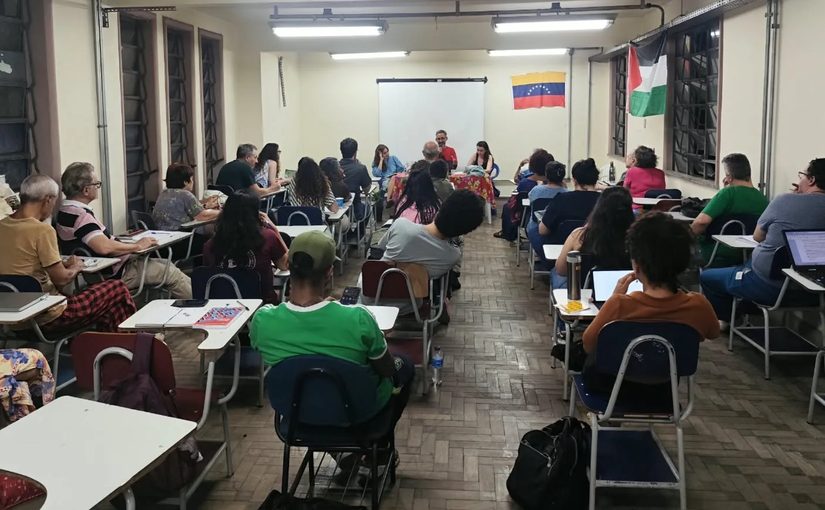
During a recent visit to Brazil, Friends of Socialist China co-editor Carlos Martinez was interviewed by Flora Villela of Brasil de Fato in Belo Horizonte, where he was taking part in the debate “China and Socialism in the Global Geopolitical Dispute”, organised by the Landless Workers’ Movement (MST).
In the interview, Carlos makes the case for the socialist character of contemporary China; discusses Western media stereotypes and what democracy actually means in Britain and in China; sets out the transition from a US-led imperialist system towards a multipolar world; and addresses what China can and cannot do in defence of countries under attack by the US, as well as the wars in Iran and Ukraine.
We are pleased to reproduce an English translation of the interview, which first appeared in Portuguese in Brasil de Fato.
China and the construction of socialism in the 21st century: expert discusses conflicts and prospects
Author, researcher and activist Carlos Martinez defends the socialist character of contemporary China
By Flora Villela
We are living through one of the most tense moments in global geopolitics: not since the Second World War has the planet seen a period with so many simultaneous armed conflicts and wars.
At the centre of these challenges are military arbitrariness and economic policies imposed on various countries by the world’s greatest power – the United States; new technologies represent civilisational challenges for every nation; authoritarianism is regaining ground and eroding democracies; and the conflicts threaten to produce economic crises that would generate widespread poverty.
Despite this scenario, China continues to emerge as the world’s new economic power, following, by all indications, a path centred on peace. And the defence of multilateralism as a solution to the crisis is gaining strength, particularly in the so-called Global South. Nonetheless, “there is a whole campaign of defamation, a propaganda war in an attempt to win public support for increasingly hostile policies towards China, which at the moment take the form of a Cold War with tariffs, semiconductor restrictions, sanctions and unilateral, coercive economic measures”, argues Carlos Martinez.
A co-editor of the Friends of Socialist China website, an author, researcher and activist, Martinez has written the books The East Is Still Red: Chinese Socialism in the 21st Century and The End of the Beginning: Lessons from the Soviet Collapse. His work focuses on dispelling what he considers an “enormous misunderstanding in relation to China”.
“Even on the left, there is an assumption that China is just another capitalist country and that the conflict between the US and China is an example of imperialist rivalry or the so-called ‘Thucydides Trap’. So in my work I try to explain the true nature of China and of Chinese socialism, and at the same time to counter anti-China propaganda”, he explains.
During a visit to Belo Horizonte to take part in the debate “China and Socialism in the Global Geopolitical Dispute”, the author spoke to Brasil de Fato MG. In the interview, we discussed the conflicts under way around the world, the role of Brazil and of this year’s elections, the dispute over global hegemony, and the path of multilateralism and peace.
“It will be a long and painful process towards our post-imperialist world, but I believe that in the end humanity will get there”, says Martinez.
The full interview
Brasil de Fato MG: You are the author of the book The East Is Still Red: Chinese Socialism in the 21st Century. And here in Belo Horizonte you took part in the debate “China and Socialism in the Global Geopolitical Dispute”. What do you address in your book, and what was the content of the debate?
Carlos Martinez: The East Is Still Red – the clue is in the title. The central question it asks is: is China still a socialist country?
Most people accept that until the death of Mao Zedong in 1976 – that is, in the first three decades of socialist construction, from 1949, when the Communist Party of China took power, until Mao’s death and the beginning of the market reforms in 1978 – China was a socialist country. And it is certainly true that it was probably the most egalitarian country in human history, and that it operated on the basis of what we traditionally consider to be socialist economic and political principles.
With the launch of the reform process and the construction of what they call a socialist market economy from the 1980s onwards, China came to display characteristics of both socialism and capitalism. The book focuses on explaining the characteristics of modern Chinese socialism and some of its contradictions.
What I essentially conclude is that, although there have been vast market reforms, although there is private capital in China, and there is exploitation of labour and inequality, although there are stock exchanges and billionaires, and despite the presence of global brands headquartered in the West, the basic structure of Chinese society – of its economy, and of the Chinese political and democratic system – is socialist.
The proof of this is that China has managed to achieve what other countries have not. The most obvious example is that China was able to eradicate extreme poverty. According to World Bank data (and the World Bank is not a pro-China or pro-communist organisation), since 1980, 800 million people have been lifted out of poverty in China. In the Chinese targeted poverty alleviation programme, which began in 2013, the goal was to lift the remaining 100 million out of extreme poverty by 2021, the centenary of the founding of the Communist Party of China (CPC). And they succeeded in that.
Being out of extreme poverty doesn’t just mean having an income of at least $2 a day, or whatever the internationally defined poverty line of the IMF and World Bank happens to be. It includes that, but it also means that you have reliable access to decent food, you have housing, clothes on your back, access to healthcare; your children go to school for at least ten years of guaranteed universal education; you have clean running water at home and modern energy (electricity and/or gas) in your home. Meeting all of those conditions is the definition of being out of extreme poverty.
If you live in a Third World or Global South country (my father was from India and I have visited many times, as well as other countries in Asia), having your own home, running water, electricity, children in school and food on the table is the very definition of being middle class.
To achieve this, incredible resources were deployed. They sent 3 million CPC cadres to villages across China to work with communities, families and individuals, to understand their specific situation and find a way out of poverty for people and communities. That might involve building a housing complex, a new roof for a school, or creating an app so that rural communities could sell their produce to nearby towns – there are a million different techniques that were used.
Can you imagine the resources needed to achieve something like that, and to do it sustainably – that is, so that people not only get out of poverty but stay out of poverty permanently and never fall back into it? I argue that only a state that operates along socialist lines, where the working class, the peasantry and their allies are the ruling class, and not the capitalist class, is able to concentrate resources in this way on projects for the people.
I think Brazil is a great counter-example. What Brazil managed to achieve in poverty alleviation under the Lula and Dilma governments was very impressive. But it doesn’t compare with what has been achieved in China. And the difference was not the will of the government; it was not whether Lula and Dilma had good proposals and good plans, or whether there was popular support for those plans. The difference is the basic political structure of the country: the ruling class in Brazil is still the capitalist class, whereas the ruling class in China is not.
That is the basis for saying that China is still essentially and overall a socialist country, with a planned economy geared primarily towards the general development needs of the country, and not towards the enrichment of an elite.
Generally speaking, Brazilians are not very familiar with the reality or the culture of China. On the other hand, the perspective offered by the mainstream media is a stereotyped one, of an authoritarian country where individual freedom does not exist. As a scholar of China, how do you interpret the perspective of Western media propaganda about the country? Does it correspond to reality? How can we get closer to a more realistic view of what life in China is like today?
We need to start by discussing what we mean by democracy. I’m from Britain, where we are used to equating democracy with the Westminster parliamentary system (a model of government in which the executive emerges directly from the legislature and answers to it), in which the Conservative Party and the Labour Party alternate in power. We have a nominally independent media (the Guardian, the Telegraph, the Daily Mail and so on) and a certain level of freedom of expression.
However, people rarely analyse the limitations of this concept. For example, I can say whatever I like in support of Palestine, Iran, China, Russia, Venezuela or Cuba, but I don’t have a public voice. I can’t publish in a major newspaper or appear on mainstream television, because the so-called independent media is owned by billionaires.
Meanwhile, the main electable political parties are capitalist parties. There’s a wide variety of opinion expressed, but within a very narrow spectrum: the limits of what is politically acceptable are just one variant of capitalism against another variant of capitalism. And the result is that nothing really changes and power remains concentrated in the hands of rich people. We have a very, very strong correlation between wealth and political power. And the same is obviously true in the United States, probably even more so.
And what we’re finding is that as the economic situation under Western capitalism worsens – in the US, in Britain, in Europe – people get more upset, they start to resist, to complain, to organise. We have seen an enormous popular reaction against, for example, the genocide in Gaza since October 2023. And the state responds to this by cracking down on democratic freedoms, freedom of expression and freedom of the press.
In Britain, and now in the United States, the peaceful, non-violent direct action group Palestine Action has been labelled a terrorist organisation. So expressing support for that organisation is considered a crime. Literally thousands of people, most of them elderly (including people over 80), have been arrested and taken to police cells for holding a sign saying “I oppose genocide, I support Palestine Action”.
Now Iran’s Islamic Revolutionary Guard Corps, which is part of the Iranian armed forces, has been designated a terrorist organisation in Britain. In other words, you have a country that is suffering an illegal and criminal war, for which there is no legal basis whatsoever under international law or under the terms of the UN Charter – a country that is defending itself – and expressing support for that defence is committing a crime in Britain. That is the real state of democracy and freedom of expression in a country like Britain, and the same can be seen in the United States.
China has a completely different political system, which they call “whole-process people’s democracy”. They have elections, they have a democratic system and the system of People’s Congresses at five levels. In parallel to the system of People’s Congresses, they have the consultative conferences, dedicated to consultative democracy, which essentially consists of going to people in their workplaces, communities and mass organisations (of women, ethnic minorities, trade unions and so on) and consulting them to understand their needs and develop policies around those needs.
If you look at a document like China’s Five-Year Plan – China’s economy works on the basis of five-year plans; the 15th Five-Year Plan has just begun – a document of that kind is debated by tens of millions of people and goes through thousands of edits and revisions, reflecting discussions in party branches, communities, village meetings, workplaces, trade unions, women’s organisations and so on, over at least a year. You can have millions of these meetings, resulting in tens or hundreds of thousands of proposals that are synthesised into the final document.
Their economy is incredibly democratic compared with how things work in capitalist countries, where gigantic organisations with very rich owners take decisions that affect millions of people. I would say that the Chinese system is profoundly different from what we consider democracy in the West, but it is its own kind of socialist democracy, and in many respects it is more democratic.
As for authoritarianism in China, it’s true that there are limits to freedom of expression. But there is an enormous variety of political opinion in China. In fact, I think there is much more variety of political opinion in China than in Britain. For example, I’m not currently an academic, but with my views and political positions I would find it extremely difficult to get a job at a British university. I know many left-wing academics who really struggle, and only a few become tenured professors.
In China, if you are good, if you have strong opinions and can substantiate them, formulate arguments, write and teach, you are considered to have a right to a voice: you can express yourself, appear in the media, work as an academic and so on. The real range of acceptable opinion is much broader.
What you can’t do is organise a political party of the capitalist class, or work towards dismantling socialism and building a capitalist society. As a capitalist – someone who owns and deploys capital – you can join the Communist Party, or one of the other eight or nine parties that are part of the Chinese political system, if you agree with their aims.
In fact, there are many well-known capitalists in China, including billionaires, who agree with the aims of the Communist Party and work to support them – but you can’t organise for capitalism. That is the most important limit on political freedom, and the main way in which authoritarianism expresses itself.
As for the Western stereotypes that China is a police state or an authoritarian system, that simply doesn’t correspond to reality. I’ve been to China many times: to big cities, smaller towns, villages. You hardly see the police. The idea that China is a police state is rather ridiculous. People enjoy all the personal freedoms you would expect and, very importantly, they enjoy freedom from extreme poverty – an essential freedom that is often ignored in capitalist countries.
What does the freedom to express myself politically mean if I’m starving, if my children can’t go to school, if I don’t have electricity, or if, as in much of South Asia, I’m trapped in intergenerational debt bondage and the only way out is to move to a peri-urban slum on the outskirts of Mumbai, Delhi, Lagos, Dakar or wherever it may be?
It’s no secret to anyone that we are witnessing a dispute over global hegemony involving the United States and China. How do you see this dispute and the process of transition the planet is going through?
The Chinese use the expression “changes unseen in a century”. It is presumed that this refers to the October Revolution, the beginning of humanity’s journey from capitalism to socialism. If these are the changes unseen in a century, then they must be quite significant and substantial changes.
And the way I think this should be conceived is in terms of the shift from an imperialist system led by the US to a multipolar system in which all countries are equal, all nations enjoy their sovereignty and have a voice in international affairs. And where we genuinely respect and adhere to the principles of the UN Charter and international law, which are beautiful ideas that emerged from the ashes of the Second World War but have never been properly put into practice.
What we had, essentially, was a bipolar system, with the Soviet Union and its allies on one side and the United States and its allies on the other. The Soviet Union was advancing towards a socialist future and was ultimately defeated in that respect, with its collapse and that of the people’s democracies of Eastern Europe between 1989 and 1991.
The United States, for its part, has since then been committed to defending, recovering and expanding the imperialist and neocolonial system – that is, to replacing the colonial system imposed by the British, French, Germans, Belgians, Portuguese and Spanish, from which the countries of Latin America and Africa had won their liberation, with neocolonial structures, through structural adjustment programmes, debt traps, coercive and aggressive lending practices and so on.
So what we mean by multipolarity is the transition to a situation in which all countries have their independence and their sovereignty and can choose their own development path. Essentially, it is a post-imperialist system. And we are already starting to see it emerge in reality.
The most obvious example is the rise of China, which has gone from being one of the poorest countries in the world to the second-largest economy measured by nominal GDP, or the largest economy in the world measured by purchasing power parity (PPP) – and has become a scientific and technological superpower, leading the way in telecommunications, renewable energy, space exploration, advanced manufacturing and so on. It is also reflected in the rise of the Global South in general and in the resurgence of Russia as a major independent power.
Another example is the rise of a country like Iran as a major independent power – a country that, despite facing 47 years of brutal sanctions, probably the most comprehensive any country has ever faced, has reached a level of economic and technological progress that allows it to essentially defeat the United States, the most sophisticated and elaborate military power in history, in a war like the one the US and Israel started on 28 February this year.
We also see it in the rise of sovereign powers in Latin America, Brazil among them. And in the fact that the BRICS economies are now substantially larger than the G7 economies, which represents an enormous shift. So increasingly, the countries of the Global South and developing countries are in a better position to assert their own sovereignty and cooperate with one another. They are no longer as dependent as they were.
That is the trajectory towards sovereignty, towards South–South cooperation, towards the ability of countries to choose their own development path, which is very important. And as the Egyptian Marxist Samir Amin pointed out, multipolarity becomes a stepping stone on the road to socialism, because if you have the freedom to choose your own development path, then you have the freedom to choose a socialist development path. So from a Marxist point of view, this is very important.
Several African countries, such as Angola, Mozambique, Guinea-Bissau, Zimbabwe and Ethiopia, pursued a socialist development path in the 1960s, 1970s and 1980s. Countries in Latin America, such as Nicaragua under the Sandinistas in the 1980s, also tried to follow a socialist development path.
And the response of the United States and the West was a combination of economic coercion, sanctions, predatory lending and, in the case of Angola and Nicaragua, literal war, to prevent a country from asserting itself, choosing its own path and taking the road towards socialism.
In that sense, there is a very important link between the idea of multipolarity and the idea of socialism, and I think that is the trajectory of the changes we are witnessing in the world. But what is very clear is that the United States and its allies are not simply going to accept this trajectory; they are not going to give up without a fight.
And we can see the expression of that in the war on Iran, largely due to the recognition that Iran is part of the multipolar process. Iran is a member of BRICS, a member of the Shanghai Cooperation Organisation and a key player in the Belt and Road Initiative. Iran has a comprehensive strategic partnership with China, with agreed investment of around $250 billion. And Iran is a resistant state, unlike most countries in the Arab world and the West Asia region. It does not cooperate with the United States or with Israel.
The United States and its allies are trying to change that and remove a resistant Iran from the equation. Cuba is another country that is part of the multipolar process, part of humanity’s socialist trajectory – and how does the United States respond to Cuba? With a genocidal energy siege and attempts at regime change.
How does the United States respond to Venezuela, a country trying to find its own path to socialism in the 21st century? Countless coup attempts, decades of sanctions, and now the kidnapping of President Nicolás Maduro and first combatant Cilia Flores, along with the seizure of control of Venezuelan oil.
And it’s no coincidence, by the way, that Venezuela is the Latin American country with the closest ties to China. Controlling these energy chokepoints – in Venezuela, in Iran, in the Persian Gulf – and the threats to annex Greenland and control the Arctic Circle: all of this, from a strategic point of view, is about preparing for a future war against China, that is, imposing an energy blockade on China.
And Brazil is another great example. Brazil is a country that is finding its own development path, its own kind of socialism, its own kind of progressive, people-centred politics; that cooperates with China, with Venezuela, with Cuba; that has good relations with Russia; and that is also a founding member of BRICS.
And the United States, especially under this Trump administration, within the framework of this new Monroe Doctrine, is trying to influence and subvert the elections that will take place shortly – imposing these sanctions, doing everything it can to support the Bolsonaro family and to restore a political situation in Brazil that is favourable to US hegemony.
So it won’t be an easy road, a smooth journey, towards multipolarity and a world of equality, a democratic system of international relations. But I think this is the real dichotomy: however much military and economic power the United States has, it won’t actually be able to achieve what it wants.
So we shouldn’t imagine that the United States can simply, as if by magic, keep the imperialist system in place. In fact, Iran is the best example of all, because they threw every available resource at Iran and failed to defeat it. So it will be a long and painful process towards our post-imperialist world, but I believe that in the end humanity will get there.
Other Latin American nations have faced direct interference, the imposition of tariffs and even military action by the US. In none of these cases have other world powers, such as Russia, made any concrete move in defence of these nations. Even China only verbally condemned these acts. In Brazil’s case, we are one of the founding members of BRICS and a strategic state on the global stage. Even so, in your view, can we expect any support in defending our sovereignty, which seems more threatened by Washington every day?
Increasingly, on the left, we find people saying: “China is now a world power; it should be doing more to defend international law and the UN Charter, sovereignty and the principles of peaceful coexistence.” The problem is that, as Chairman Mao Zedong said, “political power grows out of the barrel of a gun”. And there is an enormous military disparity between China and the United States. The United States enjoys a global infrastructure of power projection, with more than 800 military bases overseas. It has military alliances such as NATO. It has tens of thousands of troops stationed in West and East Asia, the Pacific and Latin America, and its military budget exceeds $1 trillion a year, which I believe is three or four times larger than China’s – and, per capita, more than 20 times larger than China’s.
China has one overseas military base, which is essentially a logistics and support hub in Djibouti, used not only by China but by various countries carrying out commercial shipping in the region. So in practical terms it is not a military base in the same sense as US military bases.
So China is not really in a position to impose its will militarily in the way the United States does. The United States enjoys real hegemony, based on a material reality: its military superiority and the fact that it has been the world’s policeman for the last 80 years, particularly since the end of the Second World War – reinforced by the collapse of the Soviet Union and the emergence of the United States as the world’s only superpower.
We were told in the 1980s that the West’s victory in the Cold War and the collapse of the Soviet Union would bring a peace dividend, but in fact they brought endless wars. They brought the first and second Iraq wars, the wars in Afghanistan, Yugoslavia, Libya, Syria, Yemen, now the war on Iran, and so on. So what China can do in material terms is quite limited.
Obviously, in diplomatic terms, it does what it can in the UN Security Council and the General Assembly. In terms of economic assistance, diplomatic assistance and solidarity, I think it does what it can. And it is doing some very important things. For example, with regard to Cuba, China’s response to the energy siege imposed by the US, which is trying to prevent oil from reaching the country, is to develop Cuban energy sovereignty through solar power.
So China is building almost 100 solar parks in Cuba. As a result, Cuba is on the verge of carrying out the fastest transition to renewable energy in history. And as many have commented, you can’t blockade the sun. So Cuba’s transition to a renewable energy system based on solar power will ultimately solve the problem of the energy blockade.
Obviously that will take a few years, but based on what is already being installed, it can meet around 20 to 25 percent of the country’s energy needs. It can power hospitals, schools, household refrigerators and so on through solar energy. So that is an important contribution, and it is within the limits of what China can actually do.
It’s important to remember that China can’t actually send warships to the Caribbean to defend Cuba’s sovereignty. And if it did, that could trigger an all-out war and a confrontation with the United States, which China does not want. Above all, the country is responsible to its own population of 1.4 billion people, who want to continue their progress, ensure the continued existence of the People’s Republic of China, enjoy peace and development, and continue improving their democratic system. They want to move up the hierarchy of needs, from “we have electricity, education, food, clothing and housing” to a point where everyone can enjoy a high cultural level, engage in meaningful and self-fulfilling work, and so on. That is China’s domestic trajectory, and it is obviously very important for them to protect it.
China’s entire development has been based on peace, and there is nothing the United States wants more than to drag China into a war that would interrupt its development. That’s exactly why the United States invests so much capital in sending weapons to Taiwan and supporting Taiwanese separatism – to corner China into a war situation.
Within the limits of what it can realistically do, China is doing what it can for Cuba, and for Iran, for example, at the diplomatic level. As well as obviously condemning the war and demanding that it end, China has been heavily involved at the level of international relations. In the UN Security Council, when Bahrain put forward a resolution aimed at paving the way for an expansion of the war and legitimising a potential ground invasion of Iran, China and Russia opposed it and vetoed the resolution.
China has continued buying Iranian oil, which has been very important in sustaining the Iranian economy during this period. China buys 90 percent of Iran’s oil and, while the United States has tried to impose sanctions on the Chinese companies that buy that oil, China – and this is the first time a major country has done this – has imposed reciprocal sanctions and told its companies, and companies that work with China, that if they follow and comply with these US sanctions, they will be sanctioned and penalised, and considered guilty of criminal activity.
That is a historic achievement and an important way for China to take a stand, first in defence of Iran and second against this whole infrastructure of sanctions and economic coercion put in place by the United States. Meanwhile, China continues to do business with Iran, provides Iran with satellite positioning systems and all kinds of equipment, which undoubtedly helps the country to pursue its war effort.
And there are many other ways in which China works with Cuba, with Venezuela, with Iran and with Palestine that are not necessarily public knowledge – that is, we don’t know about them. But I think that, within the limits of what China and Russia can do, they are actually doing quite a lot – despite limitations grounded in material reality, and the fact that the US is, militarily speaking, the only superpower. And, as I said before, power grows out of the barrel of a gun. And the United States has a lot of guns.
A major concern today is military escalation, mainly on two fronts: the US and Israeli war on Iran, and the conflict between Ukraine and Russia. Do you think we are seeing the beginning of a third world war? How is China positioned in this scenario?
I’m not going to make predictions, because I’ve made them in the past and they have generally turned out to be wrong. I think the conflicts in Russia and Iran have served to show the limits of US power. In fact, both have backfired on the West to a certain extent.
The West has been pushing Russia into this conflict in Ukraine for decades, with the aim of using Ukraine in a very cynical way, to fight Russia to the last Ukrainian (as has even been said out loud). And, sadly, hundreds of thousands of Ukrainians are dying in a war that doesn’t actually help them at all.
There is no good reason why Russia and Ukraine shouldn’t be friendly neighbours and maintain perfectly good economic, political, diplomatic and social relations, given that their countries share an important history. The vast majority of Ukrainians also speak Russian. They have their common history during the Soviet period; several of the main leaders of the Soviet Union were Ukrainian.
So the whole conflict fomented by the United States and Europe revolves around drawing Russia into a war into which Europe and the US can pour all their resources to weaken and destabilise it – in order to get rid of a Russian government that is neither welcome nor popular in the West, because, whatever one thinks of Vladimir Putin, the United Russia party or the Russian state in its current form, it is opposing imperialism. It is asserting its independence and its sovereignty.
It is asserting its right to develop and not to submit to the dictates of the United States. So the idea is to weaken it and ultimately bring about regime change – ideally, as an ambitious goal, to break Russia up and turn it into three, four or five different states that could be more easily controlled by the West.
So they have spent billions and billions of dollars on this war. They have sent all kinds of weaponry to Ukraine. They have sent personnel, advisers and, in many cases, troops. And the fact is that they cannot defeat Russia, which from its point of view is fighting an existential war. Russia cannot accept the idea that NATO, a military organisation that has defined it as an enemy, would have a 2,000-kilometre border with Russia, and that Ukraine would be a launching pad for a war, as Ukraine has been in the past – most recently in 1941, with the launch of Operation Barbarossa by Hitler’s Nazi army.
So Russia is very close to achieving its war aims. It is very close to controlling all of Donetsk and all of Lugansk, having a land link to Crimea and maintaining control of Crimea. Despite everything the West has thrown at this war, Russia is prevailing. It is a slow and arduous process, but even so, the trajectory points towards some kind of negotiated solution that reflects Russia’s aims in the conflict.
Again, with Iran, the idea was to assassinate the Supreme Leader, Ayatollah Ali Khamenei, and some scientists, to assassinate some important politicians, including the speaker of parliament, Ali Larijani, and to bomb a school in Minab, killing 165 girls – as well as bombing energy infrastructure, hospitals, schools and water systems – counting on the Iranian people taking to the streets, overthrowing the government and taking power.
Trump said at the start that he expected the war to last three weeks. Here we are, six months later, at a stalemate. And the US has run out of military options. This is acknowledged even by the Financial Times, the Guardian, the New York Times and CNN. They have not been able to defeat Iran militarily. Iran’s military strategy has been so creative, effective and brilliant that the result of this military pressure on Iran has been the total dismantling of US military infrastructure in the region.
The United States maintained very strong military bases and a significant military presence in Bahrain, Saudi Arabia, the United Arab Emirates, Jordan and Qatar, among other countries. Those bases have had to be dismantled. In fact, it is no longer viable to maintain large numbers of troops and a large amount of military infrastructure in the Persian Gulf.
And, in a kind of admission that they have been defeated militarily, the United States is now saying: “Let’s move on to sanctions.” Scott Bessent has said they will impose D-Day-style sanctions on Iran. The sanctions won’t work: Iran is already under sanctions and has managed to develop its economy adequately, and Russia isn’t going to comply with these sanctions, nor is China. In short, the sanctions won’t have any significant impact beyond the impact they are already having.
So I think that in the case of both Iran and Ukraine, what we are seeing are the limits of US military might. And that is a very important lesson for the world. It teaches a lesson to the countries of Latin America, the Caribbean, Central Asia, South Asia, East Asia, West Asia and the Pacific: you can resist the United States. You don’t have to accept domination or intimidation. You don’t have to accept hegemony.
As I said, the United States and its allies won’t give up without a fight. But increasingly they are losing their military adventures. And increasingly we are seeing the limits of their power; they are in fact becoming isolated. The other imperialist powers and the traditional allies of the US understood from the start that Iran would be a tough nut to crack.
If they had thought it was possible, then Britain, France, Germany and Canada would have got involved, but they all realised it wasn’t going to happen. So what we have seen is that the United States, through the war on Iran and its support for the genocide in Gaza, has become more isolated than ever.
In part this is a manifestation of Donald Trump and his particular personality, which is so grotesque, and which has no interest in democracy, human rights, press freedom and the things the United States at least partly pretended to care about. Donald Trump isn’t interested in any of that. But that in itself is a reflection of the decline of US imperialism. It is a reflection of the fact that the world is changing.
So what all this represents is in fact a last desperate attempt to build something like a Project for a New American Century. But in reality the world doesn’t support it. The Global South doesn’t support it. Even the rest of the Global North – Europe, and to a certain extent Canada – is starting to realise and understand that, whether we like it or not, the world is becoming multipolar; Francis Fukuyama’s so-called end of history from the 1990s is over. We are living through the end of the end of history and entering a new phase of international relations.
The United States will be the last country to learn this lesson, but ultimately it will have to learn it.






One thought on “China, Brazil, and the building of socialism in the 21st century”