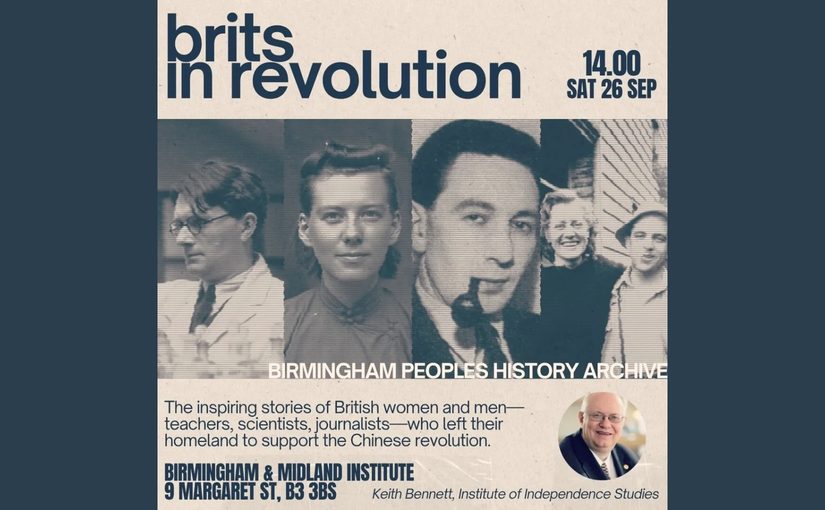
The following is the text of a talk given by our co-editor Keith Bennett on September 23rd to a meeting organised by the Birmingham People’s History Archive and held at its offices housed in the Birmingham and Midland Institute.
With the title of Brits in Revolution, Keith introduces various British people whose lives became entwined with the Chinese revolution in various ways and in its different phases and stages and travels back and forth between Britain and China, between the Chinese revolution and progressive and working class movements in Britain, and between individuals in both countries, illustrating in this way how each influenced and reinforced the other, creating history in the process.
Starting with the first opium war waged by British imperialism against China and the Chartist movement in Britain, the first mass political expression of the modern proletariat, in the early 1840s, Keith takes us through the Taiping Heavenly Kingdom, the early collaboration between British and Chinese communists in the 1920s, the war of resistance against Japanese aggression, the early days of building New China and the more complicated period of the 1960s.
Inevitably these snapshots omit many great events and many individuals who richly deserve to be remembered, but Keith concludes:
“In this spirit, in going back and forth, I have tried to draw out how the role of British people in supporting and even participating in the Chinese revolution is not simply a matter of something that happened ‘over there’. Rather it represented two mutually reinforcing fronts of ultimately the same fight, a struggle whose commonality was forged through the interweaving of numerous threads in such a way that they could not actually be dissevered. And further that here we can perceive part of the makings of what Xi Jinping now calls a community of shared future for humanity.”
A video of the talk along with the ensuing discussion can be viewed here.
Thank you for the invitation and it’s a pleasure to be back in Birmingham and at this historic venue again.
I was last here about nine months ago, when we marked the 80th anniversary of the victory over Japanese militarism on the eastern front of the global anti-fascist war, especially the contributions of the Chinese people and the friendship forged in battle between the peoples of Britain and China at that time, not least thanks to the brave Chinese fishermen who risked everything to save the lives of the British POWs aboard the Lisbon Maru.
Today, I’m going to speak about a related subject but from a somewhat different angle and across a wider canvas.
When we discussed about this talk, we gave it the working title, Brits in Revolution, meaning specifically the stories of British people whose lives in one way or another became bound up with the Chinese revolution.
So, first we should perhaps clarify what we mean by the Chinese revolution.
Among his many memorable sayings, China’s Chairman Mao Zedong said that “where there is repression there is resistance”.
So, the modern Chinese revolution may be said to have begun with the first Opium War of 1839-1842, when British imperialism, prompted not least by the East India Company went to war against Qing dynasty China after it sought to crack down on the opium trade that was causing an epidemic of addiction, destitution and immiseration of the Chinese people. Opium was Britain’s single most profitable commodity trade of the 19th century.
The war concluded with the unequal Treaty of Nanjing, under which, among other things, China was forced to cede the island of Hong Kong to Britain.
Thus began a century, often referred to by Chinese people as the ‘century of humiliation’, in which virtually all the imperialist powers sought to seize Chinese territory or establish spheres of influence or extraterritoriality under which Chinese people were subject to forms of apartheid-style neo-colonialism. Meanwhile the vast countryside and the great mass of the peasantry groaned under semi-feudal oppression and stagnation.
However, the Chinese people were never merely passive bystanders and victims. Peasant revolts mobilised the poor in their tens of millions, progressive individuals explored possible avenues for reform; then the October Revolution in neighbouring Russia brought Marxism-Leninism to China and after several decades of wars against foreign aggression and revolutionary civil wars, at the cost of immense suffering and sacrifice, finally on October 1, 1949, Mao was able to proclaim the founding of the People’s Republic and that the Chinese people had stood up.
This has in turn been followed by 77 years to date of new democratic reforms, socialist revolution and construction, reform and opening up, through to the current new era under Xi Jinping, in which China is increasingly a prosperous, modern country and society, leading the world in numerous fields of research and development, and innovation, in fields from super computers to climate resilience and clean energy.
Gladstone, the Chartists and the Opium War
The solidarity of British working and progressive people with the Chinese people’s struggles also begins from the first Opium War and continues to the present.
The most prominent person to speak out in Britain at the time was William Gladstone, who would later go on to serve as Britain’s Liberal Prime Minister. Gladstone lambasted the first Opium War as “Palmerston’s Opium War” and said in May 1840 that he felt “in dread of the judgments of God upon England for our national iniquity towards China”. Gladstone also made a famous speech in Parliament against the war, stating, “A war more unjust in its origin, a war more calculated to cover this country with disgrace, I do not know, and I have not read of.”
But solidarity with the Chinese people was certainly not confined to the House of Commons. The first mass political movement of the modern proletariat, the Chartists put solidarity with the Chinese people at the heart of their propaganda.
Writing in the History Workshop journal in 1987, Chinese scholar Shijie Guan notes that Chartist newspapers described the landing of British troops at various points along the Chinese coast, reported the British occupation, and related how the British advance was marked, at each step, by robbery and slaughter of Chinese civilians.
When merchants in Manchester, London, Liverpool, Leeds and Bristol who were directly profiting from the opium trade, signed a memorandum addressed to Her Majesty’s Government demanding to send an expedition to China to take vengeance upon the Chinese ‘for the robbery of our merchants, and the insult offered to the representative of our Sovereign’, the Chartists responded: ‘What an idea the fellows, who write thus, must have of moral or of international justice, thus to describe the suppression of an illicit trade, which was spreading depravity and misery throughout the Chinese empire.’
The Chartist newspaper the Northern Star in its editorial of January 18, 1840, entitled ‘The Shopkeepers, their ‘profit’ and our ‘loss’, writes that: ‘Mr. Opium Elliot, his master, the Reform Government, and their masters, the ‘shopkeepers’ of India, have chosen to exhibit this whole people to the Chinese empire. They are representatives of this contemptible category of businessmen and politicians, who threatened the Chinese government to withdraw their patronage from its commerce and to return home, who behave like thieves and bullies gloating over the prospects of the bloodshed, the famine, the insurrections among the people and the multiform distress and misery which must follow a blockading of their ports.’
The Chartist editorial further asserted that the Chinese had neither insulted Her Majesty’s officials to China nor any of her subjects, as the Chinese laws were known and made public with their enforcement, coming as it did within the sovereign jurisdiction of the Chinese empire, was legitimate. The British opium smugglers, it noted, had been warned to abstain from the illegal trade.
The Chartists were clear that whilst the opium trade might enrich some in British society, it certainly would not benefit the British working class.
The Taiping Heavenly Kingdom
With Chinese society in turmoil, due not least to foreign aggression, the Taiping Rebellion, also known as the Taiping Heavenly Kingdom, erupted in December 1850. Led by the charismatic Hong Xiuquan, who, apparently after a series of visions, declared himself to be the younger brother of Jesus Christ, the Taipings essentially represented a type of peasant millenarian communism. The ensuing conflict raged until 1864 and claimed tens of millions of lives.
Although the Taipings were finally defeated, the Qing dynasty had been greatly undermined and their example influenced and inspired successive generations of revolutionaries, including Dr. Sun Yat Sen, whose 1911 revolution finally ended imperial rule in China.
The distinguished US historian of China John King Fairbank compares the Taipings to the Communists as follows:
“In addition to the zeal, vigour, and puritanical discipline so often found in new political movements, they shared certain traditional Chinese interests, such as propagating and maintaining doctrinal orthodoxy, recruiting an elite of talent, realising a utopian social order, and developing military power based on farmer-soldiers. Furthermore, both made use of foreign ideologies which required translation into Chinese with inevitable modifications in the process.”
The lasting influence of the Chartists can be seen in the too short life of Augustus Frederick Lindley, February 1840 – March 1873. In 1859, as a young Royal Navy officer stationed in Hong Kong, Lindley resigned his commission and having taken a job with a trading steamer in order to smuggle funds to the Taipings, accepted a commission from them, trained their fighters in advanced British military techniques, was responsible for sinking numerous Qing warships and was finally given the rank of colonel.
In its August 1963 edition, History Today wrote:
“Lindley returned to England, twenty-four years old but broken in health, determined to publicise the cause of the Taipings. In two years, he wrote a half-million-word account of the rebellion, documented and illustrated, including his own activities. A Chinese edition of this work has just been issued in Peking.”
Describing the social reforms carried out by the Taipings, Lindley wrote, “the disgusting scenes, the inseparable concomitants of the Manchu magisterial dwelling, or yamun, such as the torture of litigants, criminals and prisoners, are entirely abolished.”
History Today adds: “Lindley noted that many of the social reforms were of special benefit to women. Regulations prohibited the sale of slaves (a traffic mainly in females), houses of prostitution, adultery, and foot-binding: ‘All children born since the earliest commencement of the Taiping rebellion have the natural foot.’”
Lindley went on to oppose British imperialist aggression in Ethiopia and South Africa and History Today notes:
“There was nothing mercenary about Lindley. The causes he supported were unlikely to gain him prestige or personal advancement. By the age of twenty-four he had proved himself disciplined but audacious in battle. He wrote with the same fervour as he fought.”
Communist parties form in Britain and China
The 1917 October Revolution in Russia, leading to the formation of the Communist International or Comintern in 1919 and being decisive in the formation of the Communist Party of Great Britain (CPGB) in 1920 and the Communist Party of China (CPC) in 1921 as member parties, was to decisively influence much of the British solidarity with China for the rest of the century and indeed beyond.
In May 1923, after a Japanese employer shot dead a CPC trade unionist, protestors filled the streets of Shanghai, only to be gunned down by British colonial police. Millions of people then struck and marched across China, some clashing fatally with British and Japanese security forces.
The CPC rapidly grew and built trade union and local strike committees, culminating in the formation of the All-China Federation of Trade Unions. Peasant associations were set up in the countryside.
In Britain, the CPGB launched a militant ‘Hands Off China’ propaganda campaign of leaflets, meetings and marches. Labour Monthly editor Rajani Palme Dutt declared China’s example to be one which “lit up the world”. The ebb of European capitalist-imperialist expansion had begun; the subject nations were finding their way to freedom.
Britain’s workers, Palme Dutt added, had a duty to demand the complete withdrawal of all British forces and garrisons from China – something the TUC and Labour Party had failed to do.
As the nationalist Kuomintang’s National Revolutionary Army (at that time in a united front with the Communist Party of China) advanced northwards in 1926, organisations of workers and peasants grew rapidly – to the alarm of warlords, landlords and capitalists within China and beyond.
The CPGB press publicised these gains, and miners’ leader Arthur Horner moved an emergency resolution at the TUC conference, warning that any British military intervention in China would be aimed at the Soviet Union as well.
In April 1927, after British and US warships on the Yangtze River bombarded newly liberated Nanjing, in league with imperial police and local criminal gangs, the Kuomintang, now under the right-wing leadership of Chiang Kai-shek, following the death of Sun Yat Sen in May 1925, swooped into Shanghai and other cities to disarm the workers and butcher, imprison and torture many thousands of actual or suspected communists.
Two months before the massacres, Tom Mann, the legendary communist trade unionist, had travelled to Canton (today’s Guangzhou) on a mission for the Comintern-led Red International of Labour Unions. Speaking on arrival, he accused the “British imperialist pirates” of filling history with many bloody pages, oppressing hundreds of millions of colonial peoples. Over the next five months, Mann addressed dozens of meetings in China, joined workers on picket lines and led a mass march against the arrival of thousands more imperialist troops.
He remained a tireless champion of Chinese workers and the CPC until his death in 1941.
War against Japanese aggression
By far the greatest test for the Chinese people came with the Japanese invasion and occupation of large parts of the country – a traumatic period which caused the death and injury of more than 30 million people.
This aggression began in 1931, with Japan occupying the three provinces of China’s northeast. A full-scale invasion began in July 1937.
Within weeks of the Marco Polo, or Lugouqiao, Bridge incident of July 7, which heralded Japan’s all-out invasion, the Communist Party of Great Britain was instrumental in forming the China Campaign Committee (CCC), with party member Arthur Clegg as national organiser.
On July 14, the Daily Worker, the newspaper of the CPGB, described this as a “plain case of aggression” in its editorial, adding: “The Chinese people must be backed up.”
In an August 20 resolution passed by its Executive Committee, the CPGB stated:
“The cause of peace throughout the world depends to a considerable extent upon the success of the heroic Chinese people… Unless peace forces can be rallied the Japanese attack on Central China will be followed by a German fascist outbreak in Central Europe… The defence of China is the defence of peace.”
Regarding the China Campaign Committee, Arthur Clegg’s daughter, the well-known campaigner and scholar Dr. Jenny Clegg has written that the “roots of this activism are to be found in Chartist opposition to the first Opium War”. Arthur himself traces the roots of such solidarity back even further, writing in his memoir, Aid China – 1937-1949, published in 1989:
“Movements like the China Campaign Committee have long been part of the democratic tradition in Great Britain. They date back to the English Revolution [of the 1640s] when the Levellers took a stand for Irish independence and the end of English interference in Ireland.”
In his compelling memoir, Arthur Clegg details the extraordinary range of forces mobilised by the CCC. They included church and missionary societies, businesses, leading intellectual and cultural figures, members of the House of Lords, the Chinese community, people with a specialised interest in China and Chinese culture, and many others.
On one occasion he even personally received a financial donation from a Colonel Younghusband. Only years later did he realise that it was the same Younghusband who had led the 1905 British invasion aimed at separating Xizang (Tibet) from the rest of China. He writes: “The only explanation I can find was that he was trying to make amends for his past efforts to weaken China.”
Support was forthcoming from many members of the Labour and Liberal parties and even from the occasional Conservative MP. However, Clegg is at pains to point out:
“Our greatest and most consistent supporter was the Communist Party, both directly and indirectly, for in those days it had influence far beyond its small but increasing membership. It was the first party to take a position defending China, the first to issue a pamphlet for China, the first to organise a Hyde Park meeting, where on August 23 [1937], J.R. Campbell demanded a Japanese withdrawal. Its branches and members loyally supported our meetings, distributed our handbills, posted our posters and saw in this a reinforcement for, rather than any rivalry with, the similar work they were doing for Spain. We all knew the issue of Spain and the issue of China were one and the same, the issue of preventing a world war.”
A clear example of how such direct and indirect support worked in practice is provided by the South Wales miners. Through much of its history, the miners and the mining communities may be considered to have constituted a key vanguard of the British working class. The 1926 general strike lasted for just nine days, but the miners fought on for a further six months, despite facing hunger, destitution and repression, just as they did throughout their great strike of March 1984–March 1985.
In 1937, the communist-led South Wales Miners Federation adopted a resolution which read in part:
“This Council of the South Wales Miners’ Federation, representing 120,000 members, expresses its deep-felt horror at the savage and inhuman massacre of defenceless men women and children in China by the invading forces of Japan. We urge the Trades Union Congress Council to make every effort through the International Federation of Trade Unions and other working class organisations, particularly in European countries, Australia, [the] United States and Canada, to adopt a policy of refusing to handle any goods and materials for export to or imported from Japan and to create a worldwide movement to boycott all Japanese goods, until the Japanese have left Chinese territory.”
The next year, while making a donation for the provision of medical supplies to China, it passed the following resolution:
“This Executive Council of the South Wales Miners’ Federation expresses the strongest indignation and protest against the ruthless war of aggression which Japanese imperialism is waging on China, accompanied as it has been by the systematic barbarous and pitiless massacre of the Chinese civil population.
“It hopes that the victories of the Chinese armies over the Japanese armies will continue and that they will have the effect of wearing down and ultimately smashing the power of the Japanese military clique, thus opening the way of peace, freedom and democracy in Japan as well as liberating China from the danger of foreign domination.
“This Executive Council therefore calls upon the members of the South Wales Miners’ Federation to do whatever they can to assist the Chinese people in their struggle, particularly in regard to boycotting Japanese goods and creating a public opinion to force the British government to adopt a more positive policy in aid of China and against the present imperialist rulers of Japan.”
As Communist MP for West Fife from 1935, Willie Gallacher had taken up the cudgels for China in his maiden speech. Why, he wanted to know, had the National Government refused to back the League of Nations against Japan’s invasion and occupation of China’s Manchuria since 1931, yet now sided with the League against Italy’s invasion of Abyssinia (Ethiopia)? In both cases, the British government was doing whatever served the interests of British railway shareholders.
It was also at this time that the activities of progressive British people in China itself again became worthy of note.
George Hogg
During his state visit to the United Kingdom in 2015, the 70th anniversary year of victory in the global anti-fascist war, President Xi Jinping recalled in a speech at a dinner in Buckingham Palace how our two countries had once stood together as allies and fought shoulder to shoulder.
Saying that the Chinese people would never forget this help during their hard time, he mentioned one individual in particular.
George Hogg died of tetanus aged just 30 on 22 July 1945 after devoting the last nearly eight years of his tragically short life to the Chinese people and their struggle for liberation, initially as a journalist and finally as headmaster of the Shandan Bailie School, caring for children orphaned by Japan’s brutal war of aggression. He is perhaps best remembered for leading his pupils on a month-long 1,100 kilometre (700 miles) journey, most of it on foot and over snow-covered mountain paths, to the relative safety of Gansu.
Long acclaimed as a national hero in China, Hogg remained almost entirely unknown in his native country for decades. This began to be partially rectified with the 2008 publication of James MacManus’s biography, Ocean Devil. The same year saw the release of the perhaps overly fictionalised feature film, The Children of Huang Shi, also called Children of the Silk Road or Escape from Huang Shi, starring Jonathan Rhys Meyers as Hogg and Chow Yun-fat as the legendary Chinese communist Chen Hansheng.
George Hogg came to China as a young idealist. Although from a privileged background, he had a strong family background in pacifism, specifically in the Fellowship of Reconciliation, and rooted in non-conformist Christianity. However, he not only served China. His world outlook was transformed by China, as is well expressed in the title of his book, I See a New China.
In his 1954 book, The People have Strength, his mentor, the New Zealand internationalist Rewi Alley wrote:
“The sixty-odd peasant and refugee kids who carried him out to his grave in what has now become a playing field in a school training new technicians for a new China, will not forget the day. For them it meant the passing of a comrade who was very close to them. It is not given to everyone to live with heroic disciplined revolutionary armies. George had had inspiration from his tour, as correspondent, with the Eighth Route Army and then he came at my bidding, to work with Gung Ho [the Chinese Industrial Cooperatives], where there was little glory, many problems and a simple grave at the end of the trail.
“As he fought with tetanus in his last days of the summer of 1945, he asked to have the ‘Communist Manifesto’ read to him. I read it and he said, ‘That makes sense.’”
The 2nd Baron Lindsay
Michael Francis Morris Lindsay, 2nd Baron Lindsay of Birker (1909–1994), is also largely unknown in the UK but is remembered by the Chinese people for his contributions to China’s War of Resistance against Japanese Aggression.
As a graduate of Oxford and with further studies at Cambridge, Lindsay was appointed as an economics lecturer at Yenching University in Peiping (Beijing) in 1938. Sympathetic to the Chinese people and eager to support them against Japanese aggression, Lindsay started to contact the Red Army guerrillas led by the CPC not long after his arrival.
The summer of 1938 saw Lindsay’s participation in the guerrilla attack on the Peiping-Hankou Railway at the Jin-Cha-Ji (short for Shanxi-Chahar-Hebei) Base. After witnessing the guerrillas’ fight against Japanese aggression despite the acute lack of supplies and technicians, Lindsay was convinced of the CPC’s commitment to the liberation and wellbeing of the Chinese people.
Determined to improve the Red Army’s extremely difficult conditions, Lindsay used his expertise in radio engineering to assist the guerrilla forces by taking charge of the maintenance and improvement of their equipment. He also made good use of his status as a foreigner and risked his life to send urgently needed supplies, medicine and radio equipment behind enemy lines.
The protection provided by Lindsay’s foreign status was tenuous and became redundant with the British declaration of war on Japan on 8 December 1941, following Japanese attacks on the then British colonies of Hong Kong and Malaya. Upon hearing the news, Lindsay fled the university campus, driving a car with his newlywed wife Hsiao Li, the Bands (his friends’ family), and one big suitcase of radio parts. Lindsay later heard that the Kempetai (Japanese Military Police Corps), who had long suspected them of collaborating with the communists, rushed to their house to arrest them only 10 minutes after their escape.
Following this narrow escape from the Japanese, the four of them hid with the help of CPC secret members working undercover in the Miaofeng Mountain, to the west of Peiping. They finally managed to be united with Red Army guerrilla troops two days later.
Escorted by the guerrillas, the Lindsays crossed numerous Japanese lines, and finally reached the Pingxi Base on New Year’s Day, 1942.
In April 1942, the Lindsays left Pingxi for Fuping, Hebei Province, where the headquarters of the Jin-Cha-Ji Base led by General Nie Rongzhen was located. For the next two years, Lindsay served as a wireless radio technical advisor of the communication department in the base area. He gave lectures on radio engineering at the army advanced wireless radio training school which was established in the spring of 1942. Many of the students later became senior technicians at the communication department of the Red Army and held top positions in the telecommunications field following the establishment of the People’s Republic of China.
Lindsay also helped start a general rebuilding of radio communication equipment under harsh conditions. The old radio equipment being used by the communist forces at the time tended to be large, bulky and unreliable. With significant improvements, the new radio sets had much more stability within their frequency and could be fitted into smaller boxes. This improved radio equipment aligned with the Red Army’s needs better.
In 1944, feeling that he “had used up almost all available components for building new equipment and had taught the majority of the army technicians with enough knowledge of mathematics to benefit following war” at the Jin-Cha-Ji base , Lindsay asked to be transferred to the CPC headquarters in Yan’an. This involved a 500-mile journey, mostly on foot, during which he also had to avoid being captured by the Japanese forces .
In May 1944, Chairman Mao Zedong, together with other leading officials of the Communist Party and the Red Army, hosted a welcome dinner party for the Lindsays’ arrival to Yan’an. Mao warmly commended Lindsay’s contributions to the Chinese efforts in fighting against the Japanese. Lindsay suggested to Mao that the immediate task was to set up a transceiver (a combined radio transmitter and receiver) to break the news embargo and make the voice of Yan’an heard by the outside world. He was soon appointed as the Wireless Advisor to the Headquarters.
Lindsay worked day and night to set up the radio station. After extensive research, he built a highly sensitive V-shaped directional antenna and installed it successfully. With Lindsay’s assistance, on September 1, 1945, the first English-language broadcast was sent out to the world with the headline “Xinhua News Agency Yan’an”.
Lindsay greatly upgraded Yan’an’s communications and journalism standards. Furthermore, he wrote articles reporting the general situation around China’s liberated areas, and asked foreigners passing through and leaving Yan’an to send his articles to suitable news outlets, government agencies, or anyone interested in knowing about the Chinese base areas’ fight against Japanese aggression. As a result, his articles were published in such widely-read newspapers as The London Times and The Manchester Guardian and exercised considerable influence in making the true nature of the Chinese people’s struggle better known to the outside world.
Following the end of the Second World War and a farewell dinner hosted by Chairman Mao, the Lindsays returned England in 1945. In 1952, Lindsay succeeded to his father’s barony, making Hsiao Li, the new Lady Lindsay, the first Chinese person to hold such a title in British history.
Before his death in 1994, Lindsay wrote five books about China, including his memoir The Unknown War North China 1937-1945.
He made several return visits to China, including with an August 1954 Labour Party delegation led by former prime minister Clement Attlee, where he acted as interpreter.
A 2021 tribute published by Peking University states: “Today, the Chinese people continue to hail Lord Lindsay as a remarkable international ally who was sincere in helping the Chinese people by participating in the Chinese wartime resistance against the Japanese aggression.”
(I’ve chosen to speak today about Michael Lindsay at relatively greater length as unlike many of the others we’re discussing today this is the first time for me to speak or write about him.)
Sol Adler
Sol Adler, who died in Beijing in 1994 at the age of 84, was born in Leeds in 1909 as the fifth of ten children in a Jewish family who had fled from what is now Belarus, then part of the Tsarist empire. He studied economics at Oxford and at University College London and joined the Communist Party. He travelled to the United States in 1935, initially to do research but soon started work on the Roosevelt administration’s New Deal. He became a naturalised US citizen in 1940 and was posted to China in 1941 where he remained as Treasury Representative until 1948. During the war he worked closely with Chinese communists including later Premier Zhou Enlai and the economist Ji Jaoding, who was later to play a significant role in the establishment of economic relations between the People’s Republic and the UK.
Persecuted as an alleged spy from 1949, as McCarthyite Cold War hysteria swept the United States, he returned to England, where he taught at Cambridge University for several years, before moving back to China permanently in 1960, where he worked for an economics unit under the International Department of the CPC Central Committee and was also part of the team responsible for the English language translations of Mao Zedong’s Selected Works.
On returning to China, he said:
“I have come to settle in China for three reasons: First, I have all along had great trust and confidence in the Chinese people and their leaders; second, I have all along had unshakeable faith in the cause of socialism; and third, I hope to stay in China for as long as possible and work for world peace and the friendship between the Chinese people and the peoples of the world. I want to devote my whole life to the cause of socialism.”
His 1957 pamphlet on the Chinese economy, co-authored with Cambridge professor Joan Robinson, and published by the Fabian Society, featured a foreword by future prime minister Harold Wilson, who had resigned from the post-war Labour government in protest at the imposition of the first charges in the newly created NHS, introduced to pay for British participation in the Korean War. Sol’s longer work of the same year, entitled simply, The Chinese Economy, was published by Monthly Review Press.
Patricia Sarah Elizabeth Davies, known to her family in Britain as Betty, and to her family, friends and comrades in China as Pat, was born into a working-class and socialist family in Newport, south Wales, on 18 November 1926. So, her 100th birth anniversary is coming up soon.
In 1962, as a CPGB member, Pat travelled to Beijing, intending to teach English for a few years. In Beijing, she met and fell in love with Sol and they married the next year. Pat maintained an active interest in the communist movement in Britain and China until she died after a long illness aged 89 on 20 December 2015. I always greatly enjoyed my visits and talks with her when I was in Beijng in her final years.
David and Isabel Crook
David Crook (August 1910 – November 2000) was born in London. A committed Marxist from 1931, he joined the International Brigades to fight in Spain, where he was also recruited as an agent of the Communist International. He was later sent to China in the same capacity, where one of his main responsibilities was to keep tabs on a largely expatriate Trotskyist group in Shanghai led by Frank Glass. He had carried out similar duties in Barcelona with regard to George Orwell. This was an aspect of his work that David later came to regret. On a visit back to England, he made a trip to Leeds to apologise to Wang Fanxi, a leading Chinese Trotskyist, who lived in exile there from 1975 until his death in 2002 at the age of 92.
In the case of Orwell, considering the later revelations of his own role as a snitch for the British state, informing on his fellow writers among othrs, perhaps David should have been less apologetic.
Whilst staying in the western Chinese city of Chengdu, David met and later married Isabel Brown, who had been born in the city on 15 December 1915, the daughter of Canadian missionaries.
Having lived in Britain, where Isabel was active in the Finsbury Park (north London) branch of the CPGB, the couple returned to China in 1948, armed with a letter of introduction from the British party to the CPC to secure them access to the liberated areas and intending to stay for about a year to complete their academic research, which eventually became the classic work, Revolution in a Chinese Village: Ten Mile Inn.
But the Crooks didn’t leave. They entered Beijing with the People’s Liberation Army and, at the request of the CPC, participated in establishing and building the Beijing Foreign Studies University, where David’s bronze bust now stands, engraved with the words: “In memory of David Crook (1910-2000). British, Jewish, Communist. Friend of the Chinese people. Teacher of Beijing Foreign Studies University and its forerunners since 1948″
Isabel lived on campus until she passed away on 20 August 2023, at the remarkable age of 107. In September 2019, Xi Jinping personally presented her with the Friendship Medal, China’s highest state honour for foreigners.
David was imprisoned for nearly six years on false charges during the Cultural Revolution, but this did not dim his faith in China or communism. On his 75th birthday, in 1985, he said:
“Some people say they are disillusioned by the negative aspects of Chinese society today. But Chairman Mao said (in 1949) our past work is only the first step on a long march of 10,000 li … Over the years I have come to realise that the remaking of a society of hundreds of millions of people, steeped in centuries of feudalism, cannot be accomplished quickly and easily, without setbacks and mistakes. But I am confident that by the end of this century – which with a bit of luck I may live to see … this China, which Isabel and I love, which has become our second homeland, will be creating a strong socialist society, and in the course of its modernisation will strive to avoid the evils, suffering, ugliness and injustice which have beset modernisation elsewhere.”
From the Battle of Cable Street to the building of New China and war in Korea
October 4 this year will see the 90th anniversary of the Battle of Cable Street. The British Union of Fascists, led by Oswald Mosely planned to send his Blackshirt thugs into the east end of London to terrorise the working-class Jewish community living there. While the ‘respectable’ so-called leaders of the community, such as the Board of Deputies, urged people not to resist, the Communist Party organised a mighty fightback that shattered not only the attempt to intimidate the local community, but with it Mosley’s dream of becoming the British Fuhrer.
Among the thousands who took part in that epic struggle were three men whose lives were to become intimately bound up with the Chinese revolution. Michael Shapiro had been recruited to the Communist Party by Sol Adler and was a key organiser of the fight back. He was joined by his younger brother Jack Shapiro and by their friend Jack Perry.
Michael was an expert on housing matters, which he had studied at the London School of Economics and was a key organiser of the Stepney Tenants Defence League. This work provided much of the mass base that saw Phil Piratin elected as the local communist MP in the 1945 general election, with Shapiro heading a group of 11 local communist councillors elected around the same time.
However, very shortly after the founding of the People’s Republic he was one of four British communists, the others being Alan Winnington, Dave Springhall and Ruby Springhall, who answered the appeal from the Chinese to the British party to move to Beijing to work on the English language service of the Xinhua News Agency. Beijing was to be his home until his death in 1986.
Shortly after his arrival in China, US imperialism started the Korean War. When the war reached to the very borders of China, and placed the newly born People’s Republic in jeopardy, the Chinese people responded to the call of Chairman Mao and the Party to: “Resist US aggression, Aid Korea, Defend the Motherland and Safeguard our homes”.
When the Chinese People’s Volunteers marched into Korea, Michael, now attached to the Xinhua News Agency, marched with them.
Whilst in Korea, Michael had some contact with the British Prisoners of War, giving them political talks, facilitating their letters home (indeed many of the PoWs were at best semi-literate and Michael helped them to learn to read and write properly) and helped them organise their social and cultural life, including what are almost certainly the only cricket teams to have existed to date in the Democratic People’s Republic of Korea.
Speaking from the comfort and safety of the House of Commons, MPs demanded that Michael be hanged as a traitor should he ever return to Britain and the government refused to renew his passport.
Michael therefore settled down in China, continued to work for Xinhua and also participated in revising and editing the English translations of Chairman Mao’s Selected Works, along with his poetry. He married an eminent Chinese child psychologist, Liu Jinghe, who had first joined the communist movement whilst studying in the United States of America and was one of the first patriotic scientists to return home after the founding of New China, and together they adopted two children.
Chinese leader Deng Xiaoping was to praise Michael Shapiro as “a staunch international soldier and sincere friend of the Chinese people”.
Meanwhile, back in the early 1950s, after his friend had departed for China, Jack Perry, who had now built a relatively thriving textile business, was contacted by Ji Jaoding, who had worked with Sol Adler, and was visiting Britain in part to make contact with sympathetic businesspeople who might help to overcome the Western embargoes and blockade that, on US instigation, had been imposed on New China.
Following their introduction, meetings in London, Copenhagen and Moscow led to the July 1953 Icebreaker Mission, the first Western trade delegation to visit the People’s Republic and to sign agreements based on Zhou Enlai’s principles of equality and mutual benefit. Organised by Jack Perry, the delegation was led by Lord Boyd Orr, the winner of the 1949 Nobel Peace Prize for his work on global nutrition (evidently the prize was not so debased and devalued in those days) and who was also the first director-general of the UN Food and Agriculture Organisation and was also joined by Professor Joan Robinson. The Icebreaker Mission in turn led to the formation of the 48 Group, which is now led by the third generation of the Perry family. [It should however be noted that on October 9 this year, the Nobel Peace Prize committee did something quite extraordinary in terms of its recent record – it awarded someone who has actually made some contribution to peace and whose acknowledgment is not a complete farce. Navi Pillay, a South African Tamil lawyer, has long made a courageous and principled contribution to the struggle against both Afrikaner apartheid and against its even more evil and depraved zionist equivalent. That they have done so once again shows how ‘Gaza changes everything’.]
The Britain-China Friendship Association
In terms of the work in Britain, with the founding of the People’s Republic, the activity of predecessor organisations such as Hands off China and the China Campaign Committee was now carried forward by the newly-formed Britain China Friendship Association (BCFA). This grouped a diverse range of people, including distinguished academics such as Robinson and Dr. Joseph Needham, a Marxist but never a party member who had worked with Chinese scientists at Cambridge since the 1930s, was the director of the Sino-British Science Co-operation Office in China’s wartime capital Chongqing from 1942 to 1946, and whose lifelong magnum opus, Science and Civilisation in China, was just one reason why obituaries, for example that published by the Independent newspaper, when he died in 1995 described him as possibly the greatest scholar since Erasmus.
They were joined by business figures from the 48 Group, arts and cultural personalities, trade unionists and many others, but the association had the Communist Party at its heart.
But despite its relative breadth, no Labour Party organisations were among its 80 or so affiliated bodies, the BCFA having been put on Labour’s list of proscribed “communist front” organisations. Jim Mortimer, later to become Labour’s left-wing general secretary, 1982-85, was among those expelled from the Labour Party at the time for his support of the BCFA.
Communist Party leadership and commitment was the BCFA’s strength. But ultimately it was its undoing. As the split between the Chinese and Soviet communist parties developed and their relationship deteriorated, the British party, unlike some in the international communist movement, did make some efforts to maintain a relatively balanced position, but there was no doubting that their main loyalty was to the Soviet Union and comrades who too loudly agitated for the alternative view found themselves liable to be expelled.
Moreover, by 1963, China and its then ally Albania were openly encouraging the formation of what were termed as anti-revisionist and genuinely Marxist-Leninist parties and organisations, in opposition to the existing parties.
In this situation, the CPGB was instrumental in getting the BCFA to vote to suspend its activities.
Facing the challenges of the 1960s
In 1965, some people who had played key roles in the BCFA, including Joseph Needham, Joan Robinson and Jack Perry, took the initiative to found the Society for Anglo-Chinese Understanding (SACU), intended to be a broad-based organisation and independent of any political party.
SACU was launched with the support of a galaxy of the ‘great and the good’, Anglican bishops, members of the House of Lords, writers, artists, scientists, cultural personalities, including a youthful Vanessa Redgrave, prior to her full-blown embrace of Trotskyism, and even a young Jeremy Thorpe from the then Liberal Party, testifying to the growing and broad-based interest in China and its development at that time.
However, the next year saw the start of the Great Proletarian Cultural Revolution and nearly all these figures withdrew their support in a matter of months.
Ironically, the Cultural Revolution proved in many ways to be SACU’s finest hour, with it being one of the few channels available for those in Britain who wished to engage with the country, and attracting a cohort of mostly young activists, who were key to forging links with students and academics, rank and file trade unionists, anti-racist figures in the black and Asian communities and others.
New Marxist-Leninist parties and organisations also emerged in Britain, but this movement remained small, divided and often sectarian. It never came even remotely close to challenging the CPGB, itself not a mass party, in size and scale, although it was not without influence and achievements in various fields, including culture, and Reg Birch, who had founded the Communist Party of Britain (Marxist-Leninist) in 1968 retained a base in the engineering union and eventually won a place on the TUC General Council.
Claudia Jones
But the real exception to the largely bleak scenario sketched above was to be found in Britain’s minority communities, many of whom came with experience of anti-imperialist struggle in their own countries, which often made their understanding of and identification with the Chinese revolution far more than academic.
In a special report, published as a book in 1968, The Times News Team wrote:
“Given the right target, the right leadership, the right moment, the right fervency from immigrant militants and some popular support, the mixture of pro-Chinese communism and American-style Black Power on the immigrant scene can be devastating.”
An early pioneer here was Claudia Jones, born in the then British colony of Trinidad and Tobago, she grew up in the United States where she became a leader of the CPUSA, was imprisoned for her advocacy of communism and opposition to the Korean War, and deported to Britain (the colonial ‘mother country’) on her release.
Largely and shamefully ignored by the British party, Claudia had a real feel for mass work in the community, founding the West Indian Gazette, later the West Indian Gazette and Afro-Asian Caribbean News and being still honoured today as the mother of the Notting Hill Carnival. It is hard to estimate what she might have gone on to achieve had she not passed away on Christmas Eve 1964, following a massive heart attack at the early age of 49, a result of years of overwork, poverty and ill treatment and lack of medical care in a US prison.
A staunch supporter of the People’s Republic, she travelled to China in the last part of her life and even met Chairman Mao. A poem she wrote on the plane to China makes a discreet but unmistakable reference to the polemics then directed by the CPC at its Soviet counterpart:
Change the mind of Man
Against the corruption of centuries
Of feudal-bourgeois, capitalist ideas
The fusion of courage and clarity
of Polemic against misleaders
Who sought compromise with the enemy
These were the pre-requisites of Victory
Mass organisations with a pro-China orientation developed among the Caribbean, Bangladeshi, Pakistani, Kashmiri and other communities in Britain. Along with substantial organisations of students, exiles and refugees from countries including Iran, Turkey, Greece, and Malaysia and Singapore.
The Indian Workers’ Association
But by far the largest and most influential of these bodies was the Indian Workers’ Association (GB) and its generally discreet leadership in the Association of Indian Communists, sometimes with the suffix ML.
And this really brings us to Birmingham. It was above all here and elsewhere in the West Midlands that Jagmohan Joshi, Teja Singh Sahota and Avtar Singh Jouhl built a membership and organising capacity in the tens of thousands at its peak, while maintaining close ties with China and its communist party. Years later, I met Chinese people in Beijing with the works of Mao in English – printed and published in China but with a small sticker indicating that they had been purchased from Joshi’s Progressive Books and Asian Arts in Birmingham.
Writing in memory of the most revered internationalist friend of the Chinese revolution, the Canadian surgeon of Scottish heritage Norman Bethune, Mao noted:
“What kind of spirit is this that makes a foreigner selflessly adopt the cause of the Chinese people’s liberation as his own? It is the spirit of internationalism, the spirit of communism, from which every Chinese Communist must learn. Leninism teaches that the world revolution can only succeed if the proletariat of the capitalist countries supports the struggle for liberation of the colonial and semi-colonial peoples and if the proletariat of the colonies and semi-colonies supports that of the proletariat of the capitalist countries. Comrade Bethune put this Leninist line into practice. We Chinese Communists must also follow this line in our practice. We must unite with the proletariat of all the capitalist countries, with the proletariat of Japan, Britain, the United States, Germany, Italy and all other capitalist countries, for this is the only way to overthrow imperialism, to liberate our nation and people and to liberate the other nations and peoples of the world. This is our internationalism, the internationalism with which we oppose both narrow nationalism and narrow patriotism.”
A community of shared future
In this spirit, in going back and forth, I have tried to draw out how the role of British people in supporting and even participating in the Chinese revolution is not simply a matter of something that happened ‘over there’. Rather it represented two mutually reinforcing fronts of ultimately the same fight, a struggle whose commonality was forged through the interweaving of numerous threads in such a way that they could not actually be dissevered. And further that here we can perceive part of the makings of what Xi Jinping now calls a community of shared future for humanity.
Of course, as we have glimpsed, those Brits who have been drawn over the generations into engagement in various ways with the Chinese people’s struggles have come from varied backgrounds and all walks of life. Christians as well as communists. (For reasons not least of time, I haven’t dealt here with the Friends Ambulance Unit, organised by the Quakers and composed of conscientious objectors, roughly 200 of whom, with the British contingent being the largest group, served in China during the war; or the lives of such devout Christians as the missionary and athlete Eric Liddell, depicted in the 1981 film, Chariots of Fire, written by Colin Welland and produced by Lord [David] Puttnam; or the evangelical missionary Gladys Aylward, whose life inspired the 1958 film, The Inn of the Sixth Happiness, starring Ingrid Bergman.) Businessmen as well as trade unionists. People of aristocratic heritage and from the most oppressed sections of the working class.
But ultimately what has held all this together has had, at its core, at least since 1917, the international communist movement guided by the Marxist-Leninist understanding succinctly summarised quoted above by Mao.