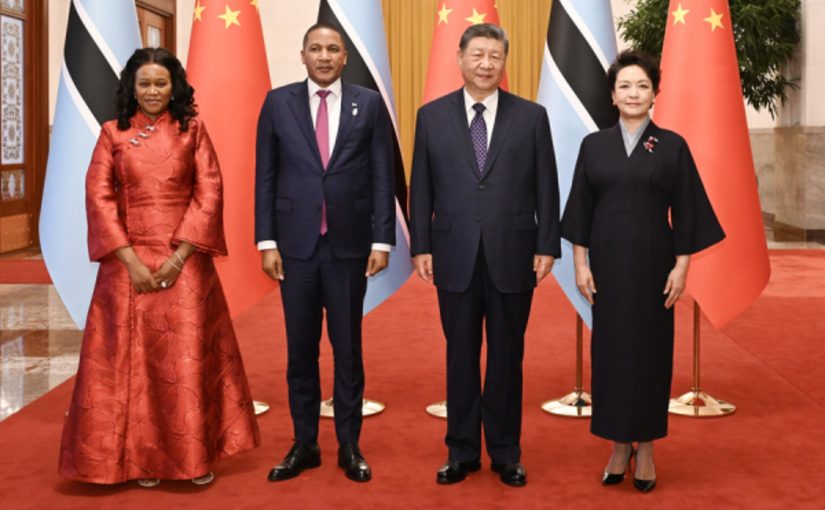
At the invitation of President Xi Jinping, President of the Republic of Botswana Duma Gideon Boko paid a state visit to China from October 12 to 17.
Xi Jinping held talks with his Botswanan counterpart in Beijing’s Great Hall of the People on the afternoon of October 13. The two heads of state made the announcement to elevate their bilateral relationship to a comprehensive strategic cooperative partnership.
President Xi noted that Botswana voted in support of restoring the People’s Republic of China’s lawful seat in the United Nations in the 1970s, even before the two countries established diplomatic ties. Today, the two countries are marching side by side on the journey toward modernisation, writing a new chapter in bilateral friendship. China-Botswana friendship should shine bright and endure like diamonds. (Botswana ranks second in world diamond production after the Russian Federation.)
Xi further observed that a common direction brings people together on the same road. This year marks the 105th anniversary of the founding of the Communist Party of China and the 60th anniversary of the independence of Botswana. The two governing parties should strengthen cooperation, deepen experience-sharing in state governance, and foster greater convergence of ideas. (President Boko heads the Umbrella for Democratic Change, an alliance of left-wing parties including the Botswana National Front, the Botswana Movement for Democracy, the Botswana People’s Party and the Botswana Congress Party. It achieved a landslide victory in the 2024 elections, forming the first left-wing government in the country’s history.)
China, Xi added, supports Botswana in pursuing a development path suited to its national conditions. The two sides should continue to develop the framework for economic and trade cooperation and seize the new opportunities emerging from China’s zero-tariff treatment for African countries having diplomatic relations with China. China is ready to enhance cooperation with Botswana in areas such as the digital economy, agriculture and the livestock industry and carry out the Smart Education Project to support economic and social development in Botswana.
Xi put forward a four-point proposition on China-Botswana and China-Africa mining cooperation:
First, the starting principle should be African resources belonging to Africa. China stands ready to share its experience and help African countries formulate mining development plans consistent with their national conditions.
Second, the guiding philosophy should be a right approach to friendship and interests and ensuring mutual benefit. China will continue to encourage Chinese companies to enhance their operational capacity, transfer green technologies suited to Africa’s conditions, and promote South-South cooperation in mining development.
Third, the direction of cooperation should be high-quality development. China will continue to move China-Africa mining cooperation toward industrial value addition, explore new financing models that are affordable and sustainable, and support Africa’s modernisation through high-standard cooperation.
Fourth, a fair and open cooperation environment is crucial. Africa’s resources should not be used for geopolitical rivalry. China would be glad to see other parties providing genuine support for Africa’s development and stands ready to work with Africa to create more enabling conditions for business investment and operation.
President Boko said that under President Xi Jinping’s strong leadership, China has made remarkable development achievements. China has lifted all its people out of poverty and opened a successful development path with Chinese characteristics, which is a good example for Botswana to follow.
He added that Botswana attaches great importance to its relations with China, will stay committed to the one-China principle, oppose any separatist attempt to seek “Taiwan independence,” and oppose any interference in China’s internal affairs. His country welcomes more Chinese companies to invest and operate in Botswana, so as to enhance cooperation under the Belt and Road Initiative and work together in industrial development, agriculture, mining, innovation, and digital transformation to deliver more tangible outcomes in bilateral relations.
The two countries agreed a Joint Statement on the Establishment of a Comprehensive Strategic Cooperative Partnership.
In it, the two sides shared the assessment that the world is undergoing an accelerating transformation, characterised by heightened geopolitical tensions, economic uncertainty, rapid technological change and increasingly complex global challenges. Botswana highly commended President Xi Jinping’s proposals, including the building of a community with a shared future for humanity and high-quality Belt and Road cooperation, which are conducive to bringing valuable stability to a turbulent world.
It added: “In this context, the two Presidents decided to elevate bilateral relations to a Comprehensive Strategic Cooperative Partnership between the People’s Republic of China and the Republic of Botswana, opening a new chapter in the longstanding and evolving relationship between the two countries.”
They further recognised the important contribution of political-party exchanges to enhancing mutual understanding and promoting people-centred governance. They agreed to encourage exchanges and experience-sharing between their respective political parties in areas including leadership development, policy formulation, organisational development, training and institutional strengthening. Botswana welcomed opportunities for members of the Umbrella for Democratic Change to participate in relevant bilateral and multilateral training and capacity-building programmes hosted by China.
The statement is noteworthy in that it details ways of working together to advance the four key global initiatives put forward by China.
On the Global Development Initiative (GDI), Botswana welcomed measures aimed at expanding market access and strengthening China–Africa economic and trade relations, including the zero-tariff measures for the 53 African countries having diplomatic relations with China initiated by President Xi Jinping. In this regard, they agreed to work together to expand bilateral trade and facilitate greater access for Botswana’s products to the Chinese market, including through the effective utilisation of Green Channel 2.0 and other appropriate trade facilitation mechanisms. The two sides committed to expanding market opportunities for Botswana’s beef, citrus and other agricultural products, while working to address relevant technical, sanitary, phytosanitary and market-access requirements.
The two sides also reaffirmed their shared commitment to strengthening China-Africa solidarity, unity and cooperation in pursuit of common development, peace and prosperity. They recognised the strategic importance of the Forum on China-Africa Cooperation (FOCAC) as a key platform for collective dialogue, policy coordination and practical cooperation between China and African countries. They welcomed the 70th anniversary of the establishment of diplomatic relations between China and Africa and agreed to work together to advance the outcomes and commitments of FOCAC.
On the Global Security Initiative (GSI), they committed to strengthening exchanges and practical cooperation in support of peace and security in Africa and to contributing, within their respective capacities, to international and regional peace, security and stability. They reaffirmed their support for the principle of “African solutions to African problems” and agreed that African countries and institutions should play the leading role in preventing and resolving conflicts on the continent. They expressed support for the African Union and regional economic communities in their efforts to prevent and resolve conflicts, promote dialogue and strengthen peace and security.
In advancing the Global Civilisation Initiative (GCI), they expressed satisfaction with the contribution of health cooperation to the well-being of their peoples and welcomed the 45th anniversary of the deployment of Chinese medical teams to Botswana. They agreed to further strengthen cooperation in health through the deployment of medical teams, the “Brightness Journey” voluntary clinic programme, the provision of medical supplies, and partnerships between healthcare institutions and hospitals, to explore expanded cooperation in specialist healthcare, minimally invasive medicine, medical technology and health-sector capacity development, with a view to strengthening Botswana’s healthcare system, building local capacity, and improving access to quality and affordable healthcare.
And to advance the Global Governance Initiative (GGI), they agreed to advocate for a global governance system based on extensive consultation, joint contribution and shared benefit, and to support reforms that strengthen the voice, representation and meaningful participation of developing countries, particularly those of the Global South, in global decision-making. They reaffirmed their commitment to an international system with the United Nations at its core, and to an international order based on international law, and to the basic norms governing international relations based on the purposes and principles of the Charter of the United Nations.
They further agreed to promote genuine multilateralism, international fairness and justice, greater democracy in international relations, the peaceful resolution of disputes and to support the multilateral trading system with the World Trade Organisation (WTO) at its core. They expressed their shared opposition to unilateralism, protectionism, hegemonism and power politics, and affirmed their support for an equal and orderly multipolar world and universally beneficial and inclusive economic globalisation.
The two sides also reaffirmed the importance of digital sovereignty and agreed that all countries should have the right to independently determine their approaches to the development and application of digital technologies, including artificial intelligence, in accordance with their national circumstances and development priorities. They further emphasised that countries should not be forced to take sides in technology options, while strengthening international dialogue and cooperation on responsible artificial intelligence, digital transformation and emerging technologies, with a view to ensuring that technological advances contribute to sustainable development, inclusive growth and the well-being of humanity.
They also welcomed Botswana’s successful hosting of the first African Biodiversity Summit and agreed to strengthen cooperation in climate change, biodiversity conservation, environmental protection and sustainable development. They reaffirmed the principle of common but differentiated responsibilities and respective capabilities and agreed to strengthen cooperation through relevant multilateral frameworks and to promote the effective implementation of the United Nations Framework Convention on Climate Change and the Paris Agreement.
Meanwhile, at the invitation of Premier of the State Council Li Qiang, President of the Council of Togo Faure Essozimna Gnassingbé paid an official visit to China from October 9 to 16. President Xi Jinping met with him, also on the afternoon of October 13 and the two leaders announced the elevation of bilateral relations to a China-Togo community with a shared future in the new era.
President Xi noted that the traditional friendship between China and Togo, forged by the older generation of leaders, is deep-rooted and time-honoured. In solidarity, the two sides have, over the past decades, continuously strengthened cooperation and enhanced mutual understanding and friendship between the peoples, writing a vibrant chapter in building the all-weather China-Africa community with a shared future for the new era.
The Chinese leader put forward four principles on the constructive participation of relevant parties in the resolution of African hotspot issues:
First, uphold Africa’s leadership. African people are the true masters of the continent and should therefore play a central role in regional affairs.
Second, safeguard equity and justice. Parties should observe the purposes and principles of the UN Charter and respect the sovereignty and territorial integrity of countries concerned.
Third, cease hostilities and build peace. War and unilateral sanctions are never real solutions to disputes between states. Countries should respect each other, engage in extensive consultation, seek common ground despite differences, and practise mutual understanding and accommodation.
Fourth, address both symptoms and root causes. Addressing immediate security concerns should go hand in hand with long-term development planning.
President Faure Gnassingbé said that during this visit, he has witnessed firsthand that under the visionary leadership of President Xi Jinping, Chinese modernisation has made remarkable progress, and the fine Chinese tradition and culture have been kept alive and are thriving. He has also gained deeper insights into China’s governance philosophy and the secret to its success. Togo and China enjoy a long-standing and ever-stronger friendship, and will celebrate the 55th anniversary of bilateral ties next year. Togo will enhance mutual trust with China, increase dialogue and communication, strengthen long-term mutually beneficial cooperation, and jointly build a Togo-China community with a shared future in the new era to benefit the two peoples. Togo, he added, completely agrees with the important principles President Xi Jinping set forth for the constructive participation of relevant parties in the resolution of African hotspot issues and highly commends China’s important role in maintaining world peace and stability and in promoting joint responses to global challenges. Togo is ready to step up multilateral cooperation with China to jointly defend multilateralism and safeguard the interests of developing countries.
The following articles were originally published on the website of the Chinese Foreign Ministry and by the Xinhua News Agency.
President Xi Jinping Holds Talks with President Duma Gideon Boko of Botswana
October 13 (MFA) – On the afternoon of October 13, President Xi Jinping held talks with President Duma Gideon Boko of Botswana, who is on a state visit to China, at the Great Hall of the People in Beijing. The two heads of state made the announcement to elevate bilateral relationship to a comprehensive strategic cooperative partnership.
President Xi noted that Botswana voted in support of restoring the People’s Republic of China’s lawful seat in the United Nations in the 1970s before the two countries established diplomatic ties. Today, the two countries are marching side by side on the journey toward modernization, writing a new chapter in bilateral friendship. China-Botswana friendship should shine bright and endure like diamonds. The two countries should remember the journey of mutual assistance they have traveled together, stride ahead in the new era on a broad path for the development of bilateral ties, and contribute to world development and progress.
President Xi observed that a common direction brings people together on the same road. This year marks the 105th anniversary of the founding of the Communist Party of China and the 60th anniversary of the independence of Botswana. The two governing parties should strengthen cooperation, deepen experience-sharing in state governance, and foster greater convergence of ideas. China supports Botswana in pursuing a development path suited to its national conditions. The two sides should continue to develop the framework for economic and trade cooperation and seize the new opportunities emerging from China’s zero-tariff treatment for African countries having diplomatic relations with China. China is ready to enhance cooperation with Botswana in areas such as the digital economy, agriculture and the livestock industry and carry out the Smart Education Project to support economic and social development in Botswana.
President Xi put forth a four-point proposition on China-Botswana and China-Africa mining cooperation. First, the starting principle should be African resources belonging to Africa. China stands ready to share its experience and help African countries formulate mining development plans consistent with their national conditions. Second, the guiding philosophy should be a right approach to friendship and interests and ensuring mutual benefit. China will continue to encourage Chinese companies to enhance their operational capacity, transfer green technologies suited to Africa’s conditions, and promote South-South cooperation in mining development. Third, the direction of cooperation should be high-quality development. China will continue to move China-Africa mining cooperation toward industrial value addition, explore new financing models that are affordable and sustainable, and support Africa’s modernization through high-standard cooperation. Fourth, a fair and open cooperation environment is crucial. Africa’s resources should not be used for geopolitical rivalry. China would be glad to see other parties providing genuine support for Africa’s development, and stands ready to work with Africa to create more enabling conditions for business investment and operation.
President Boko said that under President Xi Jinping’s strong leadership, China has made remarkable development achievements. China has lifted all its people out of poverty and opened a successful development path with Chinese characteristics, which is a good example for Botswana to follow. Botswana attaches great importance to its relations with China, will stay committed to the one-China principle, oppose any separatist attempt to seek “Taiwan independence,” and oppose any interference in China’s internal affairs. Botswana appreciates China’s long-term support and assistance for its national development, hopes to further align their development strategies, and welcomes more Chinese companies to invest and operate in Botswana, so as to enhance cooperation under the Belt and Road Initiative and work together in industrial development, agriculture, mining, innovation, and digital transformation to deliver more tangible outcomes in bilateral relations. President Xi’s four global initiatives in response to global challenges demonstrate the great sense of responsibility of a major country and contribute to the U.N.-centered international order. Botswana is ready to closely coordinate and cooperate with China to uphold multilateralism, strengthen solidarity among developing countries, advance Africa-China solidarity and cooperation, and make the global governance system more inclusive and representative.
Following the talks, the two heads of state witnessed the signing of multiple cooperation documents, including on the implementation of the Global Security Initiative, Belt and Road cooperation, green mining, health, and human resources.
The two sides issued the Joint Statement Between the People’s Republic of China and the Republic of Botswana on the Establishment of a Comprehensive Strategic Cooperative Partnership.
Before the talks, President Xi Jinping and Mme. Peng Liyuan held a welcome ceremony for President Duma Gideon Boko and Mrs. Kaone Tumalano Boko at the Northern Hall of the Great Hall of the People.
Guards of honor lined up in salutation as President Boko arrived. With the two heads of state on the viewing stand, the military band played the national anthems of the two countries. A 21-gun salute was performed on the Tian’anmen Square. President Boko reviewed the guard of honor of the People’s Liberation Army and watched the march-past in President Xi’s company.
On the same evening, President Xi and Mme. Peng held a welcome banquet for President and Mrs. Boko at the Golden Hall of the Great Hall of the People.
Wang Yi was present at the above events.
Joint Statement between the People’s Republic of China and the Republic of Botswana on the Establishment of a Comprehensive Strategic Cooperative Partnership
October 13 (Xinhua) – At the invitation of His Excellency Xi Jinping, President of the People’s Republic of China, Advocate Duma Gideon Boko, President of the Republic of Botswana, paid a State Visit to the People’s Republic of China from October 12 to 17, 2026.
President Xi Jinping and President Duma Gideon Boko held extensive and constructive discussions on the state and future direction of China-Botswana relations, China-Africa relations, and regional and international developments of mutual interest and concern.
The two sides reaffirmed that the longstanding friendship between China and Botswana has withstood the test of time. Since the establishment of diplomatic relations 51 years ago, the two countries have maintained relations founded on the principles of sovereign equality, mutual respect, mutual benefit and non-interference in the internal affairs of states. Over the years, the two sides have progressively deepened political mutual trust, expanded practical cooperation and strengthened coordination on regional and international issues, thereby contributing to greater solidarity and cooperation among countries of the Global South.
The two sides shared the assessment that the world is undergoing and accelerating transformation, characterized by heightened geopolitical tensions, economic uncertainty, rapid technological change and increasingly complex global challenges. Botswana highly commended President Xi Jinping’s proposals, including the building of a community with a shared future for humanity, high-quality Belt and Road cooperation, which are conducive to bringing valuable stability to a turbulent world. Against this backdrop, they reaffirmed their shared commitment to promoting international peace and security, sustainable development, multilateralism, respect for international law, and the purposes and principles of the Charter of the United Nations.
The two sides recognized the growing convergence of their national development priorities and international interests and agreed to further strengthen their partnership through enhanced political trust, expanded economic and development cooperation, strengthened strategic coordination, and greater people-to-people exchanges.
In this context, the two Presidents decided to elevate bilateral relations to a Comprehensive Strategic Cooperative Partnership between the People’s Republic of China and the Republic of Botswana, opening a new chapter in the longstanding and evolving relationship between the two countries.
ESTABLISHING COMPREHENSIVE STRATEGIC COOPERATIVE PARTNERSHIP
1. The two sides reaffirmed the strategic importance of Head-of-State diplomacy in providing overall direction and political impetus to bilateral relations. They agreed to translate the consensus reached by the two Presidents into sustained political engagement, strengthened institutional cooperation and tangible outcomes.
2. The two sides agreed to strengthen exchanges and cooperation among governments, legislatures, political parties, local authorities, business communities, academic institutions and other relevant sectors. They committed to making full and effective use of established bilateral mechanisms, including political consultations between the two Foreign Ministries and mechanisms for economic and trade cooperation, to facilitate the implementation of agreed priorities and ensure effective follow-through.
3. The two sides agreed to support each other’s efforts to safeguard sovereignty, independence, territorial integrity, national dignity, security, development and prosperity. They reaffirmed their continued staunch support for each other on issues concerning their respective core interests and major concerns. Botswana reaffirmed its longstanding commitment to the one-China principle, recognizing that there is but one China in the world, Taiwan is an inalienable part of China’s territory, and the government of the People’s Republic of China is the sole legal government representing the whole of China. Botswana resolutely opposes any form of “Taiwan independence,” supports all efforts by China to achieve national reunification, and steadfastly upholds the authority of United Nations General Assembly Resolution 2758. Botswana further noted that matters relating to Xinjiang, Xizang and Hong Kong are internal affairs of the People’s Republic of China.
4. The two sides congratulated each other on their respective national milestones and welcomed the development achievements recorded by both countries. China congratulated Botswana on the 60th anniversary of its independence and commended its efforts to accelerate inclusive and sustainable economic transformation through the implementation of NDP 12 and the Botswana Economic Transformation Programme. Botswana, in turn, congratulated the Communist Party of China on the 105th anniversary of its founding and welcomed China’s development achievements, as well as the commencement of the implementation of its 15th Five-Year Plan.
5. The two sides agreed to promote exchanges of experience and mutual learning in governance, public administration, institutional development, sustainable development, economic transformation, modernization, poverty reduction and other areas of mutual interest, while recognizing that each country will pursue a development path suited to its own national circumstances.
6. The two sides further recognized the important contribution of political-party exchanges to enhancing mutual understanding and promoting people-centred governance. They agreed to encourage exchanges and experience-sharing between their respective political parties in areas including leadership development, policy formulation, organizational development, training and institutional strengthening. Botswana welcomed opportunities for members of the Umbrella for Democratic Change (UDC) to participate in relevant bilateral and multilateral training and capacity-building programmes hosted by China.
WORKING TOGETHER TO ADVANCE THE GLOBAL DEVELOPMENT INITIATIVE (GDI)
7. Botswana commended the Global Development Initiative (GDI) proposed by President Xi Jinping and recognized its potential to strengthen international development cooperation and advance the implementation of the United Nations 2030 Agenda for Sustainable Development. They agreed to explore practical opportunities to align cooperation under the GDI with Botswana’s national development priorities, with a view to promoting inclusive growth, sustainable development and shared prosperity.
8. The two sides welcomed Botswana’s signing of the Cooperative Plan for Joint Progress on the Belt and Road Initiative and the Memorandum of Understanding identifying priority areas and potential flagship projects for cooperation, agreed to deepen practical cooperation within its framework, expand cooperation in the areas of trade and investment, mining development, science and technology, digital economy, green development, medical and health services, agriculture, forestry, water conservancy, human capital development, and people-to-people exchanges. The two sides agreed to leverage Botswana’s strategic geographical position in Southern Africa to promote regional economic integration.
9. Botswana welcomed measures aimed at expanding market access and strengthening China–Africa economic and trade relations, including the zero-tariff measures for the 53 African countries initiated by President Xi Jinping. In this regard, they agreed to work together to expand bilateral trade and facilitate greater access for Botswana’s products to the Chinese market, including through the effective utilization of Green Channel 2.0 and other appropriate trade facilitation mechanisms. The two sides committed to expanding market opportunities for Botswana’s beef, citrus and other agricultural products, while working to address relevant technical, sanitary, phytosanitary and market-access requirements. They agreed to expedite the signing and implementation of early-harvest arrangements under the Economic Partnership for Common Development Agreement within SACU, consistent with applicable regional and national processes.
10. The two sides committed to strengthening bilateral investment cooperation and encouraged enterprises from both countries to identify and pursue commercially viable opportunities, particularly in mining, energy, infrastructure, agriculture, manufacturing, logistics, digital technology and other productive sectors. The two sides appreciated Botswana’s participation in the Initiative on International Trade and Economic Cooperation Framework for Digital Economy and Green Development, committed to expanding cooperation in digital transformation, smart cities, e-commerce, artificial intelligence and other emerging technologies. They agreed to strengthen business-to-business engagement through business missions, forums and other platforms, with a particular focus on converting identified investment opportunities into feasible projects, productive capacity and tangible economic outcomes.
11. The two sides expressed satisfaction with progress in mining cooperation and agreed to strengthen cooperation in sustainable mineral development and energy transition, including through cooperation relating to the Khoemacau Copper Mine. They welcomed Botswana’s participation in the International Economic and Trade Cooperation Initiative on Green Mining and Minerals and agreed to work towards implementing a Memorandum of Understanding on Green Mining Cooperation. They further agreed to strengthen cooperation in the diamond sector, including through the Kimberley Process, and enhance access for Botswana’s diamond products to the Chinese market.
12. The two sides reaffirmed their shared commitment to strengthening China-Africa solidarity, unity and cooperation in pursuit of common development, peace and prosperity. They recognized the strategic importance of the Forum on China-Africa Cooperation (FOCAC) as a key platform for collective dialogue, policy coordination and practical cooperation between China and African countries. They welcomed the 70th anniversary of the establishment of diplomatic relations between China and Africa and agreed to work together to advance the outcomes and commitments of FOCAC. Botswana reaffirmed its commitment to participating constructively in FOCAC follow-up activities and initiatives and expressed its best wishes for the success of the 18th Senior Officials’ Meeting and the 10th Ministerial Meeting of FOCAC.
WORKING TOGETHER TO ADVANCE THE GLOBAL SECURITY INITIATIVE (GSI)
13. Botswana commended the Global Security Initiative (GSI) proposed by President Xi Jinping as a framework for advancing a vision of common, comprehensive, cooperative and sustainable security and expressed its readiness to strengthen cooperation with China within the framework of the GSI. The two sides reaffirmed their shared commitment to promoting international and regional peace, security and stability, and agreed that security challenges should be addressed through dialogue, consultation and peaceful means, consistent with the principles of sovereignty, territorial integrity and non-interference in the internal affairs of states.
14. The two sides committed to strengthening exchanges and practical cooperation in support of peace and security in Africa and to contributing, within their respective capacities, to international and regional peace, security and stability. They reaffirmed their support for the principle of “African solutions to African problems” and agreed that African countries and institutions should play the leading role in preventing and resolving conflicts on the continent. They expressed support for the African Union and Regional Economic Communities in their efforts to prevent and resolve conflicts, promote dialogue and strengthen peace and security.
15. The two sides expressed concern over the continued conflicts and instability in the Middle East and their broader implications for international peace and security, humanitarian conditions and sustainable development, including their potential impact on Africa. They called upon all parties concerned to exercise maximum restraint, work towards the cessation of hostilities, de-escalate tensions and pursue dialogue and negotiations in accordance with international law and the purposes and principles of the Charter of the United Nations.
16. The two sides agreed to strengthen cooperation in law enforcement and security, including enhanced coordination to safeguard the safety and legitimate interests of their respective citizens, institutions, enterprises and projects operating in each other’s territories. They committed, in accordance with their respective laws and international obligations, to strengthening cooperation in combating transnational organized crime, including cyber-enabled and telecommunications fraud, illicit drug trafficking, smuggling, trafficking in persons and other forms of cross-border criminal activity.
WORKING TOGETHER TO ADVANCE THE GLOBAL CIVILIZATION INITIATIVE (GCI)
17. Botswana commended the Global Civilization Initiative (GCI) proposed by President Xi Jinping. The two sides reaffirmed their shared commitment to strengthening mutual understanding, friendship and lasting ties between the peoples of Botswana and China, and agreed to promote equality, mutual learning, dialogue, inclusiveness and respect for the diversity of civilizations.
18. The two sides welcomed the outcomes of the 2026 China-Africa Year of People-to-People and Cultural Exchanges and commended the successful organization of cultural activities in Botswana. They agreed to build on these achievements by expanding cultural exchanges and promoting sustained interaction between their peoples. They committed to expanding cooperation in culture, tourism, sport, youth, women’s empowerment, media, think tanks and other areas that contribute to greater mutual understanding and closer people-to-people ties.
19. The two sides further agreed to strengthen cooperation in education, research, innovation and human capital development and encouraged universities and institutions of higher learning to establish partnerships under the China-Africa 100 Universities Cooperation Plan in the fields of environment and sustainable development, language and cultures, and the mutual learning among civilizations. They agreed to support the continued contribution of the Confucius Institute to educational and cultural exchanges and to expand cooperation in language education. China will continue to provide government scholarships, professional training and capacity-building opportunities for outstanding students and professionals from Botswana.
20. The two sides expressed satisfaction with the contribution of health cooperation to the well-being of their peoples and welcomed the 45th anniversary of the deployment of Chinese medical teams to Botswana. They agreed to further strengthen cooperation in health through the deployment of medical teams, the “Brightness Journey” voluntary clinic programme, the provision of medical supplies, and partnerships between healthcare institutions and hospitals, to explore expanded cooperation in specialist healthcare, minimally invasive medicine, medical technology and health-sector capacity development, with a view to strengthening Botswana’s healthcare system, building local capacity, and improving access to quality and affordable healthcare.
WORKING TOGETHER TO ADVANCE GLOBAL GOVERNANCE INITIATIVE (GGI)
Botswana commended the Global Governance Initiative (GGI) put forward by President Xi Jinping. The two sides agreed to strengthen dialogue and coordination on international governance issues of mutual interest and concern. They agreed to advocate for a global governance system based on extensive consultation, joint contribution and shared benefit, and to support reforms that strengthen the voice, representation and meaningful participation of developing countries, particularly those of the Global South, in global decision-making. They reaffirmed their commitment to an international system with the United Nations at its core, and to an international order based on international law, and to the basic norms governing international relations based on the purposes and principles of the Charter of the United Nations.
The two sides agreed to promote genuine multilateralism, international fairness and justice, greater democracy in international relations, the peaceful resolution of disputes and support the multilateral trading system with the WTO at its core. They expressed their shared opposition to unilateralism, protectionism, hegemonism and power politics, and affirmed their support for an equal and orderly multipolar world and universally beneficial and inclusive economic globalization.
23. The two sides reaffirmed the importance of digital sovereignty and agreed that all countries should have the right to independently determine their approaches to the development and application of digital technologies, including artificial intelligence, in accordance with their national circumstances and development priorities. They further emphasized that countries should not be forced to take sides in technology options, while strengthening international dialogue and cooperation on responsible artificial intelligence, digital transformation and emerging technologies, with a view to ensuring that technological advances contribute to sustainable development, inclusive growth and the well-being of humanity.
24. The two sides welcomed China’s successful hosting of the 2026 World Artificial Intelligence Conference and the High-Level Meeting on Global AI Governance and agreed to strengthen cooperation and dialogue on global AI governance and emerging technologies and build a just and equitable system for global AI governance. Botswana will positively consider participation in the World Artificial Intelligence Cooperation Organization and the International Organization for Mediation, in accordance with its national interests, applicable laws and established procedures.
25. The two sides welcomed Botswana’s successful hosting of the first African Biodiversity Summit and agreed to strengthen cooperation in climate change, biodiversity conservation, environmental protection and sustainable development. They reaffirmed the principle of common but differentiated responsibilities and respective capabilities, and agreed to strengthen cooperation through relevant multilateral frameworks and to promote the effective implementation of the United Nations Framework Convention on Climate Change and the Paris Agreement.
26. The two sides reaffirmed that the protection and promotion of human rights is a shared responsibility of humanity. They agreed to promote dialogue, exchanges and cooperation on human rights on the basis of equality, mutual respect, objectivity and non-selectivity. They further expressed their shared opposition to the politicization, instrumentalization and application of double standards in human rights and reaffirmed the importance of taking into account the national circumstances, laws, development priorities and historical contexts of individual countries in addressing human rights issues.
27. The two sides affirmed that President Duma Gideon Boko’s State Visit to the People’s Republic of China constitutes an important milestone in the history of China-Botswana relations. They committed to carrying forward their longstanding friendship and to developing the Partnership into a strategic, mutually beneficial and results-oriented framework for common development.
28. President Duma Gideon Boko expressed his sincere appreciation to President Xi Jinping, the Government and the people of the People’s Republic of China for the warm welcome and gracious hospitality extended to him and his delegation during the State Visit.
Following their meeting, the two Presidents witnessed the signing of bilateral cooperation documents in various fields.
President Xi Jinping Meets with President of the Council of Togo Faure Essozimna Gnassingbé
October 13 (MFA) – On the afternoon of October 13, 2026, President Xi Jinping met with President of the Council of Togo Faure Essozimna Gnassingbé, who is on an official visit to China, at the Great Hall of the People in Beijing. The two leaders announced the elevation of bilateral relations to a China-Togo community with a shared future in the new era.
President Xi Jinping noted that the traditional friendship between China and Togo, forged by older generation of leaders, is deep-rooted and time-honored. In solidarity, the two sides have, over the past decades, continuously strengthened cooperation and enhanced mutual understanding and friendship between the peoples, writing a vibrant chapter in building the all-weather China-Africa community with a shared future for the new era. Friendship and cooperation between China and Togo are underpinned by closely aligned visions and enjoy broad prospects for development. The two sides should further strengthen exchanges at various levels between the two parties and two countries, deepen experience sharing on state governance, and firmly support each other on issues concerning their respective core interests and major concerns. The zero-tariff policy is a special arrangement adopted by China to support Africa’s independent development and energize China-Africa cooperation through institutional opening-up. China welcomes Togo in making good use of this policy and the “green lanes” for African exports, among other measures, to give fuller play to its role as a regional trade and logistics hub and bring more specialty products of Togo and the wider region into the Chinese market. China appreciates Togo’s initiative to expand the cross-border use of RMB, and stands ready to step up new energy, digital and intelligent cooperation with Togo with a view to boosting Togo’s industrialization. Sharing similar positions on international and regional issues, China and Togo should enhance multilateral coordination, make concerted efforts to reform and improve global governance, and promote regional peace and security.
President Xi Jinping put forward four principles on the constructive participation of relevant parties in the resolution of African hotspot issues. First, uphold Africa’s leadership. African people are the true masters of the continent and should therefore play a central role in regional affairs. Second, safeguard equity and justice. Parties should observe the purposes and principles of the U.N. Charter and respect the sovereignty and territorial integrity of countries concerned. Third, cease hostilities and build peace. War and unilateral sanctions are never real solutions to disputes between states. Countries should respect each other, engage in extensive consultation, seek common ground despite differences, and practice mutual understanding and accommodation. Fourth, address both symptoms and root causes. Addressing immediate security concerns should go hand in hand with long-term development planning.
President Faure Gnassingbé said that during this visit, he has witnessed firsthand that under the visionary leadership of President Xi Jinping, Chinese modernization has made remarkable progress, and the fine Chinese tradition and culture have been kept alive and are thriving. He has also gained deeper insights into China’s governance philosophy and the secret to its success. Togo and China enjoy a long-standing and ever-stronger friendship, and will celebrate the 55th anniversary of bilateral ties next year. Togo will enhance mutual trust with China, increase dialogue and communication, strengthen long-term mutually beneficial cooperation, and jointly build a Togo-China community with a shared future in the new era to benefit the two peoples. Togo stands ready to learn from China’s experience in state governance, welcomes more Chinese enterprises to invest and operate in Togo, and will expand cooperation with China in areas such as trade, infrastructure, and science and technology. Togo completely agrees with the important principles President Xi Jinping set forth for the constructive participation of relevant parties in the resolution of African hotspot issues, and highly commends China’s important role in maintaining world peace and stability and in promoting joint responses to global challenges. Togo is ready to step up multilateral cooperation with China to jointly defend multilateralism and safeguard the interests of developing countries.
Wang Yi was present at the meeting.