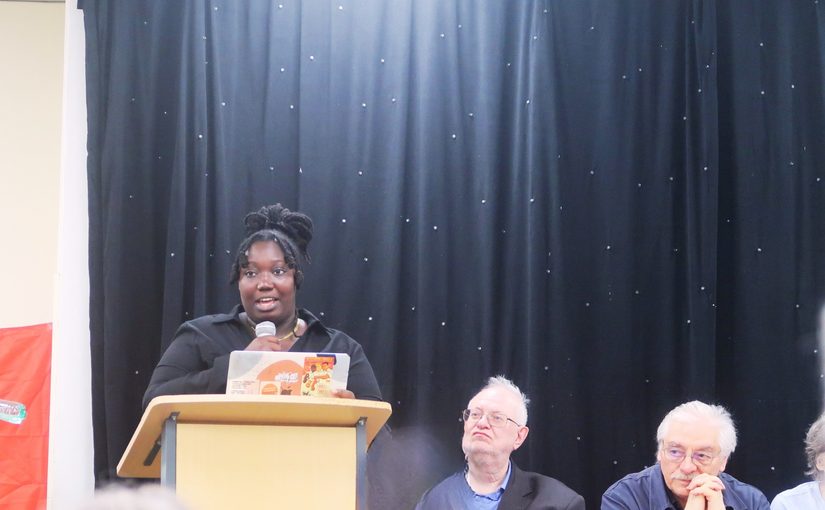
In the following speech, delivered at the Socialist China Conference 2026, Myriam Kane of the Black Liberation Alliance reflects on her visit to China in September 2025 as one of more than 70 African delegates to a China-Africa youth festival.
Starting from the 1884 Berlin Conference, where European powers carved up Africa with no African at the table, Myriam asks whether China’s engagement with Africa breaks the old colonial design or repeats it. Drawing on what she saw – from the preservation of China’s cultural heritage in the Forbidden City, to the Xiaomi electric vehicle factory, to the “photovoltaic sheep” of Qinghai’s Talatan desert, where solar power has helped lift hundreds of thousands out of poverty – she argues that development and cultural identity, and development and environmental protection, go hand in hand.
Myriam contrasts the US refusal of visas to Senegal’s women’s basketball team with China’s scholarships for Senegalese athletes preparing for the Dakar 2026 Youth Olympic Games, and points to the projects built through China-Africa cooperation in her own country, alongside China’s extension of zero-tariff access to 53 African countries. Her conclusion is a call to action: “Use our own sun, build our own solar parks and train our own engineers… That is what it means to be anti-imperialist today.”
The full text of the speech follows.
Let me begin with a date: 1884. In Berlin, European powers sat around a table with a map of Africa and carved it up. No African was present. They built railways that ran in one direction only: from our mines to their ports.
Independence changed the flags, but not automatically the design. Look at the structural adjustment programmes that forced our governments to cut schools and clinics. Look at the debts, the unfair trade terms and the currencies still tied to a former colonial power.
So when young Africans engage with China, we must ask: does this break the old design or repeat it? In September 2025 I went to China to see for myself.
Over seventy African delegates headed to China for the China-Africa Youth Festival. The delegates, alongside Chinese students, youth leaders, young African journalists and African diplomats, filled the hall for the opening ceremony with officials. We heard China’s Vice Minister of Foreign Affairs Miao Deyu, Foundation Chairperson Li Bin, the African Union’s Special Envoy on Women and Youth Chido Cleopatra Mpemba, and Angola’s Ambassador, Her Excellency Dalva Allen. I came away with one thought: in Berlin in 1884, we were not at the table. In Beijing in 2025, we were.
After the opening ceremony we visited the Forbidden City, where we were able to see the preserved history and the work China is doing to preserve its culture and teach its young people the importance of knowing where they came from and where they are heading. It was striking for us as Africans, as our own culture and heritage have been whitewashed in many ways: our curriculum reflecting the coloniser, our languages suppressed, even our own constitutions – and I could go on.
After that cultural and historic visit, the contrast was amazing to witness. We headed for a visit to the Xiaomi electric car factory. I watched cars being assembled in 76 seconds, ready to go for testing. A company that began as a phone maker now builds electric cars that compete globally against Ferrari – in a country that was living in extreme poverty four decades ago.
That shows us Africans that we don’t have to leave our history and culture behind in order to develop. They go hand in hand.
The following day we hopped on a plane to Qinghai Province, where I visited the Talatan Gobi Desert. I witnessed something truly remarkable. What was once a dry, barren landscape, exposed to strong winds and soil erosion, has been transformed by vast fields of solar panels into a greener environment where thousands of sheep graze peacefully beneath the panels. The approach, known locally as “photovoltaic sheep”, demonstrates how renewable energy can go hand in hand with agriculture and environmental restoration.
As an African, I found this experience particularly inspiring because it showed me how the right use of technology, combined with sustainable land management, can turn challenges into opportunities. It reminded me that Africa, too, has enormous potential to harness its abundant sunshine, protect its environment, create livelihoods and improve the well-being of its people. My visit to Qinghai was a powerful reminder that development and environmental protection do not have to compete; with vision, innovation and commitment, they can thrive together.
This is how Qinghai fights poverty. Its officials describe “solar poverty relief” projects: since 2015, about 720 megawatts of capacity has been installed, bringing nearly 320,000 local people out of poverty. All 42 of Qinghai’s national-level poor counties have been removed from the poverty list – and the programme did not rely on one trick. Qinghai also created 126,000 “ecological conservator” jobs for poor residents, relocated nearly 120,000 people from harsh conditions, funded fifteen years of education in Tibetan areas and cut what poor patients pay out of pocket for hospital care.
It also protects the land: Qinghai is the source region of the Yangtze, the Yellow River and the Mekong. Development there is not allowed to poison the water downstream. And, quite frankly, it was the best view I have ever had the chance to witness in my life.
Nationally, Xi Jinping announced in 2021 that China had lifted 98.99 million rural residents out of poverty in eight years, and 770 million since reform began. The World Bank’s own country director has called it extraordinary.
Now think about us. Dakar, Niamey, Bamako, Ouagadougou and Nouakchott have a great deal of sun. We have land. We have young people. The question is not whether the sun shines on the Sahel. It is whether we – and not foreign companies extracting profit – decide who benefits.
So what happens when you let other countries, like the US and France, decide your fate?
In June 2025, the Senegalese women’s basketball team, the Lionesses, planned a ten-day training camp in the United States. The US refused visas to twelve people: five players and seven members of staff. No reason was given publicly. Our then Prime Minister Ousmane Sonko cancelled the trip and moved the camp to Dakar. On the same day he thanked the People’s Republic of China, which had awarded several dozen preparation scholarships to Senegalese athletes and their coaches ahead of the Dakar 2026 Youth Olympic Games – the first Olympic event ever to be organised on African soil, which is about to take place.
Think about what that says. One country closed a door on our young athletes. Another opened one. Dakar is about to host the first Olympic event ever held on African soil, and our youth are preparing for it with scholarships from Beijing.
Scholarships. Training. Exchange visits like the one I joined. That is what investing in youth looks like.
China’s partnership has built things in my own country. The Grand Théâtre National in Dakar was funded by a Chinese grant of about 23 million dollars and handed over in 2011. The Museum of Black Civilisations, funded by a grant of approximately 18 million dollars, opened in 2018, fulfilling a dream of the pan-Africanists of 1966. It is a museum telling the story of Black civilisation, built through South-South cooperation – and the same museum where many anti-imperialists and organisers against Françafrique are now holding meetings. In Kenya, the Mombasa-Nairobi railway, about 480 kilometres of route, was financed around 90 percent by China’s Exim Bank.
Now the numbers. China-Africa trade rose from about 10 billion dollars in 2000 to 348 billion in 2025. China has been Africa’s largest trading partner for sixteen years. In December 2024, China granted zero tariffs to the 33 least developed African countries, and their exports to China rose 15 percent in four months, to 21.4 billion dollars. On May 1 this year, zero-tariff access was extended to all 53 African countries with diplomatic ties. Kenyan coffee that paid up to 30 percent now enters duty-free. West African cocoa that paid up to 22 percent does too.
So we must take what we saw and bring it home. Use our own sun, build our own solar parks and train our own engineers. Process our cocoa, cotton and cobalt on African soil. Demand that every project hires African workers, transfers skills and technology and is transparent about its financing. That is what it means to be anti-imperialist today. It is not only protest; it is building, and uniting the Global South.
I came back with one conviction. The future will not be written in Berlin, in Washington or in Brussels. It will be written wherever the Global South decides to stand together and build. In Beijing, I saw Africa treated as a partner. In Qinghai, I saw how poverty can be defeated with sunlight and planning. On the factory floor, I saw what we could make ourselves.
Seventy years after China and African countries first established diplomatic ties, this generation holds the pen. Let us make Africa the architect of its own future.