In the following article, Dr Francisco Dominguez, Secretary of the Venezuela Solidarity Campaign, argues that Latin America is caught between two diametrically opposed global forces: US imperialism, whose drive for regional hegemony traces back to the 19th-century Monroe Doctrine, and the China-led effort to build a multipolar world grounded in the Five Principles of Peaceful Coexistence formulated by Zhou Enlai.
Francisco charts the extraordinary growth of China-Latin America relations – from total trade of US$1.8 billion in 1990 to US$565 billion in 2025 – along with Chinese investment in infrastructure, energy and manufacturing, and China’s sustained support for Cuba in the face of an ever-tighter US blockade.
He contrasts this win-win cooperation with the Trump administration’s “Monroe Corollary”, which so far has involved the kidnapping of President Maduro, the militarisation of the hemisphere, the US-led “Shield of the Americas” coalition, and open threats against Mexico and Cuba, as voiced by Trump at the UN General Assembly and denounced there by Mia Mottley, Bruno Rodríguez and Lula.
China, Francisco concludes, offers Latin America “the normalisation of choice” – and the prospect of a region where sovereignty, development and social progress can flourish. Hence his rallying cry: “Down with Monroe and up with Zhou Enlai!”
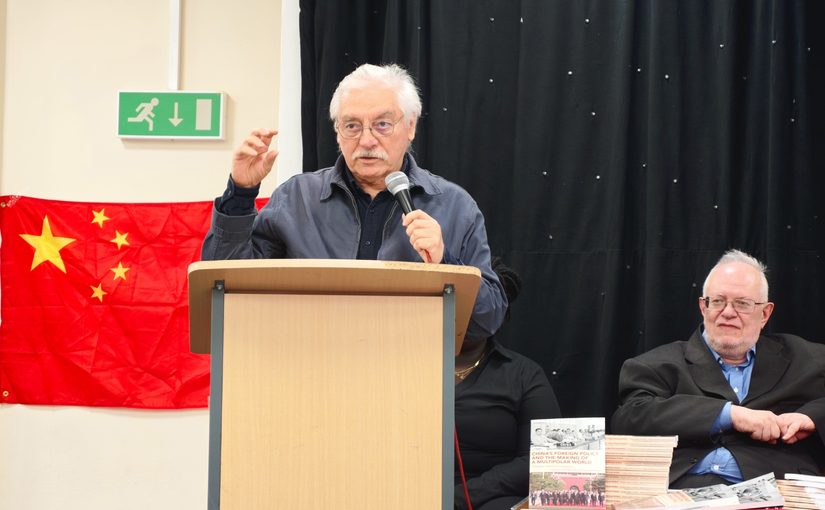
This is an expanded version of the speech Francisco delivered at our Socialist China Conference on 3 October 2026.
Introduction
Currently Latin America finds itself caught between two diametrically opposing global forces. On the one hand, US imperialism and its world and regional allies, aimed at an intensified regional US hegemony whose ultimate logic is colonization and, on the other, the China-led drive to build a multipolar world as the foundation to construct a global community of shared future. The former originates in the 19th century known as the Monroe Doctrine, the other, in the formulation by Zhou-Enlai, the five principles of peaceful coexistence. Hence the title of this paper: Latin America: Between James Monroe and Zhou-Enlai.
China’s highly beneficial ‘win-win’ cooperation
Despite strenuous US efforts—especially under Trump 1.0 and 2.0—to disrupt it, the relationship between China and Latin America has continued to flourish. From the modest beginnings of total bilateral trade of US$1.8 billion in 1990, it has skyrocketed to US$565 billion in 2025. In other words, over the course of 36 years, trade between the two sides increased by more than 300-fold.
An article published by Xinhua on 10 February 2026 explained this development in the following terms: “From cherries to electric cars, China and Latin American countries have seen closer mutually beneficial cooperation amid growing global uncertainties, driven by China’s commitment to broader opening up, optimized trade structure and deepened industrial collaboration.”
Wang Fei, Deputy Director at the Institute of Latin American Studies of the Chinese Academy of Social Sciences, explained that the exponential growth in China–Latin America trade is attributable to the strong complementarity between the two sides. “China boasts a huge consumer market and a complete industrial system, while Latin America is rich in agricultural products and mineral resources.” Furthermore, the two sides have developed stable cooperation in sectors such as energy, agriculture and manufacturing.
China is the main trading partner of South America and the second-largest trading partner of Central America. Furthermore, China has signed free trade agreements with Chile, Costa Rica, Ecuador, Nicaragua and Peru. Twenty countries in the region have joined the BRI. The figure was previously 22, but Panama withdrew following pressure from Trump, and, after Marco Rubio’s visit, Colombia also announced its withdrawal.
The value of Chinese infrastructure projects in Latin America and the Caribbean is approximately US$286 billion, including the US$1.3 billion project at Peru’s Port of Chancay, which has become a “major transpacific shipping channel linking China and South America, bypassing traditional deepwater ports in the U.S. and Mexico.”
The Centre for Strategic and International Studies (CSIS) expressed alarm that, by June 2025, China had embarked on 37 port investments in several countries including Mexico, Cuba, Guatemala, Colombia, Ecuador, Brazil, Peru, Chile, Argentina and Uruguay. In March 2021, Admiral Craig Faller, then SOUTHCOM commander, told the Senate Armed Services Committee that China “by promoting itself as an effective vaccine distributor to combat the pandemic, underwriting 40 port expansions or developments, offering questionable loans and pressuring the few remaining countries who recognize Taiwan as an entity to drop diplomatic recognition of the island,” was rapidly expanding its “corrosive, insidious influence.”
However, Chinese engagement extends far beyond port projects. Chinese FDI in energy, renewable energy, power generation, minerals, manufacturing, telecommunications, electronics, transport, auto parts and the automotive sector, services, and others, between 2000 and 2025 reached US$213.5 billion, generating a total of 771,115 jobs.
The CSIS makes three further alarmist points:
(a) “China is not only looking to ports in LAC, but is also growing its position in the infrastructure within and around these sites, including railways, energy generation, security scanners, and ship-to-shore cranes.”
(b) “As the United States embarks on a historic pivot to the Americas, enshrined in key documents like the 2025 National Security Strategy and 2026 National Defense Strategy, dealing with China’s foothold in regional ports should be a top priority.”
(c) CSIS argues that LAC countries may or may not share Washington’s concerns about China’s trade and investment in the Western Hemisphere, “but believe that they have no other credible offers to meet their development goals.” The Los Angeles Times explained why Latin America will not abandon China despite Trump’s pressure campaign: Chinese investment “remains too big and entrenched for the region’s governments to simply cast off on a whim of the US administration.”
“In Brazil, BYD, which has a dealership in every state, capital and major city, has poured money into prime-time television, telenovelas and football sponsorships. Brazilians’ phones are becoming increasingly Chinese: Shein, AliExpress, Temu and TikTok Shop in online shopping; Didi’s 99 in ride-hailing; and 99Food and Meituan’s Keeta in food delivery.”
This strong cooperation helps explain why academic literature in Latin America has long emphasised the need to establish a strategic relationship between China and the region. Indeed, in a 2012 publication the Economic Commission of Latin America and the Caribbean (ECLAC) argued “that China and the Latin American and Caribbean region now enjoy a sufficiently mature relationship and are poised to make a qualitative leap towards a mutually beneficial strategic alliance.”
Special mention must be made of China’s sustained support for Cuba in the very difficult moments it is going through due to the brutal and extremely tight US naval blockade, leading to the collapse of its electricity supply with blackouts of up to 20 to 24 hours in Havana and continuous power cuts stretching for 70 hours or more, including the total collapse of the energy supply for the whole island.
China aims to build 92 solar parks, 55 have already been installed, generating 1GW to the national grid. Additionally China has donated 10,000 photovoltaic systems for rural areas but also for maternity wards and health clinics, and a further 5000 solar kits installed in health centres (in all 168 municipalities) with panels and storage batteries. Previously Xi Jinping had approved US$80 million emergency financial aid for electrical equipment, plus the donation of 60,000 tons of rice (10% of Cuba’s annual consumption). And much more.
Trump’s Monroe Corollary: By military means
No wonder Trump has intensified the US’s aggressive policy towards its “backyard”, grossly interfering in elections across the region, massively escalating the blockade against Cuba, launching a military attack against Venezuela that resulted in the brutal kidnapping of President Nicolás Maduro and Cilia Flores, and pursuing a frenetic expansion of the US military throughout the hemisphere. All of this has taken place within the framework of the 2025 National Security Strategy, issued by the White House, whose stated aim is to expel “non-Hemispheric actors” from the region and enforce US hegemony by military means.
The implementation of the US National Security Strategy has thus far manifested itself, first and foremost, in the feverish militarisation of the hemisphere, through the establishment of new US military bases in the region and the conduct of joint military operations with compliant far-right governments against criminal gangs on their own soil.
Another particularly worrisome development is Washington’s Shield of the Americas, a ‘US-led military coalition of the willing’ established in March 2026. It held its second meeting on 22 September 2026, attended by the governments of the US, Argentina, Bolivia, Chile, Colombia, Costa Rica, the Dominican Republic, Ecuador, El Salvador, Guyana, Honduras, Panama, Paraguay, Peru, and Trinidad and Tobago—all pro-US, many under far-right administrations.
The participants agreed to catalyse “international enforcement actions against transnational organised criminal groups” and, through “individual and collective action to confront the scourge of narco-terrorism”, to focus their first joint action on 24 organisations that the United States has designated as Foreign Terrorist Organizations (FTOs). The statement also commits the signatories to “promoting and facilitating collective action against narco-terrorist organizations under the Rio Treaty.”
The intensification of US interventionism in Latin America came sharply to the fore at the 81st UN General Assembly, held in New York (21-25 September 2026), when several Latin American representatives denounced US violations of the fundamental principles of international law enshrined in the UN Charter.
For Mia Mottley, Prime Minister of Barbados, for example, “the mindset that established, justified, and sustained slavery” –“the trafficking of enslaved African and racialized cattle enslavement of Africans is the gravest crime against humanity” – is “the same mindset that sustains the iniquities and the inequities within the power structures of this very institution [the UN] and within the international financial architecture.”
Bruno Rodríguez, Cuba’s Foreign Minister, denounced: “It is alarming to see the advance of expansionism, usurpation, plunder, conquest, as well as economic and military aggressions.” He added: “The fundamental pillars of international law and the United Nations organisation, such as the sovereign equality among states, are under permanent attack.” He further stated that “the genocidal crime of Zionism against the Palestinian people, the pirate attacks against vessels, and the extrajudicial executions in the Caribbean Sea and some areas in the Pacific, the military aggression against the Bolivarian Republic of Venezuela and the war against the Islamic Republic of Iran are new expressions of this atrocity.” Furthermore, the United States are perpetrating a crime against humanity on the people of Cuba.
Brazil’s President Lula, in a powerful speech, stated: “We witness once more interference in electoral processes, dividing the world into zones of influence, and neocolonial incursions for strategic resources are anachronistic gestures. The Venezuelan people deserve to define their own destiny. […] In Cuba, the world watches in horror as collective punishment is imposed on 10 million people by an illegal economic and energy embargo.” On organised crime, Lula said: “We do not need aircraft carriers guarding our waters. We need cooperation to block the flow of weapons and money that feeds organised crime.”
In contrast, Trump’s speech at the 81st UNGA, full of exaggerated bluster, boasted that his government “had invested more money in the US military than ever before” (US$1.5 trillion), while claiming to be the president of the “most extraordinary nation in history”. His most vociferous attacks were directed against the Islamic Republic of Iran, including total annihilation. Regarding Latin America, he boasted of the military attack against Venezuela and the kidnapping of President Maduro and First Lady Cilia Flores: “It was a war, but it’s perhaps the biggest [oil] deal ever made; to the victor, belong the spoils.”
Trump characterised the situation in Latin America as follows:
“For decades, other administrations allowed much of this region to be dominated by vicious gangs and bloodthirsty drug cartels, destabilized by uncontrolled migration and infiltrated by hostile foreign adversaries, foreign sick, demented adversaries. But not anymore. We are reasserting American power, including American military power where necessary in our region and around the world to create a safer future for all of us. It’s happening and it’s happening quickly. Upon taking office, I designated the drug cartels as foreign terrorist organizations and unleashed the United States armed forces to eliminate them. The cartels are the ISIS of the Western Hemisphere.”
He went on to say: “Mexico is the epicentre of the cartel violence. Unfortunately, it’s unacceptable for the United States to share a 2,000 miles border with a territory controlled by enemy cartels. So, Mexico must reclaim control of its soil from the enemies of humanity.” This fits with the Shield of the Americas objectives, which has designated eight Mexican drug cartels as FTOs, making Trump’s statement an ominous and serious threat.
On Cuba, as expected, Trump announced:
“My administration is also seeking a fundamental change in the situation in Cuba, where the communist regime is under great pressure, the biggest pressure they’ve ever been under. It’s an absolutely failed state.”
“It’s failing like never before and it will fall. Marco Rubio is handling a negotiation. He’s deep into negotiations with Cuba. Let’s see what happens. We will not allow a haven for foreign adversaries to threaten America on our own doorstep. It’s right at our doorstep. The Cuban regime has also spent decades coordinating with the left-wing radicals and communist networks here in the United States.”
US imperialism has long perpetrated gross crimes against Latin American nations, including the aggression that the Trump administration has carried out against Venezuela and Cuba, the use of tariffs as a weapon against Mexico –and, more recently, Brazil – and egregious interference in elections, in Honduras, Colombia and Argentina and currently, against Lula’s candidacy and in favour of the far-right candidate Flávio Bolsonaro. The Trump administration represents an intensified manifestation of decades of US efforts to hegemonize the region through brutal means.
Conclusion
In stark contrast, China’s foreign policy towards Latin America as set out in its third Policy Paper on Latin America and the Caribbean—summarised in China, the American Pole and the Battle for Latin America—is diametrically opposed to that embodied in the US National Security Strategy, and which
“presents the region as an active political subject and an essential force within the rising Global South. It emphasises integration through trade, infrastructure, industrial cooperation, technology transfer, cultural exchange, regional institution-building, local-currency settlement, and engagement via multilateral bodies such as CELAC. In China’s vision, sovereignty is strengthened through diversified partnerships that reduce exposure to US financial vetoes, sanctions and conditional lending.”
In short, China offers “the normalisation of choice”. Our discussion of the beneficial evolution of trade and cooperation between the region and China over the period 1990–2026 unambiguously confirms this. Moreover, Xi Jinping, on behalf of China, has called to the building of a global community with a shared future that, together with the BRICS, the SCO and the BRI, has now been supplemented by four global initiatives: the Global Development Initiative (GDI), the Global Security Initiative (GSI), the Global Civilization Initiative (GCI) and the Global Governance Initiative (GGI).
“It advocates an equal and orderly multipolar world and a universally beneficial and inclusive economic globalization, and promotes the building of a community with a shared future for humanity.” This was confirmed by Han Zheng, Vice-President of China, at the 81st UNGA in New York.
Now imagine a Latin America in which the Five Principles of Peaceful Coexistence were upheld, relations between countries were governed by ‘win-win’ cooperation, and mutually beneficial relationships with China and other advanced societies, prevailed.
Cuba would be a thriving medical and probably also biotechnological powerhouse, having the most comprehensive welfare state in the Global South, financed by the revenues of a flourishing tourism industry. The estimated one million-plus people—mainly young people—who were forced to emigrate could instead be playing productive and fulfilling roles in Cuba, while its economy would probably have been booming, with millions of US, Canadian, European and Russian tourists. Venezuela, meanwhile, would have remained a prosperous oil-based economy and a vanguard of Latin American regional integration, developing by leaps and bounds, and would not have lost more than three million—mainly young—people to emigration. Furthermore, Latin America as a whole would have continued to deepen policies of social inclusion and equality, with further reductions in poverty, would have a better-educated population, and would be enjoying expanding access to universal, free healthcare, education, and social housing.
So Down with Monroe and Up with Zhou Enlai!!!