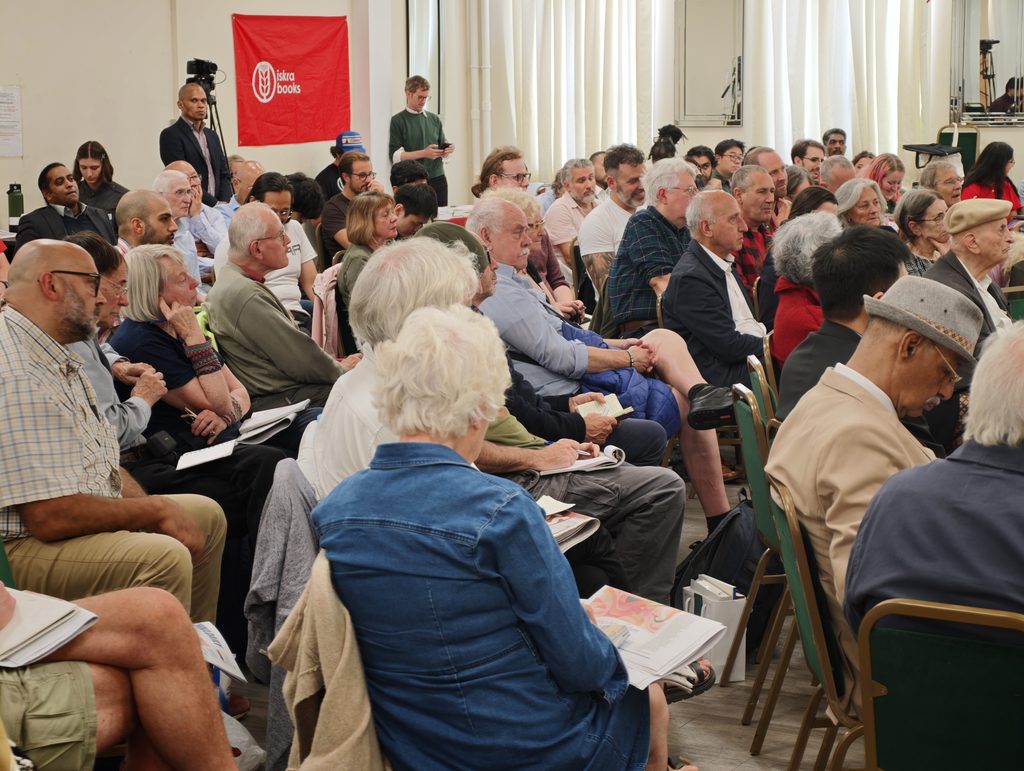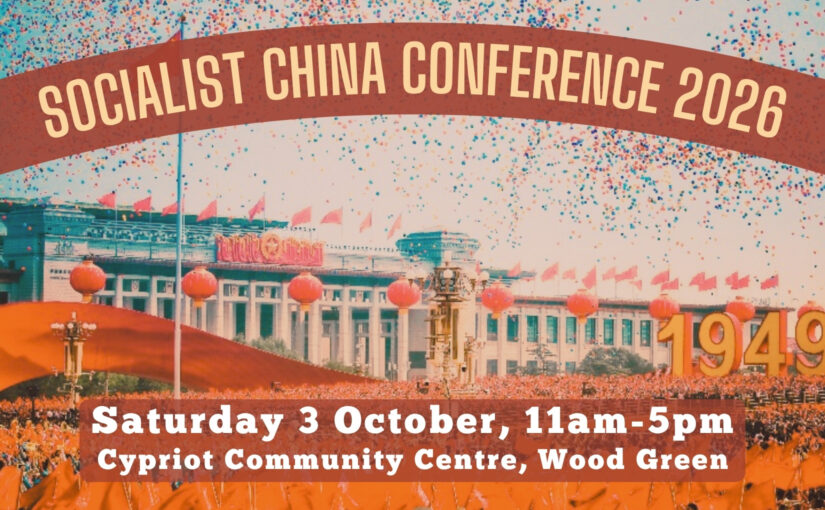
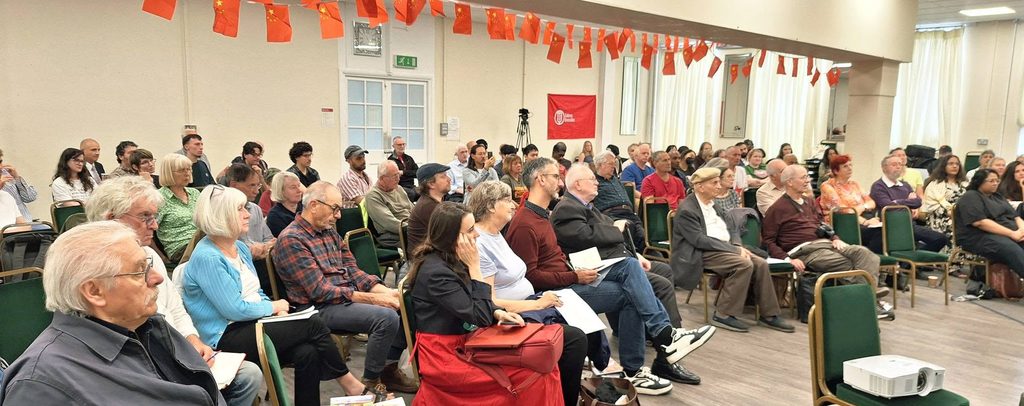
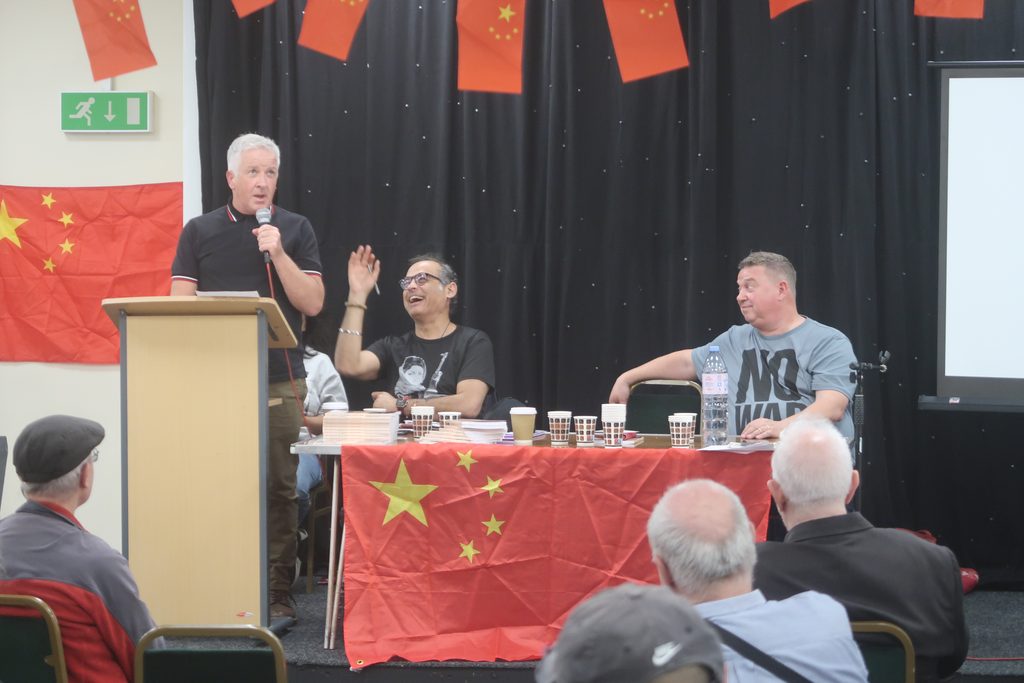
On Saturday 3 October 2026, Friends of Socialist China held its third annual Socialist China Conference at the Cypriot Community Centre in Wood Green, north London, to mark the 77th anniversary of the founding of the People’s Republic of China. More than 150 people attended, and a remarkable number stayed for the full six and a half hours.
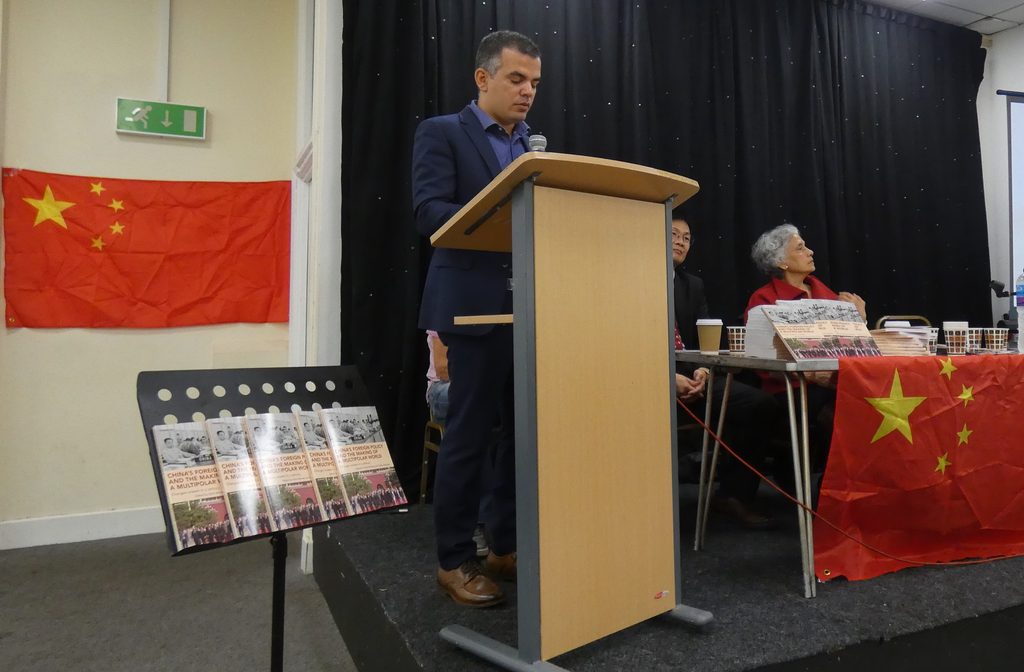
Alongside the opening and closing rallies, there were three panels: on artificial intelligence and the new quality productive forces; on China’s foreign policy and the making of a multipolar world (launching the new book of that name); and on resisting the New Cold War.
Opening rally
Andreas Grigoriou, Secretary of AKEL (Progressive Party of Working People of Cyprus) in Britain, welcomed everyone on behalf of the Cypriot Community Centre. Chairing the opening rally, Professor Radhika Desai of the University of Manitoba took issue with the currently fashionable description of our moment as a Gramscian interregnum – loosely paraphrased as a ‘time of monsters’, in place of Gramsci’s ‘morbid symptoms’ – in which the old is dying and the new cannot be born. The old North Atlantic world is certainly dying, she said, but the new world is not struggling to be born: it is already being actively constructed, and socialist China is leading that process. China demonstrates in practice what capitalism insists is impossible: that prosperity and justice can be planned at scale, with markets harnessed through regulation rather than left to rule.
Jiang Zhouteng, Minister Counsellor at the Embassy of the People’s Republic of China in the UK, said his country had produced two miracles rarely seen in the world – rapid economic development and long-term social stability – citing fourteen consecutive five-year plans completed and the 15th now begun, and a contribution to global economic growth that exceeded 35 percent in 2025.
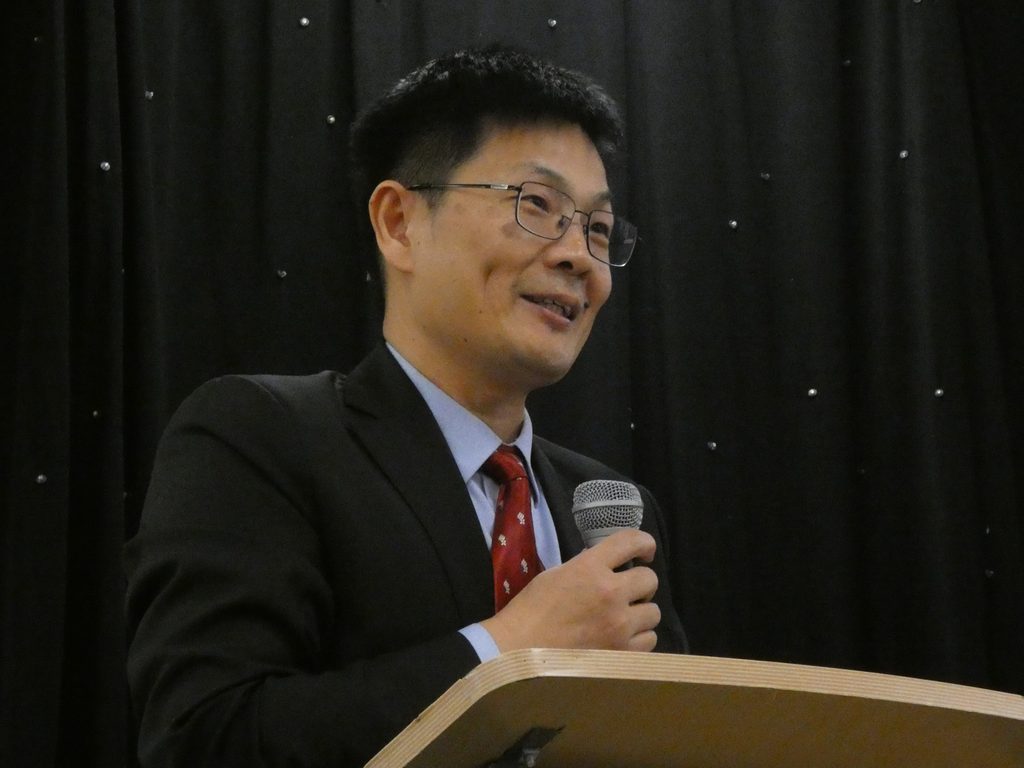
Pablo Ginarte Sampedro, First Secretary for Political Affairs of the Cuban Embassy, outlined what is the hardest period in Cuba’s modern history: eight collapses of the national grid this year, and more than 100,000 patients – among them 11,000 children – waiting for surgery delayed by the blockade. He praised the Chinese contribution of 900 megawatts of solar generation, 144 solar parks and 10,000 household photovoltaic systems, all of which has lifted the renewable share of Cuba’s electricity from around three percent to 21 percent in the space of a single year. “The United States cannot blockade the sun”, he remarked. For Cuba, multipolarity is not an abstraction but the difference between being able to survive and being crushed by imperialism.
Mick Wallace, a former MEP (Member of the European Parliament) for Ireland South, asked whether war is inevitable, and answered that it is not: the peoples of Europe and of the Global South do not want war, and neither does China – which matters, because China is the new big player, and the world is a different place both for its rise and for the approach it takes. China has not dropped a bomb on anyone in 47 years. While it now takes more minerals out of Africa than Europe and the US combined, there is no coercion involved, and it invests dramatically in infrastructure: a couple of years ago, in the same month that the US completed its 29th military base on the African continent, the Chinese completed their 29th major infrastructure project. He noted too that China has been consistent in upholding the UN Charter at a time when the West has effectively abandoned it.
By video from Beijing, renowned CGTN journalist Li Jingjing conveyed the atmosphere of the anniversary flag-raising in Tiananmen Square, drawing attention to the second slogan on the rostrum, too often forgotten: “Long live the great unity of the people of the world.”

Czech MEP Ondřej Dostál also sent a video greeting, observing that socialism with Chinese characteristics has carried China in three generations from utmost poverty to today’s success story.
AI, technology and the new quality productive forces
The first panel was chaired by Carlos Martinez, who noted that in 1949 China was a poor, largely agrarian country with a literacy rate of around 10 percent, while in 2026 it leads the world in renewable energy, advanced manufacturing, electric vehicles and robotics – the first major power since the Soviet Union to modernise without recourse to war, colonialism or slavery.
Dr Ali Al-Assam, co-founder of the Mushtarek platform, discussed the differences between the US and China in terms of AI development. The US strategy on AI, drafted in the White House along with the ‘tech bro’ oligarchs, frames AI as a national security imperative; the Chinese strategy, developed through mass consultation, speaks of reshaping the paradigm of human productive forces. China’s strategy is built around open-source development and includes sharing the latest technologies with the other countries of the Global South. Where China insists that AI serve the people, Trump assembled AI executives to endorse “self-regulation” – and, as Ali put it, they self-regulate after they kill people.
Environmental activist Paul Atkin argued that the destruction of the climatic conditions for human civilisation is not one item on a list of issues but the framework within which everything else must be placed. He noted that China invests twice as much in renewables as the rest of the world combined, its solar now out-generates its coal, and its green technology exports last year displaced emissions equivalent to Britain’s entire output.
Alessandro Serra Zancan of Iskra Books argued that large language models (LLMs) are simply an example of pattern prediction without understanding, and that conflating them with artificial intelligence as such leaves the left defenceless. Drawing on Gramsci, he described LLMs, trained on the dominant corpus of Western knowledge production, as the most codified form of ‘common sense’ yet devised: the United States reinforces common sense, while China builds the infrastructure for good sense.
China’s foreign policy and the making of a multipolar world
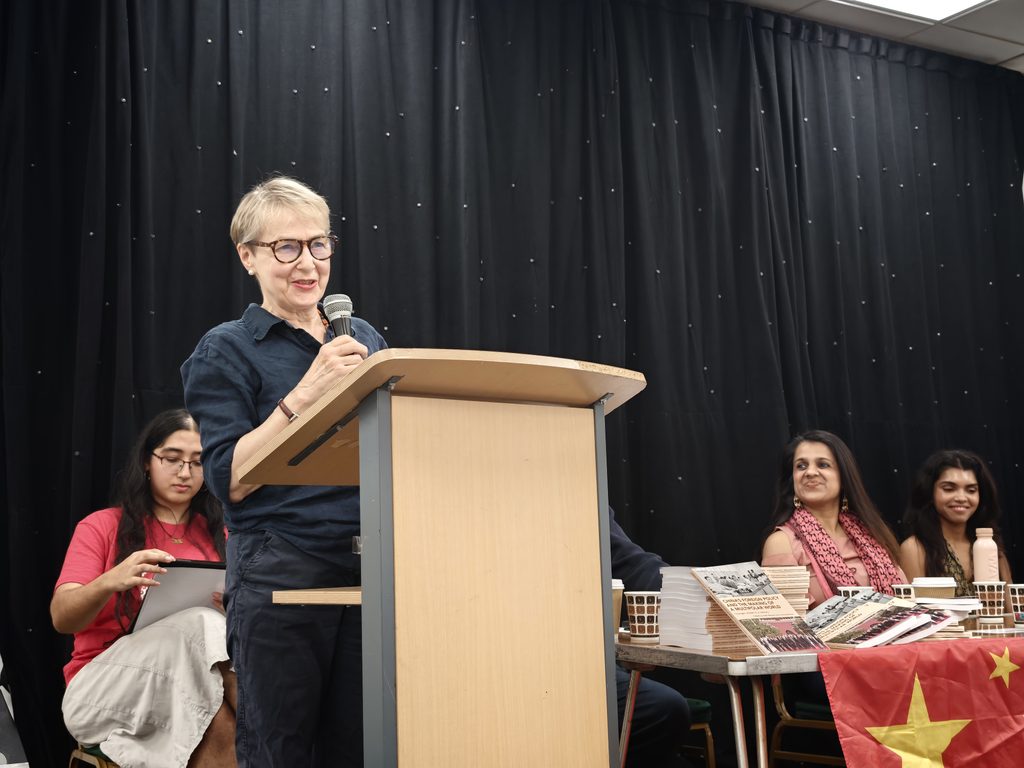
The second panel, chaired by David Peat, marked the launch of China’s Foreign Policy and the Making of a Multipolar World, edited by Keith Bennett and Carlos Martinez and published by Praxis Press. Keith explained that the book was conceived as a weapon in the battle for public opinion: China is progressively moving to the centre of the world stage, yet the bookshops are filled with sensationalist rubbish by the likes of Jung Chang and Frank Dikötter rather than serious Marxist scholarship. He traced anti-China sentiment on the left to imperialist ideas within the workers’ movement, above all social democracy’s assumed identity of interest between worker and capitalist. But, he noted, Gaza changes everything: the first genocide people can watch live on their phones has brought a new generation to anti-imperialist politics, and with it the recognition that those who lie about Palestine may be lying about everything else.
Dr Jenny Clegg asked what the defeat of imperialism would actually consist of, and found the end of unequal exchange, monopoly and finance capital to be a long haul in each case: Chinese electric vehicles are breaking the Western car monopoly, but the Fortune 500 endures and over half of world trade is still invoiced in dollars. Invoking Mao’s On Contradiction, she argued that external causes are the condition of change: the Global Governance Initiative reshapes the situation conditioning our own struggle, which is why internationalism is more than an adjunct to a socialist agenda for Britain.
Dr Francisco Domínguez, National Secretary of the Venezuela Solidarity Campaign, set two opposed projects against one another in Latin America: a Monroe Doctrine whose ultimate logic is colonisation, and the Five Principles of Peaceful Coexistence, first enunciated publicly by Premier Zhou Enlai in 1954. China–Latin America trade has grown from $1.8 billion in 1990 to $565 billion in 2025, and the relationship has brought significant benefits to the people of the region. Meanwhile, the Trump regime has set about attempting to re-colonise the continent, including the kidnapping of Venezuelan President Nicolás Maduro and First Combatant Cilia Flores at the beginning of this year.
Kenny Coyle of Praxis Press noted that 2026 is a year of centenaries – the General Strike in Britain, the birth of Fidel Castro, the founding of AKEL as the Communist Party of Cyprus – and pinned his contribution on one more: Deng Xiaoping’s arrival in Moscow to begin his political education at the Moscow Sun Yat-sen University and the Communist University of the Toilers of the East, after six years in France as an impoverished worker-student in factories such as Renault, in the company of Chen Yi and Zhou Enlai. Deng’s arrival in Moscow came at the height of the New Economic Policy, and when he was asked half a century later whether markets were compatible with socialism, his answer – that markets had existed in China for thousands of years, under feudalism and capitalism alike, and there was no reason they could not be used to build socialism – was drawn not from abstraction but from his direct experience.
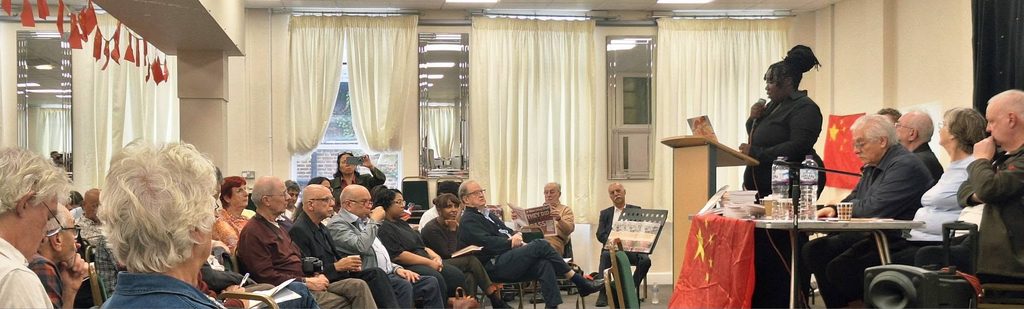
Myriam Kane of the Black Liberation Alliance also began with a date: 1884, when the European powers sat around a table in Berlin with a map of Africa and carved it up, with no African in the room, building railways that run in one direction only – from our mines to their ports. Independence changed the flags, she said, but not necessarily the design; so when young Africans engage with China, the test must be whether the relationship breaks the old design or repeats it. China–Africa trade has risen from around $10 billion in 2000 to $348 billion in 2025, and China has been Africa’s largest trading partner for 16 years; zero-tariff access, extended on 1 May this year to all 53 African countries with diplomatic ties with Beijing, means Kenyan coffee that paid up to 30 percent and West African cocoa that paid up to 22 percent now enter duty-free. She contrasted the US refusal of visas to twelve members of Senegal’s women’s basketball team with Beijing’s scholarships for Senegalese athletes preparing for the Dakar 2026 Youth Olympic Games, the first ever held on African soil, and pointed to Dakar’s Grand Théâtre National and its Museum of Black Civilisations, both built through Chinese grants. In Berlin in 1884, she concluded, we were not at the table; in Beijing today, we are. The future will not be written in Berlin, Washington or Brussels, but wherever the Global South decides to stand together and build.
Resisting the drive to war
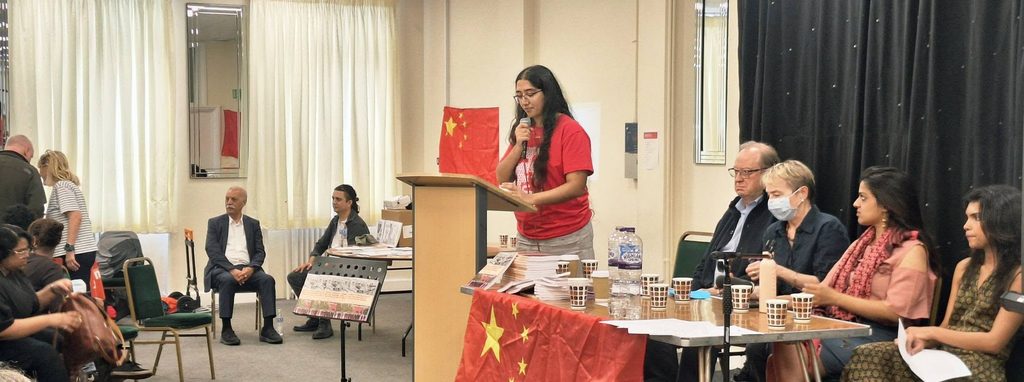
The third panel was chaired by Nuvpreet Kalra of CODEPINK. Dr Kate Hudson, Vice-President of CND, described AUKUS as the concrete handle on an otherwise abstract Cold War. Australia’s nuclear-powered submarines are both a major regional escalation and an act of nuclear proliferation, and the pact amounts to a wealth transfer of probably more than £260 billion from Australian taxpayers to the British and US military-industrial complex – at a time when Australian housing and public spending are being gutted. She urged building cross-border links to resist the drive to war.
John Ross of the Chongyang Institute at Beijing’s Renmin University described this as the most dangerous moment in history: if the US does not succeed in defeating China in the next 10–15 years, it will consider itself to have “lost” the epochal struggle to maintain its hegemony, and there is nothing it will not do to prevent that. John’s central argument was for a popular front against US aggression on China: since capitalism will not be overthrown in the US in the short run, the task is to unite everyone who opposes that aggression for whatever reason, just as the Soviet Union allied with Churchill against Hitler.
Anti-imperialist activist and journalist Nandita Lal spoke on critical minerals as the reason the hot war has limits, given the US military’s dependence on Chinese-processed rare earths – the acquisition of Serra Verde by US Rare Earths, yttrium for US missiles, the AI build-out – and on the way a “just transition” discourse is weaponised against sovereign development in the Global South. Nupur Paliwal of the Student Federation of India UK described the Indian state’s raids on and arrest of NewsClick’s Prabir Purkayastha, in an atmosphere where heightened Sinophobia made anti-democratic and draconian charges possible.
Closing rally
Chairing the closing rally, Fiona Sim of the Black Liberation Alliance argued that propaganda is not simply about telling lies: a photograph can be genuine and still tell a false story if everything outside the frame is excluded, and solidarity work must therefore include restoring the frame. One example she gave was the scare story of the People’s Liberation Army (PLA) being the world’s largest armed force, although Chinese military spending per capita is barely one-twentieth that of the US.
Vijay Prashad of the Tricontinental Institute for Social Research argued that anti-China sentiment fuses two vectors: the yellow peril – a racism far older than the Chinese revolution – and the red menace. He rejected both the study of China as though it were another planet and the litmus-testing of its socialism: the Chinese revolution is part of the single human story of emancipation – “China is ours” – and the point is not only to defend it but to learn from it.
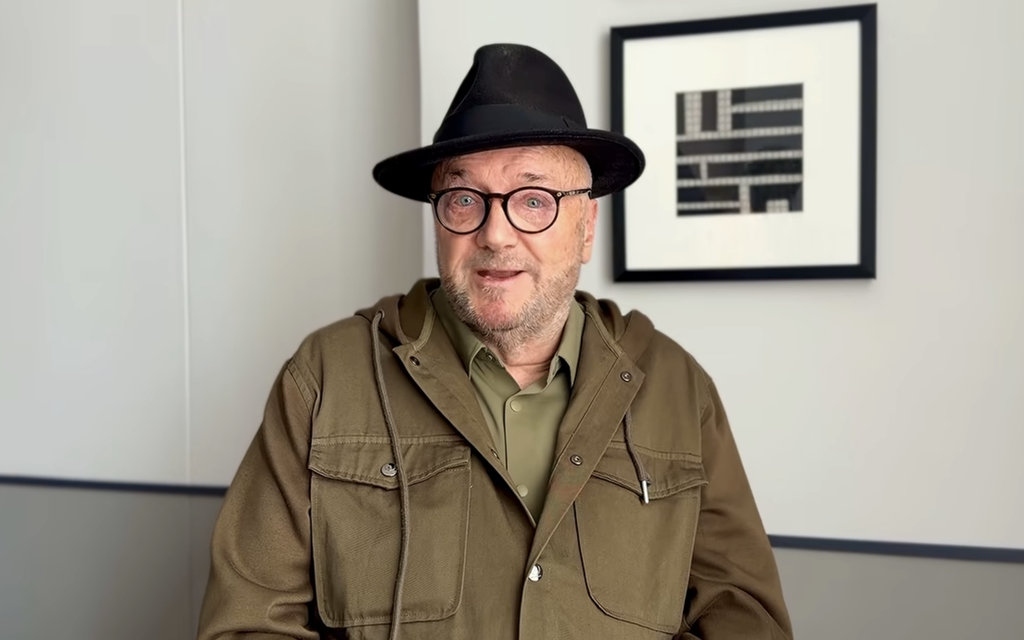
By video from Cape Town, where he also addressed a large demonstration for Palestine on the same day, George Galloway, veteran parliamentarian and leader of the Workers Party of Britain, said that those who disregard China’s achievements can only be people who have never been there. The reason for China’s success is the direction of the economy by the Communist Party and the Chinese state: private enterprise exists, but it must conform to the political priorities set by the party and the government – a model that works, and one he believes Britain should emulate. Capitalism left to its own devices pursues the precise opposite, and he spoke of the neglect of his home city of Dundee, Glasgow and the Scottish borders, and of England’s coastal communities and its abandoned mining, steel and shipbuilding areas, all left to rot. None of that would happen in China, where there is a ceaseless effort to ensure no community is left behind, backed by an enormous direction of state resources.
Alex Gordon, General Secretary of the Communist Party of Britain, described the delegations his party has sent to China this year as evidence that it means what it says when it calls it the duty of Marxists to study and learn from socialist China. Speaking on the eve of the 90th anniversary of the Battle of Cable Street, Alex observed that 12 years before that famous anti-fascist struggle, the first minority Labour government had been funding and arming fascists in southern China to assassinate trade unionists. The coming home of fascism in the 1930s was imperialism ripping off its mask and applying the methods it had used in India, China and Ireland.
Professor Zhang Weiwei of Fudan University’s China Institute, by video, traced the transformation of a poverty-stricken country into the world’s largest economy by purchasing power parity, with extreme poverty eradicated and the world’s largest social safety net and healthcare system now covering the entire population. China has become a science and technology superpower, producing more than two-thirds of the world’s electric vehicles, solar panels and lithium batteries. Its rise, he argued, represents a new model of modernisation – people-centred, long-termist, holistic and with a powerful capacity for execution – offering an alternative to the Western-centric development model. The world, and the world’s cause of socialism, are forever different as a result.
Gearóid Ó Machail, bringing greetings from the Communist Party of Ireland, drew out the historical parallels between Ireland and China: on very different scales, both have endured the long shadow of imperialism, both have struggled for national liberation, and both still face the task of complete national reunification – China has Taiwan, Ireland the six counties that remain under British rule. He emphasised that China’s technological leap is planned rather than spontaneous: state-owned enterprises have invested over $591 billion in strategic emerging industries, with more than 15 percent of research funds going to basic research, and total R&D spending reached 3.92 trillion yuan in 2025, or 2.8 percent of GDP – surpassing the OECD average for the first time. At a time when the imperialist powers demand that every nation pick a side, he argued, multipolarity and neutrality alike serve as our safeguard. He closed on James Connolly’s words at the outbreak of the First World War – “We serve neither King nor Kaiser, but Ireland” – adding that today, facing the threat of a third world war, “we serve neither empire nor capital. We serve the cause of socialism, the dignity of nations and the solidarity of the people.”
Building friendship and solidarity
The conference was supported by a broad range of progressive organisations: the Morning Star, Communist Party of Britain, Workers Party of Britain, Communist Party of Ireland, Communist Party of Portugal (UK), AKEL in Britain, International Manifesto Group, No Cold War Britain, No 2 NATO, Mushtarek Platform, Student Federation of India UK, Young Communist League, Black Liberation Alliance, Caribbean Labour Solidarity, Third World Solidarity, Institute for Independence Studies, Birmingham People’s History Archive, Labour Affairs Magazine, Iskra Books, Praxis Press and Manifesto Press.
Recordings of all five sessions can be found on our YouTube channel, along with the pre-recorded contributions.
The conference marks another landmark in the vital work of building friendship and solidarity with China.