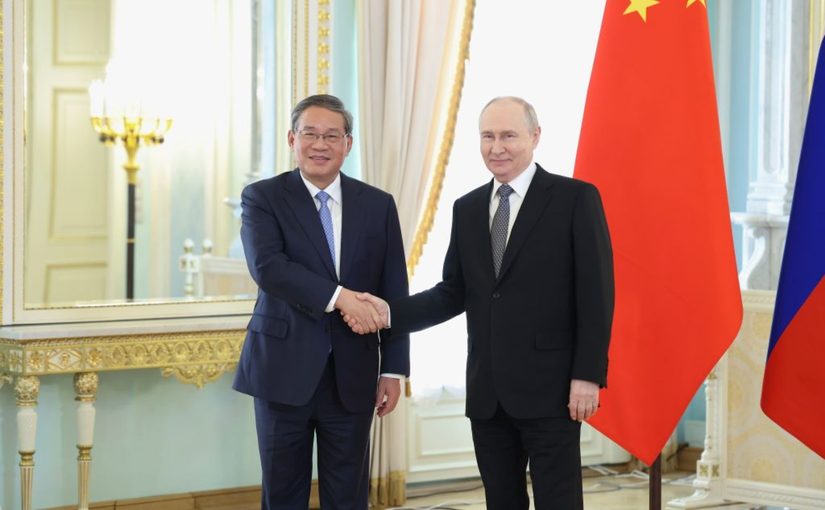
On October 15, the spokesperson of the Chinese Foreign Ministry announced that:
“At the invitation of Prime Minister of the Republic of Uzbekistan Abdulla Aripov, Premier of the State Council Li Qiang will pay an official visit to Uzbekistan from October 17 to 18.
“At the invitation of Prime Minister of the Republic of Tajikistan Kokhir Rasulzoda, Premier Li Qiang will pay an official visit to Tajikistan from October 18 to 20 and attend the 25th meeting of the Council of Heads of Government (Prime Ministers) of the Shanghai Cooperation Organisation.
“At the invitation of Prime Minister of the Russian Federation Mikhail Mishustin, Premier Li Qiang will travel to Russia from October 20 to 22 for the 31st regular meeting between Chinese and Russian heads of government.”
Arriving in the Uzbek capital Tashkent to begin his visit, Premier Li noted that the traditional friendship between China and Uzbekistan has a long history and that the two countries are good friends, good partners and good brothers. Over the past 34 years since the establishment of diplomatic relations, they have always respected each other and treated each other as equals, regardless of changes in the international landscape.
In recent years in particular, with the joint efforts of both sides, political mutual trust between China and Uzbekistan has become more solid, friendship has taken deep root in the hearts of the people, and practical cooperation has achieved fruitful results, delivering tangible benefits to the two peoples, Li said, adding that Chinese President Xi Jinping and Uzbek President Shavkat Mirziyoyev met in Bishkek, the capital of Kyrgyzstan, not long ago and reached important consensus on further deepening bilateral relations.
Meeting with Uzbek President Shavkat Mirziyoyev on the day of his arrival, Li said that China stands ready to ensure the high-quality implementation of the China-Kyrgyzstan-Uzbekistan railway project. In the face of a complex and turbulent international landscape, China and Uzbekistan should strengthen solidarity and cooperation and remain firmly committed to moving forward together. China is ready to strengthen coordination of positions with Uzbekistan on major issues, enhance collaboration within multilateral frameworks such as the China-Central Asia mechanism and the Shanghai Cooperation Organisation (SCO), safeguard the common interests of both countries, and contribute to peace and development at both the regional and global levels.
In his talks with Uzbek Prime Minister Abdulla Aripov, Li said that China stands ready to strengthen the alignment of development strategies with Uzbekistan and deepen cooperation in energy and resources, artificial intelligence, modern agriculture and other areas. China stands ready to strengthen coordination and cooperation with Uzbekistan within multilateral frameworks such as the Shanghai Cooperation Organisation, the China-Central Asia mechanism and the United Nations, work with all parties to implement the four global initiatives [put forward by President Xi] and advance an equal and orderly multipolar world and a universally beneficial and inclusive economic globalisation.
Aripov said that Uzbekistan is willing to work with China to fully promote the construction of the China-Kyrgyzstan-Uzbekistan railway and other projects of Belt and Road cooperation, deepen mutually beneficial cooperation in economic and trade investment, agriculture, energy and mineral resources, customs, finance, digital technology, artificial intelligence, ecological protection and other fields, strengthen exchanges in tourism, education, locality and other fields, enhance multilateral coordination, and promote continuous development of the Uzbekistan-China all-weather comprehensive strategic partnership for a new era.
Following the talks, they witnessed the signing of multiple cooperation documents covering trade and economy, education, customs, health and poverty reduction, among other areas. And during the visit, the two sides also signed cooperation documents including those on e-commerce, climate and media.
A summary of the importance of the visit published by the Xinhua News Agency quoted Eldor Tulyakov, executive director of the Development Strategy Centre of Uzbekistan, as saying that bilateral engagement has entered a broader and deeper stage and cooperation with China has worked to advance the Central Asian country’s national development goals. “Political trust creates favourable conditions, and practical work gives it substance,” he said, highlighting tangible economic gains from electric vehicle manufacturing to green energy.
In recent years, Chinese-built solar plants and wind farms have been supplying electricity to grids across several regions in Uzbekistan, powering the country’s green transition while bolstering its equipment manufacturing capabilities. New projects are adding further momentum to this transition. In August, a China-supported wind power project was completed in the Tashkent region’s Bostanlyk district. Upon full operation, it is expected to save roughly 12 million cubic metres of natural gas and cut carbon dioxide emissions by about 24,000 tons per year.
The article further noted that the Chinese premier and the Uzbek leaders also highlighted collaborations on regional connectivity initiatives, including the high-level construction of the China-Kyrgyzstan-Uzbekistan railway, among other projects of Belt and Road cooperation. Not long ago, President Xi Jinping called for efforts to ensure the high-quality construction of the China-Kyrgyzstan-Uzbekistan railway, during his stay in Bishkek for a state visit to Kyrgyzstan and to attend the Shanghai Cooperation Organisation (SCO) Summit 2026. Xi described the railway as a major transportation artery that carries the development aspirations of the people across the region. Officially launched in December 2024, the project, which is now under construction, is a manifestation of the practical side of multilateral collaboration between China and Central Asia.
Meeting with Tajik President Emomali Rahmon in the capital Dushanbe on October 19, Li said that China is willing to expand cooperation with Tajikistan in emerging industries such as the digital economy and artificial intelligence as well as to expand bilateral trade with Tajikistan, strengthen cooperation in infrastructure, green minerals, connectivity and other fields, so as to jointly build new drivers of economic growth. China is also willing to strengthen communication and coordination with Tajikistan within the United Nations, the China-Central Asia mechanism and other multilateral frameworks, actively implement the four global initiatives proposed by Chinese President Xi Jinping, and work together to build a community with a shared future for humanity.
Noting that Tajikistan always attaches great importance to and highly values its partnership with China, Rahmon said that in May this year, he successfully held talks with President Xi during his visit to China and reached a series of important consensus, charting the course for the development of Tajikistan-China relations. Tajikistan firmly adheres to the one-China principle and firmly supports China in safeguarding its core interests.
Li met with his Tajik counterpart Prime Minister Kokhir Rasulzoda the previous day. He said that China stands ready to work with Tajikistan to advance high-quality Belt and Road cooperation and is willing to deeply align its development strategies with Tajikistan, deepen cooperation in trade and investment, green minerals, connectivity, clean energy, artificial intelligence and other areas, so as to better achieve mutual benefit and win-win results. China will import more high-quality goods from Tajikistan, encourage Chinese enterprises to invest and start businesses in Tajikistan, and hopes that Tajikistan will continue to provide a favourable business environment for China’s enterprises.
Noting that the international situation continues to undergo complex changes, Li said that as important members of the Global South, China and Tajikistan should unite and coordinate more closely, safeguard the common interests of both countries and defend international fairness and justice. The two sides should further strengthen communication and coordination within multilateral frameworks including the United Nations, the Shanghai Cooperation Organisation, the China-Central Asia mechanism and the World Artificial Intelligence Cooperation Organisation, and work to build a more just and equitable global governance system.
Rasulzoda said that China is the most important trade and investment partner of Tajikistan and expressed appreciation for China’s long-standing and strong support for Tajikistan’s economic development. Tajikistan is committed to advancing all-round cooperation with China and stands ready to further leverage such platforms as the China-Tajikistan intergovernmental committee on economic and trade cooperation, promote high-quality Belt and Road cooperation, and deepen mutually beneficial cooperation in trade, investment, agriculture, transport and logistics, energy and minerals, and connectivity. He also called for expanding cooperation in emerging fields such as the green economy, digital economy and artificial intelligence, enhancing people-to-people exchanges, and strengthening communication and coordination within multilateral frameworks, including the Shanghai Cooperation Organisation and the China-Central Asia mechanism, to promote further progress in Tajikistan-China relations.
Li Qiang attended the 25th meeting of the Council of Heads of Government (Prime Ministers) of Member States of the Shanghai Cooperation Organisation (SCO) in Dushanbe on October 20.
In his speech, he said that the organisation should strive to promote regional stability and prosperity while contributing to common development worldwide. He noted that at the Bishkek summit, held on August 31-September 1 this year, President Xi Jinping had pointed out that at the crossroads concerning the future of humanity, the SCO should shoulder its historic responsibility and take the initiative in steering the course of history.
Li announced that China is willing to sponsor 1,000 medical professionals from SCO countries to come to China for further training, continuously enhancing the well-being of people across the region.
He also stated that in recent years, the international community has seen growing calls to strengthen multilateralism and reform and improve global governance, noting that the SCO should strive to unite more international partners and play an active role at the global level. It should also seek common interests amid differences in countries’ concerns and work together to uphold world peace and stability, while promoting harmony and coexistence amid cultural differences.
After the meeting, Li and other participating leaders of SCO member states signed and issued a joint communique and approved cooperation documents covering trade and investment, industry and connectivity, as well as resolutions concerning the SCO’s development.
In a meeting with Iran’s First Vice President Mohammad-Reza Aref on the sidelines of the SCO meeting, Li said that China has been making every effort to encourage peace and promote dialogue. Upholding the spirit of the series of major initiatives and proposals put forward by President Xi Jinping, China will continue to work to promote peace, stability and development in the Middle East.
For his part, Aref said that Iran attaches great importance to its relations with China and stands ready to maintain close exchanges at all levels, strengthen mutually beneficial cooperation across various fields, enhance coordination within multilateral frameworks such as the SCO and BRICS, and promote the sustained and in-depth development of the Iran-China comprehensive strategic partnership.
As a responsible major country, China has consistently supported multilateralism and worked to safeguard the common interests of Global South countries, which Iran appreciates. The Iranian side further appreciates China’s consistent efforts to promote peace and bring an end to conflicts and welcomes and supports the important proposals and propositions put forward by President Xi to promote peace and security in the Middle East. He expressed Iran’s willingness to resolve conflicts and differences through dialogue and consultation, and voiced hope for an early return to the Islamabad Memorandum of Understanding [between Iran and the United States] and the early restoration of peace and stability in the region.
On the same day, Li Qiang also met with Belarusian Prime Minister Alexander Turchin. He said that China stands ready to strengthen the alignment of development strategies with Belarus. Noting that China and Belarus are true friends who trust and support each other, Li added that under the strategic guidance of President Xi Jinping and President Alexander Lukashenko, the China-Belarus all-weather comprehensive strategic partnership has continued to develop steadily, yielding fruitful results in bilateral cooperation.
In recent years, he noted, certain acts of hegemonism and power politics have grown increasingly rampant, adding that China stands ready to enhance communication and coordination with Belarus in regional and international affairs, closely collaborate within mechanisms such as the SCO and BRICS, promote multilateralism and free trade, safeguard the common interests of the two countries, and uphold international fairness and justice.
On the conclusion of the meeting, the chairmanship of the SCO Council of Heads of Government passed to the Republic of Uzbekistan, and it was agreed that the next meeting will be held in that country in 2027.
The same day, Li Qiang flew to St. Petersburg to begin his visit to Russia at the invitation of Prime Minister Mikhail Mishustin to attend the 31st regular meeting between Chinese and Russian heads of government.
On his arrival, he said that China is ready to work with Russia to make sustained efforts to steer bilateral cooperation in a direction that is deeper, more substantive and more resilient. He added that this year marks the 30th anniversary of the establishment of the China-Russia strategic partnership of coordination and the 25th anniversary of the signing of the China-Russia Treaty of Good-Neighbourliness and Friendly Cooperation. Looking back on the journey China and Russia have taken together, the two countries have jointly explored a way of getting along featuring non-alliance, non-confrontation and not targeting any third party, continuously deepened cooperation in various fields, and set a fine example of major-country relations featuring permanent good-neighbourly friendship, comprehensive strategic coordination and mutually beneficial cooperation. Noting that changes unseen in a century are accelerating across the world, Li said the two heads of state have met twice this year, drawing a new blueprint for the development of bilateral relations. The efforts made by both sides will bring greater benefits to the two peoples and inject valuable stability and certainty into world peace and development.
Li Qiang met with Russian President Vladimir Putin in St. Petersburg on October 21. He said that against the backdrop of a continuously evolving and complex international situation, China and Russia have maintained close coordination, serving as a valuable force for stability in a world marked by turbulence and transformation. China is ready to work with Russia to better leverage their economic complementarity, maintain the sound momentum of bilateral cooperation, strengthen practical cooperation in energy and resources, trade and investment, transportation and other areas, deliver more positive outcomes and promote common prosperity in both countries. Noting that unilateralism and hegemonism are rampant in today’s world, Li said China is ready to strengthen communication and coordination with Russia on major issues, enhance coordination within multilateral platforms such as the Shanghai Cooperation Organisation and BRICS, unite more forces of the Global South to safeguard common interests and uphold fairness and justice.
Li noted that: “This is my third visit to beautiful Russia since I took office as Premier of the State Council of China. On each visit, I have been struck by the sincerity and friendliness of the Russian people. Last month, Russia successfully held elections to the State Duma, and the results fully reflect the will of the Russian people. The Chinese side extends its congratulations to the Russian side. I am confident that, under your steadfast leadership, Russia will continue to advance confidently along the path of national development and revival.”
For his part, Putin asked Li to convey his sincere greetings to President Xi Jinping and wished the upcoming fifth plenary session of the 20th Central Committee of the Communist Party of China a success. Russia-China relations are built on the basis of equality and mutual respect, mutual benefit and win-win results, and accommodation of each other’s concerns, he said, noting that bilateral relations are not affected by changes in the international landscape and not subject to interference from any third party. China has been and will always be Russia’s closest and most reliable partner and Russia supports China in hosting the APEC Economic Leaders’ Meeting this year and in assuming the BRICS chairmanship next year.
On the same day, Li co-chaired the 31st regular meeting between Chinese and Russian heads of government with Prime Minister Mikhail Mishustin. Li said that in recent years, China and Russia have stood side by side and moved forward together in the face of a complex and turbulent international landscape. Under the strategic guidance of the two heads of state, China and Russia have leveraged more dynamic and resilient cooperation to cushion the impact of external uncertainties and instability, and bilateral cooperation has continued to broaden and grow ever more steadily. China stands ready to work with Russia in the spirit of mutual respect, mutual benefit and win-win cooperation to deepen and substantiate cooperation across various fields, better translate the important consensus reached by the two heads of state into concrete actions and tangible outcomes, better serve the development and revitalisation of both countries, and bring greater benefits to the two peoples.
After the meeting, Li and Mishustin signed the joint communique of the 31st regular meeting between Chinese and Russian heads of government. The two sides also agreed cooperation documents in areas such as economy and trade, space, science and technology, and education. The full text of their detailed joint communique, extending to just over 9,000 words, can be read here.
Li Qiang returned to Beijing on October 22.
The following articles were originally published by the Xinhua News Agency and on the websites of the Shanghai Cooperation Organisation and the President of Russia.
Chinese premier arrives in Uzbekistan for official visit
TASHKENT, Oct. 17 (Xinhua) — Chinese Premier Li Qiang arrived in Tashkent on Saturday for an official visit to Uzbekistan at the invitation of Uzbek Prime Minister Abdulla Aripov.
The traditional friendship between China and Uzbekistan has a long history, Li said, noting that the two countries are good friends, good partners and good brothers.
Over the past 34 years since the establishment of diplomatic relations, China and Uzbekistan have always respected each other and treated each other as equals, regardless of changes in the international landscape, Li said. Bilateral relations and cooperation have continued to move forward, with new vitality and dynamism, he added.
In recent years in particular, with the joint efforts of both sides, political mutual trust between China and Uzbekistan has become more solid, friendship has taken deep root in the hearts of the people, and practical cooperation has achieved fruitful results, delivering tangible benefits to the two peoples, said the premier.
Li noted that Chinese President Xi Jinping and Uzbek President Shavkat Mirziyoyev met in Bishkek not long ago and reached important consensus on further deepening bilateral relations.
China is ready to work with Uzbekistan to translate the consensus reached by the two heads of state into more tangible outcomes, and deepen and strengthen the building of the China-Uzbekistan community with a shared future, Li added.
On Li’s arrival, the Uzbek prime minister and other senior government officials greeted him at the airport and held a welcome ceremony in his honor.
Chinese premier says Beijing ready to ensure high-quality China-Kyrgyzstan-Uzbekistan railway
TASHKENT, Oct. 17 (Xinhua) — Chinese Premier Li Qiang said on Saturday that China stands ready to ensure the high-quality implementation of the China-Kyrgyzstan-Uzbekistan railway project.
During his meeting with Uzbek President Shavkat Mirziyoyev here, Li also said that China supports more capable Chinese enterprises in investing and doing business in Uzbekistan and hopes that the Uzbek side will continue to provide a favorable business environment for these enterprises.
In recent years, under the strategic guidance of President Xi Jinping and President Mirziyoyev, the building of a China-Uzbekistan community with a shared future has continued to achieve new results, Li said.
In the face of a complex and turbulent international landscape, China and Uzbekistan should strengthen solidarity and cooperation and remain firmly committed to moving forward together, he said.
China stands ready to strengthen strategic communication with Uzbekistan, continue to firmly support each other’s core interests, and expand mutually beneficial cooperation to deliver greater benefits to the peoples of both countries, Li said.
China is ready to work with Uzbekistan to expand bilateral trade and optimize its structure, strengthen cooperation in areas such as energy, minerals, finance, and connectivity, and deepen cooperation in scientific and technological innovation in fields such as artificial intelligence, the green economy, and aerospace, so as to jointly seize future development opportunities, Li said.
Both sides should also promote people-to-people connectivity and facilitate the establishment of cultural centers in each other’s countries as soon as possible, Li said.
China is ready to strengthen coordination of positions with Uzbekistan on major issues, enhance collaboration within multilateral frameworks such as the China-Central Asia mechanism and the Shanghai Cooperation Organization (SCO), safeguard the common interests of both countries, and contribute to peace and development at both the regional and global levels, Li said.
For his part, Mirziyoyev congratulated the Communist Party of China on the 105th anniversary of its founding, saying that under the wise leadership of President Xi, China is forging ahead toward national rejuvenation.
Uzbekistan-China relations are currently enjoying a “golden age,” he said, adding that his successful meeting with Xi on the sidelines of the SCO summit in Bishkek charted the course for advancing bilateral cooperation.
Uzbekistan firmly adheres to the one-China principle and firmly supports China in safeguarding its core interests, he said, noting that Uzbekistan will continue to work with China to combat the “three evil forces” of terrorism, separatism and extremism.
Uzbekistan welcomes more Chinese enterprises to invest and do business in the country and stands ready to work with China to accelerate the construction of the China-Kyrgyzstan-Uzbekistan railway and advance exchanges and cooperation across various fields, he said.
Uzbekistan supports the four global initiatives proposed by Xi and is willing to strengthen communication and coordination with China in multilateral affairs, promoting continued progress in the Uzbekistan-China all-weather comprehensive strategic partnership for a new era, he added.
Chinese premier says China ready to strengthen alignment of development strategies with Uzbekistan
TASHKENT, Oct. 17 (Xinhua) — Chinese Premier Li Qiang said on Saturday that China stands ready to strengthen the alignment of development strategies with Uzbekistan and deepen cooperation in energy and resources, artificial intelligence, modern agriculture and other areas.
Li, who is on an official visit to the Central Asian country, made the remarks when holding talks with Uzbek Prime Minister Abdulla Aripov.
Chinese President Xi Jinping and Uzbek President Shavkat Mirziyoyev met in August, charting the course for further development of bilateral relations, Li said.
Noting that next year marks the 35th anniversary of bilateral relations, Li said that China is ready to take this opportunity with Uzbekistan to carry forward their traditional friendship, deepen political mutual trust, enhance practical cooperation, and deepen the building of the China-Uzbekistan community with a shared future, so as to deliver greater benefits to the people of both countries.
Li said that China is ready to work with Uzbekistan to further leverage the complementary strengths of the two economies, continuously enhance connectivity in infrastructure, finance and other areas, advance the high-quality construction of the China-Kyrgyzstan-Uzbekistan railway, and strive for more tangible outcomes.
China is also willing to import more high-quality and specialty products from Uzbekistan, and welcomes Uzbekistan to make full use of platforms such as the China International Import Expo to actively explore the Chinese market, he added.
Li encouraged the two sides to continue to make good use of the mutual visa exemption policy, expand two-way personnel exchanges, strengthen exchanges and cooperation in culture, tourism, education, youth, locality and other fields, and constantly enhance mutual understanding and friendship between the two peoples.
China stands ready to strengthen coordination and cooperation with Uzbekistan within multilateral frameworks such as the Shanghai Cooperation Organization, the China-Central Asia mechanism and the United Nations, work with all parties to implement the four global initiatives, and advance an equal and orderly multipolar world and a universally beneficial and inclusive economic globalization, he said.
For his part, Aripov said that Uzbekistan admires China’s remarkable achievements in development, and sincerely appreciates China’s strong support for Uzbekistan’s reform and development efforts.
Under the joint guidance of the two heads of state, Uzbekistan-China relations have continued to reach new heights, he noted.
Aripov said that Uzbekistan is willing to work with China to fully promote the construction of the China-Kyrgyzstan-Uzbekistan railway and other projects of Belt and Road cooperation, deepen mutually beneficial cooperation in economic and trade investment, agriculture, energy and mineral resources, customs, finance, digital technology, artificial intelligence, ecological protection and other fields, strengthen exchanges in tourism, education, locality and other fields, enhance multilateral coordination, and promote continuous development of the Uzbekistan-China all-weather comprehensive strategic partnership for a new era.
Before the talks, the two leaders jointly watched a video showcasing practical cooperation between China and Uzbekistan across various fields.
Following the talks, they witnessed the signing of multiple cooperation documents covering trade and economy, education, customs, health and poverty reduction, among other areas. During the visit, the two sides also signed cooperation documents on e-commerce, climate and media, among other fields.
On Saturday afternoon, Li also laid a wreath at the Independence Monument.
China, Uzbekistan seek tangible gains from expanding cooperation during premier’s visit
TASHKENT, Oct. 18 (Xinhua) — During a productive day of high-level exchanges in Tashkent on Saturday, China and Uzbekistan pledged to deepen practical cooperation, from expanding trade and connectivity to exploring emerging fields such as artificial intelligence and the green economy.
Chinese Premier Li Qiang arrived in the Central Asian nation on Saturday for a two-day official visit, where he highlighted China’s readiness to enhance bilateral practical cooperation and deepen the building of the China-Uzbekistan community with a shared future to deliver greater benefits to the people of both countries.
During his meeting with Uzbek President Shavkat Mirziyoyev, Li said China is ready to work with Uzbekistan to expand bilateral trade and optimize its structure.
China supports more capable Chinese enterprises in investing and doing business in Uzbekistan, he said, calling for continued provision of a favorable business environment for these enterprises.
China is also willing to import more high-quality and specialty products from Uzbekistan, and welcomes Uzbekistan to make full use of platforms such as the China International Import Expo to actively explore the Chinese market, he told Uzbek Prime Minister Abdulla Aripov in their talks.
China has been a major trading partner of Uzbekistan and its main source of imports. Two-way trade reached 16.1 billion U.S. dollars in 2025, marking a 17.9 percent increase year over year, Chinese official data showed.
In the first eight months of this year, China accounted for the largest share of Uzbekistan’s foreign trade turnover, at 23 percent, according to the Uzbek official tally. More than 6,000 joint ventures involving Chinese participation are operating in Uzbekistan.
Building on a decade of flourishing cooperation under the China-Uzbekistan comprehensive strategic partnership, the two countries are exploring broader avenues for cooperation to inject fresh vitality into a golden age of bilateral ties.
In Tashkent, Li and Aripov jointly watched a video showcasing practical cooperation between China and Uzbekistan across various fields.
They also witnessed the signing of multiple cooperation documents covering trade and economy, education, customs, health and poverty reduction, among others. During the visit, the two sides also signed cooperation documents on such areas as e-commerce and climate.
In his diplomatic engagement with the Uzbek side, Li vowed China’s readiness to strengthen the alignment of development strategies with Uzbekistan and further leverage the complementary strengths of the two economies.
China is ready to work with Uzbekistan to deepen cooperation in scientific and technological innovation in fields such as artificial intelligence, the green economy, and aerospace, so as to jointly seize future development opportunities, he said.
Eldor Tulyakov, executive director of the Development Strategy Center of Uzbekistan, told Xinhua that as bilateral engagement enters a broader and deeper stage, cooperation with China has worked to advance the Central Asian country’s national development goals.
“Political trust creates favorable conditions, and practical work gives it substance,” he said, highlighting tangible economic gains from electric vehicle manufacturing to green energy.
In recent years, Chinese-built solar plants and wind farms have been supplying electricity to grids across several regions in Uzbekistan, powering the country’s green transition while bolstering its equipment manufacturing capabilities.
New projects are adding further momentum to this transition.
In August, a China-supported wind power project was completed in the Tashkent region’s Bostanlyk district. Upon full operation, it is expected to save roughly 12 million cubic meters of natural gas, and cut carbon dioxide emissions by about 24,000 tons per year.
The Chinese premier and the Uzbek leaders also highlighted collaborations on regional connectivity initiatives, including the high-level construction of the China-Kyrgyzstan-Uzbekistan railway, among other projects of Belt and Road cooperation.
Not long ago, Chinese President Xi Jinping called for efforts to ensure the high-quality construction of the China-Kyrgyzstan-Uzbekistan railway, during his stay in Bishkek for a state visit to Kyrgyzstan and to attend the Shanghai Cooperation Organization (SCO) Summit 2026.
Xi described the railway as a major transportation artery that carries the development aspirations of the people across the region.
Officially launched in December 2024, the railway project, which is now under construction, is a manifestation of the practical side of multilateral collaboration for China and Central Asia.
The railway “links the interests of several countries around a common project,” said Tulyakov, adding that it is expected to spur the development of trade and logistics infrastructure along the mainline and promote the use of digital solutions in trade and transport procedures.
“The tangible results of cooperation are most visible where enterprises are already operating, infrastructure has been built, and new professions have emerged,” the expert added.
Chinese premier says ready to expand cooperation with Tajikistan in emerging industries
DUSHANBE, Oct. 19 (Xinhua) — Chinese Premier Li Qiang said Monday that China is willing to expand cooperation with Tajikistan in emerging industries such as the digital economy and artificial intelligence.
In his meeting with Tajik President Emomali Rahmon, Li said China stands ready to expand bilateral trade with Tajikistan, strengthen cooperation in infrastructure, green minerals, connectivity and other fields, so as to jointly build new drivers of economic growth.
He called for deepening cooperation with Tajikistan in law enforcement and security, saying both sides should strengthen intelligence exchanges and information sharing, jointly combat the three forces of terrorism, separatism and extremism, and safeguard lasting peace and stability in the region.
The Chinese premier expressed hope that the Tajik side will continue to take strong measures to ensure the safety and security of Chinese personnel and enterprises in Tajikistan.
Li arrived here on Sunday for an official visit to Tajikistan and the 25th meeting of the Council of Heads of Government (Prime Ministers) of Member States of the Shanghai Cooperation Organization (SCO).
In talks with the Tajik president, he said China will fully support Tajikistan in successfully hosting the SCO meeting, and stands ready to work with all parties to promote higher-quality development of the SCO.
China is also willing to strengthen communication and coordination with Tajikistan within the United Nations, the China-Central Asia mechanism and other multilateral frameworks, actively implement the four global initiatives proposed by Chinese President Xi Jinping, and work together to build a community with a shared future for humanity, he said.
The premier noted that China and Tajikistan are currently advancing efforts to build a community with a shared future between the two countries, and in May this year, President Xi met with President Rahmon, providing further guidance for the development of bilateral relations.
China cherishes its profound friendship with Tajikistan and will always view China-Tajikistan relations from a strategic and long-term perspective, Li said.
China stands ready to consolidate and deepen political mutual trust with Tajikistan, firmly support each other’s core interests, continuously enhance the quality and effectiveness of cooperation, and continue to work hand in hand on the path toward modernization, he added.
Noting that Tajikistan always attaches great importance to and highly values its partnership with China, Rahmon said that in May this year, he successfully held talks with President Xi during his visit to China and reached a series of important consensus, charting the course for the development of Tajikistan-China relations.
Tajikistan firmly adheres to the one-China principle and firmly supports China in safeguarding its core interests, the president noted.
Rahmon said that Tajikistan is willing to further deepen cooperation with China in areas such as economy and trade, industry, agriculture, energy and minerals, connectivity and artificial intelligence, and promote people-to-people and cultural exchanges.
Tajikistan firmly supports the four major global initiatives proposed by President Xi, said Rahmon, noting that Tajikistan stands ready to enhance coordination with China within multilateral frameworks including the United Nations, the SCO and the China-Central Asia Mechanism, advance the Tajikistan-China comprehensive strategic cooperative partnership in the new era to new heights, and work together to build a community with a shared future for the two countries.
Chinese premier says ready to advance high-quality Belt and Road cooperation with Tajikistan
DUSHANBE, Oct. 18 (Xinhua) — Chinese Premier Li Qiang said on Sunday that China stands ready to work with Tajikistan to advance high-quality Belt and Road cooperation.
He made the remarks in talks with Tajik Prime Minister Kokhir Rasulzoda during his official visit, saying China is willing to deeply align its development strategies with Tajikistan, deepen cooperation in trade and investment, green minerals, connectivity, clean energy, artificial intelligence and other areas, so as to better achieve mutual benefit and win-win results.
China will import more high-quality goods from Tajikistan, encourage Chinese enterprises to invest and start businesses in Tajikistan, and hopes that Tajikistan will continue to provide a favorable business environment for enterprises, Li added.
Both sides should expand exchanges and cooperation in areas such as culture, education, health, sports and local-level fields to enhance the sense of gain of the people of both countries, said Li, noting that at the same time, the two countries should continue to deepen law enforcement and security cooperation to foster a stable and secure environment for personnel exchanges between the two sides.
Noting that the international situation continues to undergo complex changes, Li said that as important members of the Global South, China and Tajikistan should unite and coordinate more closely, safeguard the common interests of both countries and defend international fairness and justice.
He said the two sides should further strengthen communication and coordination within multilateral frameworks including the United Nations, the Shanghai Cooperation Organization, the China-Central Asia mechanism and the World Artificial Intelligence Cooperation Organization, and work to build a more just and equitable global governance system.
People of China and Tajikistan have always shared friendly sentiments toward each other, Li said, noting that in recent years under the strategic guidance of President Xi Jinping and President Emomali Rahmon, China-Tajikistan relations have maintained a high level of development, with cooperation across various fields deepening and yielding tangible results.
Next year marks the 35th anniversary of diplomatic relations between China and Tajikistan, Li said, adding that China stands ready to work with Tajikistan to deepen strategic mutual trust, firmly support each other, take all-round cooperation to new heights, deliver more tangible outcomes and better benefit people of both countries.
For his part, Rasulzoda said that under the strategic guidance of the two heads of state, Tajikistan-China relations are currently at their best level in history.
In May this year, Tajik President Emomali Rahmon paid a successful visit to China, and relations between the two countries have entered a new stage of development, Rasulzoda said.
China is the most important trade and investment partner of Tajikistan, Rasulzoda said, expressing appreciation for China’s long-standing and strong support for Tajikistan’s economic development.
He said Tajikistan is committed to advancing all-round cooperation with China and stands ready to further leverage such platforms as the China-Tajikistan intergovernmental committee on economic and trade cooperation, promote high-quality Belt and Road cooperation, and deepen mutually beneficial cooperation in trade, investment, agriculture, transport and logistics, energy and minerals, and connectivity.
Rasulzoda also called for expanding cooperation in emerging fields such as the green economy, digital economy and artificial intelligence, enhancing people-to-people exchanges, and strengthening communication and coordination within multilateral frameworks, including the Shanghai Cooperation Organization and the China-Central Asia mechanism, to promote further progress in Tajikistan-China relations.
Following the talks, the two sides witnessed the signing of multiple documents covering infrastructure development, education, anti-corruption and standardized cooperation.
On Sunday afternoon, Li also laid a wreath at the monument of Ismoil Somoni.
Chinese premier says SCO should promote regional stability, prosperity, contribute to global development
DUSHANBE, Oct. 20 (Xinhua) — The Shanghai Cooperation Organization (SCO) should strive to promote regional stability and prosperity while contributing to common development worldwide, Chinese Premier Li Qiang said here on Tuesday.
Li made the remarks while addressing the 25th meeting of the Council of Heads of Government (Prime Ministers) of Member States of the SCO in Tajikistan’s capital of Dushanbe.
Noting that this year marks the 25th anniversary of the founding of the SCO, Li said the Bishkek summit held in September achieved a series of important outcomes, injecting fresh impetus into the promotion of peace and development.
Meanwhile, factors contributing to global instability and uncertainty continue to increase, he added.
He noted that at the Bishkek summit, Chinese President Xi Jinping pointed out that at the crossroads concerning the future of humanity, the SCO should shoulder its historic responsibility and take the initiative in steering the course of history.
To achieve this, Li said, all parties need to build greater consensus both on the level of underlying principles, including vision, philosophy and thinking, and the level of practical approaches, including operations and implementation.
At the level of underlying principles, he emphasized the importance of having a clear understanding of several fundamental issues and the vision to discern broader trends.
At present, Li said, different schools of thought are interacting and competing on the international stage, but multipolarity and economic globalization remain the prevailing trends.
Li called for embracing a global perspective and a strong sense of responsibility for the world, saying that the SCO should continue to uphold the Shanghai Spirit.
He urged the SCO to demonstrate perseverance in pursuing long-term goals. Noting that SCO countries share a common aspiration to promote friendship, safeguard security and pursue development, Li said all parties should remain steadfast, strengthen solidarity and move forward with resolve.
At the level of practical approaches, the premier said all parties need to strengthen cooperation and pursue practical innovation.
China stands ready to work hand in hand with all member states to enhance the organization’s operational efficiency, strengthen and consolidate cooperation projects, and play a leading and exemplary role in advancing the SCO’s high-quality development, implementing the four global initiatives proposed by President Xi, and building a community with a shared future for humanity, Li said.
He said China is ready to work with all parties to strengthen coordination and complete, as soon as possible, the institutional frameworks and rules for the four security centers.
China is also willing to sponsor 1,000 medical professionals from SCO countries to come to China for further training, continuously enhancing the well-being of people across the region, the premier said.
In recent years, the international community has seen growing calls to strengthen multilateralism and reform and improve global governance, Li said, noting that the SCO should strive to unite more international partners and play an active role at the global level.
To this end, he noted, it is particularly important to seek common ground while reserving differences and to build consensus while resolving differences.
The SCO should strengthen economic and trade cooperation and promote regional economic integration by leveraging the complementary strengths of its members, build a stable and resilient system of international transport corridors, and safeguard the stability and smooth functioning of global industrial and supply chains, Li said.
The SCO should also seek common interests amid differences in countries’ concerns and work together to uphold world peace and stability, while promoting harmony and coexistence amid cultural differences, Li added.
Participants said the SCO has grown steadily and gained increasing international influence since its establishment 25 years ago.
They called for efforts to implement the outcomes of the Tianjin summit and Bishkek summit, further carry forward the “Shanghai Spirit,” strengthen communication and coordination, promote the SCO’s high-quality development and make greater contributions to regional and global peace and development.
After the meeting, Li and other participating leaders of SCO member states signed and issued a joint communique and approved cooperation documents covering trade and investment, industry and connectivity, as well as resolutions concerning the SCO’s development.
Full Text: Remarks by Chinese Premier Li Qiang at 25th Meeting of the Council of Heads of Government of Member States of the Shanghai Cooperation Organization
DUSHANBE, Oct. 20 (Xinhua) — Chinese Premier Li Qiang on Tuesday delivered a speech at the 25th Meeting of the Council of Heads of Government of Member States of the Shanghai Cooperation Organization (SCO) in Dushanbe, the capital of Tajikistan.
The following is the full text of the speech:
Remarks by H.E. Li Qiang
Premier of the State Council of the People’s Republic of China
At the 25th Meeting of the Council of Heads of Government
Of Member States of the Shanghai Cooperation Organization
Dushanbe, October 20, 2026
Your Excellency Prime Minister Kokhir Rasulzoda,
Colleagues,
It is a great pleasure to join you in the beautiful city of Dushanbe. I would like to thank Prime Minister Rasulzoda and the government of Tajikistan for the meticulous preparations and thoughtful arrangements for this meeting.
This year marks the 25th anniversary of the Shanghai Cooperation Organization, and the beginning of the implementation of the SCO development strategy for the next decade. The Bishkek Summit in September produced a series of important outcomes, which has enabled us to take our work forward on multiple fronts and added new momentum to peace and development in our region and beyond. That said, our world today is far from tranquil. Factors of instability and uncertainty are still on the rise. As President Xi Jinping pointed out at the Bishkek Summit, at such a crossroads with humanity’s future at stake, the SCO should step forward to shoulder its historical responsibility and steer the course for the future. What should we do to undertake such a responsibility? In my view, SCO members should, at the conceptual level, build greater consensus in vision, philosophy and way of thinking, and at the practical level, be more effective in execution and operation.
At the conceptual level, we should have a clear understanding of some fundamental questions and stay sober-minded and clear-eyed. First, we should have a keen insight into the overarching trend. Currently in the world, different ideas are contending and even clashing with each other. In particular, some narratives that cling to the zero-sum mindset and clamor for power politics are gaining traction. Despite this, the underlying logic of history and the fundamental trend of the times will not change. Multipolarity and economic globalization represent the future, and multilateralism and free trade remain the shared popular aspiration. Second, we should have a grand vision that embraces the world. All countries live in the same global village, and share the same future. The interests of a country or a region can only be better realized, preserved and advanced when they are in harmony with the common interests of the international community. The SCO should continue to carry forward the Shanghai Spirit. We should work to promote stability and prosperity in our region and at the same time contribute our share to the common development of the world. Third, we should have the perseverance to forge ahead. SCO members share the aspiration of promoting friendship, ensuring security and pursuing development, but the realization of this vision will not be smooth sailing. There will be risks, challenges, and even disruptions and sabotage, which makes it all the more important for the SCO to stay the course, remain closely united, and forge ahead with fortitude.
At the practical level, we should strengthen coordination and adopt a pragmatic and innovative approach to keep improving our relevant working mechanisms. China is ready to work with fellow member states to push for higher-quality development of the SCO. First, the SCO should boost the efficiency of its operation. Taking the opportunity provided by the amendment of the SCO Charter, members should implement a package of organizational reform, increase resources input and enhance capacity building, optimize the cooperation mechanisms in all areas and at all levels, and improve and expand the functions of the permanent bodies including the Secretariat, so as to make the SCO better structured and its operation more efficient. China is ready to step up coordination with all parties to put in place the institutional frameworks of the four security centers as soon as possible, and lay a solid foundation for their high-standard operation. Second, the SCO should strive for concrete and robust outcomes in cooperation projects. Only when consensus and plans are translated into specific cooperation projects can their value be truly released and shared by all parties. We should put greater emphasis on development and people’s livelihood, implement a number of priority cooperation projects in such areas as trade, energy, and digital and green development, and strive for concrete outcomes at an early date. China stands ready to build the branches of the Demonstration Base for Agricultural Technology Exchange and Training with relevant countries and provide funding for 1,000 medical workers from member countries to study in China via the China-SCO Cooperation Center for Metabolic Diseases, so as to continuously enhance the well-being of people in our region. Third, the SCO should lead by example. Through its participation in international and regional affairs, the SCO has accumulated rich experience and shown the Shanghai Spirit to the world. We should strengthen dialogue and coordination with the U.N., BRICS, the Eurasian Economic Union, ASEAN, and other multilateral institutions, encourage all parties to jointly implement the four global initiatives and build a community with a shared future for humanity.
In recent years, there have been increasingly stronger calls for enhancing multilateralism and reforming and improving global governance in the international community. During the Bishkek Summit, leaders had in-depth discussions on building a multipolar world and reached important consensus, demonstrating the SCO’s sense of responsibility of our times. Under the current circumstances, the SCO should bring together more international partners and shoulder its responsibility on the global stage. In doing so, it is crucial to lay greater stress on seeking common ground and resolving differences, so as to pool wisdom and strength to the largest extent.
First, the SCO should enhance economic and trade cooperation based on different endowments. Countries vary in resources, technology and market. That is no obstacle to cooperation, but an advantage for complementarity. The SCO should further promote regional economic integration, work to build an open global economy and turn differences of endowment into drivers for win-win results. We need to step up connectivity of markets and industries. It’s important to enhance trade and investment liberalization and facilitation, oppose building walls or creating barriers, and keep global industrial and supply chains stable and unimpeded. All parties are welcome to join the International Economic and Trade Cooperation Initiative on Green Mining and Minerals, boost digital trade and investment cooperation, and jointly build the Pilot Zone for Silk Road E-commerce Cooperation and the Smart Customs Cooperation Partnership. We need to build stable and resilient international transportation corridors. It’s important to strengthen the building of Arctic waterways and the Trans-Caspian International Transport Corridor, and actively develop multimodal transport, so as to enhance transport capacity and grow industries along the routes. Participation in the United Nations Convention on Negotiable Cargo Documents enables better leverage of the transnational land logistics corridor.
Second, the SCO should pursue common interests among different needs. Countries differ in national condition and naturally have differences regarding interests and needs. The key to handling the differences lies in mutual respect and equal consultation, which enables a joint endeavor in the same direction to seek the broadest common ground. The SCO should encourage all parties to focus on common interests, replace confrontation and estrangement with dialogue and inclusion, seek viable solutions, and jointly safeguard world peace and stability. Amidst increasing attention on energy security in the international community, SCO countries should work together in producing and supplying traditional energy, and at the same time accelerate green and low-carbon transition. Joint efforts in building the China-SCO Energy Cooperation Platform and the China-SCO Platform for Green Industry Cooperation and sharing their benefits could help expand cooperation in such areas as green energy, new-type energy storage and digital grid.
Third, the SCO should promote coexistence and harmony among different cultures. The history of human development is also one of the development of diverse civilizations. The SCO should work with all parties to carry out more people-to-people exchanges and dialogue, and boost cooperation in culture and tourism, so as to strengthen the bond between people from different countries, and promote mutual learning between different civilizations. China is ready to enhance cooperation with all parties in talent cultivation, joint research and high-quality education at all levels, bring free clinic “Brightness Action” to cataract patients in more countries, and deliver greater benefits to more peoples.
Through solidarity we can achieve great success, and through cooperation we can open up the future. Pakistan has assumed the chairmanship of the SCO. China will work with all parties to fully support Pakistan in carrying out its plan under the theme “Turning Vision into Action”, and to continuously improve the quality and efficiency of the SCO development. Let us join hands to build a better and stronger SCO, and thus a more beautiful future for humanity.
Thank you.
Chinese premier says to continue promoting peace, stability in Middle East
DUSHANBE, Oct. 19 (Xinhua) — Chinese Premier Li Qiang said on Monday that China, upholding the spirit of the series of major initiatives and proposals put forward by President Xi Jinping, will continue to work to promote peace, stability and development in the Middle East.
In his meeting with Iran’s First Vice President Mohammad-Reza Aref on the sidelines of the 25th meeting of the Council of Heads of Government (Prime Ministers) of Member States of the Shanghai Cooperation Organization (SCO), Li also said that China has been making every effort to encourage peace and promote dialogue.
Noting that China and Iran are both ancient civilizations with a long history of traditional friendship, Li said that over the 55 years since the establishment of diplomatic relations, China-Iran relations have maintained steady and sound development and withstood the test of changing international circumstances.
This year marks the 10th anniversary of the establishment of the China-Iran comprehensive strategic partnership, and China stands ready to take this opportunity to work with Iran to achieve new progress in exchanges and cooperation across various fields, Li said.
Noting that the situation in the Middle East has been turbulent since the beginning of this year, Li said that President Xi has made four propositions on safeguarding and promoting peace and stability in the Middle East and put forward a four-point proposal on promoting regional common security in the Middle East, which have resonated widely with countries in the region and the international community.
China believes that sovereignty and security of all countries should be respected, Li said, noting that all parties concerned should opt for peace, resume dialogue and negotiations at an early date, and resolve differences through political and diplomatic means, so as to help restore peace and tranquility to the region at an early date.
For his part, Aref said that Iran attaches great importance to its relations with China and stands ready to maintain close exchanges at all levels, strengthen mutually beneficial cooperation across various fields, enhance coordination within multilateral frameworks such as the SCO and BRICS, and promote the sustained and in-depth development of the Iran-China comprehensive strategic partnership.
As a responsible major country, China has consistently supported multilateralism and worked to safeguard the common interests of Global South countries, which Iran appreciates, Aref said.
He said that the Iranian side appreciates China’s consistent efforts to promote peace and bring an end to conflicts, welcomes and supports the important proposals and propositions put forward by President Xi to promote peace and security in the Middle East.
Aref expressed Iran’s willingness to resolve conflicts and differences through dialogue and consultation, and voiced hope for an early return to the Islamabad Memorandum of Understanding and the early restoration of peace and stability in the region.
Chinese premier says ready to strengthen alignment of development strategies with Belarus
DUSHANBE, Oct. 19 (Xinhua) — Chinese Premier Li Qiang said Monday that China stands ready to strengthen the alignment of development strategies with Belarus and fully unleash the positive effects of their Agreement on Trade in Services and Investment.
Li made the remarks during his meeting with Belarusian Prime Minister Alexander Turchin on the sidelines of the 25th meeting of the Council of Heads of Government (Prime Ministers) of Member States of the Shanghai Cooperation Organization (SCO) in Tajikistan.
Noting that China and Belarus are true friends who trust and support each other, Li said that under the strategic guidance of President Xi Jinping and President Alexander Lukashenko, the China-Belarus all-weather comprehensive strategic partnership has continued to develop steadily, yielding fruitful results in bilateral cooperation.
Next year will mark the 35th anniversary of the establishment of diplomatic relations between China and Belarus, Li said, noting that China is willing to work with Belarus to carry forward their traditional friendship, consolidate strategic mutual trust, expand mutually beneficial cooperation, jointly promote development and prosperity, and continuously enhance the well-being of the two peoples.
China stands ready to further leverage the role of the inter-governmental cooperation mechanism, jointly hold the “Years of China-Belarus Industrial Cooperation,” and deepen cooperation in areas such as the automotive industry, digital economy, artificial intelligence and green economy, Li added.
China is willing to import more quality products from Belarus and supports Chinese enterprises investing and doing business in the country, Li said, expressing hope that Belarus will provide Chinese firms with an open, transparent and predictable business environment.
Both sides should expand exchanges and cooperation in areas including culture, tourism, youth, media and local affairs to make China-Belarus friendship more deeply rooted in the hearts of the two peoples, Li said.
In recent years, certain acts of hegemonism and power politics have grown increasingly rampant, Li said, adding that China stands ready to enhance communication and coordination with Belarus in regional and international affairs, closely collaborate within mechanisms such as the SCO and BRICS, promote multilateralism and free trade, safeguard the common interests of the two countries, and uphold international fairness and justice.
For his part, Turchin said that China is a true friend and partner of Belarus and sets an example of a responsible major country, adding that the two heads of state have charted the course for bilateral relations.
Belarus stands ready to take the 35th anniversary of the establishment of diplomatic relations next year as an opportunity to deepen mutually beneficial cooperation with China in economy and trade, industry, automobiles and other fields, explore new growth drivers of cooperation in areas including artificial intelligence and digital economy, continuously enhance people-to-people and local exchanges, and further advance the all-weather comprehensive strategic partnership between the two countries, Turchin added.
Meeting of the Council of Heads of Government of the SCO Member States Held in Dushanbe
October 20 (SCO) – On 20 October 2026, the 25th meeting of the Council of Heads of Government (Prime Ministers) of the Member States of the Shanghai Cooperation Organisation (SCO) was held in Dushanbe under the chairmanship of Tajikistan.
The heads of delegations were received by President of the Republic of Tajikistan Emomali Rahmon.
The restricted-format meeting was attended by: Prime Minister of the Republic of Belarus Alexander Turchin; Minister of Defence of the Republic of India Rajnath Singh; First Vice President of the Islamic Republic of Iran Mohammad Reza Aref; Prime Minister of the Republic of Kazakhstan Olzhas Bektenov; Premier of the State Council of the People’s Republic of China Li Qiang; First Deputy Chairman of the Cabinet of Ministers of the Kyrgyz Republic Daniyar Amangeldiev; Deputy Prime Minister and Minister of Foreign Affairs of the Islamic Republic of Pakistan Mohammad Ishaq Dar; Chairman of the Government of the Russian Federation Mikhail Mishustin; Prime Minister of the Republic of Tajikistan Kokhir Rasulzoda; Prime Minister of the Republic of Uzbekistan Abdulla Aripov; SCO Secretary General Nurlan Yermekbayev; and Director of the Executive Committee of the SCO Regional Anti-Terrorist Structure (RATS) Ularbek Sharsheev.
The participants held an in-depth exchange of views on the directions of transformation of the global economic architecture. The heads of delegations undertook a substantive review of the prospects for strengthening the SCO’s economic dimension, paying particular attention to the practical aspects of cooperation and to enhancing the Organisation’s effectiveness in light of current challenges.
The meeting of the delegations of the Organisation’s member states in an expanded format was attended by the heads of government of Mongolia and Turkmenistan, the Secretary General and the Director of the RATS SCO Executive Committee, as well as representatives of the SCO Business Council and the SCO Interbank Consortium. The participants discussed current priorities of the trade, economic and cultural-humanitarian agenda, including through the use of the potential of international partners.
Addressing the meeting, SCO Secretary General Nurlan Yermekbayev reviewed the outcomes of the Bishkek Summit (1 September of this year) in the context of the economic agenda. It was emphasised that concrete agreements have already been reached in a number of priority areas. It was noted, in particular, that the establishment of the SCO Development Bank is intended to broaden opportunities for identifying and financing promising multilateral projects.
Nurlan Yermekbayev also stressed the need to improve the effectiveness of the SCO’s specialised mechanisms, on which the efficiency of the Organisation’s work depends.
The meeting heard reports by authorised representatives on the activities of the Business Council and the Interbank Consortium of the SCO for 2025–2026.
The heads of government of the SCO member states adopted a Joint Communiqué and signed a number of decisions, including on the implementation of the Programme of Multilateral Trade and Economic Cooperation and on the development of cooperation in areas of mutual interest, including industry and transport. The Organisation’s budget for 2027 was approved.
The chairmanship of the Council of Heads of Government passed to the Republic of Uzbekistan, and it was agreed that the next meeting will be held in that country in 2027.
Following the meeting, Prime Minister of Tajikistan Kokhir Rasulzoda and SCO Secretary General Nurlan Yermekbayev briefed representatives of national and foreign media on its results.
Chinese premier says to promote deeper, more substantive, more resilient cooperation with Russia
ST. PETERSBURG, Oct. 20 (Xinhua) — China is ready to work with Russia to make sustained efforts to steer bilateral cooperation in a direction that is deeper, more substantive and more resilient, Chinese Premier Li Qiang said Tuesday upon his arrival in St. Petersburg.
Both sides will push the China-Russia comprehensive strategic partnership of coordination for the new era to yield new and fruitful results, he added.
Li arrived here at the invitation of Russian Prime Minister Mikhail Mishustin to attend the 31st regular meeting between Chinese and Russian heads of government.
The premier said this year marks the 30th anniversary of the establishment of the China-Russia strategic partnership of coordination and the 25th anniversary of the signing of the China-Russia Treaty of Good-Neighborliness and Friendly Cooperation.
Looking back on the journey China and Russia have taken together, the two countries have jointly explored a way of getting along featuring non-alliance, non-confrontation and not targeting any third party, continuously deepened cooperation in various fields, and set a fine example of major-country relations featuring permanent good-neighborly friendship, comprehensive strategic coordination and mutually beneficial cooperation, Li said.
In particular, under the strategic guidance of Chinese President Xi Jinping and Russian President Vladimir Putin in recent years, China-Russia relations have become more mature and resilient, with the foundation of political mutual trust growing ever stronger, mutually beneficial cooperation becoming increasingly solid, and the bonds of friendship from generation to generation growing ever closer, he said.
Noting that changes unseen in a century are accelerating across the world, Li said the two heads of state have met twice this year, drawing a new blueprint for the development of bilateral relations.
The efforts made by both sides will bring greater benefits to the two peoples and inject valuable stability and certainty into world peace and development, he added.
Li arrived here after concluding an official visit to Tajikistan and attending the 25th meeting of the Council of Heads of Government (Prime Ministers) of Member States of the Shanghai Cooperation Organization.
Chinese premier says China, Russia serve as valuable force for stability in turbulent world
ST. PETERSBURG, Oct. 21 (Xinhua) — Chinese Premier Li Qiang said on Wednesday that against the backdrop of a continuously evolving and complex international situation, China and Russia have maintained close coordination, serving as a valuable force for stability in a world marked by turbulence and transformation.
Li made the remarks when meeting with Russian President Vladimir Putin in St. Petersburg.
Li first conveyed cordial greetings and best wishes from Chinese President Xi Jinping to Putin, noting that since the beginning of this year, the two heads of state have met twice and made further plans for deepening China-Russia relations and cooperation.
China is willing to work with Russia to strengthen strategic communication, consolidate political mutual trust, expand all-round mutually beneficial cooperation, and continuously enhance the well-being of the two peoples, he said.
Li noted that China is ready to work with Russia to better leverage their economic complementarity, maintain the sound momentum of bilateral cooperation, strengthen practical cooperation in energy and resources, trade and investment, transportation and other areas, deliver more positive outcomes and promote common prosperity in both countries.
The two sides should ensure the success of the China-Russia Years of Education, continuously deepen exchanges and cooperation in culture, tourism, sports and youth, and further enhance mutual understanding and friendship between the two peoples, Li said.
Noting that unilateralism and hegemonism are rampant in today’s world, Li said China is ready to strengthen communication and coordination with Russia on major issues, enhance coordination within multilateral platforms such as the Shanghai Cooperation Organization and BRICS, unite more forces of the Global South to safeguard common interests and uphold fairness and justice.
For his part, Putin asked Li to convey his sincere greetings to Xi and wished the upcoming fifth plenary session of the 20th Central Committee of the Communist Party of China a success.
Putin said that he and Xi had met several times this year and reached new important consensus on advancing the Russia-China comprehensive strategic partnership of coordination for a new era.
Since the establishment of the Russia-China prime ministers’ regular meeting mechanism 30 years ago, it has earnestly implemented the achievements of head-of-state diplomacy and promoted the deepening and substantive cooperation between the two sides, Putin said.
Russia-China relations are built on the basis of equality and mutual respect, mutual benefit and win-win results, and accommodation of each other’s concerns, he said, noting that bilateral relations are not affected by changes in the international landscape and not subject to interference from any third party.
China has been and will always be Russia’s closest and most reliable partner, Putin noted.
Russia is ready to deepen practical cooperation with China in such areas as energy, agriculture, space, civilian nuclear energy, information technology, artificial intelligence and transportation, jointly ensure the success of the Russia-China Years of Education, and expand people-to-people and cultural exchanges, he said.
Putin added that Russia supports China in hosting the APEC Economic Leaders’ Meeting this year and in assuming the BRICS chairmanship next year.
Conversation with Premier of the State Council of the People’s Republic of China Li Qiang
October 21 (Kremlin) – The President of Russia held a conversation with Premier of the State Council of the People’s Republic of China Li Qiang at the Constantine Palace in St Petersburg.
On the Russian side, taking part in the meeting were Deputy Prime Minister, Russian Co-Chair of the Russian-Chinese Intergovernmental Commission on Energy Cooperation Alexander Novak, Deputy Prime Minister, Russian Co-Chair of the Russian-Chinese Commission for the Preparation of Regular Meetings of Heads of Government Dmitry Chernyshenko, Deputy Chief of Staff of the Presidential Executive Office Maxim Oreshkin, Ambassador Extraordinary and Plenipotentiary of the Russian Federation to the People’s Republic of China Igor Morgulov, Minister of Economic Development Maxim Reshetnikov, Minister of Science and Higher Education Valery Falkov, Deputy Foreign Minister Andrei Rudenko, and State Secretary – Deputy Minister of Finance Alexei Sazanov.
President of Russia Vladimir Putin: Mr Premier, friends,
Allow me to warmly welcome you to St Petersburg.
First of all, I would like to ask you to convey my warmest regards to my friend, President of the People’s Republic of China Xi Jinping. We have already met three times this year and, as agreed, we will have an opportunity to meet again at the APEC summit in Shenzhen in November this year. Our top-level talks have yielded important new agreements on the further development of Russian-Chinese relations of comprehensive partnership and strategic interaction. Naturally, the main responsibility for implementing them rests with the governments of our two countries. It is our governments that translate our cooperation into practice across all key areas.
Today, together with Prime Minister of Russia Mikhail Mishustin, you held the 31st regular meeting of the heads of government of Russia and China. Over the past 30 years, this mechanism has proved its effectiveness and relevance. We are grateful for your personal contribution to the development of Russian-Chinese ties and for the constructive approach taken by your colleagues – members of the Government of the People’s Republic of China – towards all these matters.
Overall, I would like to note that the ties between Russia and China are developing successfully and dynamically. They are based on the principles of equality, respect for each other, mutual benefit, and consideration for each other’s interests. Our relations do not depend on the international climate and are not directed against anyone.
Trade and economic ties are on the rise, and we will continue to expand practical cooperation across all key areas. We are working together in energy, information technology, space exploration, and the peaceful use of nuclear energy.
I would like to note the substantial progress in agricultural supplies: over the first eight months of this year, trade turnover increased by 34 percent.
Cooperation in the humanitarian sphere is growing stronger. Events as part of the Cross Years of [Russian-Chinese Cooperation in] Education are being held successfully; President Xi Jinping and I officially launched them in Beijing in May.
Comrade Li Qiang,
I know that next week, October 26–29, a major event in China’s domestic political life will take place – the fifth plenary session of the 20th Communist Party of China (CPC) Central Committee. I wish our Chinese friends every success in holding this important event.
Once again, welcome.
Premier of the State Council of the People’s Republic of China Li Qiang (retranslated): Mr President Putin,
I am pleased to meet with you here in St Petersburg.
First of all, allow me to convey the sincere greetings and best wishes from President of China Xi Jinping. This is my third visit to beautiful Russia since I took office as Premier of the State Council of China. On each visit, I have been struck by the sincerity and friendliness of the Russian people.
Last month, Russia successfully held elections to the State Duma, and the results fully reflect the will of the Russian people. The Chinese side extends its congratulations to the Russian side.
I am confident that, under your steadfast leadership, Russia will continue to advance confidently along the path of national development and revival.
Earlier this year, President Xi Jinping met with you, and you jointly outlined a roadmap for the development of bilateral relations and cooperation.
Amid complex and turbulent international situation, unilateralism and hegemonism are running rampant. Against this backdrop, the close ties between China and Russia are particularly valuable, serving as a precious stabilising factor in a turbulent world. China stands ready to work together with Russia, building on the agreements reached by the two countries’ leaders, to further deepen mutual trust and expand mutually beneficial cooperation across a wide range of areas for the benefit of our nations.
I look forward to hearing your important thoughts, Mr President.
<…>
Chinese premier says China, Russia work side by side in complex, turbulent world
ST. PETERSBURG, Oct. 21 (Xinhua) — Chinese Premier Li Qiang said on Wednesday that China and Russia have in recent years stood side by side and moved forward together in the face of a complex and turbulent international landscape.
Co-chairing the 31st regular meeting between Chinese and Russian heads of government with Russian Prime Minister Mikhail Mishustin in St. Petersburg, Li said that in recent years, under the strategic guidance of the two heads of state, China and Russia have leveraged more dynamic and resilient cooperation to cushion the impact of external uncertainties and instability, and bilateral cooperation has continued to broaden and grow ever more steady.
At present, he said, the China-Russia comprehensive strategic partnership of coordination for the new era is entering a new stage, marked by greater achievements and faster development.
China stands ready to work with Russia in the spirit of mutual respect, mutual benefit and win-win cooperation to deepen and substantiate cooperation across various fields, better translate the important consensus reached by the two heads of state into concrete actions and tangible outcomes, better serve the development and revitalization of both countries, and bring greater benefits to the two peoples, Li said.
Noting that this year marks the 25th anniversary of the signing of the Russia-China Treaty of Good-Neighborliness and Friendly Cooperation, Mishustin said the Russia-China comprehensive strategic partnership of coordination for a new era is currently at its highest level in history and has set an example for relations between countries.
Despite uncertainties in the international landscape, Russia-China economic and trade cooperation has maintained sound momentum, he said.
Russia is willing to work with China on the basis of mutual benefit, win-win cooperation, mutual respect and good-neighborliness and friendship, to further strengthen practical cooperation in various fields and safeguard the common interests of the two countries, he added.
Li and Mishustin heard reports from representatives of both sides on the work of the China-Russia Investment Cooperation Committee, the China-Russia Energy Cooperation Committee, the China-Russia Committee on Humanities Cooperation, the committee for regular meetings between the Chinese and Russian heads of government, and the Intergovernmental Commission for Cooperation of Northeast China and the Far East Region of Russia.
The two countries fully affirmed the work of the committees over the past year. Both sides agreed that strategic guidance from the heads of state is an important guarantee for the steady development of China-Russia relations.
China and Russia should take the important consensus of the two heads of state as the fundamental guide, advance cooperation in key areas such as economy and trade, investment, energy and resources, connectivity, aerospace, finance and industry, foster new drivers of development in frontier areas such as artificial intelligence, biotechnology and the digital economy, jointly ensure the success of the China-Russia Years of Education, strengthen people-to-people and cultural exchanges in tourism, culture, youth and media, stimulate the vitality of local cooperation, maintain close communication and coordination on multilateral affairs, and strive for more practical outcomes.
After the meeting, Li and Mishustin signed the joint communique of the 31st regular meeting between Chinese and Russian heads of government. The two sides also reached cooperation documents in areas such as economy and trade, space, science and technology, and education.