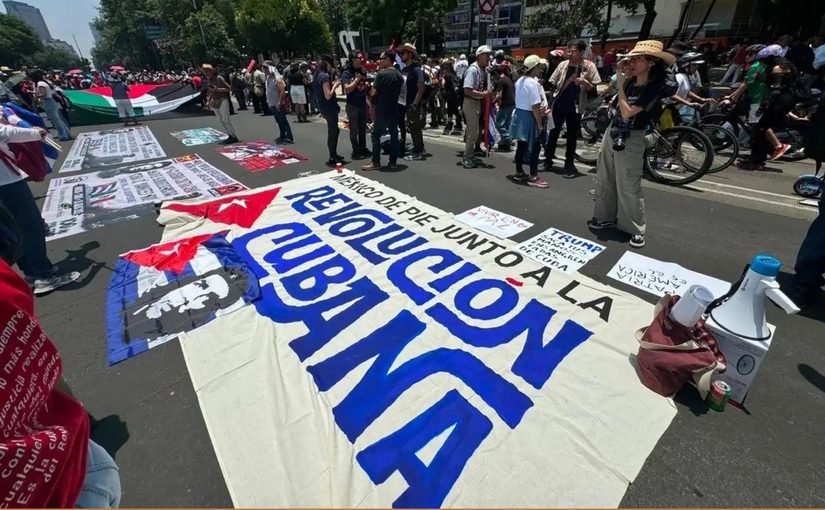
In the following article, Alice Walker and Salim Lamrani argue that Cuba deserves the world’s support, not least on account of its own record of internationalism: “Cuba has never failed in its duty of solidarity.”
The first example they give is: “Cuba was the first country in the Americas to recognise the People’s Republic of China in 1960, thereby breaking Beijing’s diplomatic isolation imposed by the United States in the Western Hemisphere. That same year, Havana urged the United Nations General Assembly to open its doors to the legitimate representatives of the Chinese people, rejecting the puppet regime of Chiang Kai-shek. Ten years later, beginning in 1970, Canada and Chile, as well as other countries on the continent, would follow the path charted by the island, officially recognising the legitimacy of Mao Zedong’s revolution. Thus, from the very beginning, the Caribbean island, despite mounting pressure, expressed its friendship toward the People’s Republic of China.”
They also cite the examples of Algeria, Angola, struggles against military dictatorships in Latin America, and training “tens of thousands of foreign professionals – including doctors, engineers, teachers, and technicians – from every continent. Cuba has also provided healthcare assistance in 165 countries, deploying a total of more than 600,000 healthcare professionals who have treated nearly two billion people and saved millions of lives. Even today, numerous Third World countries, as well as developed nations such as Italy, benefit from Cuban medical cooperation, which is crucial for preserving health care systems and protecting populations. At a time when the drums of war are beating everywhere, claiming tens of thousands of innocent victims – particularly in Gaza, where genocide continues to be perpetrated – Cuba continues to save human lives.”
And all this despite the fact that, “for more than six decades, the Cuban people have endured a relentless economic siege imposed by the United States, which constitutes the main cause of their suffering, the greatest violation of their human rights, and the primary obstacle to their development. Since the Trump administration returned to power in 2025, the island has been facing critical times due to the imposition of a medieval energy blockade and the proliferation of unilateral coercive measures that have triggered an unprecedented humanitarian crisis.”
Alice Walker is a long-time supporter of Cuba, a novelist, short story writer, poet, and social activist. In 1982, she became the first African-American woman to win the Pulitzer Prize for Fiction, which she was awarded for her novel ‘The Color Purple’. She has published seventeen novels and short story collections, twelve non-fiction works, and collections of essays and poetry.
Salim Lamrani is a French scholar and journalist and a long-time researcher on Cuba. He holds a PhD in Iberian and Latin American Studies from Sorbonne University and is Professor of Latin American History at the Université de La Réunion, specialising in relations between Cuba and the United States. Between 2018-2022 he also worked at the English Premier League football club Leeds United, first as interpreter for Marcelo Bielsa, the club’s Argentine manager, and later also as discipline coach, with responsibilities including overseeing conflict prevention, cultural projects and promoting positive values including through community outreach, such as providing help and support to homeless people in winter.
The following article was originally published in English in Resumen Latinoamericano, translated from its Spanish publication in La Jornada.
Since the triumph of the revolution in 1959, Cuba has made support for peoples fighting for their emancipation the cornerstone of its foreign policy, providing constant aid to nations of the Global South and to independence movements around the world. After breaking the chains of neocolonial domination by overthrowing the dictatorship of Fulgencio Batista, Fidel Castro made internationalism—that is, concrete support for just causes—a national priority. Despite its modest territorial size and limited resources, and despite the economic blockade imposed by Washington since 1960, Cuba has never failed in its duty of solidarity.
Cuba was the first country in the Americas to recognize the People’s Republic of China in 1960, thereby breaking Beijing’s diplomatic isolation imposed by the United States in the Western Hemisphere. That same year, Havana urged the United Nations General Assembly to open its doors to the legitimate representatives of the Chinese people, rejecting the puppet regime of Chiang Kai-shek. Ten years later, beginning in 1970, Canada and Chile, as well as other countries on the continent, would follow the path charted by the island, officially recognizing the legitimacy of Mao Zedong’s revolution. Thus, from the very beginning, the Caribbean island, despite mounting pressure, expressed its friendship toward the People’s Republic of China.
Opposed on principle to colonialism, Havana immediately offered its support to the cause of Algerian independence beginning in 1959, declaring before the United Nations its rejection of the subjugation of Africa’s largest country by colonial France. In 1961, Cuba became the first country in the Americas to officially recognize the provisional government of the Algerian Republic. That same year, the island sent a large shipment of weapons to the mujahideen of the National Liberation Front and took in wounded combatants and war orphans. In 1963, following Morocco’s invasion of Algeria, Cuba sent its best troops to repel the armed aggression, thereby helping to preserve the country’s territorial integrity. Also in 1963, the Cuban Revolution sent its first medical brigade to Algeria to care for a population that had suffered 132 years of colonial oppression.
In 1975, when Angola had only just won its independence, apartheid-era South Africa invaded the country with the aim of overthrowing the MPLA and installing a regime loyal to it. In response to Agostinho Neto’s urgent appeal, Fidel Castro launched Operation Carlota, sending tens of thousands of experienced combatants to repel the aggression and inflict the first defeat on the supremacist troops on African soil, irreversibly shattering the myth of the white army’s invincibility. In 1988, the decisive Battle of Cuito Cuanavale, led by the Cubans, dealt the final blow to the racist regime in Pretoria and led to the independence of Southern Africa and the collapse of apartheid, paving the way for the liberation of Nelson Mandela and the South African people.
For decades, Cuba served as a land of asylum for numerous activists fleeing persecution by U.S.-backed Latin American military dictatorships. The island welcomed thousands of political refugees, particularly from Chile, Argentina, Uruguay, Brazil, Paraguay, Bolivia, Guatemala, El Salvador, Honduras, Nicaragua, Haiti, and the Dominican Republic. All of them found protection on the revolutionary island, which provided them with housing, work, and access to education and healthcare.
Finally, since 1959, Cuba has trained tens of thousands of foreign professionals—including doctors, engineers, teachers, and technicians—from every continent. Cuba has also provided healthcare assistance in 165 countries, deploying a total of more than 600,000 healthcare professionals who have treated nearly two billion people and saved millions of lives. Even today, numerous Third World countries, as well as developed nations such as Italy, benefit from Cuban medical cooperation, which is crucial for preserving health care systems and protecting populations. At a time when the drums of war are beating everywhere, claiming tens of thousands of innocent victims—particularly in Gaza, where genocide continues to be perpetrated—Cuba continues to save human lives.
However, for more than six decades, the Cuban people have endured a relentless economic siege imposed by the United States, which constitutes the main cause of their suffering, the greatest violation of their human rights, and the primary obstacle to their development. Since the Trump administration returned to power in 2025, the island has been facing critical times due to the imposition of a medieval energy blockade and the proliferation of unilateral coercive measures that have triggered an unprecedented humanitarian crisis.
Revolutionary Cuba, so generous to the rest of the world, now faces an existential threat, without receiving support commensurate with the solidarity it has demonstrated for decades. The island’s many friendly nations around the world—particularly the most powerful ones—must come to the aid of the Cuban people, in the name of the sacred principle of gratitude.