In the following article, Marxist economist Michael Roberts examines the extraordinary week in which Nvidia’s Jensen Huang was forced out as chief executive amid claims of an affair with an alleged Chinese spy – only to be reinstated days later.
Michael notes that the move against Huang was driven by the US intelligence agencies and promoted by Secretary of State Marco Rubio and Treasury Secretary Scott Bessent – China hawks determined to strangle China’s economy and stop it catching up with the US in artificial intelligence. Selling chips to China, even indirectly, was anathema to them.
Donald Trump, however – fresh from the APEC summit in Shenzhen, where he met Xi Jinping and Vladimir Putin, and the owner of some $97 million worth of Nvidia shares – intervened to force the company’s board into an about-turn. Huang’s alleged spy turned out not to be a spy after all, and the sale of Nvidia chips via Singapore-based Megaspeed to Alibaba was declared perfectly acceptable. The episode left “egg on the faces of the China hawks – at least for now”, though, as Michael warns, “they will wipe that egg off and continue with their aim to weaken powers resistant to US imperial hegemony”.
The bulk of the article examines the deeper economic picture: a debt-fuelled AI investment bubble that the European Central Bank says has parallels with the subprime crisis, driven by circular financing between Nvidia and the AI labs, and built on a mountain of fictitious capital. Michael concludes that a slump is likely, potentially matching or surpassing the one that followed the dotcom bust.
Readers may also be interested in our previous coverage of the Nvidia affair by Gary Wilson (and again after Huang’s resignation) and by Sara Flounders.
This article first appeared on Michael Roberts’ blog.
They used to say that a week is a long time in politics – that aphorism can be applied to the US stock market in the last week.
It all started last Thursday when the world’s leading semiconductor chip maker, Nvidia, announced its quarterly earnings results. Investors were unimpressed and the stock headed for a seventh straight weekly loss, its longest losing streak since July 2008, and had by then lost about 35% of its value since the start of October.
And then came the bombshell. Nvidia announced that co-founder and largest shareholder Jensen Huang was resigning following reports of extramarital affairs, including one with an alleged Chinese spy. The Nvidia board made it firmly clear that Huang would not be coming back. The stock market plunged into what is called ‘correction’ territory (ie a fall of up to 10% in stock prices). Nvidia shares dropped even further (19%). Given that Nvidia is at the centre of the whole AI investment boom, providing all the semiconductor chips for the AI labs, Anthropic and OpenAI, and for the huge data centres being built by the so-called hyperscalers, stock market investors panicked and sold off.
And then after the weekend, on Monday morning it was announced that Huang was being reinstated as chief executive officer because the Nvidia board said it was satisfied with “Huang’s candour and leadership ability and, after receiving input from senior US government officials, saw no national security risk in his return.” Nvidia shares rocketed back up 35% and the Nasdaq tech stock index rolled back up over 7%. The AI bubble was restored.

What had happened was that Donald Trump, who owns $97m worth of Nvidia shares, intervened and told the Nvidia board to reverse their decision that earlier they adamantly had said they would not. Apparently Huang’s Chinese mistress was no spy after all. Moreover, Huang’s policy of quietly selling Nvidia chips to his mistress’ company Megaspeed, based in Singapore, which in turn sold them on to AliBaba, the Chinese version of Amazon, was perfectly ok. It did not break the US sanctions on selling chips to China; and it did not matter that Huang did this – at least according to Trump when he spoke in a lengthy telephone interview to the TV business channel, CNBC.
What is behind this rollercoaster of events? The move against Huang was inspired by the US intelligence bodies and promoted by US Secretary of State Marco Rubio and Treasury Secretary Scott Bessent. They are China hawks determined to strangle China’s economy, stop it catching up and so threatening US AI supremacy. Selling chips to China was anathema to the deep state and the anti-China ‘globalists’ in the US government. In contrast, Trump, having just returned from a ‘photo opportunity’ at the APEC summit, where he met his ‘friends’ Russia’s Putin and China’s Xi, was aghast at this manoeuvre by the hawks. Not only was he losing money as his Nvidia shares dived, but he is opposed to outright war with Russia and China, preferring, as always, some deal. He quickly forced an about turn by the Nvidia board, leaving egg on the faces of the China hawks – at least for now. They will wipe that egg off and continue with their aim to weaken powers resistant to US imperial hegemony.
So what now? In my view, this saga has ended up changing little or nothing. AI-related tech stocks have been declining for over six months already and particularly since October. Even before the Nvidia drama, AI computing cloud outfit CoreWeave was down by 70 per cent from its 12-month peak, Intel 61 per cent, Oracle 56 per cent, Micron 50 per cent. Even Alphabet and Meta are down 32 and 26 per cent respectively. The S&P 500 is up only 5% for the year—putting it on track for one of its weakest years in two decades—and heading for its longest losing streak since 2020.

The outcome of the issuance of shares to the public (IPO) by the AI ‘lab’ Anthropic was another indicator that the AI stock market boom has reached the top of the mountain. Anthropic raised roughly $81 billion in a world record initial public offering, pricing 980 million shares at $83 each for an estimated valuation of the company at about $1.5 trillion. In one day, the Anthropic share price rocketed to $117. And then just as quickly within another day it dived back to near its issue price.

Yes, the issue sale raised over $200bn in cash for the company to spend. And the Anthropic owners and employees became multi-millionares overnight.

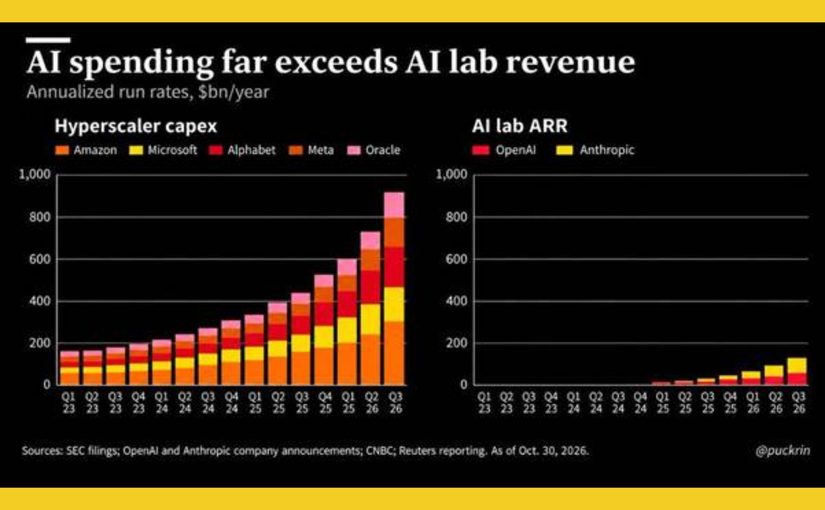
The cash is real, but the obligations to buy computing space, chips and data centres made by Anthropic over the next few years is way more. Its revenues from selling ‘tokens’ (computing units) to customers have been rising, but it is still making huge losses when contracted obligations are included ($104bn net loss for the first nine months of this year).

Anthropic has nearly $1trn in financial commitments and around $700bn of those commitments come due in the next five years. According to the Financial Times, Anthropic could need $602bn in annual revenue to deliver a 20% return on its investment. That’s 150% more than Meta’s annual revenue, 74% more than Microsoft’s, 28% more than Alphabet’s, 26% more than Apple’s. The required revenue is equal to 66% of the entire S&P 1500 software and IT services sector. So investors are betting that Anthropic can grow into one of the biggest revenue-generating companies in the world. If that revenue falls short, the losses for investors could be enormous, and the damage could spread across the AI market.
As I have shown in previous posts, the AI investment boom is increasingly financed by debt (loans from banks and other financial institutions) but also but what has now called ‘circular financing’ where the likes of Anthropic and OpenAI agree to buy a huge amount of chips to flll the data centres and run their AI models, but get credit to do so from the likes of Nvidia. Nvidia has become the centre of this circle of finance, obtaining obligations to pay for chips pushed into the future on the expectation that Anthropic and OpenAI will soon become hugely profitable, driven by demand from companies massively adopting their models and buying tokens to apply them in their businesses.
Indeed, the European Central Bank has recently warned that this global debt-fuelled AI investment boom has “parallels” with the subprime mortgage bubble that triggered the global financial crisis almost two decades ago. In its latest Financial Stability Review, the ECB warned that AI companies were amassing trillions of dollars in ‘off-balance-sheet’ commitments in addition to raising vast amounts of debt to fund development of the technology. “Big tech firms are estimated to have total off-balance-sheet commitments of more than $4tn as of the second quarter of 2026,” the report said, adding that this was “well in excess” of on-balance-sheet liabilities. The ECB said that it saw “historical parallels with the dotcom and subprime bubbles” and the risk of “spillovers” affecting euro area financial stability. “Even if AI as a technology successfully transforms the global economy, the credit-driven AI boom may result in overcapacity, capital misallocation and credit losses for investors,” the ECB warned. In other words, whatever the real contribution to economies that the AI technological revolution will achieve, right now there is just a huge amount of what Marx called ‘fictitious capital’ (ie. stocks and bonds) way more than any future real return can justify.
The AI bubble had already started to deflate and the return of Nvidia’s hero Huang will not stop the bubble bursting. After the dramatic drop and then recovery of the Nvidia share price, it has started to resume its slide.

As I posted in September on my blog, AI is the biggest bet in US economic history and at least for stock investors that bet is looking an increasingly bad one. History shows that financial bubbles typically don’t just deflate slowly, they collapse quite rapidly. If this fictitious AI stock market boom collapses, then it will hit the ‘real economy’ too.

If an economic recession or slump is coming, how severe will it be? Jason Furman is a former economic adviser to the US White House and provides useful facts and analysis on the US economy He does not see a severe slump ahead: “if there is a bubble that bursts, it will reduce economic growth by about 0.6 percentage point over the next year according to my preferred specification. The magnitude could be as large as 3.4 percentage points, but I view that happening solely through the wealth effect on consumption—the sole subject of this post—as a very remote tail risk.” Moreover, not every stock market crash leads to an economic recession – on the contrary.

Furman’s prediction, however, is based on two premises; first, that the stock market falls only 25% in the bust and second that it is only household consumption that falls in the ensuing slump. Furman’s first premise is optimistic given the history of the size of stock market slides; and the second ignores the key fact that it is productive investment and profits that fall in a slump while the impact on consumption is much smaller and even minimal. In each of the occasions where a stock market crash has accompanied an economic slump it has been because of a fall in profitability and an ensuing drop in productive investment.

AI investment in models, data centres, chips etc has now reached over 3.5% of US GDP. Just a halving of that investment spending would take 1.7% off US GDP growth (see here for a similar analysis by Brian Green). The US is currently expected to grow by little more than 2% in 2027. In addition, any fall in corporate profits and investment will lead to reduced employee income growth and consumption. Already, construction spending on AI data centres has peaked, while business investment in the rest of the economy is weak.

And forecasts are for a slowing of corporate profit growth from a mega rise of 33% this year to a more moderate 16% next year.

Stagnation at best, more likely a slump, is coming, perhaps not of the proportion of the Great Recession of 2008-9 or the pandemic slump of 2020, but still matching or surpassing the slump following the dot.com bust of 2000-1.
In my next post on AI, I shall review what will happen to the AI revolution after the crash.