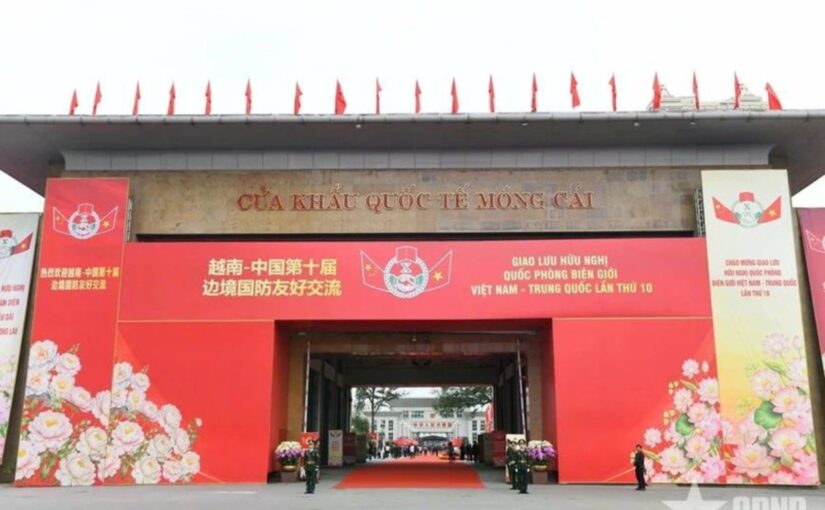
Following the First Ministerial Meeting of the China-Vietnam “3+3” Strategic Dialogue on Diplomacy, Defence and Public Security held in the Vietnamese capital Hanoi on March 16, Chinese Defence Minister Dong Jun led a programme of joint military-related activities with his Vietnamese counterpart Phan Van Giang.
The 10th Vietnam – China Border Defence Friendship Exchange got underway on March 18, launching a two-day programme aimed at strengthening defence cooperation between the two countries. Events were held in Vietnam’s Quang Ninh province on the first day and in China’s Guangxi Zhuang Autonomous Region the following day.
In Quang Ninh, activities began with a welcome ceremony for the Chinese defence minister at the Mong Cai International Border Gate. The two ministers then took part in a range of joint engagements, including a friendship tree-planting ceremony at the border gate, the start of work on a medical station in Hai Son commune, and visits to the Tran Phu High School and Tra Co Border Guard Station.
In China, the main activities included a welcome ceremony for the Vietnamese delegation at the Dongxing International Border Gate; a visit by the two defence ministers to a border guard company, where they also planted friendship trees; and the launch of a joint patrol and training exercise in the Gulf of Tonkin.
The two sides also visited an exhibition wall highlighting the starting point of the Ho Chi Minh Sea Trail, as well as local enterprises. In addition, they laid wreaths at a monument to fallen soldiers of the Vietnam – China people’s revolutionary forces, before a farewell ceremony for the Vietnamese delegation at the Dongxing International Border Gate.
Another highlight of this year’s exchange was the joint patrol and training exercise in the Gulf of Tonkin involving the two countries’ navies.
The two defence ministers held talks on March 18.
Reviewing a decade of the exchange since its launch in 2014, the Vietnamese minister described the mechanism as a bright spot in bilateral defence relations, evolving steadily in both scope and substance. Initially focused on military-to-military activities, the programme has expanded to include local authorities and mass organisations, with regular initiatives such as free medical services for border residents and cultural exchanges among communities and students on both sides. Notably, this year’s edition marks the first time the two navies have conducted joint training activities.
For his part, Dong expressed thanks to the Vietnamese Ministry of National Defence for its thorough preparations and warm reception. He noted that both ministers had recently participated in the first “3+3” strategic dialogue, where defence cooperation was a key topic of discussion. Affirming that relations between the two countries and their militaries have continued to grow stronger, Dong emphasised the need to expand exchanges to contribute to regional and global stability. Since its inception in 2014, the border defence friendship exchange has fostered goodwill and driven forward bilateral ties, while playing an important role in maintaining border security, he emphasised.
He added that the mechanism has increasingly expanded into new areas and deepened in substance, not only strengthening state-level relations but also promoting ties among border communities and facilitating trilateral exchanges involving Vietnam, Laos and China.
On March 19, the two ministers visited the Ho Chi Minh Trail at Sea historical site and the Fangchenggang International Medical Opening-up Pilot Zone.
The Ho Chi Minh Trail at Sea site, located at Fangcheng tourist port in China’s Guangxi, was built on April 30, 2015, in the shape of a lighthouse and features bilingual Chinese–Vietnamese inscriptions.
In March 1968, with approval from the Central Committee of the Communist Party of China, Fangchenggang launched the construction of a port under the codename “Guangxi Project 322” to support combat operations. The project opened a 35-nautical-mile secret sea route that pierced the US naval blockade, delivering vital supplies during Vietnam’s resistance against the US.
During 1972 – 1973, the route facilitated the shipment of 161,800 tonnes of aid to Vietnam through more than 1,000 ship voyages. Regarded as a maritime lifeline during Vietnam’s resistance war against the US, it earned the Vietnamese designation Ho Chi Minh Trail at Sea.
Secretary of the Fangchenggang municipal Party Committee Huang Jiang briefed the ministers on the port’s transformation from a wartime logistics hub to a modern open foreign trade facility. She expressed hope that the exchange activities would reinforce border and maritime security and stability while advancing bilateral cooperation and wider international linkages.
The zone showcases exhibition areas highlighting its master plan, layout, and ongoing partnerships with members of the Shanghai Cooperation Organisation and Association of Southeast Asian Nations (ASEAN) countries, along with key development milestones.
Another section focuses on traditional medicine and pharmacy, the Gulf of Tonkin and Shiwandashan region’s rich biodiversity in medicinal plants and animals, its geographic advantages, and the concept of food-medicine homology in ethnic traditions.
The two ministers also attended a wreath-laying ceremony at the memorial dedicated to fallen revolutionary soldiers of Vietnam and China, located in the China – Vietnam Friendship Park in Dongxing city.
The memorial honours 29 soldiers from both countries who sacrificed their lives during the joint struggle against French colonialism. This is one of the foremost institutions for patriotic education in the Guangxi Zhuang Autonomous Region, serving as a symbol of the longstanding solidarity and friendship between the two peoples.
Later the same morning, at Fangcheng Port in Guangxi, the ministers attended the launch of the 40th joint patrol and a joint training exercise in the Gulf of Tonkin between the Vietnam People’s Navy and the Chinese People’s Liberation Army Navy. They also visited a photo exhibition on previous joint patrols between the two navies.
Following these events, a joint patrol of border guards from the two countries was held on March 20.
At the event, commanders of both sides affirmed that the annual joint patrols between the Dien Bien Provincial Border Guard and the Mengzi Regional Border Guard reflect close coordination and stand out as a highlight in border external affairs, contributing to building a borderline of peace, friendship, cooperation and development.
At the end of the patrol, the two sides jointly carried out maintenance work on the tri-border marker of Vietnam, China and Laos, and held talks to review the outcomes. They agreed to continue maintaining effective information exchange via hotlines, while enhancing exchanges and coordination in border management and protection.
Both sides also stressed the need to strengthen cooperation in preventing and combating crimes such as illegal entry and exit, smuggling, human trafficking, and other violations of law, reaffirming their determination to jointly safeguard territorial sovereignty and border security for the peace and stability of people in border areas of the two countries.
The following articles were originally published by Nhân Dân.
10th Vietnam – China Border Defence Friendship Exchange kicks off with packed agenda
March 18 (Nhân Dân) – One of the highlights of this year’s exchange is the joint patrol and training exercise in the Gulf of Tonkin involving the two countries’ navies.
Activities under the 10th Viet Nam – China Border Defence Friendship Exchange officially got underway on March 18, launching a two-day programme aimed at strengthening defence cooperation between the two countries.
The exchange is taking place on March 18–19 in Viet Nam’s Quang Ninh province and China’s Guangxi Zhuang Autonomous Region.
The Vietnamese delegation is led by Politburo member, Deputy Secretary of the Central Military Commission and Minister of National Defence General Phan Van Giang, while the Chinese side is headed by Chinese Minister of National Defence Senior Lieutenant General Dong Jun. The two sides are participating in activities in Viet Nam on March 18 and in China on March 19.
In Quang Ninh, activities on March 18 began with a welcome ceremony for the Chinese defence minister at the Mong Cai International Border Gate (the demarcation line on Bac Luan Bridge I). The two ministers will then take part in a range of joint engagements, including a friendship tree-planting ceremony at the border gate, the sgtart of work on a medical station in Hai Son commune, and visits to the Tran Phu High School and Tra Co Border Guard Station.
They are also scheduled to hold official talks before a send-off ceremony for the Chinese delegation on Bac Luan Bridge II.
In China, the main activities scheduled for March 19 include a welcome ceremony for the Vietnamese delegation at the Dongxing International Border Gate; a visit by the two defence ministers to a border guard company, where they will also plant friendship trees; and the launch of a joint patrol and training exercise in the Gulf of Tonkin.
The two sides will also visit a commemorative stele, an exhibition wall highlighting the starting point of the Ho Chi Minh Sea Trail, as well as local enterprises. In addition, the delegations will lay wreaths at a monument to fallen soldiers of the Viet Nam – China people’s revolutionary forces, before a farewell ceremony for the Vietnamese delegation at the Dongxing International Border Gate.
One of the highlights of this year’s exchange is the joint patrol and training exercise in the Gulf of Tonkin involving the two countries’ navies. The Viet Nam People’s Navy has deployed a task group comprising frigates 015 Tran Hung Dao and 012 Ly Thai To from Brigade 162 under Naval Region 4 to take part in the joint activities with the Chinese People’s Liberation Army Navy.
The Viet Nam – China Border Defence Friendship Exchange is an annual important defence diplomacy activity held in border provinces of the two countries. Over time, it has continued to expand in both scope and depth, featuring a wide range of practical and meaningful activities. The programme holds significant political importance, with strong support from leaders at all levels and the public of both countries, as well as attention from the international community.
Through each edition, Viet Nam – China defence cooperation has recorded positive progress, helping to further deepen relations between the two countries and their militaries.
Vietnamese, Chinese defence ministers hold talks in Quang Ninh
March 18 (Nhân Dân) – Vietnamese Minister of National Defence General Phan Van Giang held talks with his Chinese counterpart Senior Lieutenant General Dong Jun in Quang Ninh province on March 18, within the framework of the 10th Viet Nam–China Border Defence Friendship Exchange.
Giang underscored the special significance of this year’s exchange, which takes place shortly after the inaugural ministerial-level “3+3” strategic dialogue between the foreign affairs, defence and public security ministers of the two countries, reflecting the role of both defence ministries in implementing common perceptions reached the two countries’ high-ranking leaders on defence cooperation and areas of collaboration agreed by the two defence ministries.
Expressing confidence in the success of the exchange, Giang said the series of practical and meaningful activities will serve as a highlight in bilateral external relations in the early months of 2026, contributing to friendship and collaboration between the two Parties, States and militaries.
Reviewing a decade of the exchange since its launch in 2014, the Vietnamese minister described the mechanism as a bright spot in bilateral defence relations, evolving steadily in both scope and substance. Initially focused on military-to-military activities, the programme has expanded to include local authorities and mass organisations, with regular initiatives such as free medical services for border residents and cultural exchanges among communities and students on both sides. Notably, this year’s edition marks the first time the two navies have conducted joint training activities.
Giang emphasised that the mechanism has become an important channel for dialogue between the two defence ministries, helping to concretise cooperation directions and reinforce defence ties as a pillar of bilateral relations. It has also promoted people-to-people exchanges, enhanced coordination among border protection forces and improved the capacity to jointly address emerging issues in a timely manner.
Looking ahead, the Vietnamese minister called for continued efforts to enhance the effectiveness of the exchange mechanism, ensuring it remains a substantive and influential platform. He also stressed the importance of strengthening communication efforts to amplify its impact and highlight messages of political trust and solidarity between the two countries. For his part, Dong expressed thanks to the Vietnamese Ministry of National Defence for its thorough preparations and warm reception. He noted that both ministers had recently participated in the first “3+3” strategic dialogue, where defence cooperation was a key topic of discussion.
Affirming that relations between the two countries and their militaries have continued to grow stronger, Dong emphasised the need to expand exchanges to contribute to regional and global stability. Since its inception in 2014, the border defence friendship exchange has fostered goodwill and driven forward bilateral ties, while playing an important role in maintaining border security, he assessed.
He added that the mechanism has increasingly expanded into new areas and deepened in substance, not only strengthening state-level relations but also promoting ties among border communities and facilitating trilateral exchanges involving Viet Nam, Laos and China.
On this occasion, the Chinese minister extended an invitation to his Vietnamese counterpart to attend this year’s Xiangshan Forum.
Later the same day, a farewell ceremony for the high-level Chinese defence delegation was held at the Mong Cai International Border Gate. The high-level Vietnamese defence delegation, led by General Giang, is scheduled to visit China on March 19 to continue exchange activities in the Guangxi Zhuang Autonomous Region.
10th Viet Nam – China border defence friendship exchange wraps up
March 19 (Nhân Dân) – Vietnamese Minister of National Defence Gen. Phan Van Giang and his Chinese counterpart, Sen. Lieut. Gen Dong Jun visited the “Ho Chi Minh Trail at Sea” historical site and the Fangchenggang International Medical Opening-up Pilot Zone on March 19, as part of the 10th Viet Nam-China border defence friendship exchange.
The “Ho Chi Minh Trail at Sea” site, located at Fangcheng tourist port in China’s Guangxi, was built on April 30, 2015, in the shape of a lighthouse and features bilingual Chinese–Vietnamese inscriptions.
In March 1968, with approval from the Central Committee of the Communist Party of China, Fangchenggang launched the construction of a port under the codename “Guangxi Project 322” to support combat operations. The project opened a 35-nautical-mile secret sea route that pierced the US naval blockade, delivering vital supplies during Viet Nam’s resistance against the US.
During 1972 – 1973, the route facilitated the shipment of 161,800 tonnes of aid to Viet Nam through more than 1,000 ship voyages. Regarded as a maritime lifeline during Viet Nam’s resistance war against the US, it earned the Vietnamese designation “Ho Chi Minh Trail at Sea”.
Secretary of the Fangchenggang municipal Party Committee Huang Jiang briefed the ministers on the port’s transformation from a wartime logistics hub to a modern open foreign trade facility. She expressed hope that the exchange activities would reinforce border and maritime security and stability while advancing bilateral cooperation and wider international linkages.
At the pilot zone, the two ministers received an overview of progress in medical services, pharmaceuticals, and healthcare innovation. They experienced traditional Chinese medicine therapies, enjoyed a tea art performance, sampled tea, and light refreshments made with medicinal herbs.
The zone showcases exhibition areas highlighting its master plan, layout, and ongoing partnerships with members of the Shanghai Cooperation Organisation and ASEAN nations, along with key development milestones.
Another section focuses on traditional medicine and pharmacy, the Gulf of Tonkin and Shiwandashan region’s rich biodiversity in medicinal plants and animals, its geographic advantages, and the concept of food-medicine homology in ethnic traditions.
Later that day, a farewell ceremony for the high-ranking Vietnamese delegation took place at the Dongxing international border gate, concluding the exchange.
Viet Nam, China defence ministers visit border unit, launch joint naval patrol
March 19 (Nhân Dân) – Chinese Minister of National Defence Senior Lieutenant General Dong Jun presided over an official welcoming ceremony for the Vietnamese delegation at the Dongxing International Border Gate in China.
The two ministers later visted the Dongxing Border Guard Company in Dongxing city of the Guangxi Zhuang Autonomous Region, about 5 km from the Dongxing International Border Gate.
At the unit, the officials were briefed on its functions and tasks, toured facilities, planted friendship trees and observed a friendly badminton match between the two militaries. The Vietnamese Ministry of National Defence took the occasion to present gifts to officers and soldiers of the company.
The visit highlighted the growing practical cooperation between the two countries’ border guard forces. In recent years, the two sides have maintained regular exchanges at all levels, friendship activities, and mechanisms such as hotlines, correspondence and on-site talks. Joint patrols and coordinated control measures in key areas have been conducted regularly, helping enhance mutual trust and cooperation, and maintaining peace and stability along the shared border.
After that, the two ministers attended a wreath-laying ceremony at the memorial dedicated to fallen revolutionary soldiers of Viet Nam and China, located in the China – Viet Nam Friendship Park in Dongxing city.
The memorial honours 29 soldiers from both countries who sacrificed their lives during the joint struggle against French colonialism. This is one of the first institutions for patriotic education in the Guangxi Zhuang Autonomous Region, serving as a symbol of the longstanding solidarity and friendship between the two peoples.
Later the same morning, at Fangcheng Port in Guangxi, the ministers attended the launch of the 40th joint patrol and a joint training exercise in the Gulf of Tonkin between the Viet Nam People’s Navy and the Chinese People’s Liberation Army Navy. They also visited a photo exhibition on previous joint patrols between the two navies.
The joint patrol forms part of a cooperation mechanism established under a 2005 agreement on joint patrols in the Gulf of Tonkin. Since 2006, the two navies have organised 39 joint patrols and multiple at-sea training activities, helping deepen defence cooperation, strengthen friendship and mutual trust, and improve the capacity to respond to maritime security risks.
The two ministers then toured China’s Naval Ship 568 and Viet Nam’s Naval Ship 015, and met with their commanders, officers and sailors.
During the joint patrol, the Vietnamese Navy deployed vessels 015 and 012, while the Chinese side dispatched ships 568 and 627. They are scheduled to patrol eight routes covering nine designated points, with a total sailing distance of 247 nautical miles over 28 hours.
The two sides will conduct a range of training activities, including formation manoeuvres, maritime escort, signal light communication, anti-piracy drills (with live fire using light weapons), search and rescue, and damage control.
The joint patrol mechanism has helped maintain security and order in the Gulf of Tonkin, enhance the two navies’ ability to respond to non-traditional security challenges, and strengthen mutual trust and understanding between the naval forces and the two militaries in general, thereby contributing to the Viet Nam – China friendship.
Vietnamese, Chinese border guards kick off 2026 joint patrol
March 20 (Nhân Dân) – Delegations from Viet Nam’s Dien Bien Provincial Border Guard and China’s Mengzi Regional Border Guard of the Chinese People’s Liberation Army on March 20 jointly held a ceremony to launch the 2026 bilateral patrol at Border Marker No. 3 along the Viet Nam–China border.
At the event, commanders of both sides affirmed that the annual joint patrols between the Dien Bien Provincial Border Guard and the Mengzi Regional Border Guard reflect close coordination and stand out as a highlight in border external affairs, contributing to building a borderline of peace, friendship, cooperation and development.
After the ceremony, patrol forces from the A Pa Chai Border Guard Station under the Dien Bien Provincial Border Guard and the Jinping Meeting Point under the Mengzi Regional Border Guard coordinated to conduct a joint patrol along the section from Marker No. 3 to the tripoint where the borders of Viet Nam, China and Laos meet.
During the patrol, officers and soldiers of both sides coordinated to clear patrol routes, clean and tidy up areas surrounding border markers, and promptly exchange information on the security and order situation in border areas. Inspection results showed that the borderline and marker system remained intact, with no signs of violations of border regulations, and that security in the area was stable.
At the end of the patrol, the two sides jointly carried out maintenance work on the tri-border marker of Viet Nam, China and Laos, and held talks to review the outcomes. They agreed to continue maintaining effective information exchange via hotlines, while enhancing exchanges and coordination in border management and protection.
Both sides also stressed the need to strengthen cooperation in preventing and combating crimes such as illegal entry and exit, smuggling, human trafficking, and other violations of law, reaffirming their determination to jointly safeguard territorial sovereignty and border security for the peace and stability of people in border areas of the two countries.