The future of China-Cuba economic relations

In this interesting article for CGTN, Alessandro Golombiewski Teixeira (former special economic advisor to the president of Brazil during Dilma Rousseff’s administration) assesses the results of the recent state visit by Cuban president Miguel Díaz-Canel to China in terms of trade and investment.

Noting that revolutionary Cuba was the first government in Latin America to establish relations with the People’s Republic of China, Teixeira writes that “this visit carries more than a traditional friendship visit between two comrades and leaders of communist parties. The Cuba-China relationship goes beyond good friends and good comrades for they have been joining hands on the socialist path, supporting each other on core interests, coordinating closely on international and regional issues, setting a model of solidarity between socialist countries and cooperation between developing countries.”

The author observes that the two countries already have significant and growing economic relations, and that Cuba is China’s second-largest trading partner in the region (after Venezuela). With Cuba going through very difficult times as a result of the pandemic, the tightened US blockade, and a sequence of natural disasters and accidents, Díaz-Canel’s visit will set the scene for a deepening of trade, aid and investment, “helping Cuba to overcome the most difficult situation faced in recent history… Only with the help of friendly countries as China, Cuba has a chance to overcome the US embargo and prosper as a nation.”

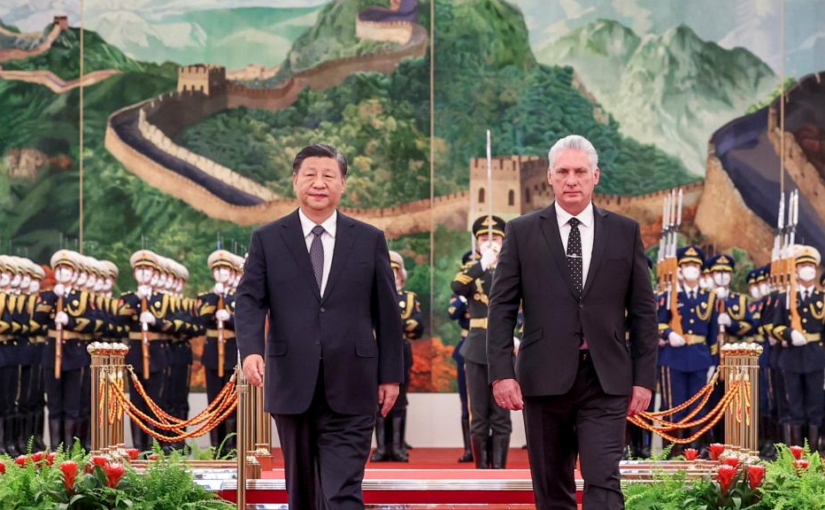
Cuban President Miguel Diaz-Canel Bermudez has embarked on a two-day visit to China at the invitation of the General Secretary of the Communist Party of China (CPC) Central Committee and Chinese President Xi Jinping. Diaz-Canel is the first head of state from Latin America and the Caribbean region to visit China after the 20th CPC National Congress. It’s important to highlight that this visit carries more than a traditional friendship visit between two comrades and leaders of the communist parties. The Cuba-China relationship goes beyond good friends and good comrades for they have been joining hands on the socialist path, supporting each other on core interests, coordinating closely on international and regional issues, setting a model of solidarity between socialist countries and cooperation between developing countries.

The origins of the bilateral relations have begun during the Qing Dynasty (1644-1911) when a representative was established in Havana while Cuba was still a colony of Spain in 1879. In 1902, the Qing Dynasty recognized the independence of the Republic of Cuba from the United States, which had taken it from Spain in 1898. On the other hand, in 1960, the new revolutionary government in Cuba established diplomatic relations with People’s Republic of China (PRC), but with the exception of Chile (1970), most other Latin American governments did not recognize the PRC until then U.S. President Richard Nixon’s 1972 visit to Beijing signaled that the world’s alliances were changing. Argentina and Mexico recognized the PRC that year, followed by Brazil in 1974 and Bolivia in 1985.

Continue reading The future of China-Cuba economic relations

Cuban president Miguel Díaz-Canel to visit China

Cuban President Miguel Díaz-Canel Bermudez is due to arrive in Beijing on Thursday 24 November, the last stop of an international trip that has so far taken him to Russia, Algeria and Türkiye. Díaz-Canel is the first head of state from Latin America and the Caribbean to visit China following the recent National Congress of the CPC. It is notable that two leaders of socialist countries, Díaz-Canel and Nguyen Phu Trong, are among the first world leaders to carry out state visits to China following the Congress.

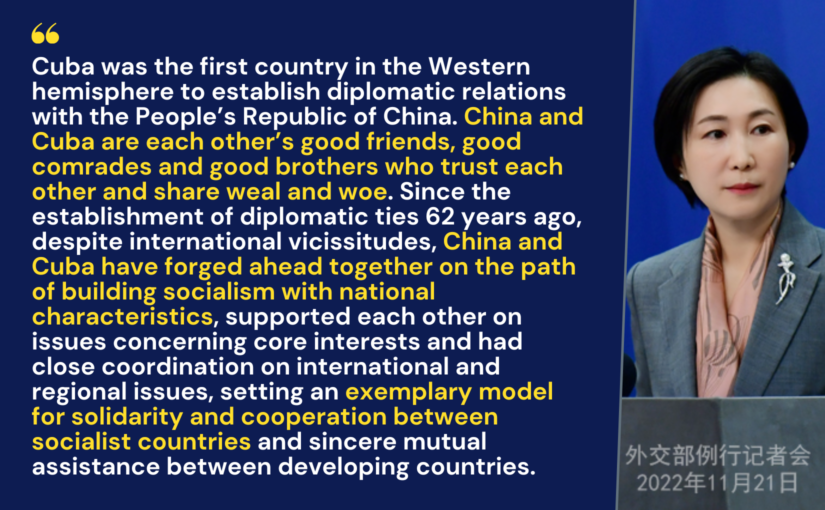
Commenting on the Cuban leader’s impending visit, Foreign Ministry spokesperson Mao Ning said on 21 November: “China and Cuba are good friends, good comrades and good brothers. They join hands on the socialist path, support each other on core interests, coordinate closely on international and regional issues, setting a model of solidarity of socialist countries and cooperation between developing countries.”

Cuba has consistently stood up in international forums against the politicisation of human rights and the attempts to interfere in China’s internal affairs. Likewise, China has been outspoken in its opposition to the criminal blockade imposed by the US on Cuba. Undoubtedly, Miguel Díaz-Canel’s state visit to China will serve to further strengthen the economic, diplomatic and cultural links between these two fraternal socialist countries.

We publish below an article by Zhang Han in the Global Times outlining the key issues in China-Cuba relations.

At the invitation of General Secretary of the Communist Party of China (CPC) Central Committee and Chinese President Xi Jinping, First Secretary of the Central Committee of the Communist Party of Cuba and Cuban President Miguel Diaz-Canel Bermudez will pay a state visit to China from Thursday to Saturday.

Diaz-Canel will be the first foreign leader to visit China after Xi returned from a diplomatic whirlwind at the G20 Leaders’ Summit in Indonesia and the Asia-Pacific Economic Cooperation (APEC) meetings in Thailand. 

Xu Shicheng, a research fellow at the Institute of Latin American Studies at the Chinese Academy of Social Sciences, told the Global Times the visit not only carries traditional friendship of the two countries, but also reflected close bonds between the two parties. 

China and Cuba are good friends, good comrades and good brothers. They join hands on the socialist path, support each other on core interests, coordinate closely on international and regional issues, setting a model of solidarity of socialist countries and cooperation between developing countries, Mao Ning, a spokesperson of China’s Foreign Ministry, said at a routine press briefing on Monday. 

Continue reading Cuban president Miguel Díaz-Canel to visit China

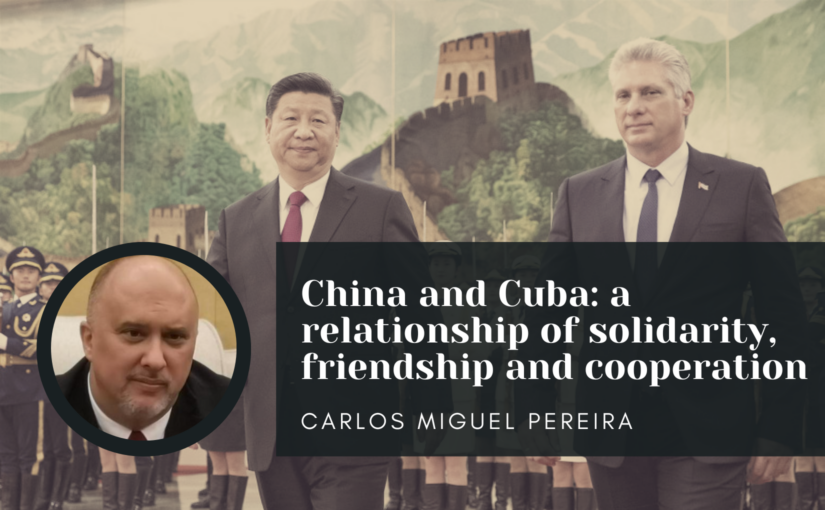
China and Cuba: a relationship of solidarity, friendship and cooperation

We are very pleased to publish below an interview with Carlos Miguel Pereira Hernández, Cuba’s ambassador to China, conducted by People’s Daily and published in Chinese on 13 October. The unabridged English translation has been provided to us by the Cuban Embassy in Beijing.

Timed to coincide with the 62nd anniversary of the establishment of diplomatic relations between the Republic of Cuba and the People’s Republic of China, the interview gives an overview of the history and contemporary reality of relations between the two countries.

Noting that revolutionary Cuba was the first country in the Western hemisphere to extend diplomatic recognition to the People’s Republic of China – in 1960, just a year after the 26th of July Movement came to power – Pereira references the role played by Chinese immigrants in Cuba’s independence struggle. He points out that Cuba and China consider themselves “mutual referents in the construction of socialism with our own characteristics” and notes that President Miguel Díaz-Canel describes Cuba-China ties as “paradigmatic”, and President Xi Jinping describes them as those of “good friends, good comrades and good brothers”.

Describing the cooperation between China and Cuba fields in a vast array of fields, Comrade Pereira expresses confidence that the relationship will continue to deepen.

This year marks the 62nd anniversary of the establishment of diplomatic relations between China and Cuba, how do you assess the fraternal friendship between the two countries? What are your specific plans to further promote economic, trade and people-to-people exchanges between the two countries?     

Relations between Cuba and China were made official on September 28, 1960, a formal step after the announcement by Commander in Chief Fidel Castro a few days earlier in front of more than a million Cubans, in the context of the historic First Declaration of Havana, to recognize the New China and rescind ties with Taiwan. That just decision was born of the political and popular will that have accompanied our relations throughout these 62 years.

The nascent Cuban Revolution definitively broke with the Monroe Doctrine and blind obedience to Washington, allowing Cuba to become the first country in the entire Western Hemisphere to establish ties with New China. We are honored to have made that modest contribution as one of the first manifestations of independence from our foreign policy.

The historical foundations and deep bonds of friendship between our peoples go back to the arrival of those first Chinese immigrants 175 years ago, who also had an outstanding and glorious participation in our struggles for independence.

Throughout these years of uninterrupted relations, Cuba has had the historic privilege of always being in the front row in promoting exchanges with China. Our relations represent a model of cooperation based on equality, respect and mutual benefit. We consider ourselves mutual referents in the construction of socialism with our own characteristics and on that basis, we carry out a broad and systematic exchange of experiences.

Continue reading China and Cuba: a relationship of solidarity, friendship and cooperation

China and Cuba: “faithful friends with unbreakable ties”

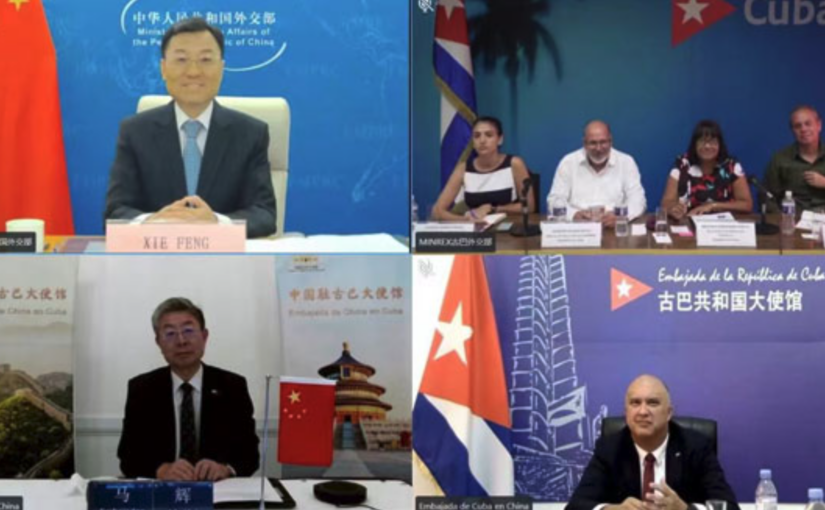
The special friendship between socialist China and socialist Cuba was underlined in an August 23 video call between Vice Foreign Minister Xie Feng and Deputy Foreign Minister Anayansi Rodriguez Camejo. 

Comrade Xie pointed out that China and Cuba are “faithful friends with unbreakable ties, and tested friends devoted to each other and as close as brothers.” He observed that they “have forged ahead hand in hand on the path of building socialism with their own characteristics, supported each other on issues concerning respective core interests, and collaborated closely on international and regional issues, setting a good example of sincerity and mutual support between developing countries and solidarity and cooperation between socialist countries.”

China, he continued, “always views and develops the special friendly relations between the two parties and the two countries from a strategic and overall perspective, and always places China-Cuba relations as special in its overall diplomacy.”

For his part, Comrade Rodriguez thanked the Chinese side for extending condolences and providing emergency humanitarian assistance to Cuba right after the explosions at an oil storage facility in Cuba recently. He stressed that Cuba and China are good friends, good comrades and good brothers, with the two parties and two countries enjoying special friendly relations.

The below report was originally carried on the website of the Chinese Foreign Ministry.

On August 23, 2022, Vice Foreign Minister Xie Feng and Cuban Deputy Foreign Minister Anayansi Rodríguez Camejo held political consultation between Chinese and Cuban Foreign Ministries via video link. The two sides exchanged in-depth views on China-Cuba relations and international and regional issues of common concern.

Xie Feng said that Cuba is the first country in the western hemisphere to establish diplomatic relations with New China and has been taking the lead in developing relations with China in the Latin American region. China and Cuba are faithful friends with unbreakable ties, and tested friends devoted to each other and as close as brothers. Over the past 60 plus years since the establishment of diplomatic relations, in the face of the evolving international landscape, China and Cuba have forged ahead hand in hand on the path of building socialism with their own characteristics, supported each other on issues concerning respective core interests, and collaborated closely on international and regional issues, setting a good example of sincerity and mutual support between developing countries and solidarity and cooperation between socialist countries.

Xie Feng said that President Xi Jinping had twice conversations with President Miguel Diaz-Canel last year, charting the course for the relations between the two parties and between the two countries. China always views and develops the special friendly relations between the two parties and the two countries from a strategic and overall perspective, and always places China-Cuba relations as special in its overall diplomacy. China is unswervingly committed to deepening the friendship that devotes to each other, to carrying out mutually beneficial and win-win cooperation, and to being a partner for reform and development. The Chinese side highly appreciates Cuba’s firm support for China on issues related to Taiwan, Xinjiang, Xizang and human rights, among others, and will, as always, support Cuba in its just struggle to safeguard sovereignty and against interference. For the next stage, the two sides should follow the important consensus reached by the two heads of state, deepen political mutual trust, advance practical cooperation, strengthen multilateral coordination, and constantly consolidate and develop the special friendly relations between China and Cuba.

Xie Feng briefed the Cuban side on the great significance of the upcoming 20th National Congress of the Communist Party of China (CPC) and elaborated on the Global Development Initiative (GDI) and the Global Security Initiative (GSI). He said that China is ready to work with Cuba to step up exchanges of experience in party governance and state administration, jointly promote global development, safeguard world peace and tranquility, advance the socialist cause together, and promote the building of a community with a shared future for mankind.

Rodríguez thanked the Chinese side for extending condolences and providing emergency humanitarian assistance to Cuba right after the explosions at an oil storage facility in Cuba recently. He stressed that Cuba and China are good friends, good comrades and good brothers, with the two parties and two countries enjoying special friendly relations. He sincerely wishes othe 20th National Congress of the CPC a successful convening. Rodríguez said that under the strategic guidance of the two heads of state, Cuba and China have continuously deepened political mutual trust and maintained close collaboration on international and multilateral occasions over the past years. Cuba always prioritizes Cuba-China relations in its foreign relations, and stands ready to work with China to follow the course charted by the top leaders of the two parties and two countries, further strengthen high-level exchanges, join hands to advance the Belt and Road cooperation, jointly promote the implementation of the GDI and the GSI, unswervingly deepen exchanges and cooperation in various fields, and constantly push for new progress in Cuba-China relations.

Rodríguez reiterated that Cuba firmly supports the one-China principle, unconditionally supports China on the Taiwan question, strongly condemns any acts that attempt to undermine China’s national sovereignty and territorial integrity, and firmly opposes interference by external forces.

Xie Feng stressed that non-interference in internal affairs is a “golden rule” that must be abided by in state-to-state exchanges and the essential safeguards for the very survival of developing countries. China’s firm countermeasures are a legitimate, necessary, and legal response to Nancy Pelosi’s visit to Taiwan. They are aimed at stopping the United States’ attempt to use Taiwan to contain China, shattering the Taiwan authorities’ illusion to pursue Taiwan independence by soliciting the support of the United States, and safeguarding China’s core interests. By so doing, China is also upholding the principles of international law, the basic norms governing international relations and the international order, maintaining regional peace and stability, and safeguarding the common interests of developing countries.