New Zealand foreign minister’s racist outburst damages relations with China

A July 29 racist incident in the New Zealand parliament has served to further sour the country’s once cordial relations with China.

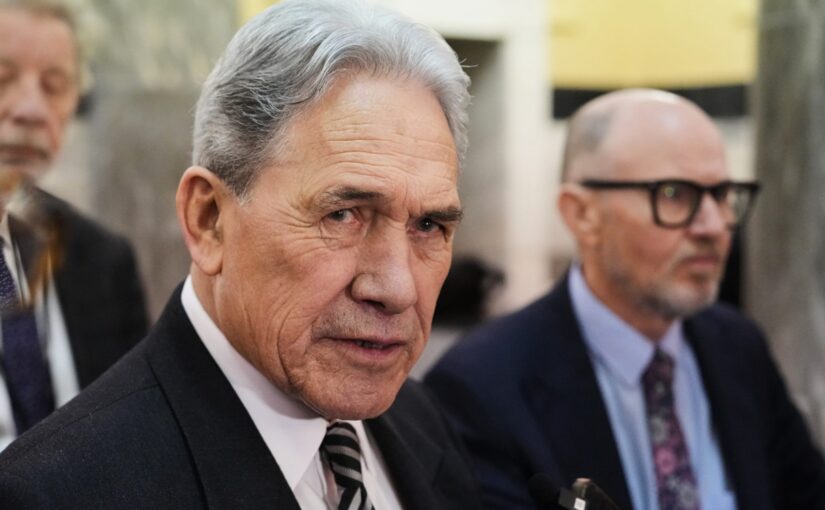
That day Green Party MP Dr. Lawrence Xu-Nan heckled Foreign Minister Winston Peters about his vaccination status during a parliamentary debate. Peters responded by shouting: “I know you just came here five minutes ago. Go back where you come from, you loud mouth!”

Writing in his Solidarity blog, Eugene Doyle notes: “For the record Xu-Nan, born in Tianjin, China, arrived in New Zealand as a child in the 1990s. He is the Green Party’s first Chinese MP and says he ‘hopes to create bridges across various tauiwi [ethnically diverse] communities and bring together the collective wisdom of these communities to find solutions to the bigger challenges facing Aotearoa [New Zealand].”

In contrast, he continues, “in the space of 30 seconds, the undiplomatic foreign minister racially insulted a fellow MP, derided the Chinese government, cast slurs on immigrants and rehearsed talking points better suited to a MAGA rally in Eastern Kentucky than the New Zealand Parliament.”

He adds that “his insult to the ambassador and the Chinese system of government is gratuitous and will not be welcome in Beijing where New Zealand’s share price has been dropping sharply since the [Christopher] Luxon government ramped up both anti-China rhetoric and moved rapidly to more deeply integrate with the US military. Ludicrously, the PM simultaneously says he wants to double trade with China!”

Bianca Ranson of Anti-War Aotearoa, which advocates for a more respectful engagement with China, said Peter’s comments were deliberately insulting to China and the Chinese people. “He’s not fit to be foreign minister. At a time when tensions are heightened around immigrants and racism, we have Winston Peters reaching for the far-right playbook, emboldening racists and giving them an example of how to treat others. New Zealand’s support for Israel has already damaged our standing in the world and this just underlines that something has gone seriously wrong.”

New Zealand has long had good political and thriving economic relations with China, especially when the New Zealand Labour Party was in office, but these have deteriorated sharply since Labour lost the November 2023 general election.

China’s public response to Peters’ outburst was extremely measured. A spokesperson for the Chinese Embassy, referring to him only as “a certain politician”, “urged the New Zealand side to value the equal and mutually beneficial relationship between China and New Zealand and to do more things conducive to bilateral relations rather than the other way around,” adding that the, “absolute majority… of the Chinese community in New Zealand abide by local laws, actively integrate into the mainstream society, and have made important contributions to New Zealand’s economic and social development, and therefore deserve to be recognised and respected.”

However, China was less restrained when, shortly after, Peters unsuccessfully attempted to cajole the countries of the South Pacific, meeting at the Pacific Islands Forum Foreign Ministers’ Meeting in the Fijian capital Suva, into condemning a recent missile launch by China.

An article carried on the embassy website said that Peters had turned the meeting, “into a stage for his own political performance, pushing hard for the forum to issue a joint statement on China’s test launch of a strategic missile by a submarine last month. Before the meeting, Peters had accused Pacific Island countries of ‘missing an opportunity’ by failing to collectively criticise China… However, the outcome delivered Peters a resounding slap in the face. Pacific Island countries clearly showed little interest in the agenda he promoted, and no joint statement was adopted…

“In recent years, New Zealand has echoed Australia in hyping up the so-called ‘China security threat’, treating the South Pacific as its own sphere of influence and repeatedly pointing fingers at Pacific Island countries’ diplomatic choices. Whenever a country carries out normal economic, trade or security cooperation with China, it is immediately stigmatised as being ‘influenced by those outside the region’.

“As a close follower of the US and Australian camp, New Zealand, despite knowing that the majority of Pacific Island countries hold different views, still attempted to force through a statement targeting China, even at the cost of creating divisions among regional countries. At its core, this was an attempt to consolidate its regional discourse power by aligning with the geopolitical strategies of external powers and seeking to become the ‘regional decision-maker’.”

A third statement by the embassy, issued on August 14, responded to the New Zealand Security Intelligence Service (NZSIS) release of its report entitled ‘New Zealand’s Security Threat Environment 2026’. It stated:

“Steeped in Cold War mentality, the report once again fabricates and hypes the so-called ‘China interference’ and ‘China threat’ narratives. Its false allegations against China either smear normal exchanges and cooperation as so-called espionage or interference or are entirely groundless and fabricated out of thin air. We firmly oppose this and will never accept it.”

It added that it formed “part of a new wave of attacks, slander and vilification against China orchestrated by certain international forces and may well itself be a product of foreign interference.

“It also reflects the reluctance of certain forces, both within and outside New Zealand, to see the sound development of China-New Zealand relations. By resorting to every possible means to fabricate disinformation, they seek to drive a wedge between our two peoples, create a chilling effect on the public including the Chinese community, undermine bilateral mutual trust, and obstruct the growth of the relationship — all in service of their own geopolitical agendas and the narrow, short-sighted political interests of a few…

“Our message to those forces and individuals attempting political machinations is this: do not sacrifice the hard-won, mutually beneficial China-New Zealand relationship for selfish gain, and do not act against the interests of New Zealand and its people. Serving as a pawn for anti-China forces will ultimately backfire. Manufacturing distractions in foreign relations will not solve New Zealand’s own problems — it will only prove counterproductive. We urge these forces and individuals not to quench their thirst with poison, and not to lift a rock only to drop it on their own feet.

“China values its relationship with New Zealand. We stand ready to work with the New Zealand side, on the basis of the consensus reached between the leaders of our two countries, to advance exchanges and cooperation across the fields of political mutual trust, practical cooperation and people-to-people ties, for the greater benefit of both peoples.

“That said, the development of China-New Zealand relations is not up to China’s efforts alone. We hope the New Zealand side will work in the same direction as China, rather than the opposite. Should it fail to do so, the responsibility for any consequences that may arise will not rest with the Chinese side.”

Continue reading New Zealand foreign minister’s racist outburst damages relations with China
First Nations and Chinese migrant workers pioneered Australia-China people-to-people links

For the last nearly six months, a landmark exhibition at the National Museum of Australia in the capital Canberra has been reminding visitors that Indigenous-Chinese bonds helped forge the links between the two peoples long before the two countries established diplomatic relations in 1972.

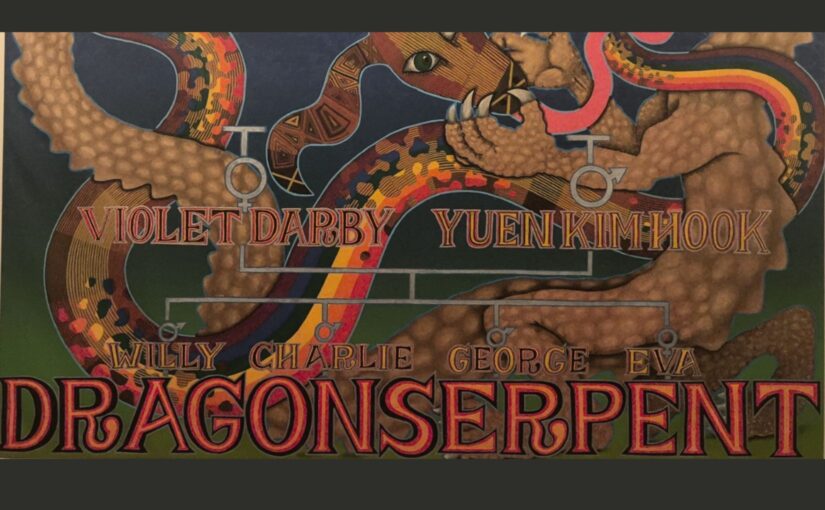
Our Story: Aboriginal–Chinese People in Australia, is the fruit of a five-year research project led and curated by Chinese-Australian artist Zhou Xiaoping and shows how mixed heritage communities wove ties of survival and solidarity on nineteenth century goldfields and in pearling camps. Drawing on historical records and oral histories, Our Story challenges monolithic accounts of Australian history.

During the gold rushes and in industries such as pearling, railways, and agriculture (1850s–1900), Chinese labourers settled across northern Australia and many formed relationships with Aboriginal women, in the face of the White Australia policy and other racist legislation that targeted both peoples.

These families blended Chinese traditions – language, cuisine, festivals – with Aboriginal kinship and cultural practices. “I’m Aboriginal, but I’m also proud of my Chinese heritage,” says Peter Yu, whose family photographs in the exhibition tell the story of how his Hakka father and Yawuru mother raised nine children under restrictive cohabitation laws, similar to those of apartheid South Africa.

Survival often demanded ingenuity. In the 1930s, Wen Liqun registered her Larrakia stepson – her Chinese husband’s son with a Larrakia woman – as “Chinese” to shield him from the Stolen Generations. (According to Wikipedia: “The Stolen Generations [also known as Stolen Children] were the children of Australian Aboriginal and Torres Strait Islander descent who were removed from their families by the Australian federal and state government agencies and church missions, under acts of their respective parliaments. The removals of those referred to as ‘half-caste’ children were conducted in the period between approximately 1905 and 1967, although in some places mixed-race children were still being taken into the 1970s. Official government estimates are that in certain regions between one in ten and one in three Indigenous Australian children were forcibly taken from their families and communities between 1910 and 1970. The Bringing Them Home Royal Commission report [1997] described the Australian policies of removing Aboriginal children as genocide.”)

In the article published below, which was originally published on the website of the Australian Institute of International Affairs, Dr. Marina Yue Zhang, an associate professor at the Australia-China Relations Institute, University of Technology Sydney (UTS: ACRI), writes:

“As the exhibition prepares to tour China in 2026, it forces a reckoning: how does a nation reconcile its suppressed histories with its multicultural present? By reconnecting with these hidden roots – embodied in everyday objects and intimate stories – Australia may yet forge its most resilient, relational partnership with China and its people.

“‘In an age of tariff wars and tech sanctions,’ says Dr. Jilda Andrews, curator of the museum, ‘Our Story isn’t just an exhibition. It’s a milestone in putting First Nations voices at the centre – creating a space for truth-telling, listening and honest conversation.’”

As the exhibition prepares to move on to China next year, readers in Australia still have until 27 January 2026 to see it at Canberra’s National Museum of Australia.

As Australia marked Reconciliation Week (27 May – 3June ), a landmark exhibition at the National Museum of Australia reminds us that Indigenous–Chinese bonds helped forge the links between the two peoples long before Canberra and Beijing formalised diplomacy in 1972.

Our Story: Aboriginal–Chinese People in Australia, a five-year research project led and curated by Chinese-Australian artist Zhou Xiaoping, uncovers a legacy of resilience and cultural fusion. Mixed-heritage communities—unwitting pioneers of people-to-people diplomacy—wove ties of survival and solidarity on 19th-century goldfields and in pearling camps. Drawing on historical records and oral histories, their stories—Our Story, the untold narratives of the nation—challenge monolithic accounts of Australian history and reveal a premodern form of “soft power.

Through videos, installations, and embedded texts in family trees and photographs, the exhibition invites contemporary Aboriginal artists to interpret these “our stories.” Together, they illuminate the accidental diplomacy of Chinese men and Aboriginal women who built communities against the odds.

Continue reading First Nations and Chinese migrant workers pioneered Australia-China people-to-people links

China-Australia relations take major step towards a return to normality

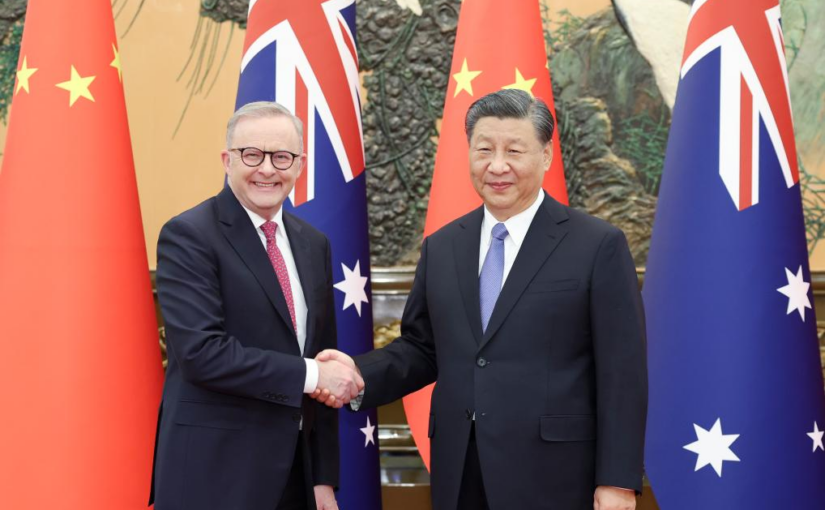
Relations between China and Australia took a major step towards a return to normality with a November 4-7 visit by Prime Minister Anthony Albanese at the invitation of his Chinese counterpart Li Qiang. The visit ended the effective freeze on high-level exchanges between the two countries, as a result of the adoption of anti-China policies by right-wing governments in Canberra, and follows the return to office of the Australian Labor Party, led by Albanese, in the May 2022 general election.

Meeting Prime Minister Albanese on November 6, Chinese President Xi Jinping said that China and Australia have embarked on the right path of improving relations. He noted:

“This year marks the 50th anniversary of the visit by Australian Prime Minister Gough Whitlam. Your visit is a journey to retrace history and plan for the future. Thanks to the joint efforts of both sides, China and Australia have resumed exchanges in various fields and embarked on the right path of improving relations.”

Xi said China and Australia are both Asia-Pacific countries and important members of the G20, with no historical grievances or fundamental conflicts of interest, but every reason to be partners of mutual trust and mutual achievement, calling on the two sides to keep to the right direction of bilateral relations amid the profound changes in the world.

In the stormy waters of the global crisis, countries are not riding on more than 190 small boats, but instead on a big boat with a common destiny, he added.

China and Australia should follow the trend of the times, proceed from the common interests of the two countries, pursue a bilateral relationship that features treating each other on an equal footing, seeking common ground while shelving differences and mutually beneficial cooperation.

In remarks that might be taken as an oblique reference to Australia’s participation in the Quadrilateral Security Dialogue, or Quad, along with the United States, Japan and India, and the AUKUS nuclear submarine deal with the United States and Britain, Xi said that in the Asia-Pacific region, China does not engage in exclusive cliques, bloc politics, or camp confrontation. Small cliques can neither solve the major challenges facing the world nor adapt to the drastic changes in today’s world. He urged vigilance against and opposition to those attempts to throw the region into chaos.

Prime Minister Albanese said it was a great honor to pay an official visit to China on this historic occasion of the 50th anniversary of Mr. Whitlam’s visit to China. In recent years, China has made remarkable achievements in poverty alleviation and development. Australia and the world have benefited significantly from China’s long-term, stable, and sustained development.

Albanese said the two sides should respect each other, be equal and benefit each other, stay in communication, enhance understanding and cooperation, and achieve win-win results. He said the Chinese people have the right to development, and he is always optimistic about China’s economy.

As Australia and China have different political systems, it is normal for differences to occur, but they should not be allowed to define the relationship. Australia and China share extensive common interests, and dialogue and cooperation is the right choice, he said.

He added that Australia adheres to the one-China policy and stands ready to work with China to promote the steady development of bilateral relations.

A joint statement agreed by the two nations likewise noted that Albanese had undertaken an “official visit to China from November 4 to 7, 2023, to mark the 50th anniversary of the first visit to China by an Australian Prime Minister, the Hon. Edward Gough Whitlam.”

Both sides welcomed the successful recommencement of the Annual Leaders’ Meeting between Premier Li and Prime Minister Albanese.

They reaffirmed their support for their Comprehensive Strategic Partnership and reiterated the importance of a stable, constructive bilateral relationship. The two sides reiterated the importance of the 1972 Joint Communique on the Establishment of Diplomatic Relations between the People’s Republic of China and Australia and restated their commitment to their respective national policies and positions contained therein, including mutual respect, equality, mutual benefit, stable development, and Australia’s commitment to its one-China Policy. They agreed that both nations could grow the bilateral relationship and uphold their respective national interests if they navigated their differences wisely.

While Prime Minister Albanese’s visit does not resolve all the issues complicating the relations between Australia and China, and does not represent a fundamental shift on the part of Canberra, it nevertheless represents a noteworthy step forward and a not insignificant breach in the united front of the Anglo-Saxon imperialist powers (or ‘Five Eyes’) against China. This finds symbolic reflection in Australia’s agreement to China’s preferred choice of framing the visit around the 50th anniversary of the first ever visit of an Australian Prime Minister.

Gough Whitlam, who remains a highly respected figure in China, was the longest-serving leader of the Australian Labor Party and served as Australia’s Prime Minister from December 1972 to November 1975. Whitlam established diplomatic relations with the People’s Republic of China within three weeks of his becoming Prime Minister. He also withdrew Australian troops from the Vietnam War and ended military conscription, established diplomatic relations with the Democratic People’s Republic of Korea, ended Australian colonial rule in Papua New Guinea, began the process of land reform for the First Nations (granting the first set of title deeds to lands to the Gurindji people), and introduced universal health care and free university education.

His policies earned him the ire not only of the Australian right wing but also of the British and US imperialists, with the latter especially fearing for the future of their Pine Gap spy base and surveillance centre, after Whitlam learned that he had been deceived as to its true purpose. As a result, he was removed from office in a constitutional coup fronted by Governor-General Sir John Kerr, but with the active involvement of the Nixon-Kissinger administration in the US, the CIA, Britain’s MI6, and key figures in Buckingham Palace, including the present monarch, Charles III.

And whilst it is the anniversary of Whitlam’s China visit as Prime Minister that is presently being marked, one reason why he was able to move towards the establishment of diplomatic relations with China with such rapidity is that, previously, in July 1971, he had already visited the country at the head of an Australian Labor Party delegation, which was also joined by political advisers, China specialists and journalists. This trip, during which he met with Premier Zhou Enlai (he was also to meet with Chairman Mao Zedong on his 1973 visit), was also criticised in some quarters for its potential negative impact on Australia’s relations with the United States. However, it later became known that just as Whitlam’s delegation was leaving Beijing, US National Security Adviser, Henry Kissinger, was arriving to arrange President Nixon’s own visit to China, which took place in February 1972.

The following articles were originally published by the Xinhua News Agency and by the Whitlam Institute, which is housed within Western Sydney University.

China, Australia embark on right path of improving ties: Xi

BEIJING, Nov. 6 (Xinhua) — Chinese President Xi Jinping met with Australian Prime Minister Anthony Albanese in Beijing on Monday, saying China and Australia have embarked on the right path of improving relations.

“This year marks the 50th anniversary of the visit by Australian Prime Minister Gough Whitlam. Your visit is a journey to retrace history and plan for the future. Thanks to the joint efforts of both sides, China and Australia have resumed exchanges in various fields and embarked on the right path of improving relations,” Xi told Albanese.

Xi said China and Australia are both Asia-Pacific countries and important members of the G20, with no historical grievances or fundamental conflicts of interest, but every reason to be partners of mutual trust and mutual achievement, calling on the two sides to keep to the right direction of bilateral relations amid the profound changes in the world.

From the perspective of self-interest, the world is small and crowded, with risks and competition all the time. From the perspective of shared destiny, the world is vast and broad, with opportunities and cooperation everywhere. In the stormy waters of the global crisis, countries are not riding on more than 190 small boats, but instead on a big boat with a common destiny, Xi said.

China and Australia should follow the trend of the times, proceed from the common interests of the two countries, pursue a bilateral relationship that features treating each other on an equal footing, seeking common ground while shelving differences and mutually beneficial cooperation, and push forward the China-Australia comprehensive strategic partnership, Xi said.

This serves the common interests of the two countries and peoples, meets the common expectations of countries in the region, and helps the international community better respond to the risks and challenges brought about by the changes unseen in a century, Xi said.

Xi stressed that at present, the global economy is facing increasingly destabilizing, uncertain, and unpredictable factors, and the economies of all countries are facing considerable challenges. In the face of a complex external environment, the Chinese economy has withstood pressure, stabilized its size, and improved its quality.

“China’s development still has a sound foundation and many favorable conditions. With its steady development, China will bring valuable certainty to the uncertain world economy. China cannot develop in isolation from the world, and the world needs China for its development,” Xi said.

Continue reading China-Australia relations take major step towards a return to normality