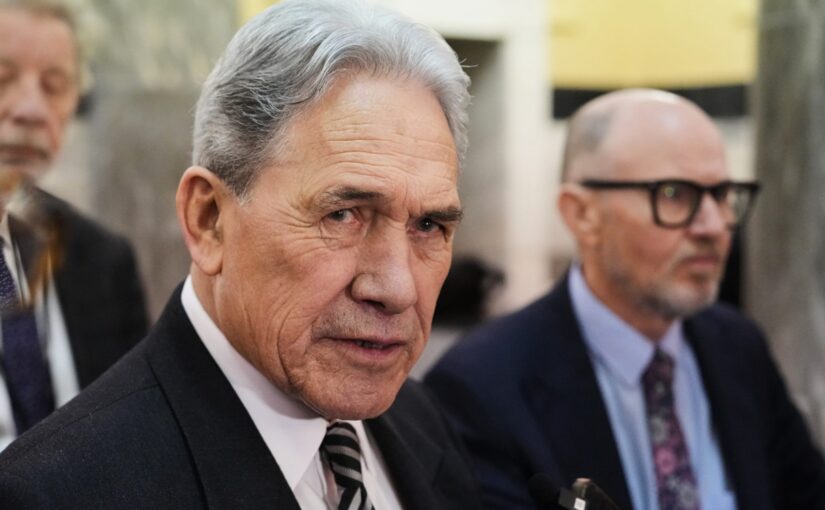
A July 29 racist incident in the New Zealand parliament has served to further sour the country’s once cordial relations with China.
That day Green Party MP Dr. Lawrence Xu-Nan heckled Foreign Minister Winston Peters about his vaccination status during a parliamentary debate. Peters responded by shouting: “I know you just came here five minutes ago. Go back where you come from, you loud mouth!”
Writing in his Solidarity blog, Eugene Doyle notes: “For the record Xu-Nan, born in Tianjin, China, arrived in New Zealand as a child in the 1990s. He is the Green Party’s first Chinese MP and says he ‘hopes to create bridges across various tauiwi [ethnically diverse] communities and bring together the collective wisdom of these communities to find solutions to the bigger challenges facing Aotearoa [New Zealand].”
In contrast, he continues, “in the space of 30 seconds, the undiplomatic foreign minister racially insulted a fellow MP, derided the Chinese government, cast slurs on immigrants and rehearsed talking points better suited to a MAGA rally in Eastern Kentucky than the New Zealand Parliament.”
He adds that “his insult to the ambassador and the Chinese system of government is gratuitous and will not be welcome in Beijing where New Zealand’s share price has been dropping sharply since the [Christopher] Luxon government ramped up both anti-China rhetoric and moved rapidly to more deeply integrate with the US military. Ludicrously, the PM simultaneously says he wants to double trade with China!”
Bianca Ranson of Anti-War Aotearoa, which advocates for a more respectful engagement with China, said Peter’s comments were deliberately insulting to China and the Chinese people. “He’s not fit to be foreign minister. At a time when tensions are heightened around immigrants and racism, we have Winston Peters reaching for the far-right playbook, emboldening racists and giving them an example of how to treat others. New Zealand’s support for Israel has already damaged our standing in the world and this just underlines that something has gone seriously wrong.”
New Zealand has long had good political and thriving economic relations with China, especially when the New Zealand Labour Party was in office, but these have deteriorated sharply since Labour lost the November 2023 general election.
China’s public response to Peters’ outburst was extremely measured. A spokesperson for the Chinese Embassy, referring to him only as “a certain politician”, “urged the New Zealand side to value the equal and mutually beneficial relationship between China and New Zealand and to do more things conducive to bilateral relations rather than the other way around,” adding that the, “absolute majority… of the Chinese community in New Zealand abide by local laws, actively integrate into the mainstream society, and have made important contributions to New Zealand’s economic and social development, and therefore deserve to be recognised and respected.”
However, China was less restrained when, shortly after, Peters unsuccessfully attempted to cajole the countries of the South Pacific, meeting at the Pacific Islands Forum Foreign Ministers’ Meeting in the Fijian capital Suva, into condemning a recent missile launch by China.
An article carried on the embassy website said that Peters had turned the meeting, “into a stage for his own political performance, pushing hard for the forum to issue a joint statement on China’s test launch of a strategic missile by a submarine last month. Before the meeting, Peters had accused Pacific Island countries of ‘missing an opportunity’ by failing to collectively criticise China… However, the outcome delivered Peters a resounding slap in the face. Pacific Island countries clearly showed little interest in the agenda he promoted, and no joint statement was adopted…
“In recent years, New Zealand has echoed Australia in hyping up the so-called ‘China security threat’, treating the South Pacific as its own sphere of influence and repeatedly pointing fingers at Pacific Island countries’ diplomatic choices. Whenever a country carries out normal economic, trade or security cooperation with China, it is immediately stigmatised as being ‘influenced by those outside the region’.
“As a close follower of the US and Australian camp, New Zealand, despite knowing that the majority of Pacific Island countries hold different views, still attempted to force through a statement targeting China, even at the cost of creating divisions among regional countries. At its core, this was an attempt to consolidate its regional discourse power by aligning with the geopolitical strategies of external powers and seeking to become the ‘regional decision-maker’.”
A third statement by the embassy, issued on August 14, responded to the New Zealand Security Intelligence Service (NZSIS) release of its report entitled ‘New Zealand’s Security Threat Environment 2026’. It stated:
“Steeped in Cold War mentality, the report once again fabricates and hypes the so-called ‘China interference’ and ‘China threat’ narratives. Its false allegations against China either smear normal exchanges and cooperation as so-called espionage or interference or are entirely groundless and fabricated out of thin air. We firmly oppose this and will never accept it.”
It added that it formed “part of a new wave of attacks, slander and vilification against China orchestrated by certain international forces and may well itself be a product of foreign interference.
“It also reflects the reluctance of certain forces, both within and outside New Zealand, to see the sound development of China-New Zealand relations. By resorting to every possible means to fabricate disinformation, they seek to drive a wedge between our two peoples, create a chilling effect on the public including the Chinese community, undermine bilateral mutual trust, and obstruct the growth of the relationship — all in service of their own geopolitical agendas and the narrow, short-sighted political interests of a few…
“Our message to those forces and individuals attempting political machinations is this: do not sacrifice the hard-won, mutually beneficial China-New Zealand relationship for selfish gain, and do not act against the interests of New Zealand and its people. Serving as a pawn for anti-China forces will ultimately backfire. Manufacturing distractions in foreign relations will not solve New Zealand’s own problems — it will only prove counterproductive. We urge these forces and individuals not to quench their thirst with poison, and not to lift a rock only to drop it on their own feet.
“China values its relationship with New Zealand. We stand ready to work with the New Zealand side, on the basis of the consensus reached between the leaders of our two countries, to advance exchanges and cooperation across the fields of political mutual trust, practical cooperation and people-to-people ties, for the greater benefit of both peoples.
“That said, the development of China-New Zealand relations is not up to China’s efforts alone. We hope the New Zealand side will work in the same direction as China, rather than the opposite. Should it fail to do so, the responsibility for any consequences that may arise will not rest with the Chinese side.”
The following articles were originally published by Solidarity and on the website of the Chinese Embassy in New Zealand.
Responding to NZ Foreign Minister’s racist slurs on China and on fellow MP
July 30 (Solidarity) – The Chinese Ambassador to New Zealand was typically restrained, dignified but crystal clear when he responded to the foreign minister Winston Peter’s racist outburst in parliament yesterday.
Wang Xiaolong said on X: “We have absolutely no interest in being dragged into the domestic politics of other countries. Suffice it to say, sometimes, a statement says more about the person that makes it than anything or anybody else.” Boom.
On Wednesday Green Party MP Dr. Lawrence Xu-Nan heckled the foreign minister about his vaccination status during a debate in parliament. The notoriously thin-skinned Peters shouted: “I know you just came here five minutes ago. Go back where you come from, you loud mouth!”
For the record Xu-Nan, born in Tianjin, China, arrived in New Zealand as a child in the 1990s. He is the Green Party’s first Chinese MP and says he “hopes to create bridges across various tauiwi [ethnically diverse] communities and bring together the collective wisdom of these communities to find solutions to the bigger challenges facing Aotearoa [New Zealand].” Exemplary.
In contrast, in the space of 30 seconds, the undiplomatic foreign minister racially insulted a fellow MP, derided the Chinese government, cast slurs on immigrants and rehearsed talking points better suited to a MAGA rally in Eastern Kentucky than the New Zealand Parliament.
In response to criticism, including from Prime Minister Christopher Luxon, the foreign minister doubled down, flaming the Chinese system of government.
“We live in a democracy that includes free speech and rights – those two values that certain other countries not only limit, but do so with force. If that offends the pearl clutchers and the communist shills labelling it as ‘dangerous’ – welcome to New Zealand,” the country’s top diplomat said.
It is worth pointing out that, according to polling, as reported by the conservative US outlet Newsweek, the overwhelming majority of people living in China (83%) say they live in a democracy whereas only 43% of people in the United States say the US is a democracy. Why a foreign minister would do this is baffling. News outlets across Asia, including The Straits Times and South China Morning Post, carried news of the slurs against China dished out by the New Zealand minister. It made news in France and as far away as Kenya.
Peters likes using spicy language but his insult to the ambassador and the Chinese system of government is gratuitous and will not be welcome in Beijing where New Zealand’s share price has been dropping sharply since the Luxon government ramped up both anti-China rhetoric and moved rapidly to more deeply integrate with the US military. Ludicrously, the PM simultaneously says he wants to double trade with China!
Bianca Ranson of Anti War Aotearoa, which advocates for a more respectful engagement with China, said Peter’s comments were deliberately insulting to China and the Chinese people. “He’s not fit to be foreign minister. At a time when tensions are heightened around immigrants and racism, we have Winston Peters reaching for the far-right playbook, emboldening racists and giving them an example of how to treat others. New Zealand’s support for Israel has already damaged our standing in the world and this just underlines that something has gone seriously wrong.”
The International Convention on the Elimination of All Forms of Racial Discrimination (ICERD), which New Zealand ratified in 1972, says that signatory states and their officials commit “to engage in no act or practice of racial discrimination against persons, groups of persons or institutions and to ensure that all public authorities and public institutions, national and local, shall act in conformity with this obligation.”
Peters was clearly dog-whistling to his primary base – those older white New Zealanders who lean into rather than away from anti-Māori, anti-immigrant, and anti-Chinese invective. With elections coming up in November, the foreign minister would rather damage relations with both China (our greatest trading partner) and the hundreds of thousands of New Zealand citizens of Chinese ethnicity in order to pull in a few extra votes.
His New Zealand First Party regularly race-baits, with one MP telling non-white MPs to “show some gratitude” and talking about a “butter chicken tsunami” at the time of the recent visit to New Zealand of India’s PM Narendra Modi.
“We have a PM who is so weak that he fails to show any kind of leadership in protecting our most important trading partnership,” Bianca Ranson says. “He allows the minister of foreign affairs to insult other nations and peoples. It’s actually quite weird to have a foreign minister trotting out this old white boy racist stuff like this. If Luxon doesn’t act, that too will speak volumes.”
Eugene Doyle is a writer based in Wellington, New Zealand. He has written extensively on the Middle East, as well as peace and security issues in the Asia Pacific region. He hosts solidarity.co.nz.
Chinese Embassy in New Zealand Makes Representations with MFAT on Certain Politician’s Negative China-related Remarks
July 30 (Embassy) – On July 30, a relevant official in charge of the Chinese Embassy in New Zealand lodged solemn representations with the New Zealand Ministry of Foreign Affairs and Trade over the negative China-related remarks made by a certain politician in the New Zealand Parliament.
The Embassy side urged the New Zealand side to value the equal and mutually beneficial relationship between China and New Zealand and to do more things conducive to bilateral relations rather than the other way around.
It emphasized that absolute majority members of the Chinese community in New Zealand abide by local laws, actively integrate into the mainstream society, and have made important contributions to New Zealand’s economic and social development, and therefore deserve to be recognized and respected. The Embassy called on the New Zealand side to respect and safeguard their legitimate rights and interests, and to create an open, inclusive and non-discriminatory environment for them to study, live and work in New Zealand.
Seeking to ‘rally’ attack on China’s missile test launch, New Zealand foreign minister only humiliates himself
August 12 (Embassy) – The Pacific Islands Forum Foreign Ministers’ Meeting was held in Suva, Fiji on Friday. The gathering was supposed to be an occasion for Pacific Island countries to discuss regional development priorities. Instead, New Zealand Foreign Minister Winston Peters turned it into a stage for his own political performance, pushing hard for the forum to issue a joint statement on China’s test launch of a strategic missile by a submarine last month. Before the meeting, Peters had accused Pacific Island countries of “missing an opportunity” by failing to collectively criticize China. He also claimed that “we will see whether logic prevails in the debate or whether the debate has already been settled by people having a predetermined position from which they will not move.”
However, the outcome delivered Peters a resounding slap in the face. Pacific Island countries clearly showed little interest in the agenda he promoted, and no joint statement was adopted. Peters expressed strong dissatisfaction, accusing these countries of catering to the wishes of “external partners.” Such remarks are deeply ironic: at a forum of Pacific Island countries, Peters criticized other countries for supposedly following the will of “external forces” while failing to realize that he himself was playing exactly the domineering role he described.
Peters, who claims to champion “logic”, is exactly the one engaging in actions that disregard logic and are driven by predetermined positions. In recent years, New Zealand has echoed Australia in hyping up the so-called “China security threat”, treating the South Pacific as its own sphere of influence and repeatedly pointing fingers at Pacific Island countries’ diplomatic choices. Whenever a country carries out normal economic, trade or security cooperation with China, it is immediately stigmatized as being “influenced by those outside the region.”
As a close follower of the US and Australian camp, New Zealand, despite knowing that the majority of Pacific Island countries hold different views, still attempted to force through a statement targeting China, even at the cost of creating divisions among regional countries. At its core, this was an attempt to consolidate its regional discourse power by aligning with the geopolitical strategies of external powers and seeking to become the “regional decision-maker.”
China’s test launch of a missile was a routine military training activity that was not directed at any specific country or target. Relevant countries had been notified in advance, and the test was in line with international law and international practices. Can such a test be equated with certain countries sending aircraft carrier strike groups thousands of miles to the Pacific to flex their military muscles? The true threat to regional stability comes precisely from external forces that repeatedly use “security concerns” as a pretext to carry out military intervention.
According to the perception of some Western countries, their own military presence in the Pacific is regarded as a legitimate “security guarantee”, while any action taken by China to safeguard regional stability is labeled a “threat to stability.” Such blatant double standards have long been clearly seen through by regional countries. Peters’ failure to achieve his goal fully demonstrates that Pacific Island nations do not want to be used as pawns by others. They know very well who is sincerely helping them pursue development and who is placing geopolitical interests above regional well-being.
Instead of exhaustively “pressuring” island countries to explain why they do not criticize China, New Zealand should reflect on a more fundamental question: why is its so-called “logic” so unconvincing among Pacific Island countries?
Remarks by the Spokesperson of the Chinese Embassy in New Zealand on the NZSIS Report
August 14 (Embassy) – Recently, the New Zealand Security Intelligence Service (NZSIS) released its report entitled “New Zealand’s Security Threat Environment 2026.” Steeped in Cold War mentality, the report once again fabricates and hypes the so-called “China interference” and “China threat” narratives. Its false allegations against China either smear normal exchanges and cooperation as so-called espionage or interference, or are entirely groundless and fabricated out of thin air. We firmly oppose this and will never accept it.
The China-New Zealand relationship is, in essence, one of mutual benefit and win-win cooperation. In recent years, thanks to the joint efforts of both sides, bilateral relations have made steady progress. Two-way trade has reached successive record highs, bringing substantial income and employment opportunities to the New Zealand people.
People-to-people exchanges have flourished, with tourist and international student numbers on a steady rise, deepening mutual understanding and the bond of friendship between our two peoples. The Chinese community in New Zealand has played a unique, important and positive role throughout this process. Since China’s implementation of unilateral visa-free policy for New Zealand, a growing number of New Zealanders have visited China and witnessed firsthand its development achievements, openness and inclusiveness. As a result, the New Zealand public has come to know China in a more comprehensive and objective light, and goodwill toward China as well as support for China-New Zealand relations continues to grow.
That this report is released at this particular juncture is no coincidence — it forms part of a new wave of attacks, slander and vilification against China orchestrated by certain international forces, and may well itself be a product of foreign interference.
It also reflects the reluctance of certain forces, both within and outside New Zealand, to see the sound development of China-New Zealand relations. By resorting to every possible means to fabricate disinformation, they seek to drive a wedge between our two peoples, create a chilling effect on the public including the Chinese community, undermine bilateral mutual trust, and obstruct the growth of the relationship — all in service of their own geopolitical agendas and the narrow, short-sighted political interests of a few. Clear-eyed observers will easily see through such schemes, which are bound to fail.
Our message to those forces and individuals attempting political machinations is this: do not sacrifice the hard-won, mutually beneficial China-New Zealand relationship for selfish gain, and do not act against the interests of New Zealand and its people. Serving as a pawn for anti-China forces will ultimately backfire. Manufacturing distractions in foreign relations will not solve New Zealand’s own problems — it will only prove counterproductive. We urge these forces and individuals not to quench their thirst with poison, and not to lift a rock only to drop it on their own feet.
China values its relationship with New Zealand. We stand ready to work with the New Zealand side, on the basis of the consensus reached between the leaders of our two countries, to advance exchanges and cooperation across the fields of political mutual trust, practical cooperation and people-to-people ties, for the greater benefit of both peoples.
That said, the development of China-New Zealand relations is not up to China’s efforts alone. We hope the New Zealand side will work in the same direction as China, rather than the opposite. Should it fail to do so, the responsibility for any consequences that may arise will not rest with the Chinese side.






Down with racism!