In the following article Bhabani Shankar Nayak reviews a spectacular show he attended in Xi’an during a recent visit to China. Bringing to life the forging of a united China by first emperor Qin Shi Huang but also presenting it from the perspectives of ordinary people, he explains that it “brings audiences together to reflect on the idea of national unification in China in a way that remains inclusive and respectful of both domestic and global perspectives” and that it “conveys to the world that patriotism and nationalism can be inclusive, and need not be grounded in supremacist ideas or practices that undermine others or create divisions in the process of nation-building.”
Bhabani is Professor of Business Management at London Metropolitan University and writes extensively on socialism and anti-imperialism.
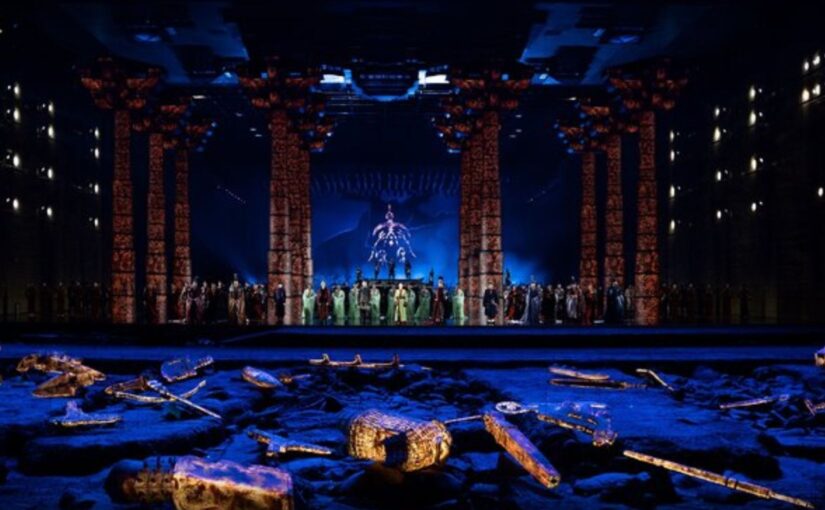
On 15 December 2025, after a hectic day of academic exchanges and talks in the morning, followed by sightseeing in the afternoon, my body was exhausted and it was difficult to keep my eyes open. My mind, however, was immersed in the cultural geography of Xi’an and the history of Shaanxi – the birthplace of Chinese civilisation. Then came an eighty-minute epic fantasy performance produced by the Shaanxi Cultural Investment Group at the Great Qin Performance Theatre located in a magnificent building on the east side of the Epang Palace in Fengdong New Town, Xixian New Area in Xi’an. This surreal production, led by a blend of acrobatics, dance, drama, technology, and music, made me forget my physical fatigue and drew me completely into the original archaeological setting of the Qin Dynasty. A 500-ton, 37-metre track platform expanded to 95 meters, accompanied by vibrating seats, transporting the audience back to the battlefields, palaces, mountains, oceans, rivers, agricultural fields, love stories, music, dance and the social and economic lives of ordinary Chinese people in 221 BCE. It was a visual marvel of Chinese history, unfolding the story of the Qin Dynasty through its main character, Hei Fu, a soldier.
The performance began in a realistic workshop setting, where Chinese archaeologists were shown working at an excavation site, restoring the ruins and remains of the Qin Dynasty. As the performance progressed, the story of China’s unification unfolded, following the journey of a Qin Dynasty soldier, Hei Fu, as its central narrative thread. Through his experiences, the performance used the fate of an ordinary individual to depict the broader historical process of Qin’s unification of the six states – Han, Chu, Yan, Zhao, Wei, and Qi. The immersive performance by Chinese theatre artists brought the past vividly to life through technologically led moving track platforms, where the stage transformed seamlessly to suit six different scenes. With 360° panoramic visuals and dynamic stage design, it recreated the military, architectural, cultural, and social landscape of the Qin Dynasty.
Directors Zhou Liya and Han Zhen, through The Great Qin, not only give life to Heifu – a figure inspired by the Terracotta Warriors and Horses Museum of Qin Shi Huang – but also connect his sacrifices to the making of China as a nation. The performance further revives the character of Dajiang Yi, a dedicated craftsman emerging from the ruins of the Epang Palace. Similarly, it portrays Guan Zhixi, an official who offers a legal perspective on the Qin Dynasty. History often reveals that heroes and villains are merely two sides of the same coin. So, the assassins depicted in The Great Qin are not merely threats to Emperor Qin Shihuang; they also serve as powerful reminders of loyalty, betrayal, and commitment in Chinese history.
The Great Qin performance is not merely an immersive theatrical show; it is also a powerful reflection on Chinese history, highlighting how ordinary people and soldiers like Heifu sacrificed their lives in the making of what would eventually become modern China. The story concludes with Heifu’s death, while his beloved continues to wait for him, embodying a quiet yet enduring form of devotion. The performance serves as a poignant reminder of the often-unseen sacrifices made by women in the making of families and nations – while men rule and die in wars, women endure loss and carry forward the continuity of life. In this respect, China is no different from the rest of the world.
There is no doubt that The Great Qin is a political show which portrays Chinese nationalism without undermining any other culture, ethnicity or nation. It brings audiences together to reflect on the idea of national unification in China in a way that remains inclusive and respectful of both domestic and global perspectives. The performance also serves as a reminder to younger generations to uphold the unity and integrity of China, emphasising that these are the results of profound historical sacrifices. The Eurocentric monolithic lens depicts China in its narrow and mono-ethnic outlook underming the diversities in China. The Great Qin show restores Chinese diversity and rejects dominant North American and European narratives on China.
The Great Qin is not merely an entertaining show; it is also an integral part of contemporary Chinese popular culture. Through the lens of The Great Qin, China once again conveys to the world that patriotism and nationalism can be inclusive, and need not be grounded in supremacist ideas or practices that undermine others or create divisions in the process of nation-building.