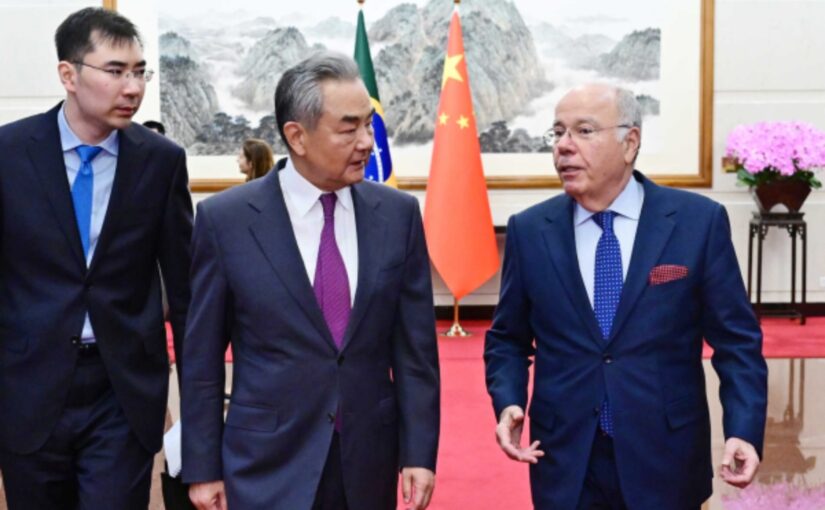
Brazilian Foreign Minister Mauro Vieira visited China, May 31-June 2, at the invitation of his Chinese counterpart Wang Yi.
On June 1, they held the fifth China-Brazil Foreign Ministerial-Level Comprehensive Strategic Dialogue in Beijing.
Wang Yi stated that in recent years, under the strategic guidance of President Xi Jinping and President Luiz Inácio Lula da Silva, China-Brazil relations have achieved a milestone leap from a comprehensive strategic partnership to a China-Brazil community with a shared future. Practical cooperation across various fields has continuously improved and upgraded, bringing the peoples of the two countries closer than ever before. China and Brazil have maintained close coordination on the international stage, demonstrating a sense of responsibility and emerging as a vital force for maintaining stability and promoting development in today’s world. With changes unseen in a century accelerating and the international community increasingly longing for peace and stability, reform of the global governance system should be placed on the agenda as soon as possible. Both sides should fully implement the important consensus reached by the two heads of state, continue to deepen the building of a China-Brazil community with a shared future, and jointly withstand external challenges. The two countries should build greater synergy in advancing their respective modernisation processes and strengthening solidarity and self-reliance among Global South countries, while providing greater certainty for a turbulent world.
Mauro Vieira stated that the Brazil-China relationship is a benchmark for developing countries in upholding independence, strengthening solidarity and enhancing coordination. The successful mutual visits between the two heads of state have elevated the bilateral relationship to a China-Brazil community with a shared future for a more just world and a more sustainable planet. This has provided crucial strategic guidance for both sides to deepen political mutual trust and strengthen bonds of cooperation, which holds even greater significance in the current international context.
Mauro Vieira also met with Chinese Vice President Han Zheng on the same day.
Pointing out that practical cooperation between China and Brazil is highly complementary and enjoys a strong internal driving force, Han said both sides should give better play to the role of mechanisms such as the China-Brazil High-level Coordination and Cooperation Committee to work for greater science and technology cooperation, with higher added value and greater strategic significance.
Vieira said at present, multilateralism is suffering an unprecedented blow, and it is particularly important for Brazil and China to deepen the construction of the community of a shared future.
The following articles were originally published on the website of the Chinese Foreign Ministry and by the Xinhua News Agency.
Wang Yi and Brazilian Foreign Minister Mauro Vieira Hold the China-Brazil Foreign Ministerial-Level Comprehensive Strategic Dialogue
June 1 (MFA) – On June 1, 2026, Member of the Political Bureau of the CPC Central Committee and Foreign Minister Wang Yi and Brazilian Foreign Minister Mauro Vieira held the fifth China-Brazil Foreign Ministerial-Level Comprehensive Strategic Dialogue in Beijing.
Wang Yi stated that in recent years, under the strategic guidance of President Xi Jinping and President Luiz Inácio Lula da Silva, China-Brazil relations have achieved a milestone leap from a comprehensive strategic partnership to a China-Brazil community with a shared future. Their global, strategic, and long-term impact has become increasingly prominent. Practical cooperation across various fields has continuously improved and upgraded, bringing the peoples of the two countries closer than ever before. China and Brazil have maintained close coordination on the international stage, demonstrating a sense of responsibility and emerging as a vital force for maintaining stability and promoting development in today’s world. With changes unseen in a century accelerating and the international community increasingly longing for peace and stability, reform of the global governance system should be placed on the agenda as soon as possible. Both sides should fully implement the important consensus reached by the two heads of state, continue to deepen the building of a China-Brazil community with a shared future, and jointly withstand external challenges. The two countries should build greater synergy in advancing their respective modernization processes and strengthening solidarity and self-reliance among Global South countries, while providing greater certainty for a turbulent world.
Wang Yi stated that China appreciates the Brazilian government’s long-standing adherence to the one-China principle, and supports Brazil in safeguarding its national sovereignty, upholding independence, and achieving greater development. Both sides should make good overall use of mechanisms such as the China-Brazil High-level Coordination and Cooperation Committee and the alignment of development strategies, leverage their respective strengths, and produce more fruits of cooperation. The two sides should implement the important consensus reached by the two heads of state on successfully hosting the China-Brazil Cultural Year 2026, and advance exchanges and cooperation in culture, education, tourism, sports, sub-national areas, youth, media and other fields. The two sides should also enhance communication and coordination within multilateral frameworks such as the United Nations and BRICS countries, actively act on the four major global initiatives, and work to establish a more just and equitable global governance system, safeguard world peace and stability, and defend the legitimate rights and interests of developing countries. China has always been a reliable friend to Latin American and Caribbean countries and stands ready to work with regional countries, including Brazil, to further deepen and expand overall China-Latin America cooperation.
Mauro Vieira stated that the Brazil-China relationship is a benchmark for developing countries in upholding independence, strengthening solidarity and enhancing coordination. It also serves as a model for the development of stable and predictable relations between major countries. Friendship is the defining feature of bilateral ties. The successful mutual visits between the two heads of state have elevated the bilateral relationship to a China-Brazil community with a shared future for a more just world and a more sustainable planet. This has provided crucial strategic guidance for both sides to deepen political mutual trust and strengthen bonds of cooperation, which holds even greater significance in the current international context. Brazil firmly adheres to the one-China principle, and looks forward to consolidating strategic mutual trust with China, deepening practical cooperation, strengthening the foundation of public support, and achieving prosperity for both. Both Brazil and China are important forces supporting multilateralism and advocating free trade. Brazil is ready to strengthen multilateral coordination with China, jointly advance reform of the global governance system, uphold the authority of the UN and promote international fairness and justice.
The two sides also conducted comprehensive and in-depth strategic communications on international and regional issues of mutual interest, reaching broad consensus.
Chinese vice president meets Brazilian FM
BEIJING, June 1 (Xinhua) — Chinese Vice President Han Zheng on Monday met with Brazilian Foreign Minister Mauro Vieira in Beijing.
Noting the building of the China-Brazil community with a shared future has been steadily and continuously advanced under the strategic guidance of the two countries’ heads of state, Han said China has always viewed and developed bilateral relations from a strategic height and a long-term perspective.
China is willing to work with Brazil to implement the important consensus reached by the two heads of state, promote high-level strategic coordination, and demonstrate the responsibility of a major country in safeguarding the interests of developing countries at large and promoting common development, said Han.
Pointing out that practical cooperation between China and Brazil is highly complementary and enjoys strong internal driving force, Han said both sides should give better play to the role of mechanisms such as the China-Brazil High-level Coordination and Cooperation Committee to work for a bigger share of science and technology in cooperation, with higher added value and of greater strategic significance.
Vieira said at present, multilateralism is suffering an unprecedented blow, and it is particularly important for Brazil and China to deepen the construction of the community of a shared future. Brazil is ready to work with China to jointly ensure the coordinating role of the high-level coordination and cooperation committee and deepen cooperation in various fields, he added.