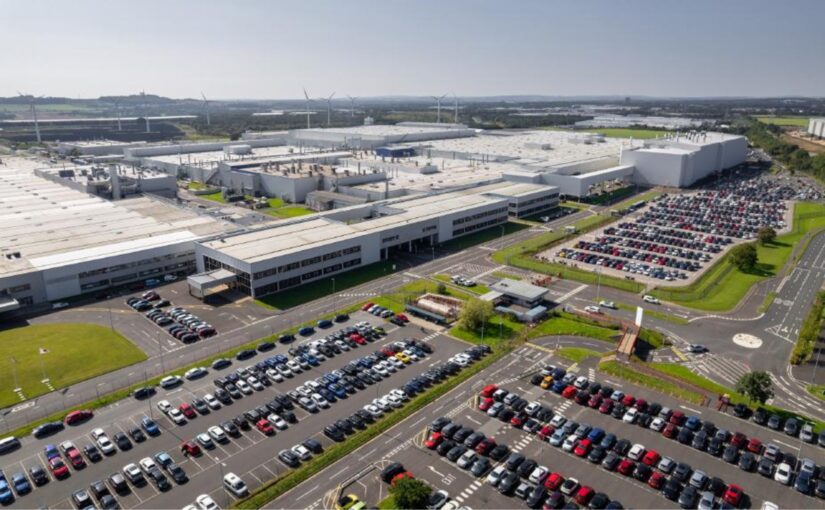
In early June 2026, the Financial Times reported that Nissan’s Sunderland plant – the UK’s largest car factory, employing 6,000 people – has secured its long-term future through a deal to manufacture vehicles for the Chinese carmaker Chery from 2027. In the following article, Friends of Socialist China co-editor Carlos Martinez argues that the agreement offers a concrete glimpse of a different economic path for Britain.
With Nissan’s global restructuring threatening thousands of jobs, and the motor industry’s own trade body admitting that Britain’s 2035 production targets are unreachable without Chinese manufacturers, Chinese industry is offering British workers what no British government has for forty years: high-quality jobs in a globally competitive, future-facing sector.
The predictable cries of ‘national security’ and ‘Chinese influence’, Martinez writes, are merely a manifestation of empire nostalgia. The real choice facing Britain is between embracing the multipolar transition or managing further decline in the service of a declining United States.
The Sunderland car plant is the largest of its kind in the UK. It employs 6,000 people directly, supports tens of thousands more in its supply chain, and is one of the few remaining anchors of high-quality manufacturing employment in a region the British state has spent four decades systematically abandoning.
This week, the Financial Times reported that the plant’s long-term future has been secured by a memorandum of understanding between owners Nissan and the Chinese carmaker Chery to manufacture Chery vehicles from 2027.
Without the Chery deal, Sunderland’s future would have been in serious doubt. Nissan’s global business is struggling. The company is in the middle of a restructuring programme that has already announced 20,000 job cuts worldwide and multiple plant closures. Utilisation at Sunderland is running at around 50 percent – far below the level at which the operation is viable in the long term.
The Chery deal puts a second product line into the factory and gives the plant a future. For the 6,000 workers in Sunderland, that is the difference between a viable career and the long, demoralising process of plant closure that has destroyed so many industrial centres in this country.
The British government has set a target of producing 1.3 million vehicles a year by 2035. Current production is around 824,000. The industry’s own trade body – the Society of Motor Manufacturers and Traders, no friend of socialism – has stated openly that the 2035 target cannot be reached without Chinese carmakers expanding their UK manufacturing. The Chery deal is the first major step in that direction.
Ford, Stellantis and Volkswagen are also in active discussions with Chinese groups including Geely and XPeng over the use of idle plant capacity in their European operations. Chery itself, which also owns the Omoda and Jaecoo brands, is now the fastest-growing carmaker in the UK market, with a six percent share in the first four months of this year.
What is happening, in short, is that Chinese industry is offering British workers what no British government has been willing to offer them for forty years: high-quality manufacturing jobs in a globally competitive sector. The vehicles being made will not be yesterday’s technology. Chery’s growth is driven by electric vehicles and hybrids.
China is now a world leader in EV manufacturing, in battery production, in solar, and increasingly in the software architecture that runs modern vehicles. Honda’s chief executive, after touring an automated Chinese factory earlier this year, told Japanese media: “We have no chance against this”. The Chinese EV revolution is one the most consequential developments in global manufacturing this decade, and Britain has the choice of partnering with it or being left behind by it.
Needless to say, there will be opposition. The British security establishment – which has spent decades operating, in substance, as a junior partner of Washington – will discover a “national security” concern. No doubt Xi Jinping will be looking for opportunities to disrupt your trip to the supermarket. The “special relationship” will be invoked. Columnists will warn against “Chinese influence” and espionage. Politicians will queue up to demand “scrutiny” of the deal. This is the standard British response to any serious proposal for economic cooperation with China.
All this is just good old-fashioned empire nostalgia. The British ruling class retains a deep attachment to the world in which it was the global hegemon, and the “special relationship” with the US provides a much-diminished version of that imperial grandeur.
In the real world of 2026, that fantasy is running out of road. The US is itself in visible decline, waging an unwinnable war in Iran, and incapable even of preventing China’s development of advanced semiconductors. The costs of clinging to this failing project are being borne by ordinary British people in the form of sky high energy prices, declining real wages and the steady disappearance of skilled industrial work.
Britain is in a position to benefit substantially from the multipolar transition now under way, if it can bring itself to participate in it. Chinese investment in manufacturing – like the Chery deal in Sunderland – can help revitalise industrial regions that no British government has had a serious plan for in living memory.
Chinese technology – in electric vehicles, in solar, in batteries, in advanced manufacturing – can accelerate the climate transition that British capital, left to its own devices, has comprehensively failed to deliver. And access to the growing Chinese consumer market – more than half a billion people in the middle-income bracket, an opportunity the rest of the world is queueing to exploit – can provide a meaningful source of export-led growth.
We can already see what cooperation with China looks like elsewhere. Serbia’s Smederevo steel mill, saved from closure by Chinese investment, now employs 5,000 people directly. The China-Laos Railway has transformed a landlocked country into a land-linked one and cut logistics costs by over 30 percent. Across the Global South, Chinese partnerships are doing the kind of large-scale industrial-policy work that, in this country, has been systematically dismantled since the Thatcher era.
The current government’s only real growth agenda is based on the military-industrial complex: increased defence spending, integration with the US war machine, the steady militarisation of the British state. That is not an economic strategy. The Chery deal in Sunderland is a small but concrete pointer in a different direction.






One thought on “Nissan, Chery and the case for cooperation with China”