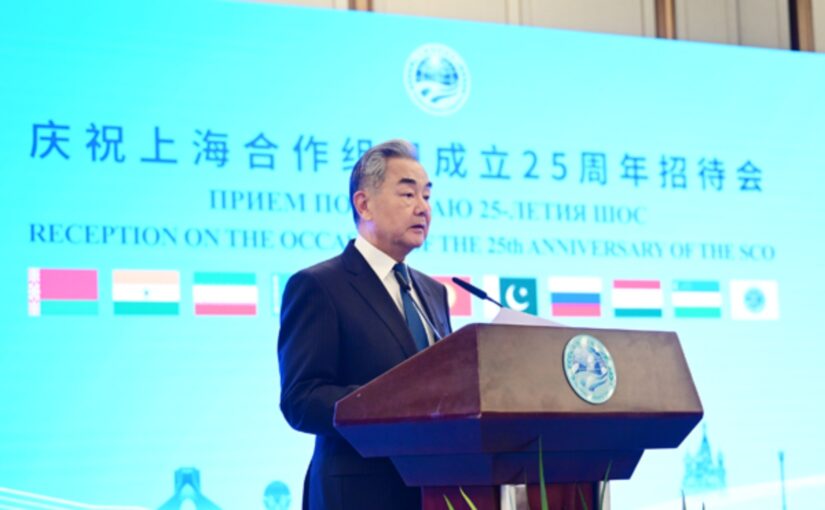
The Shanghai Cooperation Organisation (SCO) celebrated the 25th anniversary of its foundation on June 15.
Marking the occasion, Chinese Foreign Minister Wang Yi spoke at a Beijing reception.
Wang said that the founding of the SCO 25 years ago turned a new page in contemporary international relations. Over the past 25 years, member states have worked together in solidarity, upheld moral principles, pursued common development and engaged in mutual learning. They have nurtured the “Shanghai Spirit”, which features mutual trust, mutual benefit, equality, consultation, respect for cultural diversity, and pursuit of common development. The SCO has pioneered a new model of regional cooperation among neighbouring countries featuring partnership instead of alliance, under which all parties jointly safeguard security and stability and advance common development and prosperity.
Setting out some key tasks for the organisation in the coming period, he said:
- We need to safeguard peace and tranquility: adding the need to promote peace and stability in the Middle East, support Afghanistan’s reconstruction and development, and realise long-term stability in the region.
- We need to advance sustainable development: including accelerating the preparation for the establishment of the SCO Development Bank.
- We need to enhance good-neighbourly friendship and cooperation.
Secretary-General of the SCO Nurlan Yermekbayev noted in his speech that after 25 years of dedicated efforts, the SCO has entered its prime and grown into the world’s largest transregional international organisation. China Daily further reported him as noting the growing international interest in the organisation, saying that there are now about 20 applications from countries seeking to join the SCO in one capacity or another, which demonstrates the appeal of its values and principles.
Meanwhile Djoomart Otorbaev, a former prime minister of Kyrgyzstan, the country that chairs the SCO this year, contributed an ‘op ed’ to China Daily, in which he noted:
“The 25th anniversary of the founding of the Shanghai Cooperation Organization on June 15 marks more than a symbolic milestone. Over the past 25 years, the SCO has evolved from a narrowly focused border-security mechanism into one of the largest transregional organisations in Eurasia and one of the central pillars of the emerging multipolar order.
“In a world marked by fragmented globalisation, sanctions, conflicts and institutional crises within the Western system, the SCO is increasingly establishing itself as a contributor to international cooperation, emphasising sovereignty, consensus and strategic pragmatism. The SCO is becoming a symbol of resistance against the unipolar development model some powers are desperate to impose on Eurasian countries.”
Today, he points out, the SCO includes 10 member states, two observer states and 15 dialogue partners:
“The organisation’s expanding geography reflects the growing demand for non-Western mechanisms of international coordination.
“The SCO’s scale is unprecedented. The combined territory of its member states exceeds 36 million square kilometres — more than 25 percent of the Earth’s land area. The total population of SCO countries has surpassed 3.4 billion, representing nearly half of the total world population. Economically, the organisation already constitutes one of the world’s principal centers of gravity, representing about a quarter of global GDP.”
China and Russia, he continues, “remain the primary engines of this process, but the rapid integration of Central Asian economies demonstrates the broader regional significance of the SCO framework. For smaller member states, the organisation has become economically indispensable. It is estimated that SCO countries account for approximately 75 percent of Kyrgyzstan’s trade turnover, 67 percent for Tajikistan and nearly half for Uzbekistan… One of the organisation’s most strategically significant trends has been the transition toward settlements in national currencies. In trade between key SCO countries, the share of transactions conducted in rubles, yuan, rupees and other national currencies has greatly increased, gradually reducing dependence on the US dollar and Western-controlled financial systems.”
Comparing the SCO to BRICS, Otorbaev writes:
“Unlike many informal geopolitical platforms, the SCO possesses a fully institutionalised structure. It functions as a formal international organisation with a charter, permanent bodies, an approved budget, a secretary-general and fixed headquarters in Beijing and Tashkent… This institutional depth sets the SCO apart from groups such as BRICS. While BRICS mainly serves as an informal platform of geopolitical dialogue without an official charter or permanent secretariat, the SCO is a formal Eurasian organisation with legal responsibilities and ongoing operations.”
He identifies three strategic priorities that will likely determine the SCO’s future trajectory:
- Financial integration across SCO countries strengthens regional economic independence.
- Transport integration would actively advance a unified Eurasian transport network.
- The SCO brings together the world’s largest energy producers and key consumers. The SCO is progressively establishing the groundwork for a self-sufficient Asian energy market, complete with its own pricing structures and settlement systems.
He concludes: “Twenty-five years after its founding, the SCO is no longer merely a regional organisation. It is one of the institutional foundations of the new Eurasian century.”
The following articles were originally published on the website of the Chinese Foreign Ministry and by China Daily.
Wang Yi Attends Reception on the Occasion of the 25th Anniversary of the Shanghai Cooperation Organization
June 15 (MFA) – On June 15, 2026, Member of the Political Bureau of the CPC Central Committee and Foreign Minister Wang Yi attended and delivered remarks at the Reception on the Occasion of the 25th Anniversary of the Shanghai Cooperation Organization (SCO) in Beijing.
Wang Yi said that the founding of the SCO 25 years ago turned a new page in contemporary international relations. Over the past 25 years, member states have worked together in solidarity, upheld moral principles, pursued common development and engaged in mutual learning. They have nurtured the “Shanghai Spirit”, which features mutual trust, mutual benefit, equality, consultation, respect for cultural diversity, and pursuit of common development. The SCO has pioneered a new model of regional cooperation among neighboring countries featuring partnership instead of alliance, under which all parties jointly safeguard security and stability and advance common development and prosperity. It has also established a new type of international relations centered on mutual respect, fairness, justice and win-win cooperation.
Wang Yi pointed out that momentous changes unseen in a century are accelerating, and the international landscape is increasingly volatile and turbulent. Bearing in mind the shared future of humanity, President Xi Jinping has put forward four global initiatives and advocated building a community with a shared future for humanity, charting the course for our times and offering China’s solutions. As an important stabilizing, constructive and progressive force in the world today, the SCO should better play its role, take on due responsibilities and set an example for advancing world peace, development, cooperation and win-win outcomes.
Wang Yi stressed that we must carry forward the “Shanghai Spirit”. We should deliver solid results to deepen SCO cooperation, broaden the path ahead, streamline state-to-state relations, and steadily enhance the Organization’s cohesion, execution and influence.
We need to improve global governance. We will champion true multilateralism, adhere to the principle of extensive consultation, joint contribution and shared benefits, uphold the authority and role of the United Nations, and advocate an equal and orderly multipolar world and a universally beneficial and inclusive economic globalization.
We need to safeguard peace and tranquility. We will uphold the vision of common, comprehensive, cooperative and sustainable security, promote peace and stability in the Middle East, support Afghanistan’s reconstruction and development, and realize long-term stability in the region.
We need to advance sustainable development. We will foster new growth drivers in trade and investment, connectivity, scientific and technological innovation, green industries and the digital economy, accelerate the preparation for the establishment of the SCO Development Bank, and strengthen industrial chains, stabilize supply chains and move up the value chain.
We need to enhance good-neighborly friendship and cooperation. We will boost people-to-people exchanges, advance dialogue between civilizations, support non-governmental friendship, and jointly build a peaceful, safe and secure, prosperous, beautiful and amicable home.
Wang Yi stated that under the strategic guidance of President Xi Jinping and leaders of all SCO member states, the Tianjin Summit has drawn a blueprint for the SCO’s development over the next decade. He is confident that the Bishkek Summit to be held this year will further build consensus among all parties and promote regional countries to work together for enduring peace, development and prosperity. This year marks the launch of China’s 15th Five-Year Plan period. China stands ready to share development opportunities with all SCO member states to deliver win-win results through cooperation and create an even brighter future for the region.
Secretary-General of the SCO Nurlan Yermekbayev noted in his speech that after 25 years of dedicated efforts, the SCO has entered its prime and grown into the world’s largest trans-regional international organization. In September 2025, the Tianjin Summit adopted the SCO’s development strategy for the next decade, setting an ambitious yet realistic development direction to elevate the effectiveness of cooperation. The growing global attention on the SCO demonstrates the wide appeal of its values and principles. He hoped all member states would work together to deliver continued benefits to people across the Organization and advance peace and development in the region.
Around 200 guests, including diplomatic envoys of SCO member states and representatives of international organizations stationed in China, attended the reception.
Grouping remains a multipolar influencer
June 15 (China Daily) – The 25th anniversary of the founding of the Shanghai Cooperation Organization on June 15 marks more than a symbolic milestone. Over the past 25 years, the SCO has evolved from a narrowly focused border-security mechanism into one of the largest transregional organizations in Eurasia and one of the central pillars of the emerging multipolar order.
In a world marked by fragmented globalization, sanctions, conflicts and institutional crises within the Western system, the SCO is increasingly establishing itself as a contributor to international cooperation, emphasizing sovereignty, consensus and strategic pragmatism. The SCO is becoming a symbol of resistance against the unipolar development model some powers are desperate to impose on Eurasian countries. As a key founding member, China provides investment, logistics and an alternative development model to that of the West — one based on the principles of respect for the sovereignty of countries, nonviolence and mutual benefit.
The organization originated from the “Shanghai Five” mechanism created in 1996 by China, Russia, Kazakhstan, Kyrgyzstan and Tajikistan. At first, it concentrated on confidence-building and demilitarization along the post-Soviet Chinese border. However, the geopolitical dynamics of Eurasian integration soon expanded the mechanism’s scope beyond border security.
On June 15, 2001, in Shanghai, Uzbekistan joined the group, and the Declaration on the Establishment of the SCO was signed. Since then, the SCO has undergone several phases of expansion. India and Pakistan became full members in 2017, significantly boosting the organization’s geopolitical influence. Iran officially joined in 2023, and Belarus finished its accession process in 2024.
Today, the SCO includes 10 member states, two observer states — Mongolia and Afghanistan — and 15 dialogue partners, among them Turkiye, Saudi Arabia, the United Arab Emirates, Qatar, Egypt and Azerbaijan. The organization’s expanding geography reflects the growing demand for non-Western mechanisms of international coordination.
The SCO’s scale is unprecedented. The combined territory of its member states exceeds 36 million square kilometers — more than 25 percent of the Earth’s land area. The total population of SCO countries has surpassed 3.4 billion, representing nearly half of the total world population.
Economically, the organization already constitutes one of the world’s principal centers of gravity, representing about a quarter of global GDP.
Even more revealing is the organization’s trade transformation. It is estimated that in 2001, mutual trade among the SCO countries was valued at about $16 billion. Today, intra-bloc trade is approaching the historic threshold of $1 trillion.
China and Russia remain the primary engines of this process, but the rapid integration of Central Asian economies demonstrates the broader regional significance of the SCO framework. For smaller member states, the organization has become economically indispensable. It is estimated that SCO countries account for approximately 75 percent of Kyrgyzstan’s trade turnover, 67 percent for Tajikistan and nearly half for Uzbekistan.
Investment cooperation has grown significantly. Over the past 25 years, mutual direct investment among SCO countries has surged with a primary focus on infrastructure, logistics, energy and transportation corridors.
One of the organization’s most strategically significant trends has been the transition toward settlements in national currencies. In trade between key SCO countries, the share of transactions conducted in rubles, yuan, rupees and other national currencies has greatly increased, gradually reducing dependence on the US dollar and Western-controlled financial systems.
Unlike many informal geopolitical platforms, the SCO possesses a fully institutionalized structure. It functions as a formal international organization with a charter, permanent bodies, an approved budget, a secretary-general and fixed headquarters in Beijing and Tashkent.
Its highest authorities include the Council of Heads of State, the Council of Heads of Government and the Council of Foreign Ministers. Specialized institutional mechanisms coordinate cooperation among defence ministers, interior ministers, justice ministries, heads of supreme courts and procurators-general.
This institutional depth sets the SCO apart from groups such as BRICS. While BRICS mainly serves as an informal platform of geopolitical dialogue without an official charter or permanent secretariat, the SCO is a formal Eurasian organization with legal responsibilities and ongoing operations. Security cooperation is also a core aspect of the SCO’s identity. The Regional Anti-Terrorist Structure in Tashkent oversees intelligence sharing, counterterrorism drills and anti-extremism efforts — domains that BRICS does not cover.
The SCO has notable similarities with the Association of Southeast Asian Nations. Both organizations were formed as frameworks for stabilizing Asia through consensus and noninterference. ASEAN has contributed to stabilizing Southeast Asia after the Vietnam War, while the SCO focuses on stabilizing the post-Soviet Eurasian region and China’s western outskirts. In both groups, decisions are made only by full consensus, which upholds sovereignty and guards against domination by any one power.
Three strategic priorities will likely determine the SCO’s future trajectory. First, financial integration across SCO countries strengthens regional economic independence. The proposed SCO Development Bank and SCO Special Account could provide independent financing for large-scale Eurasian infrastructure projects without reliance on other financial institutions.
Second, transport integration would actively advance a unified Eurasian transport network. This framework would connect the Belt and Road Initiative, the Eurasian Economic Union, the North-South Corridor and the China-Kyrgyzstan-Uzbekistan railway.
Third, the SCO brings together the world’s largest energy producers and key consumers. The SCO is progressively establishing the groundwork for a self-sufficient Asian energy market, complete with its own pricing structures and settlement systems.
Twenty-five years after its founding, the SCO is no longer merely a regional organization. It is one of the institutional foundations of the new Eurasian century.
The author is a former prime minister of the Kyrgyz Republic and a visiting senior fellow at the Chongyang Institute for Financial Studies at Renmin University of China. The author contributed this article to China Watch, a think tank powered by China Daily. The views do not necessarily reflect those of China Daily.