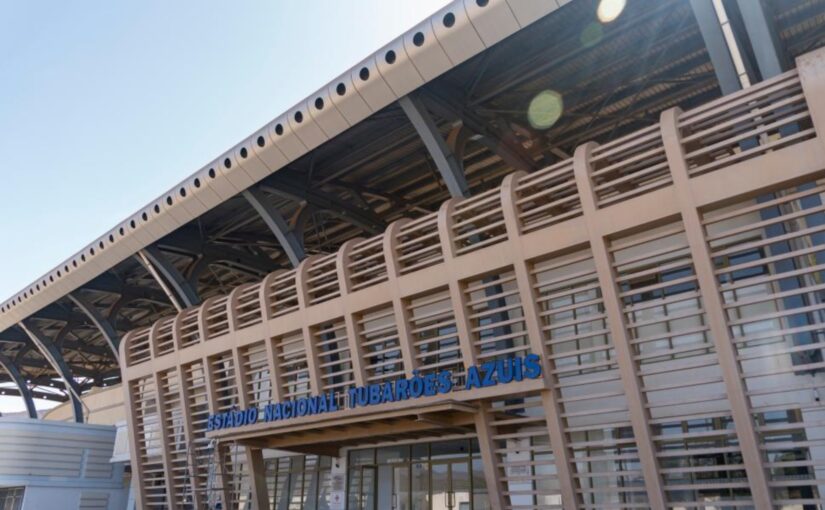
With the current 2026 Football World Cup being one of the most contentious in the history of the game due to the customarily outrageous behaviour of the US Trump administration, curtailing the movements of the Iranian team such that it has had to stay in Mexico between games in the US, denying visas to players, their family members, and referees from Global South countries, delaying their entry, detaining on arrival, subjecting them to enhanced screening including police dog inspections, and so on, there have nevertheless been some moments of joy and inspiration, not least in some brave performances from minnow teams from the Global South.
One such team has been that from Cabo Verde (Cape Verde), an island nation in West Africa of little over half a million people.
Cabo Verde drew 0:0 with Spain, tipped as cup winners, on June 15 and then, on June 21, drew 2:2 with Uruguay, a strong football nation. They will go up against Saudi Arabia on June 27.
Cabo Verde’s star goalkeeper Vozinha was one of those affected by the US administration’s policies. Financial constraints and the high visa cost were preventing his mother witnessing her son’s moments of glory.
This changed thanks to the generosity of Chinese businessman, Lin Jie, originally from Wenzhou, who has lived in Cape Verde for more than two decades. Global Times reported that prior to her departure, Ana Cándida Évora, the star’s mother who is a 59-year-old house cleaner, spoke with CGTN and expressed her gratitude to fans in China. She called China a “very good country and a friend of ours [people in Cape Verde].” She even specifically addressed the Chinese fans in Chinese, saying, “Thank you, Chinese fans.”
Vozinha’s happiness at his mother being able to join him is captured in this BBC clip.
However, China’s contribution to the success of the Blue Sharks, as the national team are known, does not start or end with Lin’s generosity.
Writing in Hong Kong’s South China Morning Post on June 17, Dulue Mbachu noted:
“On Monday, thousands of Cabo Verdeans poured out onto the streets of their capital, Praia, beating drums, blowing horns and dancing to celebrate the national football team’s shock draw against Spain at the World Cup… President Jose Maria Neves described it as a defining moment for the country, which became independent from Portugal in 1975.
“‘If today, 50 years later, we are at the World Cup, we have already proven that we are a viable nation,’ he wrote on Facebook, following the match in the US city of Atlanta.”
“Yet the story of the former colony’s footballing achievements is not complete without mentioning China’s role in building the country’s sports infrastructure.
“This included the 15,000-capacity Estadio Nacional de Cabo Verde, which was completed in 2014. The stadium was financed by Beijing and built by a Chinese state-owned contractor. This followed Cabo Verde’s first appearance at the African Cup of Nations in 2013, when the national team made it to the quarterfinals for the first time.”
He adds that China has built more than 100 sports arenas across the African continent over the past five decades:
“Ivory Coast, which is also competing at this edition of the World Cup, has three stadiums built with Chinese funding. It became the first African side to score a victory at this year’s tournament when it beat Ecuador by a single goal…
“Chinese aid also built stadiums in Angola before it hosted the Africa Cup of Nations in 2010.
“In Tanzania, China built the 60,000-capacity Benjamin Mkapa Stadium and is constructing another in the city of Arusha. In Uganda, the Mandela National Stadium was built with Chinese funding…
“Still, China’s stadium diplomacy appears to have achieved its most dramatic outcome in Cabo Verde… Apart from the national stadium, China has helped with several other construction projects, including the national legislative building, the main government offices in the capital and the Poilao Dam.”
A feature article carried by the Xinhua News Agency reports that the national stadium, “a space better known for hosting major competitions, has [also] become a regular training ground where local youth build both athletic skills and discipline.” For example, the judo program now has 28 regular trainees who practice there three times a week.
In an earlier interview with Xinhua, the country’s president Jose Maria Neves said that China has always been an important partner in Cabo Verde’s development process, with bilateral cooperation continuing to expand, making valuable contributions to the country’s economic growth, social development and institutional capacity building.
Cooperation with China has had a positive impact in areas such as education and training, health care, agriculture, water resources development and infrastructure construction, he said.
Hundreds of Cabo Verde’s officials and professionals have received training in China, while Chinese doctors and technical experts have long worked in Cabo Verde under cooperation programs.
Among the many infrastructure projects built with Chinese assistance in Cabo Verde, Neves singled out the Poilao Dam, saying it was a landmark project for the development of agriculture, livestock farming and the agro-food industry.
“It showed for the first time that it was possible to mobilise surface water in Cabo Verde.”
Cabo Verde won independence in July 1975 after centuries of Portuguese colonial rule and established diplomatic relations with China in April 1976. However, the friendship between the two peoples dates to the anti-colonial liberation struggle which China wholeheartedly supported.
In parliamentary elections held on May 17 this year, the African Party for the Independence of Cabo Verde (PAICV), the party which led the liberation struggle, returned to office, winning an absolute majority.
The following articles were originally published in Global Times and by the Xinhua News Agency.
Cape Verde goalkeeper’s mother expresses gratitude to Chinese fans, calling China a ‘very good country and a friend’
June 19 (Global Times) – Setting off from São Vicente in Cape Verde and transiting via the capital Praia, Ana Cándida Évora, mother of Cape Verde’s star goalkeeper Vozinha, is en route to her final destination Miami in the US. She plans to cheer on her son in the Blue Sharks’ crucial second Group H World Cup fixture against Uruguay, after she was granted a visa to enter the US when the cost issue on a bond payment for a visa was sorted out.
On her departure, Évora spoke with CGTN and expressed her gratitude to fans in China. She called China a “very good country and a friend of ours [people in Cape Verde].” She even specifically addressed the Chinese fans in Chinese, saying, “Thank you, Chinese fans.”
Previously, the story of Évora missing Vozinha’s stellar performance in the Cape Verde-Spain match due to financial constraints and visa cost issue went viral online. Lin Jie, a Wenzhou-born entrepreneur who has lived in Cape Verde, had already made contact with the family before international reporters and media outlets reached Vozinha’s mother. Lin was also one of the first people to reach out and offer assistance to Évora.
Lin, who has lived in the country for more than two decades, told the Global Times on Thursday that he decided to visit the goalkeeper’s family shortly after the match. Through a local connection, his wife’s clothing store, where Vozinha’s cousin works, Lin was able to establish contact with the family.
Lin later shared videos on Chinese social media platform Douyin showing Vozinha’s mother and cousin celebrating the goalkeeper’s performance and preparing gifts for his return. Another video showed Lin accompanying Vozinha’s mother to a local airport as she departed for the US.
Lin told the Global Times that Josina Freitas, a member of Cape Verde’s National Assembly helped facilitate the process. The Cape Verde National Football Association covered the cost of her visa and her flights to the capital and onward to the US.
As of Friday night, Beijing time, Lin told the Global Times that to his knowledge, Évora was making a transfer in Portugal.
Earlier, after Vozinha’s debut against Spain, the stellar goalkeeper explained that his mother could not travel to watch his historic World Cup debut “due to the mandatory visa bond deposit required to enter the US,” according to Al Jazeera.
“Also, my mum, she didn’t manage to be here because of the visa. The money for the visa, we didn’t manage on time, and I would like her to be here,” said goalkeeper Vozinha, according to Al Jazeera.
The US government placed Cape Verde on a list of countries whose citizens must post a returnable bond of $15,000 on top of visa fees to enter the country. Although the government last month dropped the requirement for World Cup ticket holders, but by that point the high costs had ruled out the trip for Evora, the mother of Cape Verde’s 40-year-old goalkeeper, The Guardian reported. Evora is a 59-year-old house cleaner, according to the report.
While Évora planned to finish all visa formalities at the US Embassy in Praia, Cape Verde’s capital, ahead of her trip to the US to catch Cape Verde’s Sunday fixture against Uruguay, Lin escorted Vozinha’s mother to the local airport as she set off for the US. He additionally provided her with travel necessities including a suitcase made of Yiwu, Zhejiang Province.
Aside from Lin’s assistance, Évora’s journey from Cape Verde to the US drew attention from Chinese netizens, racking up over 16.99 million views as a trending topic on Sina Weibo as of press time on Friday. Many netizens sent their best wishes after learning she could finally travel to the US to watch her son’s match.
According to CGTN, Évora also shared about her memories of her son’s childhood football journey and her excitement about seeing him again.
“When I see him, I want to give him a mother’s hug and wish him good luck,” Évora told CGTN.
Feature: Chinese-built stadium supports Cape Verde’s sports development, community life
PRAIA, May 15 (Xinhua) — Inside a judo room at Cape Verde’s National Stadium, young athletes practice breakfalls under the guidance of their coach Joao Jose Silva Ferreira.
The 15,000-seat sports complex, a space better known for hosting major competitions, has become a regular training ground where local youth build both athletic skills and discipline.
Ferreira told Xinhua that the judo program now has 28 regular trainees who practice three times a week at the stadium. Among them is 20-year-old Marcio da Silva, who has practiced judo for years and credits the facility with helping him stay committed to the sport.
“Without this stadium, I might not have been able to continue for so long,” said Marcio da Silva. “This place allows us to keep training, and it makes us feel that we are doing something serious.”
Located on the northern outskirts of Cape Verde’s capital city Praia, the National Stadium was built with Chinese assistance and handed over in 2014. More than a decade later, Chinese technical support has continued at the venue.
In April 2025, the third phase of Chinese technical assistance for the stadium began. A team of 11 experts is expected to work at the venue for three years, covering areas including electrical systems, civil works, sound systems, timing and scoring systems, decoration and maintenance.
“Building a stadium is one thing. Running it is another,” said Li Junsheng, manager of the third-phase technical assistance project for the National Stadium, undertaken by China’s Shaanxi Construction Engineering Group.
Li said the long-term operation of a large sports facility can face many challenges after delivery, including aging systems, equipment renewal and a shortage of local technical personnel.
“The cooperation did not stop at the moment of handover,” Li said. “What we provide is not only maintenance, but also spare parts supply and personnel training.”
According to Li, during the second phase of technical assistance, the Chinese team added ramps for people with disabilities, renovated the plastic running track, repainted steel structures, and built supporting facilities including a restaurant, kitchen and laundry room.
“Now athletes passing through Praia can stay inside the stadium and have hot meals at the new canteen, without worrying about food during training camps,” he said.
The third phase focuses on further improving the stadium’s operation and safety systems. Li said the original surveillance system, installed about 10 years ago, used analog equipment for which spare parts are now difficult to find. The fire alarm system also requires renovation due to aging.
He added that maintenance of perimeter walls, replacement of grass in auxiliary areas and repair of lighting facilities are also under way.
Gu Yuanye, an interpreter for the project, first came to Cape Verde in 2013. He said he has witnessed major changes around the stadium over the past decade.
“In the early years, people coming from downtown often had to wait for minibuses at the roundabout, and sometimes walk one or two kilometers,” Gu said. “Now houses have expanded into this area, and bus routes have been extended here.”
Orlando Jorge Mascarenhas, head of stadium management, said the opening of the National Stadium changed the landscape of sports development in Cape Verde.
“In my view, sports development in Cape Verde can be divided into two phases: before the National Stadium and after the National Stadium,” Mascarenhas said. “It was the first large-scale comprehensive national sports facility after Cape Verde’s independence, and it remains the country’s largest sports infrastructure.”
“The stadium has become deeply integrated into our daily sports life,” he said. “It is almost difficult to imagine Cape Verdean sports without it.”
Mascarenhas said the stadium has also served public needs beyond sports. During the COVID-19 pandemic, it was used as a field hospital, and it has also hosted training for the national police.
His personal connection with China began long before he managed the stadium. Mascarenhas said his father visited Shanghai in the late 1970s or early 1980s and often spoke to the family about what he had seen in China.
“My father used to say: Cape Verde is very small, and China is very big,” he said.
Years later, Mascarenhas himself traveled to China for training in stadium management. He said that experience gave him a clearer understanding of China’s cooperation with Cape Verde.
“China’s support is not only about building the facility,” he said. “It also includes follow-up operation, management experience and capacity building.”
Interview: China always an important partner in Cabo Verde’s development process, says Cabo Verde’s president
PRAIA, May 30 (Xinhua) — China has always been an important partner in Cabo Verde’s development process, with bilateral cooperation continuing to expand, making valuable contributions to the country’s economic growth, social development and institutional capacity building, said President of Cabo Verde Jose Maria Neves.
Looking back on the development of bilateral ties, China has “always been present” at crucial moments in Cabo Verde’s development, Neves said in a recent interview with Xinhua in Praia, the capital of the African island country.
Cooperation with China has had a positive impact in areas such as education and training, health care, agriculture, water resources development and infrastructure construction, he said.
Hundreds of Cabo Verde’s officials and professionals have received training in China, while Chinese doctors and technical experts have long worked in Cabo Verde under cooperation programs, he noted.
Among the many infrastructure projects built with Chinese assistance in Cabo Verde, Neves singled out the Poilao Dam, saying it was a landmark project for the development of agriculture, livestock farming and the agro-food industry.
“It showed for the first time that it was possible to mobilize surface water in Cabo Verde,” he said, adding that the country has since built several more dams across the archipelago.
In 2024, China-Cabo Verde relations were elevated to a strategic partnership. Speaking of future cooperation, Neves said the two sides should continue to expand cooperation into new areas.
The blue economy is the future of Cabo Verde, he said, noting that the two countries could strengthen cooperation in transport, fisheries, desalination, pharmaceutical and food industries.
Cabo Verde also looks forward to deepening practical cooperation with China in such fields as digital transformation, tourism, agriculture and livestock farming, and renewable energy, especially in wind and solar power, he said.
Speaking of the 2026 China-Africa Year of People-to-People Exchanges, Neves said exchanges with China have been highly beneficial.
“China is a country with a long history and a rich culture, and also a country of great diversity,” he said. “China’s cultural wealth and millennia-old heritage, both tangible and intangible, have greatly enriched human culture.”
Many Cabo Verde people who have studied in or visited China have been deeply impressed by China’s practices in innovation, urban planning, regional development, nature conservation and higher education, he noted.
Such exchanges, he said, can help Cabo Verde develop tourism, culture, education and creative industries, while also bringing the peoples of the two countries closer.
Since May 1, China has fully implemented a zero-tariff policy for 53 African countries with which it has diplomatic relations. Against the backdrop of mounting restrictions on international trade, China’s further opening up to Africa will play a positive role in the continent’s economic growth, he said.
On global governance, Neves said, “the world cannot be governed by one voice alone; all voices must be heard.”
The China-proposed Global Development Initiative, Global Security Initiative, Global Civilization Initiative and Global Governance Initiative help promote dialogue and the search for solutions for a fairer and more balanced world, and are important for improving global governance, he said.
On the role that Global South countries can play in the international order and global governance, Neves said African countries should maintain “active neutrality” and should not become parties to conflicts and wars.
It is essential to safeguard multilateralism and respect international law, as well as national sovereignty and territorial integrity, and to resolve conflicts through dialogue and diplomacy, he said.
“We must give place to diplomacy instead of war,” he added.
Cabo Verde’s final election results confirm PAICV victory with absolute majority
PRAIA, May 29 (Xinhua) — Cabo Verde’s National Elections Commission (CNE) on Friday announced the final results of the May 17 legislative elections, confirming the victory of the African Party for the Independence of Cabo Verde (PAICV), which secured an absolute majority in parliament.
According to official figures presented by CNE President Maria do Rosario Goncalves at a press conference in Praia, 193,335 of the 416,096 registered voters cast their ballots, while abstentions stood at 222,761.
The PAICV won 90,660 votes, followed by the Movement for Democracy (MpD) with 84,458 votes and the Democratic and Independent Cabo Verdean Union (UCID) with 9,812 votes. The People, Work and Solidarity party (PTS) received 3,268 votes, while the Popular Party (PP) obtained 529 votes.
Based on the final results, the PAICV won 37 of the 72 seats in the National Assembly. The MpD secured 33 seats, while the UCID won two. The PTS and the PP failed to win any seats.
“The final results confirm the sovereign will of the Cabo Verdean people, expressed at the ballot box on May 17 and peacefully accepted by all political forces and citizens in general,” Goncalves said.
She said that, following the publication of the final results in the Official Gazette on Friday, the president of the republic may consult the political parties that contested the elections and, in principle, invite the party declared the winner to form the government.
The National Assembly may meet within 20 days from Friday to open the new legislature and swear in the 72 elected deputies, she added.






One thought on “China – a true friend to World Cup heroes Cabo Verde”