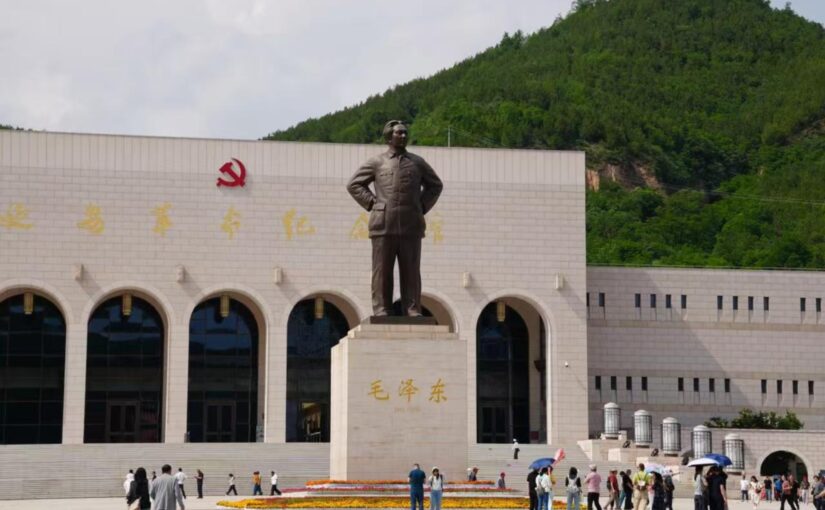
The 1st of July 2026, marks the 105th anniversary of the founding of the Communist Party of China. To mark the occasion, we are pleased to publish this reflection by Oliver Vargas, a British-Bolivian current affairs commentator working for CGTN in Beijing, written from Yan’an – the revolutionary base where the Long March ended and where the Party made its headquarters through the most decisive years of war and revolution.
Vargas argues that the revolutionary sites of Yan’an are best understood as global heritage sites of the international workers’ movement, whose lessons belong to the peoples of Latin America and the wider Global South. He locates the secret of the Party’s enduring vitality in its tradition of rigorous self-governance and self-reform – a habit written into its DNA since 1921 and raised by Xi Jinping into a systematic doctrine – bound together with its unbroken bond with the people.
This article was written for CGTN. It was first published, in Spanish, by Diario Red.
Away from the hustle and bustle of China’s major cities, one of the most beautiful areas one can visit is Yan’an, sacred land in China’s revolutionary history. That’s what I decided to do on the 105th anniversary of the Party’s founding. Just one hour away from Xi’an thanks to the country’s legendary high-speed rail, this is where the Long March concluded in 1936 and the Communist Party established its headquarters for the coming battles of what would become the most decisive years of war and revolution.
Unlike Xi’an, however, this small sleepy city isn’t swarming with foreign tourists; in fact, I didn’t see another one during my two days there. One has to be somewhat of an anorak about Chinese revolutionary history to have heard of Yan’an, something I was drawn to when seeking to understand how China had broken out of the cage of foreign domination and charted its own course of development, the long aspiration of the popular movements of my own country, Bolivia. The questions and criticisms of neocolonialism raised by those revolutionaries 105 years ago are the same questions and criticisms raised by revolutionaries across the Global South.
When one realises that, these revolutionary sites in Yan’an, where those who founded the Communist Party made their dream a reality, start to feel a lot more like global heritage sites of the international workers’ movement; the sacrifices of the Chinese people during those brutal struggles become schools for those of us in Latin America, and beyond, who wrestle with the same questions and challenges.
With that in mind, as I climbed the hills to see the former cave dwellings that once served as home and headquarters to the Party’s founding generation, I couldn’t help but think of what those men and women who sheltered here, often cold and hungry, in the midst of a resistance struggle to defend their nation, would make of China’s achievements today, the fruit of their sacrifice. Since then, under the leadership of the Communist Party, China has lifted hundreds of millions of people out of poverty and entirely eliminated absolute poverty five years ago, the year of the Party’s centenary. Today, it is a global leader in the cutting-edge technologies and industries of the future, and an inspiration to the peoples of the world.
One hundred and five years after its founding, returning to these sites offers a way of understanding how that journey was possible—and why a century-old party can retain its vitality against all the odds.
To grasp what happened here, one has to step back. Late-Qing China was a country under colonial domination: foreign concessions carved up its territory among Western powers, unequal trade treaties were imposed by force that locked the country into poverty and dependency. The 1911 democratic revolution toppled that dynasty, but it failed to complete the transformations that the country needed. China remained fragmented, quickly collapsing into warlordism, ripe for external manipulation. It was in that vacuum, in the face of the failures of the bourgeois revolution, that in 1921 a small group of workers and intellectuals founded the Communist Party of China, seeking to answer the historic challenges of imperialism, feudalism, and national reconstruction.
What began as a modest circle grew into a mass party that led the whole country through a war of national resistance against Japanese invasion, and then social revolution. A central driving quality of this process was something at the heart of Xi Jinping’s important thought on party building: full and rigorous self-governance and self-reform as a long-term strategy and a constant priority. As a basis for upholding its leadership, the party has no special interests of its own apart from those of the people, the party takes responsibility for its own ranks, setting strict standards of conduct for its members, supervising the exercise of power at every level and correcting its own errors before they take root. As General Secretary Xi has emphasized, the courage to engage in self-reform and renewal to meet each conjunctural challenge is the hallmark that most clearly distinguishes the CPC.
Yan’an is where the idea behind all this becomes tangible. After the Long March, the party based itself there between 1937 to 1948, and in these caves, it forged a discipline of self-correction alongside its military strategy. I visited the hall where the legendary Seventh National Congress was held, its banners restored and its wooden benches intact, and where the thinking that emerged during the famous Rectification Movement of the 1940s – an early expression of the effort to identify and root out errors and to adapt Marxism to the Chinese reality – became the party’s guiding principle.
This self-reform has been a habit written into the Party’s DNA since its earliest days. What General Secretary Xi has done is raise that instinct into a systematic doctrine, binding the Party’s advanced nature to a permanent vigilance over itself. A party that stops examining its own conduct begins to die, however impressive its achievements. That conviction shapes how the achievements visible from any Chinese city, town and village today are understood—as the latest stage in a long history of struggle.
Walking through the Yan’an Revolution Museum, with its photographs of peasants learning to read and soldiers tilling their own fields at Nanniwan, one senses the other pillar of this vision: the bond between the party and the people. The motto of those years – serve the people – lives to this day. From this comes a conviction that General Secretary Xi returns to often: the people are the true masters of their history, and a party that drifts from them forfeits its reason to exist. Rigorous self-governance, in this light, is the mechanism that keeps leadership anchored to the people who grant it legitimacy.
As I walked through Yan’an’s streets, with the sound of waist drums from the nearby plaza filling the air, and the legendary Tang-era pagoda watching over the people from the hills, I thought about those who had laid down their lives right here along these rivers: young cadres from all corners of the country who had marched for months across the snowed mountains of Sichuan to establish this base, the base from which the New China was built. Despite that heroic legacy, that was never an excuse for complacency. A party of 105 years could have easily reveled in its successes and forgotten what it cost to arrive at this point. General Secretary Xi’s wager on Party building points the other way, holding that those very successes are safeguarded only through unbroken self-governance and self-reform, the disciplines that preserve the Party’s vitality.
Yan’an, with its tranquil beauty, among caves and red flags, shows us that history is made by the people and their struggles, their sacrifices – and that the dreams once whispered in these hills still endure because the Party that carried them has never stopped upholding those core principles and applying them to each new stage of history, remaking them together with the people to face each new challenge.






Excellent article!