The following article by Carlos Martinez asks what kind of international order the Communist Party of China has sought to build over its 105 years – and finds a consistent answer: an order founded on peace. Against the Western media’s warnings of Chinese “assertiveness” and “expansionism”, Carlos sets out China’s actual record: no major war in over four decades, a single overseas base, a no-first-use nuclear pledge, and a tradition running from the 1954 Five Principles of Peaceful Coexistence to today’s Global Security Initiative. He traces how that principle – that security can only be common, or it is no security at all – has translated into practice, from the Iran–Saudi Arabia rapprochement to the Beijing Declaration on Palestinian unity.
This article first appeared in Beijing Review.
When the Communist Party of China (CPC) was founded on July 1, 1921, it was born into a country torn apart by foreign invasion, civil conflict and imperial predation. That history, along with the experience of the War of Resistance Against Japanese Aggression (1931-45) and the subsequent civil war, has left a deep imprint on the Party’s worldview.
As the CPC marks its 105th anniversary, it is worth asking what kind of international order it has sought to build—and the answer, consistently across more than a century, has been an order founded on peace.
This is not how China is usually portrayed in the Western media, which is full of warnings about Chinese “assertiveness,” “expansionism” and “aggression.” Yet the country’s track record tells a very different story.
China has not fought a major war in more than four decades. It maintains a single overseas military support facility, in Djibouti, nothing like the 750 to 800 overseas military bases that the United States operates across roughly 80 countries. China’s per-capita military spending is a fraction of Washington’s.
Unique among all the nuclear weapon states, China has consistently maintained an unconditional pledge never to be the first to use such weapons and never to use them against a non-nuclear country. That China is a country of peace and cooperation rather than war and domination is captured by the popular saying in Iraq: “America bombs; China builds.”
A tradition of peaceful coexistence
The CPC’s commitment to peace is not a recent invention. In 1954, then Premier Zhou Enlai set out the Five Principles of Peaceful Coexistence: mutual respect for each other’s sovereignty and territorial integrity, mutual non-aggression, non-interference in each other’s internal affairs, equality and mutual benefit, and peaceful coexistence.
Affirmed that year by China, India and Burma (now Myanmar), the five principles went on to become a cornerstone of the Non-Aligned Movement and a bedrock for the newly independent nations of the Global South. Their significance was that they raised peaceful coexistence from a tactical accommodation between states of opposing systems to an enduring basis for international relations. It was in this spirit that Zhou told the Asian-African Conference at Bandung, Indonesia, in 1955 that the Chinese delegation had come “to seek common ground, not to create divergence.”
Seven decades later, that diplomatic tradition has found its most ambitious contemporary expression in the vision of a community with a shared future for humanity and in the series of initiatives the CPC has put forward to flesh out this vision. The aim, in Chinese President Xi Jinping’s words, is an open, inclusive, clean and beautiful world that enjoys lasting peace, universal security and common prosperity. Or, more simply:
“Without peace, nothing is possible. Maintaining peace is our greatest common interest and the most cherished aspiration of people of all countries.”
The Global Security Initiative
The clearest statement of China’s approach to world peace is the Global Security Initiative (GSI), proposed by Xi at the Boao Forum for Asia Annual Conference in April 2022, as the Russia-Ukraine conflict intensified and the architecture of European security visibly buckled under the weight of decades of NATO expansion.
The conceptual heart of the GSI is a simple proposition: The security of one country cannot legitimately be built upon the insecurity of others. The pursuit of absolute security by any one power—the attempt to render oneself wholly invulnerable by encircling and weakening potential rivals—does not produce security at all. It produces mistrust, arms races and, ultimately, war. Security, on this account, is indivisible: It is either common, or it does not exist.
This is not a new idea. The principle of indivisible security was affirmed by East and West alike in the foundational documents of the European order, from the 1975 Helsinki Final Act onward. The tragedy of the period since is that the principle was never meaningfully taken up in practice.
The GSI’s answer is not to propose a new set of rules but to insist on the rules that already exist—above all, the UN Charter, of which China was a founding signatory, with its commitments to the sovereign equality of all states, the peaceful settlement of disputes and the prohibition on the threat or use of force. In this it stands in sharp contrast to the so-called “rules-based order” invoked by Washington, whose rules are nowhere written down and are applied selectively by the strong against the weak.
From principle to practice
What distinguishes the CPC’s approach is that these are not slogans but a guide to action. In March 2023, Chinese mediation enabled Iran and Saudi Arabia to restore diplomatic relations after seven years of rupture—the most significant diplomatic breakthrough in West Asia in a generation, achieved without coercion, unilateral sanctions or deploying a single troop. The rapprochement triggered a wider wave of regional reconciliation and demonstrated that common security is not merely aspirational but workable.
China has played a similar role elsewhere. It has consistently pressed for a political settlement to the Ukraine crisis, publishing a 12-point position paper, refusing to supply arms to either side, and keeping channels open to both Moscow and Kyiv.
On Palestine, China brokered the Beijing Declaration on Ending Division and Strengthening Palestinian National Unity, under which the main Palestinian factions agreed to pursue national unity, and it has used its weight in the UN Security Council to push for an immediate ceasefire and a lasting peace in Gaza, Iran and Lebanon.
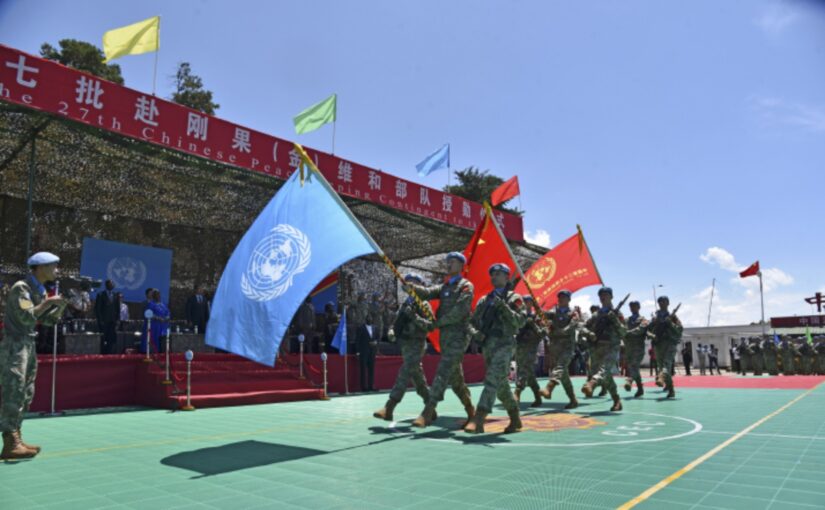
China is today the largest contributor of peacekeeping personnel among the five permanent members of the Security Council, and it has begun to extend the practical work of the GSI into new domains, including training security personnel across Africa, mediating regional disputes, and offering its experience of development-led stability as an alternative to militarized security.
Peace and development together
For the CPC, peace and development are two sides of a single coin. Lasting security, the GSI insists, rests on development, because conflicts cannot be resolved while their underlying causes—poverty, inequality, injustice—are left to fester. This is why the security initiative is inseparable from its companion, the Global Development Initiative, and from the Belt and Road Initiative, now the world’s largest platform for international cooperation, with more than 150 countries participating.
China has helped countries of Africa, Asia and Latin America build the roads, railways, ports and power grids needed to break out of underdevelopment, increasingly with green technology that allows them to leapfrog fossil fuel development.
Taken together with the Global Civilizations Initiative in 2023 and the Global Governance Initiative proposed in 2025, these form a coherent program: to democratize the institutions of global governance, strengthen rather than weaken the United Nations, and ensure that the destiny of the world is shaped by all its peoples rather than a handful of powerful states.
A consistent thread
A state genuinely bent on domination does not spend its diplomatic capital reconciling old adversaries; it does not forswear the first use of nuclear weapons; it does not decline to build the global network of bases that the projection of hegemonic power requires. The CPC’s conduct is consistent with the entire trajectory of Chinese policy since 1921—a trajectory of opposition to colonialism and hegemonism, support for the sovereignty of the formerly colonized world, and insistence on the equality of nations large and small.
In an age of nuclear weapons and shared planetary peril, the proposition at the center of that worldview is at once simple and radical: Security can only be common, or it will be no security at all. After 105 years, it remains the Party’s most valuable contribution to the governance of a turbulent world.






These initiatives and the principles that underlie them are noble, virtuous, altogether idealistic, admirable and commendable. In all of modern human political history, these are unprecedented coming from such a large country that is also a rising superpower. I can only hope that China’s execution of such a noble endeavor remains relevant, viable and truly effective in transforming people’s lives. So far, all the evidence shows that China is on the right track, such as with the Belt & Road Initiative projects, etc. The tide of common (mis) conception of Communism is turning (especially here in the West), the “Socialization” of the World is in full swing and hopefully we will see World Socialism become a reality for the majority of the earth’s people in our lifetime! In Solidarity, Carlos O. Santacruz WE NEED A DICTATORSHIP OF THE PROLETARIAT!
Once Imperialism is defeated, anything is possible. And China is showing the way to a peaceful post-Imperialist world.