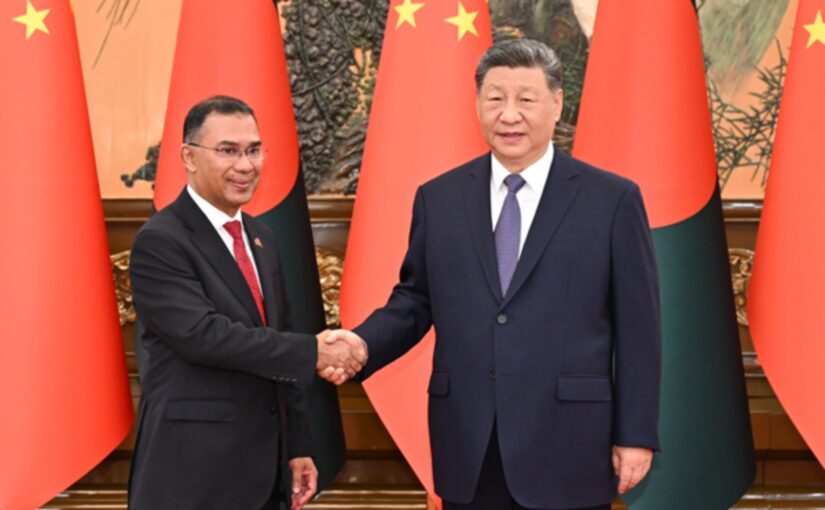
Tarique Rahman, Prime Minister of the People’s Republic of Bangladesh, paid an official visit to China from June 22 to 26, 2026, which included attending the 17th Annual Meeting of the New Champions 2026 (Summer Davos) held in the northeastern city of Dalian.
Rahman met with Chinese President Xi Jinping in Beijing on the morning of June 26 and the two leaders jointly announced the decision to build a China-Bangladesh community with a shared future in the new era, elevating bilateral relations to a higher level.
President Xi Jinping noted that China has all along attached great importance to the development of China-Bangladesh relations and stayed true to the policy of good-neighbourliness and friendship toward all the people of Bangladesh. No matter how the world changes, China will not waver in its commitment to the overall direction of China-Bangladesh friendly relations, and will always be a trustworthy good friend, good neighbour, and good partner of Bangladesh. This year marks the 105th anniversary of the Communist Party of China. Looking back over its history, the CPC has united and led the Chinese people in emerging from poverty and weakness and blazing a path of Chinese modernisation. Its strength lies in independence and self-reliance, and in keeping the future of national development and progress firmly in its own hands. China supports Bangladesh in upholding national independence, sovereignty and territorial integrity and rejecting foreign interference. China is ready to work with Bangladesh to increase exchanges of governance experience, enhance ties at all levels, deepen strategic communication, strengthen political mutual trust, and continue to support each other on issues concerning the respective core interests and major concerns of the two countries.
China supports the new government of Bangladesh in its governance efforts, and stands ready to work with Bangladesh to carry out high-quality Belt and Road cooperation, further align development strategies, exchange development experience, make sound plans for orderly cooperation in priority areas, explore cooperation potential in green and low-carbon development, digital economy, information technology, and artificial intelligence, conduct exchanges in healthcare, culture and education and at subnational levels, and advance the development of the China-Myanmar-Bangladesh Economic Corridor for greater regional connectivity. China is ready to strengthen communication and coordination with Bangladesh within multilateral frameworks including the UN, so as to jointly promote an equal and orderly multipolar world and a universally beneficial and inclusive economic globalisation and better uphold the legitimate rights and common interests of the two countries and the interests of the Global South.
Prime Minister Tarique Rahman extended congratulations on the 105th anniversary of the founding of the CPC. He said that China is a great country, holds a significant place in Bangladesh’s foreign policy, and is a valued and trusted partner of Bangladesh. He was pleased that bilateral relations have been raised to a new level of a Bangladesh-China community with a shared future in the new era. Under the strong leadership of President Xi Jinping, China has made great development achievements, and Chinese modernisation is an example for Bangladesh to learn from.
The two countries released a 15-point Joint Communiqué. In it, the two sides agreed to promote high-quality cooperation under the Belt and Road Initiative and work together to realise their goals of modernisation. China will pursue greater synergy with Bangladesh on development plans, promote both major signature projects and “small and beautiful” livelihood projects, and continue to support Bangladesh in advancing industrialisation and enhancing agricultural modernisation and resilience.
Bangladesh appreciated China for the zero-tariff treatment for 100 percent of tariff lines and will foster a favourable environment for Chinese enterprises to invest in Bangladesh. The two sides agreed to deepen cooperation in such areas as integrated water resources management, water resources planning, hydrological forecasting, flood prevention and disaster reduction, and river dredging, and related technology sharing.
China supported Bangladesh in playing a greater role in multilateral institutions such as the UN, and supported Bangladesh to participate in the BRICS and the application of Bangladesh to become a partner of the Shanghai Cooperation Organisation (SCO). The two sides expressed readiness to continue promoting multilateral cooperation in the region and welcome more regional countries to join in the process.
Bangladesh commended China’s constructive role in promoting the resolution of the issue concerning the forcibly displaced people from the Rakhine State of Myanmar who have taken shelter in Bangladesh. The Chinese side commended Bangladesh for providing humanitarian assistance to those people, and supported Bangladesh and Myanmar in finding a mutually acceptable solution through friendly consultations. China will continue to facilitate this process to the best of its capabilities.
The previous day, Rahman had met with his Chinese counterpart Premier Li Qiang, who said that China stands ready to work with Bangladesh to consolidate strategic mutual trust, expand practical cooperation, and bring more benefits to the people of both countries.
China is also ready to work with Bangladesh to uphold good-neighbourliness and friendship, consolidate strategic mutual trust, expand practical cooperation, promote continuous new and greater development of China-Bangladesh relations, and bring more benefits to the people of the two countries.
China is also willing to work with Bangladesh to promote high-quality Belt and Road cooperation, import more high-quality products from Bangladesh, support capable Chinese enterprises in investing in Bangladesh, and expand cooperation in emerging industries such as new energy, digital economy, artificial intelligence and information and communication with the Bangladeshi side.
Li also noted that China stands ready to closely coordinate and cooperate with Bangladesh in multilateral affairs, safeguard common interests, promote unity and self-reliance among developing countries, and make greater contributions to the joint development of the Global South.
Rahman expressed his gratitude to China for the valuable support it has provided to Bangladesh’s economic and social development over a long period of time, noting that Bangladesh looks forward to maintaining close high-level exchanges with China and strengthening the alignment of their development strategies.
Bangladesh firmly defends the post-war international order and highly agrees with and supports the concept of a community with a shared future for humanity and the four major global initiatives proposed by China. Bangladesh is also willing to cooperate with China on multilateral platforms.
Rahman met with Zhao Leji, chairman of China’s National People’s Congress (NPC) Standing Committee, on June 26.
Zhao said China is willing to work with Bangladesh to implement the important consensus reached by the leaders of the two countries, carry forward and practice the Five Principles of Peaceful Coexistence, deepen political mutual trust, expand mutually beneficial cooperation and promote the continuous development of China-Bangladesh relations.
The previous day he met with Liu Haixing, Minister of the International Department of the Communist Party of China (CPC) Central Committee (IDCPC), in his capacity of Chairman of the Bangladesh Nationalist Party (BNP).
Rahman said that China is a trustworthy old friend, a good friend and the most important development partner of Bangladesh. Bangladesh cannot achieve development and security without China’s assistance and support. Bangladesh firmly upholds the one-China principle and stands ready to work with China to carry forward the tradition of friendship, deepen mutual support, expand practical cooperation across all sectors, including livelihood projects in such areas as water infrastructure, industrial parks and hospitals, and push Bangladesh-China relations to a new height, so as to deliver greater benefits to the two peoples.
Liu noted that since the establishment of diplomatic relations in 1975, friendship has always been the defining feature of China-Bangladesh relations, and continuity is a defining feature of the friendship. Today, with unprecedented changes unfolding at a faster pace, the two sides should further consolidate political mutual trust through mutual support, draw a blueprint for win-win outcomes through practical cooperation, strengthen the bonds between the two peoples through people-to-people exchanges, and uphold international equity and justice through multilateral collaboration, ensuring that the friendship between China and Bangladesh is passed down through generations and continues to brim with new vitality. The CPC attaches great importance to its friendly relations with the BNP, and stands ready to take the signing of the memorandum of understanding on exchanges and cooperation between the two Parties as an opportunity to further deepen institutionalised inter-party exchanges, raise the level of the exchange of experience in state governance and administration, and promote cooperation in such areas as sub-national, youth, media and livelihood affairs through the “political party+” channel, so as to contribute the strength of the political parties to the continued development of China-Bangladesh relations.
Tarique Rahman became the 11th Prime Minister of Bangladesh on February 17, 2026, following the BNP’s decisive victory in the general election of February 12, where it won two thirds of the parliamentary seats. The Awami League, winner of the last four elections, was banned and could not contest. Rahman’s late father and mother previously served respectively as president and prime minister of Bangladesh.
The following articles were originally published on the websites of the Chinese Foreign Ministry and IDCPC and by the Xinhua News Agency.
President Xi Jinping meets with Bangladesh’s Prime Minister Tarique Rahman
June 26 (MFA) – On the morning of June 26, President Xi Jinping met with Bangladesh’s Prime Minister Tarique Rahman, who is on an official visit to China, at the Great Hall of the People in Beijing. The two leaders jointly announced the decision to build a China-Bangladesh community with a shared future in the new era, elevating bilateral relations to a higher level.
President Xi Jinping noted that China has all along attached great importance to the development of China-Bangladesh relations, and stayed true to the policy of good-neighborliness and friendship toward all the people of Bangladesh. No matter how the world changes, China will not waver in its commitment to the overall direction of China-Bangladesh friendly relations, and will always be a trustworthy good friend, good neighbor, and good partner of Bangladesh. This year marks the 105th anniversary of the Communist Party of China. Looking back over its history, the CPC has united and led the Chinese people in emerging from poverty and weakness and blazing a path of Chinese modernization. The strength lies in independence and self-reliance, and in keeping the future of national development and progress firmly in our own hands. China supports Bangladesh in upholding national independence, sovereignty and territorial integrity and rejecting foreign interference. China is ready to work with Bangladesh to increase exchanges of governance experience, enhance ties at all levels, deepen strategic communication, strengthen political mutual trust, and continue to support each other on issues concerning the respective core interests and major concerns of the two countries.
President Xi Jinping emphasized that China adheres to the policy of fostering an amicable, secure and prosperous neighborhood and the principle of amity, sincerity, mutual benefit and inclusiveness. It will continue to provide neighboring countries with new opportunities and fresh dynamism as the country grows. China supports the new government of Bangladesh in its governance efforts, and stands ready to work with Bangladesh to carry out high-quality Belt and Road cooperation, further align development strategies, exchange development experience, make sound plans for the orderly cooperation in priority areas, explore cooperation potential in green and low-carbon development, digital economy, information technology, and artificial intelligence, conduct exchanges in healthcare, culture and education and at subnational levels, and advance the development of the China-Myanmar-Bangladesh Economic Corridor for greater regional connectivity. China is ready to strengthen communication and coordination with Bangladesh within multilateral frameworks including the U.N., so as to jointly promote an equal and orderly multipolar world and a universally beneficial and inclusive economic globalization, and better uphold the legitimate rights and common interests of the two countries and the interests of the Global South.
Prime Minister Tarique Rahman extended congratulations on the 105th anniversary of the founding of the CPC. He said that China is a great country, holds a significant place in Bangladesh’s foreign policy, and is a valued and trusted partner of Bangladesh. He was pleased that bilateral relations have been raised to a new level of Bangladesh-China community with a shared future in the new era. Under the strong leadership of President Xi Jinping, China has made great development achievements, and Chinese modernization is an example for Bangladesh to learn from. Bangladesh hopes to strengthen bilateral exchanges between political parties, advance Belt and Road cooperation, and enhance cooperation and exchanges in economy and trade, connectivity, agriculture, technology, green energy, education and health to help Bangladesh achieve modernization. Bangladesh is firmly committed to the one-China principle, recognizes that Taiwan is an integral part of China’s territory, opposes any form of “Taiwan independence,” and firmly upholds the authority of the U.N. General Assembly Resolution 2758. The vision of building a community with a shared future for humanity and the four global initiatives put forward by President Xi Jinping are important to maintaining world peace, development and international fairness and justice. Bangladesh fully supports them and is ready to strengthen coordination and collaboration with China on international and regional affairs and uphold the outcomes of the victory of WWII and the U.N.-centered international order.
Wang Yi was present at the meeting.
Joint Communiqué between the People’s Republic of China and the People’s Republic of Bangladesh
June 26 (MFA)
1. At the invitation of H.E. Mr. Li Qiang, Premier of the State Council of the People’s Republic of China, H.E. Mr. Tarique Rahman, Prime Minister of the People’s Republic of Bangladesh, paid an official visit to China from June 22 to 26, 2026 and attended the 17th Annual Meeting of the New Champions 2026 (Summer Davos) in Dalian, China. During the visit, H.E. Mr. Xi Jinping, President of the People’s Republic of China, met with H.E. Mr. Tarique Rahman, Prime Minister. H.E. Mr. Li Qiang, Premier of the State Council of the People’s Republic of China, held talks with H.E. Mr. Tarique Rahman. H.E. Mr. Zhao Leji, Chairman of the Standing Committee of the National People’s Congress, had a meeting with Prime Minister Rahman. The two sides conducted an in-depth exchange of views on China-Bangladesh relations, and international and regional affairs of common interest and reached a broad consensus.
2. The two sides shared the view that since the inception of their diplomatic relations in 1975, China and Bangladesh have continuously cemented their political mutual trust, strengthened traditional friendship, and carried out fruitful pragmatic cooperation, and their bilateral relations enjoy promising prospects. The Chinese side congratulated Bangladesh for smoothly holding a general election in February 2026, expressed support for the governance of the new government of Bangladesh, and acknowledged that the new government of Bangladesh implemented the “Bangladesh Before All” policy. The Bangladeshi side believed that China’s 15th Five-Year Plan will bring important development opportunities to Bangladesh. Both sides agreed to elevate their comprehensive strategic cooperative partnership to jointly build a China-Bangladesh community with a shared future in the new era, to bring about more benefits to the two countries and peoples.
3. The two sides agreed to keep the momentum of high-level interactions, increase exchanges of governance experience, and strengthen exchanges and cooperation between governments, legislative bodies and political parties. The two sides agreed to set up a mechanism for strategic dialogue between foreign ministers. The two sides agreed to explore “2+2” dialogue mechanism on diplomacy and defense.
4. The two sides reaffirmed their firm support for each other on issues concerning their respective core interests and major concerns. They stressed that the authority of the U.N. General Assembly Resolution 2758 brooks no question or challenge. Bangladesh reaffirmed its strong commitment to the one-China principle, and recognized that there is but one China in the world, Taiwan is an inalienable part of the territory of the People’s Republic of China, and the Government of the People’s Republic of China is the sole legal government representing the whole of China. Bangladesh resolutely opposed any form of “Taiwan independence”, firmly supported efforts of the Chinese government in achieving national reunification. China reaffirmed its policy of good neighborliness toward all people of Bangladesh, firmly supported Bangladesh in safeguarding its national independence, sovereignty and territorial integrity, and respected the choice of the people of Bangladesh for an independent development path suited to their national conditions.
5. The two sides agreed to promote high-quality cooperation under the Belt and Road Initiative and work together to realize their goals of modernization. China will pursue greater synergy with Bangladesh on development plans, promote both major signature projects and “small and beautiful” livelihood projects, and continue to support Bangladesh in advancing industrialization and enhancing agricultural modernization and resilience. China will continue to support Bangladesh to the best of its capacity in advancing the economic and social development of Bangladesh.
6. China will strengthen cooperation with Bangladesh in trade, e-commerce, industrial and supply chains, and investment, in order to upgrade its export capacity and jointly uphold the multilateral trading system. Bangladesh appreciated China for the zero-tariff treatment for 100 percent tariff lines, and will foster a favorable environment for Chinese enterprises to invest in Bangladesh. The two sides agreed to jointly advance the Mongla Port Facilities Modernization and Expansion Project and the development of the Chinese Economic and Industrial Zone in Chattogram.
7. The two sides agreed to strengthen cooperation in such areas as connectivity, scientific and technological innovation, information and communications, green energy, photovoltaic technology, disaster prevention and mitigation, and addressing climate change. Both sides agreed to explore newer options for regional connectivity, including direct connectivity between China and Bangladesh.
8. The two sides agreed to deepen cooperation in such areas as integrated water resources management, water resources planning, hydrological forecasting, flood prevention and disaster reduction, and river dredging, and related technology sharing. The Chinese side will provide support and help within its capacity to the Teesta River Comprehensive Management and Restoration Project (TRCMRP), and support experts from both countries in expediting the feasibility study of the project and relevant work. They agreed to strengthen cooperation in maritime affairs.
9. The two sides agreed to deepen defense cooperation including exchanges, visits and training. Both sides agreed to maintain mutual understanding and engagement on U.N. peacekeeping affairs.
10. The two sides commended the successful commemoration of the 50th anniversary of China-Bangladesh diplomatic ties and the Year of China-Bangladesh People-to-People Exchanges in 2025. They agreed to deepen people-to-people exchanges and cooperation in such areas as media, think tanks, education, films, publishing, youth, sports and culture. The two sides will strengthen cooperation in human resources development and support closer cooperation between universities and vocational colleges. China will continue to provide Bangladeshi students with opportunities to study in China. The two sides agreed to deepen practical cooperation in such areas as public health and traditional medicine. Bangladesh welcomed and appreciated Chinese cooperation at subnational levels such as Yunnan Province in medical and health care.
11. Bangladesh appreciated and supported the vision of building a community with a shared future for humanity and the series of Global Initiatives put forward by President Xi Jinping, and stood ready to carry out cooperation with China. China supported Bangladesh in playing a greater role in multilateral institutions such as the U.N., and supported Bangladesh to participate in the BRICS and the application of Bangladesh to become the partner of Shanghai Cooperation Organization. The two sides expressed readiness to continue promoting multilateral cooperation in the region and welcome more countries in the region to join in the process.
12. Both sides agreed to firmly safeguard the U.N.-centered international system, the international order underpinned by international law and the basic norms governing international relations based on the purposes and principles of the U.N. Charter, and continue efforts to promote an equal and orderly multipolar world and a universally beneficial and inclusive economic globalization.
Both sides agreed that it is essential to firmly uphold the outcomes of the victory of World War II and oppose any attempts for fascistic and militaristic revival. The two sides expressed support for the postwar international order established by the Cairo Declaration, the Potsdam Proclamation and other international legal documents including the U.N. Charter.
13. Bangladesh commended China’s constructive role in promoting the resolution of the issue concerning the forcibly displaced people from the Rakhine State of Myanmar who have taken shelter in Bangladesh. The Chinese side commended Bangladesh for providing humanitarian assistance to those people, and supported Bangladesh and Myanmar in finding a mutually acceptable solution through friendly consultations. China will continue to facilitate this process to the best of its capabilities.
14. During the visit, the two sides signed a number of cooperation documents in sectors including development cooperation, human resources cooperation, agriculture, education, trade and investment and media cooperation.
15. Prime Minister Tarique Rahman expressed his heartfelt appreciation to the government and people of the People’s Republic of China for the warm and friendly reception extended to him and his delegation, and invited the Chinese leadership to visit Bangladesh at a mutually convenient time.
Chinese premier calls for expanded practical cooperation with Bangladesh
BEIJING, June 25 (Xinhua) — Chinese Premier Li Qiang said on Thursday that China stands ready to work with Bangladesh to consolidate strategic mutual trust, expand practical cooperation, and bring more benefits to the people of both countries.
Li made the remarks during talks with Bangladeshi Prime Minister Tarique Rahman in Beijing.
Noting China and Bangladesh are close neighbors with traditional friendship, Li said that China firmly supports Bangladesh in following a development path that suits its national conditions and supports the governance of the new government.
China stands ready to work with Bangladesh to uphold good-neighborliness and friendship, consolidate strategic mutual trust, expand practical cooperation, promote continuous new and greater development of China-Bangladesh relations, and bring more benefits to the people of the two countries, said Li.
China is willing to work with Bangladesh to promote high-quality Belt and Road cooperation, import more high-quality products from Bangladesh, support capable Chinese enterprises in investing in Bangladesh, and expand cooperation in emerging industries such as new energy, digital economy, artificial intelligence and information and communication with the Bangladeshi side, Li added.
Li also noted that China stands ready to closely coordinate and cooperate with Bangladesh in multilateral affairs, safeguard common interests, promote unity and self-reliance among developing countries, and make greater contributions to the joint development of the Global South.
Rahman said that developing relations with China is a priority of Bangladesh’s foreign policy, adding that the Bangladeshi government firmly adheres to the one-China principle, and opposes any form of “Taiwan independence.”
Rahman expressed his gratitude to China for the valuable support it has provided to Bangladesh’s economic and social development over a long period of time, noting that Bangladesh looks forward to maintaining close high-level exchanges with China and strengthening the alignment of their development strategies.
Bangladesh firmly defends the post-war international order, and highly agrees with and supports the concept of a community with a shared future for mankind and four major global initiatives proposed by China, Rahman said, adding that Bangladesh is willing to cooperate with China on multilateral platforms.
China’s top legislator meets Bangladeshi PM
BEIJING, June 26 (Xinhua) — Zhao Leji, chairman of China’s National People’s Congress (NPC) Standing Committee, met with Bangladeshi Prime Minister Tarique Rahman on Friday in Beijing.
Zhao said China is willing to work with Bangladesh to implement the important consensus reached by the leaders of the two countries, carry forward and practice the Five Principles of Peaceful Coexistence, deepen political mutual trust, expand mutually beneficial cooperation and promote the continuous development of China-Bangladesh relations.
China’s NPC is ready to work with Bangladesh’s National Parliament to deepen the exchange of experience in legislation and supervision and create a favorable legal environment for practical cooperation between the two countries, Zhao said.
Rahman stressed that Bangladesh adheres to the one-China principle, supports the series of global initiatives proposed by China, and looks forward to strengthening comprehensive strategic cooperation with China and deepening exchanges between legislative bodies.
Liu Haixing meets with Tarique Rahman, Chairman of the Bangladesh Nationalist Party (BNP) and Prime Minister of Bangladesh, upon request
June 25 (IDCPC) – Liu Haixing, Minister of the International Department of the CPC Central Committee (IDCPC), met in Beijing on June 25 upon request with Tarique Rahman, Chairman of the Bangladesh Nationalist Party (BNP) and Prime Minister of Bangladesh.
Tarique said that China is a trustworthy old friend, a good friend and the most important development partner of Bangladesh. Bangladesh cannot achieve development and security without China’s assistance and support. Bangladesh firmly upholds the one-China principle, and stands ready to work with China to carry forward the tradition of friendship, deepen mutual support, expand practical cooperation across all sectors, including livelihood projects in such areas as water infrastructure, industrial parks and hospitals, and push Bangladesh-China relations to a new height, so as to deliver greater benefits to the two peoples. He extended congratulations on the signing of the memorandum of understanding on exchanges and cooperation between the BNP and the CPC. Bangladesh attaches great importance to relations between the two ruling parties and stands ready to strengthen inter-party exchanges and cooperation with China.
Liu noted that since the establishment of diplomatic relations in 1975, friendship has always been the defining feature of China-Bangladesh relations, and continuity is a defining feature of the friendship. Today, unprecedented changes are unfolding at a faster pace, the two sides should further consolidate political mutual trust through mutual support, draw a blueprint for win-win outcomes through practical cooperation, strengthen the bonds between the two peoples through people-to-people exchanges, and uphold international equity and justice through multilateral collaboration, ensuring that the friendship between China and Bangladesh is passed down through generations and continues to brim with new vitality. The CPC attaches great importance to its friendly relations with the BNP, and stands ready to take the signing of the memorandum of understanding on exchanges and cooperation between the two Parties as an opportunity to further deepen institutionalized inter-party exchanges, raise the level of the exchange of experience in state governance and administration, and promote cooperation in such areas as sub-national, youth, media and livelihood affairs through the “political party+” channel, so as to contribute the strength of the political parties to the continued development of China-Bangladesh relations.
Prior to the meeting, Liu and Humayun Kabir, Joint Secretary General of International Relations of the BNP and Adviser to the Prime Minister on Foreign Affairs, signed on behalf of the two Parties the Memorandum of Understanding on Exchanges and Cooperation between the CPC and the BNP.
Sun Haiyan, Vice-minister of the IDCPC, Yao Wen, Chinese Ambassador to Bangladesh, Zahir Uddin Swapan, Bangladesh’s Minister for Information and Broadcasting, Md Shahiduddin Chowdhury Anee, Bangladesh’s Minister of Water Resources, and Nazmul Islam, Bangladeshi Ambassador to China, attended the above activities.






One thought on “China and Bangladesh upgrade relations to a community with a shared future in the new era”