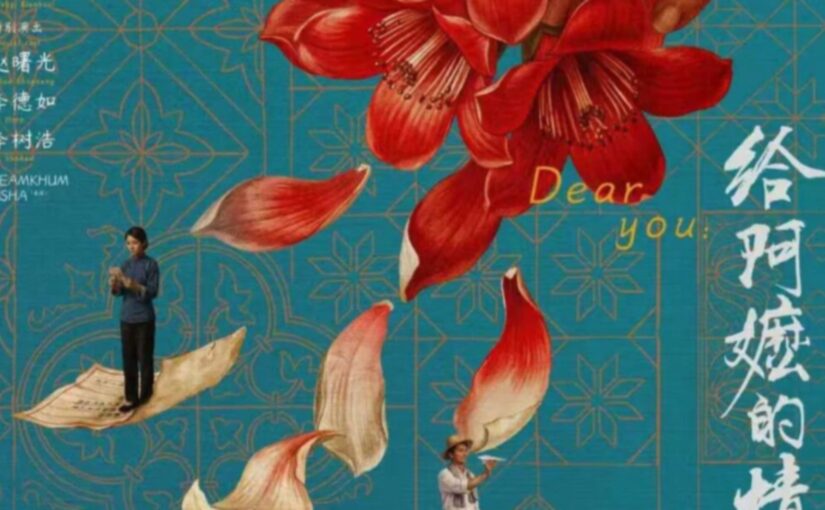
Our co-editor Keith Bennett is moved by China’s surprise film hit of 2026 – a story of the struggles and sacrifices of overseas Chinese and their families back home.
‘Dear You’, which was released in the UK and Ireland on June 26 by Trinity CineAsia, is China’s surprise film hit of the year. It was produced on a low budget of just over $2 million, featuring mostly amateur actors rather than big stars, filmed in a local dialect, and without the glitzy or dramatic special effects that increasingly characterise films produced in China as well as the West.
Going on nationwide release in China on April 30, in time for the May Day holiday, it rapidly became the country’s second highest grossing film of 2026, with box office receipts soon approaching the equivalent of $250 million.
The film is really a journey of discovery that operates on multiple levels. It has little overt political content yet is rich in political meaning. Progressively revealing the cruel realities that lay behind the waves of Chinese migration in the second half of the nineteenth century and the first half of the twentieth, it depicts how millions of Chinese people struggled and made a life – in the face of the pain of separation from home, family and motherland, and of poverty, exploitation, discrimination and exclusion.
Early in the story, Den Musheng (Bhagseng), also known as Iron Fish, is forced to leave his home in Teochew (Chaoshan), in the northern tip of Guangdong province, to avoid forcible conscription by the Kuomintang forces as they attempt to stave off their ultimate defeat at the hands of the Communist Party and the People’s Liberation Army. Leaving his wife, Sogriu (Ye Shurou), who herself had abandoned a life of privilege in a wealthy land-owning family to marry her poor lover, and their three young children, Bhagseng travels first to Malaya, then still under British colonial rule.
His time in Malaya proves short-lived in the face of British oppression and extreme exploitation. By this time, largely thanks to its rubber and tin resources, Malaya was the most profitable colony in the British Empire. With the “Malayan Emergency”, correctly known as the Anti-British National Liberation War, erupting in 1948, repression of the Chinese community in particular reached intolerable levels.
Life in Thailand is scarcely easier, with poverty, exploitation, corruption and repression still the defining features. Chinese language teaching is banned and Bhagseng helps establish an ‘underground school’ in the basement of the decidedly down at heel inn where he is struggling to rent the least salubrious room.
Through it all, he manages to make a life – through hard work and extreme frugality, never failing to support the wife and three children he has left behind.
Working as a rickshaw puller, he finally manages to save enough to acquire a share in a cargo boat. Although uneducated, he is possessed of a strong sense of community and solidarity. He understands the importance of education for the rising generation. He is fearless. When the owner of the inn where he lodges refuses to sell up to unscrupulous businessmen, who then proceed to burn the building to the ground, he rushes into the flames, saving the life of the innkeeper and his daughter Zai Lamgi (Nie Nanzhi), and beats the thugs responsible, severely injuring one of them. He takes the resulting two-year prison sentence (the arsonists predictably going unpunished) in his stride, being just concerned that his wife not know his situation and that regular payments continue to reach her.
Later as a boatman he loses his life, coming to the rescue of a neighbouring vessel that was being attacked by bandits.
Bhagseng’s example leads to a profound change in Lamgi. At the start, although she and her family are themselves barely a step away from absolute poverty, as the “landlady” she considers herself better than and above Bhagseng and others and probably dislikes him. She cares only for their micro business and for trying to charge the maximum rent. Scarcely literate herself, the only value she sees in learning is in the ability to keep basic financial records. She initially opposes the ‘underground school’, although admittedly largely out of fear of repression.
But gradually, she joins the classes herself and step by step her life’s experiences teach her the value of solidarity. She carries this understanding forward for the rest of her long life. She adopts a baby, abandoned by his mother due to poverty, and raises him as her own son. He goes on to become a teacher as she herself has become.
Finding herself unable to break the news of Bhagseng’s murder to Sogriu, she continues to write in his name, regularly sending money and special gifts, including the bicycle that Bhagseng had promised Sogriu when they first met. In effect, she raises two families in separate countries single-handed. This continues for decades until communications are broken by an unavoidable and poignant misunderstanding.
It’s the journey to Thailand, and his own voyage of discovery, by Bhagseng’s feckless and irresponsible, but not malicious, grandson Xiaowei that at last reveals the truth. Having racked up huge debts, Xiaowei hears rumours that his grandfather has become a billionaire, as numerous schools have been built and named in his honour. In fact, they have been endowed by the grateful beneficiaries of Chinese schools created from Bhagseng’s original initiative, who have gone on to become prosperous.
Such discoveries also lead Xiaowei to find the true meaning and purpose of life, as highlighted in his grandmother’s words featured at the start of the film: “In life, you must have compassion and a sense of loyalty. People without kindness and integrity are not worth keeping close.”
As the two families are finally joined together as one, the final layer of poignancy comes with Lamgi now suffering from dementia. The fleeting moments of lucidity, imbued with and radiating child-like innocence and love are among the most moving scenes in an intensely moving film. They will surely strike a chord with anyone who has cared for a well-loved relative at any stage of this cruelly degenerative condition.
What shines through in the film is its touching humanity, along with its vivid depiction of the patriotism, solidarity, loyalty, tenacity and sacrifice of the overseas Chinese. Before the customary credits roll at the end, a series of actual historical examples provide a coda for the film. The payment made to rescue a stolen daughter – one of the pervasive social ills of the old China. Contributions to support the war to resist Japanese aggression and the war to resist US aggression and aid Korea. Through to the immense funds that helped build new China – an immeasurable contribution to society; not just to families and hometowns but to the building of the modern socialist China we see today. Contributions that were certainly made by wealthy and successful people but also by countless legions of unsung heroes of the poor, whose every penny was hard-earned. Equally important is the centrality of strong, determined but tender female characters.
As director Lan Hongchun has put it in an interview: “The specific plot is fictional, but the stories and experiences that inspired it are all drawn from genuine accounts.”
It is not for nothing that ‘qiaopi’, those letters home, very often containing money, were recognised by UNESCO as part of its Memory of the World Heritage in June 2013. Doubtless there is still much in them for historians to mine.
An article in Global Times noted:
“Qiaopi is not just a letter home – it is a page of national history. From 1864 to 1911, nearly 2.94 million people from Chaoshan crossed the seas to make a living in Thailand, Malaysia, Indonesia, and Myanmar. Like Musheng [Bhagseng], they cleared wasteland, laboured in mines, tapped rubber, and sold goods on foreign streets. They bore the harshest burdens themselves yet sent home every last coin they could save. What kept them going was an unyielding determination to build a better life for their families back home. Their motherland remained an enduring spiritual beacon – a light that reached across rivers and mountains. In those turbulent and destitute years, four or five out of every 10 people in Chaoshan relied on these qiaopi to survive. Dear You thus records not merely a solitary fate, but the collective memory of struggle and mutual aid shared by millions of overseas Chinese.”
In his celebrated article, In Memory of Norman Bethune, Mao Zedong criticises, “people who are irresponsible in their work, preferring the light and shirking the heavy, passing the burdensome tasks on to others and choosing the easy ones for themselves. At every turn they think of themselves before others. When they make some small contribution, they swell with pride and brag about it for fear that others will not know.”
The strength and attraction of characters like Bhagseng, Sogriu and Lamgi comes from the fact that they epitomise the very opposite. Not by virtue of holding any political position or high office but simply by virtue of who they are and what they do every single day of their lives. In Mao’s words again:
“The masses are the real heroes… and without this understanding, it is impossible to acquire even the most rudimentary knowledge.”
The film is not all emotional intensity. Perhaps precisely because it was a low budget, semi-professional production, it also features humour, sometimes of the ‘slapstick’ variety, plenty of profane language and some robust sexual innuendo, more so than what one might be accustomed to in a Chinese film of this type but likely increasing its accessibility and relatability to an international audience as a result. That said, given contemporary standards, the British Board of Film Classification (BBFC)’s giving it an age 15 certificate seems unwarranted and excessive.
I saw the film twice a matter of days apart, both times accompanied by friends, at London’s lovely Garden Cinema, a non-commercial haven for lovers of independent, alternative and world films. On my second visit, before the film started, I was telling my friend how last time not only had I left the film in tears but so had many Chinese students. Hearing this, a young man who was sat nearby, and who along with his girlfriend, turned out to be a student taking a master’s degree in science at one of London’s most prestigious universities, reached across and told me: “I was probably one of them.”
Distribution rights for Dear You are held by Trinity CineAsia for the UK, Ireland and France and details of screenings can be found here. Rights for the USA are held by CMC Pictures.