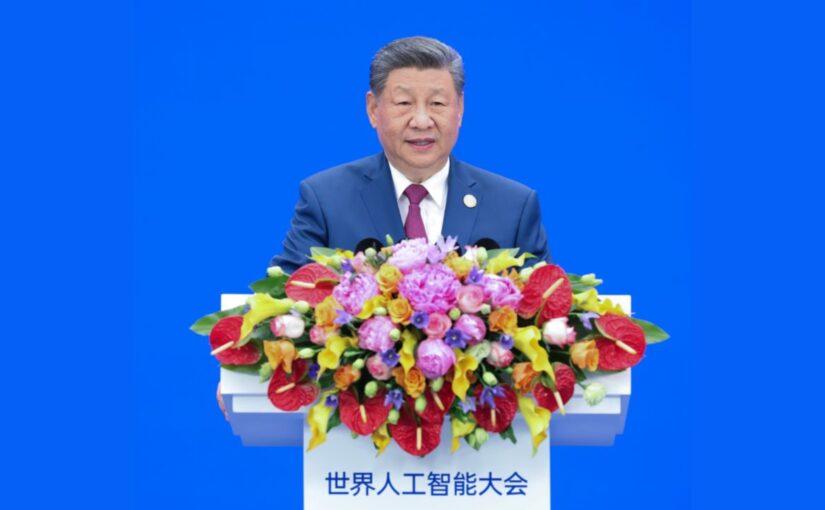
On 17 July, Xi Jinping delivered the keynote address at the opening of the 2026 World AI Conference in Shanghai – his first in-person appearance at the conference since it began in 2018, and coming a day after 29 countries signed the agreement establishing the World Artificial Intelligence Cooperation Organisation (WAICO), a new intergovernmental body headquartered in Shanghai. The event was attended by President Kassym-Jomart Tokayev of the Republic of Kazakhstan, Prime Minister Hun Manet of the Kingdom of Cambodia, Prime Minister Anutin Charnvirakul of the Kingdom of Thailand, Secretary General of the United Nations António Guterres, and official representatives, business leaders, scholars and researchers from more than 100 countries and international organisations.
In the following analysis for Friends of Socialist China, Carlos Martinez examines the significance of Xi’s speech and the launch of WAICO. He argues that they represent a direct alternative to Washington’s approach – encapsulated in the Trump administration’s “Winning the Race” AI action plan, with its export controls, model restrictions and pressure on allies to join a technological blockade of China.
Where the United States treats artificial intelligence as a weapon in a zero-sum contest for supremacy, Xi calls for “open source, openness, collaboration and sharing”, and for AI to be developed as a common asset of humanity, with its benefits extended to the Global South. It is, Carlos writes, a democratic, multipolar and socialist vision: technology as a public good, serving people before profit.
Carlos’s analysis is followed by the full text of Xi Jinping’s keynote address, as published by the Xinhua News Agency.
Should artificial intelligence – perhaps the most consequential technology of our era – be the exclusive property of a handful of corporations and one increasingly belligerent superpower, or should it be developed as a common asset of humanity? That is the question Xi Jinping posed, implicitly but unmistakably, in his keynote speech at the opening of the 2026 World AI Conference in Shanghai on 17 July – his first in-person address to the conference since its launch in 2018, and delivered a day after 29 countries signed the agreement establishing the World Artificial Intelligence Cooperation Organisation (WAICO), a new intergovernmental body headquartered in Shanghai.
Citing an old Chinese saying, Xi observed that “a single string cannot make music, and a single tree does not make a forest”, insisting that AI development “should not be a solo performance by a single country, but a symphony of international cooperation”. The metaphor is well chosen, because a solo performance is precisely what Washington has in mind.
Winning the race, or sharing the prize?
The United States announced its own AI strategy a year ago. Its title – Winning the Race: America’s AI Action Plan – tells us much of what we need to know about the underlying philosophy. AI is conceived not as a tool for human development but as a weapon in a zero-sum contest for global supremacy; the plan is built around tightening export controls on advanced semiconductors, restricting access to leading US models, and pressuring allies – under threat of secondary tariffs – to join a technological blockade of China. The Trump administration has since extended export controls to cutting-edge US AI models, forcing even European businesses to confront the risks of depending on US technology.
Xi’s speech reads as a point-by-point repudiation of this approach. Where Washington seeks to hoard the technology, China calls for “open source, openness, collaboration and sharing”. Where Washington weaponises “national security” to justify its chip war, Xi calls on the international community to “jointly oppose overstretching the national security concept in the field of AI and placing one country’s security over that of others”. Where Washington demands that the world adopt “American values” along with the American AI stack, Xi insists that AI “should not erode or undermine the diversity of world civilisations or the uniqueness of cultures of different countries”.
The West’s framing of AI as a civilisational contest is far from subtle. At the Paris AI summit last year, JD Vance warned darkly of “authoritarian regimes” using AI to control their citizens, while Britain’s technology secretary Peter Kyle declared that the AI race must be led by “western, liberal, democratic” countries. China’s response at the time – that it is “against drawing lines along ideological difference, overstretching the concept of national security, or politicising trade and tech issues” – is precisely the position Xi has now elevated to the level of a global governance programme. And as legal scholar Angela Zhang observed in the Financial Times, China does not think in terms of an “AI race”; its priority is not supremacy but self-sufficiency, diffusion and application – making the technology useful, cheap and universal.
People before profit
The contrast between China and the West’s approaches reflects two different social systems, with two different logics. In the US, AI development is driven by the profit expectations of a handful of tech giants and the war-planning of the Pentagon. In China, a socialist market economy directs the technology towards social ends: Xi spoke of smart devices that “truly improve people’s livelihood”, of coordinated upgrading across traditional and emerging industries “so that all sectors and businesses can benefit from AI”, and of keeping AI “always under human control”.
The difference shows up in practice. While Silicon Valley promises mass layoffs as a selling point to investors, China’s AI Plus programme – now fully integrated into state industrial policy – is oriented towards job creation and job quality, popularising AI as a social good while regulating its disruptions.
In Chinese hospitals, an AI screening tool called PANDA is detecting pancreatic cancer from routine CT scans before symptoms appear – catching early, at population scale, one of the deadliest cancers. And while Wall Street inflates an AI investment bubble of historic proportions, the CPC’s top theoretical journal has been urging the cultivation of “patient capital” – long-term, mission-oriented investment in place of speculative frenzy.
The DeepSeek phenomenon exemplifies the whole approach: a world-class model, developed at a fraction of the cost of its US competitors, requiring far less energy and computing power, released free and open source to the entire world. One model treats intelligence as a commodity to be enclosed; the other treats it as a public good to be shared.
Answering the call of the Global South
Some of the most striking passages of Xi’s speech concern the developing world. Xi warned against allowing the AI revolution to create a “new historical injustice” – a digital reprise of the colonial division of the world – and committed China to “help Global South countries with capacity building to bridge the AI and digital divides”. This was backed with concrete pledges: 5,000 AI training opportunities for developing countries over the next five years; international AI application cooperation centres with ASEAN, the Arab League, the African Union, CELAC, the SCO and BRICS; and the extension of MAZU, China’s AI-powered meteorological early warning system, to 30 countries.
WAICO itself is, in Xi’s words, “a major move by China to answer the call of the Global South”. Its founding membership – including Cuba, Ethiopia, Kenya, Laos, Pakistan, Brazil, Indonesia and Venezuela – speaks for itself, as does the attendance of UN Secretary-General António Guterres at the signing ceremony. Even the South China Morning Post acknowledges that Beijing is positioning itself as the advocate of openness “at a time when access to advanced technologies is increasingly constrained by export controls and corporate blacklists”.
Four initiatives, one vision
WAICO is the institutional expression of the Global AI Governance Initiative Xi proposed in 2023, and it takes its place within the broader framework of China’s four global initiatives: the Global Development Initiative (2021), the Global Security Initiative (2022), the Global Civilisation Initiative (2023) and the Global Governance Initiative (2025) – the operational programme of the community with a shared future for humanity. Indeed, the GGI concept paper explicitly identified the governance vacuum in artificial intelligence, alongside the underrepresentation of the Global South, as among the central failures of the existing international system. WAICO is the answer to that diagnosis: international rules on AI jointly formulated rather than imposed.
The speech maps directly onto the four initiatives: AI as “an important driver for shared prosperity” (development); AI as a contributor to “common security” rather than an arms race (security); AI in the service of “mutual learning between civilisations” (civilisation); and a “consensus-based global governance framework” built on “true multilateralism” and the central role of the United Nations (governance).
Beneath the mapping lies a single question, posed in every domain the initiatives touch: is the world a jungle in which the strong prey on the weak, or a family with a single shared home? Applied to AI, the first logic – the logic of capitalism and imperialism – produces export controls, corporate enclosure and an arms race; the second – the logic of socialism – produces open source, capacity building and cooperation.
What WAICO embodies is a fundamentally democratic vision of technological development: decisions about humanity’s future made not in the boardrooms of Silicon Valley or the war rooms of Washington, but through “extensive consultation and joint contribution for shared benefit” among sovereign equals. It is, equally, a socialist vision: technology as a public good, serving people before profit, with its benefits extended deliberately to those the capitalist world system has always excluded.
The United States offers the world an AI race with one permitted winner. China offers a symphony in which every country has an instrument.
Full text: Keynote speech by Chinese President Xi Jinping at the opening ceremony of the 2026 World AI Conference
SHANGHAI, July 17 (Xinhua) — Chinese President Xi Jinping delivered a keynote speech at the opening ceremony of the 2026 World AI Conference and High-Level Meeting on Global AI Governance held here on Friday.
The following is the full text of the address:
Joining Hands to Build a Just and Equitable System for Global AI Governance
Keynote Address by H.E. Xi Jinping, President of the People’s Republic of China, at the Opening Ceremony of the 2026 World AI Conference and High-Level Meeting on Global AI Governance, Shanghai, July 17, 2026
Distinguished Colleagues and Guests,
Ladies and Gentlemen,
Friends,
Seventy years ago, a group of young scholars proposed the concept of artificial intelligence (AI) for the first time at the Dartmouth Workshop in New Hampshire of the United States. In the subsequent 70 years, AI scientists and researchers from around the world ventured into this unknown territory, forged ahead through twists and turns, and made breakthroughs with persistent hard work. Seven decades later today, amid the new wave of AI development, we are gathering by the Huangpu River to discuss how to promote AI globally for the positive, for good and for humanity. All this makes our meeting highly important. On behalf of the Chinese government and people, I would like to extend a warm welcome to you all.
In the course of history, the invention of the steam engine heralded the industrial civilization, the widespread access to electricity brightened up modern society, and the birth of the Internet brought the entire world together. Each of these technological revolutions has profoundly reshaped our way of work and life, and enabled a giant leap in economic and social development.
Today, major changes unseen in a century are accelerating across the world. The new round of technological revolution and industrial transformation is advancing at a faster pace, and the world has entered an unprecedented period of active innovation on AI technologies. Intelligent connectivity, human-machine collaboration, cross-sector integration, joint creation and sharing, and other intelligent technologies are unleashing enormous power. All this carries within it great opportunities as well as challenges to governance. We human beings must answer the questions posed by our times: How to get along with thinking machines? How to ensure security when algorithm is part of decision making? How to tackle ethical challenges by technologies through adaptive governance? How to realize AI for all when the divide keeps widening? These questions demand serious consideration and real answers from the whole international community.
In China’s view, all countries should take a people-centered approach and develop AI for the positive and for good. We should ensure that AI is an important driver for shared prosperity and common security. We should join hands to build a just and equitable system for global AI governance. To this end, I wish to share four observations.
First, we should adhere to the principle of openness and win-win and boost innovation-driven development. As a new engine of world economic growth and an accelerator for the shift of growth drivers, AI is moving from the digital world into the physical world. We should seize this rare, historic opportunity to encourage open source, openness, collaboration and sharing. We should facilitate technological innovation, industrial development and scenario-based application of AI. We should make coordinated advances in the transformation and upgrade of traditional industries, the cultivation and growth of emerging industries and forward-looking planning for future industries, so that all sectors and businesses can benefit from AI.
Second, we should strengthen risk-awareness and ensure that AI is secure and controllable. AI should be a trusted tool for humanity. We should take seriously the various types of inherent and secondary risks that AI may trigger. We should put in place laws and regulations, technological monitoring, early warning and emergency response systems in order to strengthen the line of security, prevent abuses and malicious use, and ensure that AI is always under human control. In the meantime, we should jointly oppose overstretching the national security concept in the field of AI and placing one country’s security over that of others.
Third, we should encourage inclusiveness and promote mutual learning between civilizations. AI development and its application should not erode or undermine the diversity of world civilizations or the uniqueness of cultures of different countries. We must shape the values of AI with humanity’s common values, and make good use of AI technologies to increase understanding, tolerance, exchanges, and sharing among all civilizations. We should tend to the garden of civilizations with great care to ensure that the beauty of each civilization is appreciated and shared.
Fourth, we should advocate solidarity and improve global governance. AI is an invaluable asset that encapsulates humanity’s collective wisdom. We should practice true multilateralism and recognize the important role of the United Nations. We should enhance alignment and coordination on AI development strategies, governance rules and technical standards, so as to form a consensus-based global governance framework at an early date to make this frontier technology better benefit humanity. We must carry out extensive international cooperation and help Global South countries with capacity building to bridge the AI and digital divides, promote sustainable development, and prevent creating new historical injustice in AI.
Ladies and Gentlemen,
Friends,
This year marks the start of China’s 15th Five-Year Plan. It maps out China’s economic and social development for the next five years and provides immense opportunities for the international community. In recent years, China has embraced AI with open arms. We have promoted interplay between an efficient market and a well-functioning government, strengthened AI innovation, actively advanced the AI Plus Initiative, and built a healthy ecosystem for all entities to thrive in together. The core smart economy industries are worth at least RMB 1 trillion yuan. Smart devices in countless homes truly improve people’s livelihood. Intelligent Manufacturing in China has become another shining hallmark of Chinese modernization.
At the same time, China lays great emphasis on safety and security in AI development. With a deep understanding of the trends and logic of AI development, we are continuously improving laws, regulations, policies, mechanisms, application norms, as well as ethical principles to make sure that AI is safe, secure and controllable, and that this fine steed of AI gallops with both speed and stability.
As a responsible major country, China is always committed to providing international public goods relating to AI. Since I proposed the Global AI Governance Initiative, China has promoted the adoption of the U.N. General Assembly Resolution on Enhancing International Cooperation on Capacity-Building of Artificial Intelligence by consensus, published the AI Capacity-Building Action Plan for Good and for All, announced the AI Plus International Cooperation Initiative, and advocated for establishing the World Artificial Intelligence Cooperation Organization (WAICO). China has been contributing steadily to the global AI governance.
We often say in China, “A single string cannot make music, and a single tree does not make a forest.” AI development should not be a solo performance by a single country, but a symphony of international cooperation. Thanks to our joint efforts, WAICO has come into being in Shanghai. Our vision from one year ago is now a reality. This is a major move by China to answer the call of the Global South and unite the international community together to promote vigorously AI development and governance. It will be an important milestone in the history of AI development.
To further support global AI development and advance global AI capacity building, I hereby announce that in the next five years, China will provide developing countries with 5,000 opportunities in AI training and seminar programs; develop international AI application cooperation centers with the Association of Southeast Asian Nations, the League of Arab States, the African Union, the Community of Latin American and Caribbean States, the Shanghai Cooperation Organization, and BRICS; and enable 30 countries to use the AI-powered meteorological warning system, or MAZU, to safeguard homes around the world.
Ladies and Gentlemen,
Friends,
As ancient Chinese observed, “A man of wisdom adapts to changes; a man of knowledge acts by circumstances.” With AI advancing at a staggering speed, we must ensure its development is for the positive, for good and for humanity. We must make its oversight and governance precise and effective, and constantly refine measures to forestall loss of control. We should always guide AI development with human wisdom and international consensus, so that AI can truly become a mighty force that increases the well-being of humanity and advances human civilization.
China is ready to be more open, take more practical actions, and assume a more visionary perspective. We are ready to work with all parties to seize the opportunities of AI development and meet the challenges, and join hands to create a brighter future for humanity.
Thank you!






How will the seas, nature and our animals, health and water be preserved? The sea based items, how will fish and whales and dolphins navigate without being able to use their sonar? How will we preserve the bees that die off near them, and the animals exposed to EMF’s that may be causing still birth? How is this affecting us? This is a worldwide question from a concerned person. Thank you
Michael Hudson pithily observed that “American values” prioritized rent-seeking opportunities. Regardless of their rhetoric, Silicon Valley entrepreneurs want an AI platform that they can license to others and collect an endless stream of rents. As such, they will never be in compliance with Xi Jin Ping’s initiatives.