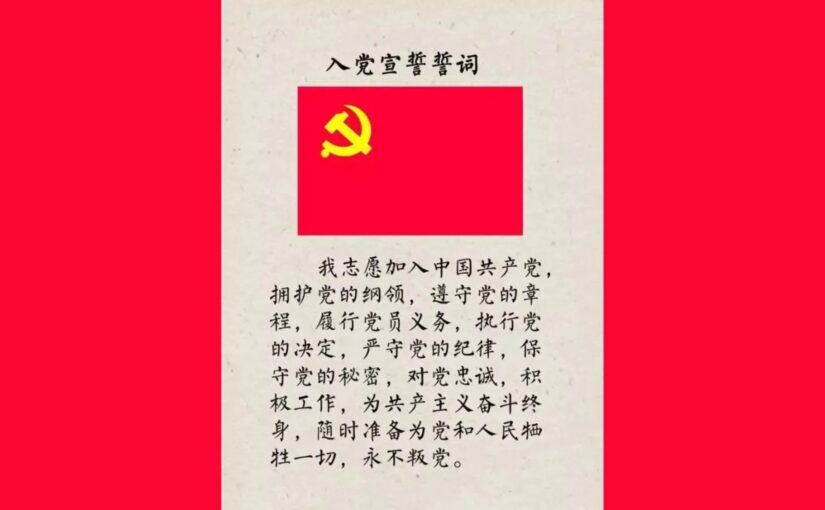
The following essay by the writer Amy Yang, who publishes on China and socialism on Substack, was written to mark the 105th anniversary of the founding of the Communist Party of China. Taking the red flag of the hammer and sickle – its yellow standing for the faith of workers and peasants in a communist future, its red honouring the more than 3.7 million martyrs who died between 1921 and 1949 – as her starting point, Yang argues that the party is best understood through the enduring lessons of the Long March.
She highlights two of these lessons. The first is that Marxism is a scientific method rather than a fixed dogma, and that no single development path suits every country: the early communist movement failed when the Comintern imposed Soviet, city-first strategies on a society that was overwhelmingly based in the countryside. It was Mao Zedong’s strategy – restored at the Zunyi Conference of 1935 – that corrected the error.
The second is that popular support decides victory: the poorly armed Red Army prevailed because it treated ordinary people, and especially China’s ethnic minorities, with discipline and respect.
Yang carries both lessons forward – to China’s reform and opening up, and to its insistence on non-interference and the people’s well-being as the measure of global governance. Each generation, she concludes, faces its own Long March.
This article first appeared on Amy Yang’s Substack.
Today is the 1st of July. It marks the 105th anniversary of the Communist Party of China (CPC).
105 years ago (on July 23rd), the Party, which at that time only had over 50 cadres and was still an “illegal” underground group, secretly but officially announced its founding on a boat on the South Lake in Jiaxing, Zhejiang on the last day of the First National Congress of the CPC. 105 years later today, the CPC has developed to the largest communist party in the world with more than 100 million cadres.
Its red flag, the flag of hammer and sickle, has become a beacon of hope and a symbol of faith for countless people not only in China but also all over the world.
Despite minor differences, flags of all communist parties around the world use the same colours and symbols, as the belief in communism has no borders and speaks the same language, the language of the masses, the language of a classless future.
The hammer and sickle in the colour “yellow”, is a symbol of unwavering faith and inextinguishable hope of all peasants and workers around the globe in a communist future for the entire humanity. The colour of the flag, “red”, is a symbol of blood and revolution. In the case of CPC, it embodies the memory of over 3,7 million communist martyrs who sacrificed their lives for the socialist and anti-imperialist cause during the period between 1921 (the founding of the CPC) and 1949 (the founding of the People’s Republic of China).
On this special day, l would like to pay tribute to this red flag of hammer and sickle together with all friends of socialist countries by learning from one important chapter in the past journey of the CPC, the Long March.
From a national perspective, the importance of the Long March lies not only in its success in helping the CPC to save and strengthen its core force, but also in its lasting impact on the current development path and the global governance philosophy of China. Thus, it is in my opinion not an exaggeration to say that to understand China, one has to understand the Long March first.
Furthermore, from an international perspective, the whole humanity is on a long march towards a classless society beyond capitalism and imperialism. By taking lessons from the Long March as mirror, we can avoid preventable mistakes, develop better strategies and take more effective actions in our anti-imperialist and anti-capitalist struggles.
So now let us travel back to around a century ago.
Lesson from the Long March 1: Marxism is not a dogma, and there is no universal development path for all countries
The inspiring story of the Long March might be well-known for many in the west. But what is seldom known is the reason why the Red Army had to make such a dangerous move. To answer this question, we need to go back to the period before it.
Before the Zunyi Conference, the CPC was still a branch of the Comintern and had to consult the Comintern on major decisions. As a result of both dogmatism and insufficient knowledge in the local cultural, political and material conditions, the Comintern tried to copy strategies of the Soviet and paste them to China without any modifications, believing that the Soviet way of revolution is the universal way that could lead to success everywhere. However, the strategies of the Soviet were not acclimatised to the soil and water in China (水土不服) and led to severe consequences.
After the August 7th Conference in 1927, the CPC officially started over one hundred armed struggles against the bourgeois comprador class represented by the Kuomintang (KMT) party. However, the strategy of armed struggles was borrowed directly from Soviet, namely “firstly targeting major cities”. This strategy was very soon proven to be a total failure because it ignored the actual conditions in China that around 90% of the Chinese people were peasants and the working class was still an extremely weak minority.
After the failure of armed uprisings, comrades with Mao Zedong as the core reflected on the mistakes of dogmatism and started changing strategies, just as Mao said, “Marxists must turn around when they reach a place where they cannot proceed further”. To “turn around”, Mao proposed strategies based on specific local conditions in China, including focusing on the countryside, establishing and consolidating Revolutionary Base Areas (革命根据地) in the countryside and encircling the cities from the countryside (农村包围城市).
For example, during the Autumn Harvest Uprising (秋收起义) in 1927, after analysing the conditions on the ground, Mao decided resolutely to change the original plan of “attacking and occupying the city Changsha”. Instead, he led the Red Army to retreat to the rural areas in Southern Hunan and established the Jinggangshan Revolutionary Base Area (井冈山革命根据地).
However, the “left” dogmatism still dominated the CPC. The Comintern insisted on completely borrowing the Soviet strategies like occupying the cities first and mobile approach without revolution base areas. At the Seventh Congress of the Fourth Red Army in 1929, Mao Zedong was dismissed from his position as secretary of the Front Committee.
Due to the strong calls for the restoration of Mao Zedong’s leadership inside the Fourth Red Army, Mao was reinstated as the secretary shortly after three months. Nevertheless, the restoration of Mao’s leadership position didn’t mark the end of the “left” dogmatic trend in the CPC under the influence of the Comintern. Few years later on the eve of the fifth counter-encirclement campaign in the autumn of 1933, this “left” dogmatic trend gained once again dominance.
While Mao had successfully led the First Front Army to defeat the army of the bourgeois KMT party in the first to fourth counter-encirclement Campaigns, he was removed from the leadership position in the fifth counter-encirclement campaign. Instead of Mao, Otto Braun (李德), a military advisor appointed by the Comintern from Germany, was given the leadership position.
Due to dogmatism and a lack of knowledge in local conditions, the provisional central committee under the new leadership of Otto Braun abandoned Mao’s previously effective guerrilla warfare and adopted erroneous positional warfare tactics, leading to heavy losses of the Red Army.
Faced with the heavy encirclement of the army of the bourgeois KMT party, the Red Army had no choice but to abandon the Central Revolutionary Base Area (中央根据地) in October 1934 and started the well-known Long March. Soon after that in 1935 the Zunyi Conference successfully corrected the mistakes of the “left” dogmatism, ended the absolute dependence on the Comintern, and formally established the leadership position of Mao Zedong.
As said in Chinese dialectical philosophy Yijing, “when things reach an impasse, we must change; change brings about a path forward; and this new path ensures endurance (穷则变,变则通,通则久)”, the Long March is exactly the effort made by the CPC in an impasse to change the past dogmatic path and bring about a new path forward, a path based on dialectical materialism. Or as Xi Jinping said,
the Long March traversed not only countless mountains and rivers, but also overcame the erroneous ideological obstacle of treating Marxism as an immutable dogma.
Thus, one of the most valuable lessons from the Long March is that Marxism is not dogma, and there is no one-fits-all solution in building socialism. Instead, Marxism is a great scientific tool based on dialectical and historical materialism that allows us to explore a feasible path to socialism that suits the conditions of our own countries.
Lesson from the Long March 2: Those who win the hearts of the people win the world, those who lose the hearts of the people lose the world (得民心者得天下,失民心者失天下)
Many people wonder why the army of the KMT party with advanced equipment and abundant financial support from the US empire failed to encircle and eradicate the poorly equipped and extremely poor Red Army. They might tribute the victory of the Long March to random good luck. Yet the real answer lies somewhere else. To find out it, we need to look at the mass line policy adopted by the CPC in the Long March.
Based on the grassroots experiences gathered in the revolutionary base areas, cadres in the CPC were fully aware of the importance of the support of the people. Thus, before the Long March began, the leadership of the Red Army had acknowledged and emphasized the key role of the mass support to the success of the Long March.
However, the support of the people for the Red Army did not fall directly from the sky. The only way to win the hearts of the people is through hard work and concrete actions, not empty talks and flowery words.
In the Long March, to avoid encirclement of the KMT party, the Red Army was forced to traverse mountainous areas and highlands of Hunan, Guangxi, Guizhou, Yunnan, Sichuan, Gansu, Qinghai, and Ningxia, where more than ten ethnic minority groups lived and still live until now, including Miao (苗), Yao (瑶), Zhuang (壮), Yi (彝). Due to years of plundering and oppression by warlords from the KMT party and the frequent exploitation by Han merchants, ethnic minority people in these poor rural areas developed mistrust and even hostile attitudes against Han people.
To win back the trust and support of the ethnic minority people, the Red Army implemented strict policies to discipline the behaviours of cadres. According to the “Directives on the work of winning over ethnic minority people” issued in 1935, “it is prohibited for all cadres to have prejudices of ‘Great Han chauvinism’, to look down upon ethnic minority people”, “all cadres should fully respect the religious beliefs and customs of ethnic minority people and strictly refrain from any form of harassment against ethnic minority people”.
These overarching rules were further specified into more detailed rules based on the specific customs of the local ethnic minority groups. For example, to co-live with Hui Muslim People (回族) in a respectful manner, the “Three Prohibitions and Four Points of Attention” was formulated and enacted in regions where Hui Muslim People lived. The policy is as follows,
it is prohibited for all cadres to station in mosques, to eat forbidden meats (such as pork) in Hui households, to attack local Hui landlords; all cadres should remember to respect Hui customs and traditions, to use Hui-owned buckets when drawing water from wells, to avoid contact with young Hui women, to trade fairly and honestly.
Another example is the “instruction on preventing fires in Red Army Encampments and Arson by Counter-revolutionaries”, which was implemented specifically for regions where the Miao (苗), Yao (瑶) Tong (侗) people lived because their traditional wooden houses are easy to be damaged by fire.
Through implementing these strict policies, soldiers (cadres) of the Red Army treated ethnic minority people respectfully, and thus gaining successfully their support.
For instance, when the Red Army was staying at the Longping Village of Tong people (侗族) in Longsheng County, Guangxi, they noticed that some agents appointed by the KMT party had set fire to wooden houses of some villagers. The Red Army soliders led by Zhou Enlai helped immediately extinguish the fire. In addition, to help the affected villagers to repair their houses, the Red Army gave each of them over 2,000 silver dollars despite having very limited money itself. To express gratitude for the help of the Red Army, the villagers named the village’s historic Drum Tower, which was spared from the fire, “Red Army Tower (红军楼)”.
In addition, when the 25th branch of the Red Army passed through areas like Xinglong Town and Shanjiaji (now part of Ningxia) where Hui Muslim People lived, the soldiers behaved completely different from soldiers in the army of the KMT party. Instead of bullying the people, they voluntarily assisted the people to clean courtyards, fetch water and treat illnesses. An elderly Hui grandpa was deeply touched by the behaviour of the Red Army and said “In all my years, this is the first time I have ever seen such a benevolent and righteous army.”
It goes without saying that no help is one-sided and all supports are mutual. The Red Army respected and helped the people, while the people, in return, firmly supported the Red Army, with many of them voluntarily joining it.
Without the support of the people, there would be no victory of the Long March. Without the 36 boatmen from Han (汉), Yi, and Dai (傣) ethnic groups, the Central Red Army could not cross the Jinsha River rapidly and safely over the course of seven days and nights. Without Zang (Tibetan, 藏) people providing grains and volunteering as guides, the Red Army could not cross Jiajin Mountain—a peak so formidable that “even birds could not fly over it”—and traverse the vast grasslands where “men and horses would sink out of sight.”
Similar to what Mao said, “the revolutionary war is a war of the masses”, the victory of the Long March is also the victory of the masses, of all Chinese people from all 56 ethnic groups.
Hence the answer to the question “why the well-equipped Army of the KMT party could not even defeat the poorly equipped Red Army” lies in the fact that before the firm support of the people, any advanced weapon seems to be powerless. And this is exactly another important lesson from the Long March.
The lasting impact of the Long March on the current development path of China
The Long March seems to be a distant past of endless wars that bears no significance for the current peaceful period (“peaceful” in Chinese context, not in a global context). However, if we see through the appearance to the essence, it is not difficult to notice many similarities between the era of the Long March and the current era of Reform and Opening-up.
The CPC made the decision of Reform and Opening-up itself in a similar situation as when the decision of the Long March was drawn, namely in an impasse. Although the old path, the planned economy dependent on technical and economic supports from the Soviet Union, had helped China successfully complete the socialist transformations and develop certain heavy industries, the old path was completely blocked in the 1960s after China breaking up with the Soviet Union led by Stalin.
Without support from the Soviet Union, a third-world backward country like China could hardly develop its productive forces quickly enough to fulfil the needs of its people. Faced with the impasse, witnessing the increasingly widening gap in living standards between people in China and in other southeast Asian capitalist countries, the Chinese people under the leadership of the CPC decided to learn from the Long March, and start to explore a new path.
In the ever-on-going process of blazing the new path, lessons from the Long March play a crucial role.
The idea of using market economy to develop productive forces is based on the lesson “Marxism is not a dogma”. By using Marxism as a scientific tool and analysing the situation dialectically, Deng Xiaoping pointed out that:
a planned economy is not equivalent to socialism, because there is planning under capitalism too; a market economy is not capitalism, because there are markets under socialism too.
The idea of socialism with Chinese characteristic is based on the lesson “there is no universal development path for all countries”. Thus, the CPC led by Deng emphasized the importance of blazing a Chinese people’s own path, or as Deng said:
China’s modernization cannot simply copy foreign models and experiences; it must follow its own path based on its national conditions.
Furthermore, the famous cat theory of Deng, “it doesn’t matter whether a cat is black or white, as long as it catches mice” is also based on the lesson from the Long March, “those who win the people win the world”. Many western Marxists who criticise Deng for his cat theory only focus on the first half of the theory, the part about the cat, but completely ignore the second half of the theory, the part about the mice.
Who is the mice? Why should the cat catch the mice? The mice is the well-being of the Chinese people. The communist cat must catch the mice because as learned from the Long March, the people are like the water, “the water can carry the boat, while it can also overrun it (水能載舟亦能覆舟)”. When the people’s well-being is improved, they will support the government and the party, while when the people are unsatisfied with their poor living standards, they can overthrow the government and the party.
Looking forward, China is still in the very beginning of its new path. The key to its success lies exactly on whether it can make maximum use of lessons from the Long March and continue blazing the new path that ensures endurance.
The lasting impact of the Long March on the global governance philosophy of China
China’s global governance philosophy has also been influenced by lessons from the Long March. There are two main examples, one is the “non-interference” policy, another is the “people-centered” approach.
I have heard some western Marxists criticising China’s foreign policy of “non-interference in internal affairs”, “if Soviet Union was still there, it would act not like China who has such a passive foreign policy”. Certainly, it would be amazing if revolutions around the world can be done by simply copying the past successful examples. However, lessons from the Long March have shown us how erroneous and utopian this idea is.
Each country has its own history, culture, beliefs, geographical and material conditions, which no matter how knowledgeable a foreigner is, may not be able to fully understand. Because of the diversity in local conditions, there is never a universal path towards socialism. People in each country need to explore their own path by themselves using the tool of dialectical and historical materialism. Thus, it can only lead to failures if socialist countries like China act as “teachers” to dictate people in other countries on how to struggle and build socialism.
Another critics some western Marxists have towards China’s foreign policy is that “China has saved capitalism many times”. This is indeed a matter of fact. At the exact moment when I am writing, China is “saving capitalism” again from the current fuel and fertilizer crisis by trying to keep the global oil price at a relatively low level.
However, instead of blaming China for “saving capitalism”, one should ask “what will happen if China does not do so?”. Countless people would suffer from unaffordable fuel and food prices and high unemployment level.
Undoubtedly, people in the third world are already suffering from these problems every single day. But what China has learned from the Long March is that as a responsible major country, it should do its best to reduce the sufferings and improve the well-being of the people. As stated clearly in the recently published China’s white paper of global governance,
People’s wellbeing is a core concern of global governance. Only by serving public interests, boosting public confidence, and meeting public expectations can the global governance system win extensive support and function effectively.
Conclusion
To conclude, I would like to quote from an article published by Xinhua News:
Every generation has its own Long March, and every generation must accomplish its own Long March well. On the new journey, we must inherit the cause of our predecessors, carry forward the spirit of the Long March, and always share the same breath, destiny, and heart with the people in order to cross new “snow-capped mountains” and “grasslands,” conquer one “Loushan Pass” and “Lazikou Pass” after another, and write new chapters and create new glories on the new Long March.
The path of the CPC in the past 105 years has never been easy. It was full of ups and downs, mistakes and successes, tears and joys. The path ahead towards socialism will undoubtedly be equally challenging. However, as long as we learn from history and remain steadfast in our beliefs in communism, we will surely overcome all obstacles and move towards a socialist future.
Long live the Communist Party of China!
Long live all communist parties in socialist countries!
中国共产党万岁!
所有社会主义国家的共产党们万岁!
回国之后,如果组织允许,我希望可以加入中国共产党,为社会主义事业而奋斗!